Meeting in slang refers to informal words or phrases people use instead of the formal word meeting, such as meet up, link up, hangout, catch up, and get together. These expressions are widely used in texting, social media, and everyday conversations because they sound more natural and relaxed.
If you’re chatting with friends, planning a weekend outing, or messaging someone online, you’ve probably seen phrases like “Let’s link up” or “We should catch up soon.” While they all involve meeting someone, each expression has a slightly different meaning depending on the situation.
Understanding these slang terms helps you communicate more naturally and understand modern English conversations.
Quick Answer:
Meeting in slang commonly refers to informal expressions like meet up, link up, hangout, catch up, kickback, and get together, which people use to describe meeting someone in a casual way.
What Does Meeting in Slang Mean in Text?
In text messages and online conversations, meeting in slang means getting together with someone in a casual or friendly way rather than attending a formal meeting.
Instead of saying:
“Let’s have a meeting.”
People often say:
- Let’s meet up.
- Let’s link up.
- Let’s hang out.
- Let’s catch up.
- Let’s get together.
These expressions are common among friends, classmates, coworkers, and online communities.
Example:
Alex: Want to link up after work?
Jordan: Sure, see you at 6.
Here, link up simply means to meet.
Full Form or Definition of Meeting in Slang
The word meeting itself is not an acronym or abbreviation. Instead, the keyword meeting in slang refers to the informal words people use when talking about getting together.
Some of the most common slang alternatives include:
| Slang Term | Meaning |
| Meet up | A planned casual meeting |
| Link up | Meeting someone socially |
| Hangout | Spending time together for fun |
| Catch up | Meeting after a long time |
| Get together | An informal gathering |
| Kickback | A relaxed social gathering or small party |
Although these expressions all involve meeting people, each one is used in a slightly different social situation.
Is Meeting in Slang Rude, Offensive, or Neutral?
Most slang words for meeting are friendly, polite, and neutral.
They are commonly used in:
- Text messages
- Social media posts
- Everyday conversations
- College and school chats
- Gaming communities
However, they are usually too informal for:
- Business meetings
- Professional emails
- Job interviews
- Academic reports
| Situation | Appropriate? |
| Friends | ✅ Yes |
| Family | ✅ Yes |
| Social media | ✅ Yes |
| Workplace chat | ✅ Sometimes |
| Business email | ❌ No |
| Formal presentation | ❌ No |
Where Is Meeting Slang Commonly Used?
You’ll frequently hear these expressions in casual conversations and online communication.
Common places include:
- Text messages
- Snapchat
- TikTok
- Discord
- College campuses
- Gaming chats
Each platform has its own style, but slang terms like meet up and link up are understood almost everywhere.
Real Life Examples of Meeting Slang
1. Friendly Conversation
Emma: Want to meet up for coffee?
Sophia: I’d love to.
2. Casual Text
Jake: Let’s link up after class.
Ryan: Sounds good!
3. Old Friends
Olivia: We should catch up sometime.
Liam: It’s been too long!
4. Gaming Chat
Player 1: Meet up near the base.
Player 2: On my way.
5. Weekend Plans
Chris: We’re having a kickback on Friday night.
Ben: I’ll be there!
6. Social Media Caption
“Nothing beats a weekend hangout with good friends.”
These examples show how different slang words for meeting fit naturally into everyday conversations.
Origin and Background of Meeting Slang
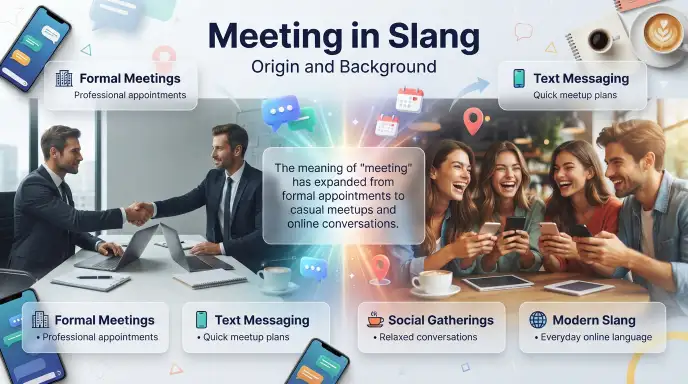
The word meeting has existed in English for centuries, but informal alternatives became more popular as casual speech evolved. As texting, social media, and online communities grew, people started using shorter and friendlier expressions like meet up, link up, and hang out instead of the more formal word meeting.
Today, these slang expressions are common in everyday conversations, messaging apps, and social platforms. While some terms originated in specific regions or communities, many are now understood by English speakers around the world.
Popular Slang Words for Meeting
Different slang words are used depending on the situation and the relationship between the people involved.
1. Meet Up
A meet up is a planned but informal gathering.
Example:
“We’re having a meet up at the café this afternoon.”
2. Link Up
Link up means to meet someone, usually friends or acquaintances.
Example:
“Let’s link up after work.”
3. Hang Out
Hang out means spending time together without a specific purpose.
Example:
“Do you want to hang out this weekend?”
4. Catch Up
Catch up is used when meeting someone after a long time to talk and share updates.
Example:
“It’s been months since we met. Let’s catch up soon.”
5. Kickback
A kickback refers to a relaxed gathering or small party.
Example:
“My cousin is hosting a kickback tonight.”
6. Get Together
A get together is an informal gathering of friends, family, or coworkers.
Example:
“We’re having a family get together on Sunday.”
Comparison with Similar Slang
Although these expressions all involve meeting people, they aren’t always interchangeable.
| Slang Term | Best Used For | Tone |
| Meet up | Planned casual meeting | Friendly |
| Link up | Meeting friends | Casual |
| Hang out | Spending free time together | Relaxed |
| Catch up | Seeing someone after a long time | Friendly |
| Kickback | Small social party | Very casual |
| Get together | Group gathering | Neutral |
Choosing the right expression makes your conversation sound more natural.
Why Do People Use Meeting Slang?
People prefer slang because it sounds less formal and more conversational.
Some common reasons include:
- Making conversations feel friendly
- Sending shorter text messages
- Sounding more natural
- Creating a relaxed atmosphere
- Matching the style of social media and texting
Instead of saying, “Let’s schedule a meeting,” friends usually say, “Let’s meet up.”
Impact of Using Meeting Slang in Communication
Using slang for meeting helps conversations feel more personal and approachable.
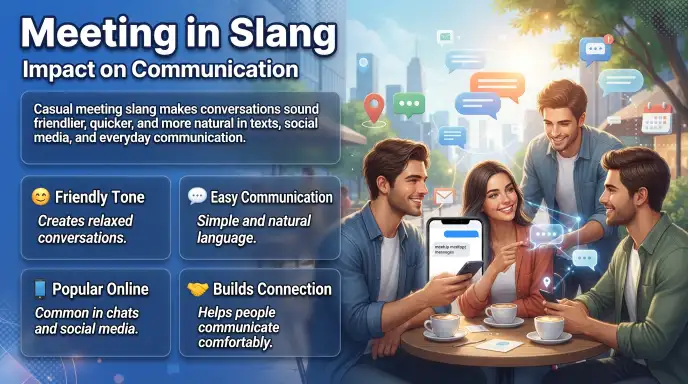
Benefits
- Sounds natural
- Creates a friendly tone
- Makes texting quicker
- Easy for younger audiences to understand
- Common across many social media platforms
Things to Remember
- Some expressions may not be suitable for formal communication.
- Older generations may prefer standard English.
- Professional settings usually require words like meeting, appointment, or conference instead of slang.
Using the right expression for the situation helps you communicate more effectively.
Is Meeting Slang Safe for Social Media?
Yes. Most slang words for meeting are completely safe and widely accepted on social media.
You’ll commonly see them on:
- TikTok
- Snapchat
- Discord
- X (formerly Twitter)
Examples include:
- “Weekend meet up with the team!”
- “Let’s link up tomorrow.”
- “Finally caught up with my best friend.”
These expressions are friendly, easy to understand, and suitable for public posts.
More Real Life Examples
1. Text Message
Mia: Are we still meeting tonight?
Noah: Yeah, let’s meet up at 7.
2. College Friends
Ava: Everyone is hanging out after class.
Ella: I’ll join you.
3. Family Chat
Dad: We’re planning a small get together this weekend.
Son: Sounds fun!
4. Gaming Friends
Player 1: Let’s link up before the tournament starts.
Player 2: I’ll be online in five minutes.
5. Social Media Post
“Nothing beats a weekend catch up with old friends.”
When Should You Avoid Using Meeting Slang?
Slang words for meeting are useful in casual conversations, but they aren’t appropriate in every situation. In professional or formal settings, using standard English is usually the better choice.
Avoid using slang when you’re:
- Writing business emails
- Attending job interviews
- Giving presentations
- Preparing academic assignments
- Speaking with clients
- Writing legal or official documents
For example, instead of saying “Let’s link up tomorrow,” it’s more professional to say “Let’s schedule a meeting tomorrow.”
Polite Alternatives to Meeting Slang
If you need a more formal way to say meeting, consider these alternatives.
| Slang | Formal Alternative |
| Meet up | Meeting |
| Link up | Meet |
| Hang out | Spend time together |
| Catch up | Reconnect |
| Kickback | Social gathering |
| Get together | Gathering |
| Link | Arrange to meet |
These expressions are clearer and more suitable for professional communication.
Why People Use Meeting Slang
People use slang instead of the word meeting because it sounds more relaxed and conversational.
Some common reasons include:
- It feels friendly and informal.
- It’s quicker to type in text messages.
- It matches modern social media language.
- It helps conversations sound natural.
- It creates a casual atmosphere between friends.
Using the right slang also helps speakers connect with people in a more personal way.
Common Misunderstandings About Meeting in Slang
Some people misunderstand the meaning of meeting slang. Here are a few common misconceptions.
1. Meeting slang always means a party.
No. While words like kickback often refer to a party, expressions like meet up or catch up can simply mean seeing someone for coffee or conversation.
2. All slang words for meeting have the same meaning.
Not exactly. Each expression has its own tone. For example, hang out suggests spending free time together, while catch up usually means meeting after a long period apart.
3. Meeting slang is appropriate everywhere.
No. These expressions are best for informal conversations. Professional settings usually require more formal language.
4. Only young people use meeting slang.
Although younger people use it more often, many adults also say meet up, catch up, and get together in everyday conversations.
Frequently Asked Questions
Q1. What are meeting slang words?
Common meeting slang words include meet-up, hangout, catch-up, link-up, session, and get-together. The meaning depends on the situation and the relationship between the speakers.
Q2. What does meeting mean in slang?
In slang, meeting often refers to a casual get-together, hangout, or catch-up rather than a formal business meeting.
Q3. What is a 5-letter slang word for meeting?
The correct 5-letter answer depends on the crossword clue and letter pattern. There is no single slang term that always fits.
Q4. What is the crossword answer for “meeting” in slang?
The answer varies by puzzle. Common possibilities include meet-up, hangout, or other informal terms that fit the required number of letters.
Q5. What is the answer to “meeting slangily” crossword clue (4 letters)?
A possible 4-letter answer is meet or another word that matches the crossword’s letter pattern. Check the crossing letters to confirm the correct solution.
Q6. What is the answer to “Broadcast journalist Kotb” crossword clue?
The answer is usually Hoda, referring to television journalist Hoda Kotb.
Q7. What is the answer to “Puts back to zero” crossword clue?
A common crossword answer is resets, which means to return something to its starting or zero position.
Q8. What is the answer to “Shortcuts” crossword clue?
Common answers include routes, cuts, or paths, depending on the crossword’s required number of letters.
Q9. How is meeting abbreviated?
Common abbreviations for meeting include MTG and Mtg., especially in calendars, schedules, and business notes.
Q10. What does “say” mean in a crossword clue?
In crossword puzzles, “say” usually means “for example” or “such as,” indicating the clue is asking for an example.
Q11. What is another word for gather in a crossword?
Common crossword answers include meet, collect, assemble, or group, depending on the number of letters required.
Conclusion
Understanding meeting in slang helps you communicate more naturally in everyday conversations, text messages, and social media. Popular expressions like meet up, link up, hang out, catch up, and get together all describe meeting someone in a casual way, but each has its own tone and purpose.
Choosing the right expression depends on the situation and your audience. While these slang terms are perfect for friends and informal conversations, standard words like meeting or appointment are better for professional settings. Using the appropriate term will help your communication sound both natural and effective.
Related Slang Meanings

Hey, I’m Jordan. I grew up in a bilingual household in LA, so Spanish and Mexican American slang has always been part of how I talk. I’ve been writing online content for five years, explaining terms the way I’d explain them to a friend meaning, tone, and when it’s actually okay to use.