SMS means “Short Message Service” in text messages. It is the technology used to send short text messages between mobile phones. People often see SMS when discussing texting, phone plans, verification codes, or messages sent without internet based apps.
You may come across SMS on TikTok, Snapchat, Instagram, WhatsApp, or in your phone settings. Someone might ask you to send an SMS, check an SMS code, or explain the difference between SMS and an online message.
Although SMS is closely connected to texting, it is not exactly the same as internet slang such as LOL or BRB. It is a technical abbreviation that people use in everyday conversations.
If you have seen SMS in a message and wondered what it means, understanding the term is simple. Let’s look at its meaning, how people use it, and how it differs from other common texting abbreviations.
What Does SMS Mean in Text?
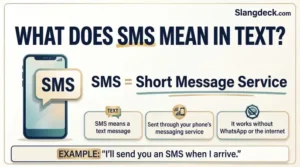
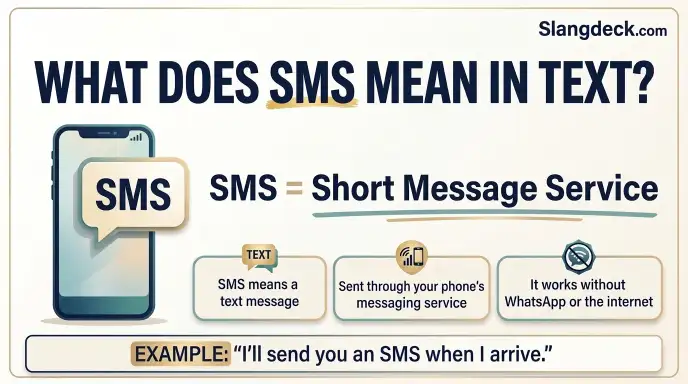
SMS stands for Short Message Service. It is a standard mobile communication service that allows people to send text messages between phones.
In everyday conversation, people often use SMS to mean a regular text message sent through a mobile phone service rather than through an internet messaging app.
For example:
A: Did you get my SMS?
B: Yes, I received your text.
Here, SMS means a text message. The sender wants to know if the other person received it.
Unlike expressions such as IDK or IMO, SMS does not describe a feeling or reaction. It names a messaging service.
Is SMS Slang, an Acronym, or an Abbreviation?
SMS is an abbreviation formed from the words Short Message Service. More specifically, it is an initialism because people usually pronounce each letter separately: “S M S.”
It is not traditional internet slang. However, people frequently use it in texting conversations because it is shorter than saying “Short Message Service.”
You might see it in sentences such as:
- “I’ll send you an SMS.”
- “Check your SMS inbox.”
- “I received an SMS verification code.”
- “My phone plan includes unlimited SMS.”
In each example, the term refers to text messaging or the service used to deliver text messages.
What Does SMS Mean in Everyday Chat?
In casual conversations, SMS usually means a normal mobile text message.
For example, someone may ask you to send an SMS when they want you to contact them through your phone’s messaging service. They may also use the term when talking about a confirmation code from a bank, website, or online account.
The exact technical meaning is Short Message Service, but people do not always use the full name in daily life.
One important detail is that SMS and messaging apps are not always the same thing. Traditional SMS generally uses a mobile carrier’s messaging service, while apps such as WhatsApp usually send messages over the internet.
Where Do People Use SMS?
SMS appears in many places because regular text messaging is still useful for personal communication, business notifications, and account verification.
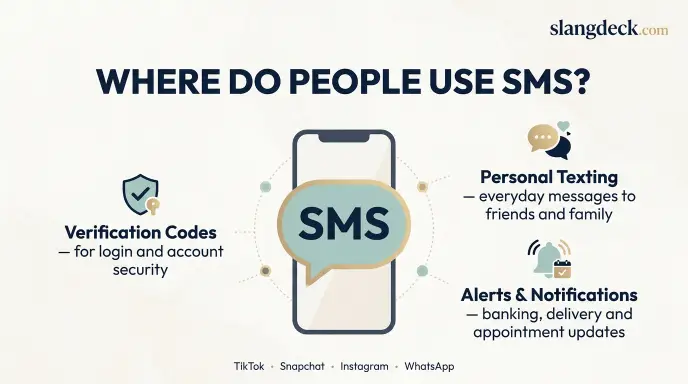
Its meaning usually stays the same across different platforms. However, the reason someone mentions it can change depending on the conversation.
SMS on TikTok
On TikTok, people may mention SMS when discussing phone verification, account security, or text messages received from a service.
For example, a user might explain that TikTok sent a verification code to their phone through SMS.
Example conversation:
A: How did you verify your account?
B: I received a code by SMS.
In this situation, SMS means the text message used to deliver the code.
It does not normally mean a special TikTok slang expression. The term refers to the messaging service.
SMS on Snapchat
Snapchat users may encounter SMS when creating an account, verifying a phone number, or receiving security notifications.
For example, a person might receive a code through a regular text message before completing a login or account recovery step.
Example conversation:
A: Did Snapchat send you a code?
B: Yes, it came through SMS.
Here, SMS means a regular mobile text message.
Remember that you should never share a private verification code with another person who asks for it unexpectedly.
SMS on Instagram
Instagram users may see SMS mentioned in discussions about login verification, security settings, and account recovery.
A person might receive a security code through a text message linked to their phone number.
Example conversation:
A: How did you get the login code?
B: Instagram sent it by SMS.
The abbreviation refers to the delivery method, not an Instagram specific slang term.
SMS on WhatsApp
WhatsApp mainly uses an internet connection to send messages. However, SMS may be involved when someone registers or verifies a phone number.
For example, WhatsApp may send a verification code by SMS during account setup.
Example conversation:
A: Why are you waiting for a text?
B: I need the SMS code to finish setting up WhatsApp.
In this example, SMS refers to the regular text message carrying the verification code.
A WhatsApp message and an SMS are different types of messages, even though both may appear on the same phone.
SMS in Regular Text Messages
SMS is especially common when people discuss ordinary texting, phone services, or mobile plans.
For example:
A: Can you send me an SMS when you arrive?
B: Sure, I’ll text you.
The sender is asking for a regular text message after the other person reaches their destination.
People may also use SMS when discussing delivery notifications, appointment reminders, banking alerts, and one time passwords.
SMS in Phone Settings
You may also see SMS in your phone’s messaging settings or mobile carrier information.
For instance, your phone may distinguish between SMS, MMS, and internet based messaging features. These labels help explain how different types of messages are sent.
SMS is therefore useful to understand even if you rarely use the abbreviation in casual conversations.
10 Real Chat Examples of SMS
These examples show how people use SMS naturally in conversations. The meaning depends on the situation, but each example uses SMS to refer to a regular text message or the service behind it.
Example 1: Asking About a Message
A: Did you get my SMS this morning?
B: Yes, sorry. I forgot to reply.
A: No problem!
Meaning: The sender is asking if the other person received a text message.
Example 2: Sending an Update
A: Let me know when you get home.
B: Okay, I’ll send you an SMS.
A: Thanks!
Meaning: The person plans to send a regular text message after arriving home.
Example 3: Receiving a Verification Code
A: Why can’t you log in?
B: I’m waiting for the SMS code.
A: Check your phone again.
Meaning: SMS refers to the text message containing a verification code.
Example 4: Talking About a Phone Plan
A: Does your package include SMS?
B: Yes, it includes unlimited text messages.
A: That’s useful.
Meaning: They are discussing the text messaging allowance included in a mobile plan.
Example 5: Contacting a Friend
A: I might be late for dinner.
B: Just send me an SMS when you’re close.
A: Sure, I will.
Meaning: The sender asks for a text message with an update.
Example 6: Discussing a Bank Alert
A: How did you know your payment went through?
B: I received an SMS from my bank.
A: Got it.
Meaning: SMS refers to a text notification from the bank.
Example 7: Explaining a Missed Message
A: I sent you the address yesterday.
B: I didn’t see the SMS. Can you send it again?
A: Sure, give me a minute.
Meaning: The person is referring to a regular text message containing an address.
Example 8: Making an Appointment
A: Will the clinic remind me about my appointment?
B: They usually send an SMS the day before.
A: Great, thanks.
Meaning: SMS refers to an appointment reminder delivered by text.
Example 9: Comparing Messaging Services
A: Should I message you on WhatsApp?
B: You can, but SMS works too.
A: Okay, I’ll text you.
Meaning: The speakers are comparing internet messaging with regular mobile texting.
Example 10: Asking About an Unknown Abbreviation
A: My phone says SMS failed. What does that mean?
B: It means the text message couldn’t be sent.
A: I’ll try again.
Meaning: SMS identifies the type of message that failed to send.
How Should You Reply When Someone Says SMS?
Your reply depends on how the person uses the term. If they ask about an SMS, they probably mean a regular text message or a message sent through a mobile carrier.
You can answer naturally without using any special slang.
Funny Replies
If you are chatting with a friend, a lighthearted response may fit:
- “Okay, old school texting it is!”
- “Send the SMS. I’ll be waiting.”
- “No Wi Fi needed for this one!”
- “My phone is ready for your message.”
Use these replies only when the conversation is casual and the other person will understand the joke.
Casual Replies
For everyday conversations, keep your response simple:
- “Sure, I’ll send you a text.”
- “Okay, check your messages.”
- “I’ll text you in a minute.”
- “Got it. Send it whenever you’re ready.”
These answers work well when someone asks you to send or check a message.
Friendly Replies
If someone is helping you with a verification code or important update, you can respond politely:
- “Thanks, I’ll check my SMS.”
- “I appreciate the update.”
- “I’ll let you know when I receive it.”
- “Thanks for sending me the information.”
A friendly response is usually enough. You do not need to repeat the abbreviation.
Neutral Replies
In a formal or professional conversation, use clear language:
- “I received the text message.”
- “I’ll send a text confirmation shortly.”
- “The verification code hasn’t arrived yet.”
- “Could you please resend the message?”
These responses are suitable for work, school, customer service, and other situations where clarity matters.
Is SMS Rude or Offensive?
No, SMS is not rude or offensive. It is a standard abbreviation for Short Message Service.
People use it in personal chats, business communication, technical instructions, and everyday discussions. The abbreviation itself does not contain an insult, profanity, or inappropriate meaning.
Is SMS Safe to Use in Text Messages?
Yes. It is perfectly normal to use SMS when talking about regular text messages or mobile messaging services.
For example, you can tell a friend, “I’ll send you an SMS when I arrive.” You can also use the term in a work message when discussing a notification or verification code.
However, the content of a message matters more than the abbreviation itself.
Be careful with unexpected messages that ask you to click suspicious links, share passwords, or reveal verification codes.
A message arriving through SMS is not automatically trustworthy just because it appears to come from a familiar organization.
Is SMS Appropriate at School or Work?
Yes. SMS is suitable for school, work, and professional communication.
Teachers may use SMS to send reminders to parents. Businesses may send appointment confirmations, and employees may discuss SMS notifications during a technical issue.
In a formal document, it can help to write the full term, “Short Message Service,” the first time you mention it. After that, using SMS is generally clear.
Who Uses SMS?
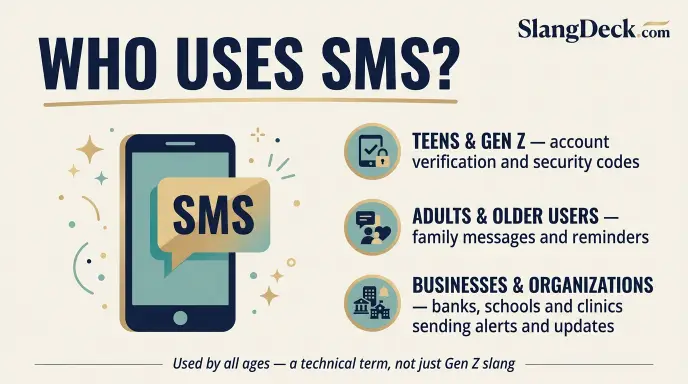
SMS is used by people of many ages and backgrounds. It is not limited to one generation or one social media platform.
Teenagers and Young Adults
Teenagers and young adults may encounter SMS when verifying accounts, receiving service notifications, or discussing regular text messages.
Although younger users often prefer messaging apps, SMS remains relevant for tasks that require a phone number.
Gen Z Users
Gen Z users may see SMS in conversations about account security, online services, mobile data, and phone settings.
However, SMS is not specifically a Gen Z slang term. It is a technical abbreviation used by people across different age groups.
Adults and Older Phone Users
Adults and older users may use SMS to communicate with family members, receive reminders, or contact businesses.
For many people, regular texting remains an easy way to send short messages without opening a separate social media app.
Businesses and Organizations
Businesses use SMS for appointment reminders, delivery updates, account alerts, and verification messages.
Schools, clinics, banks, and service providers may also use text messages to communicate important information.
How Often Does SMS Appear Online?
SMS appears frequently in mobile technology, customer service, online security, and phone related discussions. However, it is less likely to function as a casual slang expression in a conversation between friends.
People may type “text me” instead of “send me an SMS” when chatting informally. The abbreviation is especially common when the topic involves how a message is sent.
Origin of the Term SMS
SMS stands for Short Message Service, a term that developed alongside digital mobile communication.
The service was designed to let mobile phones exchange short text messages through cellular networks. SMS became widely used as mobile phones became more common and texting turned into an everyday form of communication.
Over time, people began using the abbreviation in phone settings, mobile plans, technology guides, and regular conversations.
Unlike many slang terms that spread through memes or social media trends, SMS has a technical origin. Its name describes the service itself.
The term’s meaning is well established, so there is no need to guess at a hidden slang origin. When people use SMS today, they are usually referring to the same text messaging service or to a message sent through it.
SMS vs. IDK, IDC, IMO, and BRB
SMS is different from many common texting abbreviations. While SMS names a messaging service, other abbreviations communicate opinions, feelings, or actions during a conversation.
| Abbreviation | Meaning | Type | Usage | Popularity |
| SMS | Short Message Service | Technical abbreviation | Regular mobile text messages | Common in mobile and technology contexts |
| IDK | I don’t know | Texting abbreviation | Showing uncertainty | Very common in casual chats |
| IDC | I don’t care | Texting abbreviation | Expressing a lack of concern | Common in informal chats |
| IMO | In my opinion | Texting abbreviation | Sharing a personal view | Common in online discussions |
| BRB | Be right back | Texting abbreviation | Saying you will return soon | Common in chats and gaming |
The key difference is that SMS refers to a messaging service, while IDK, IDC, IMO, and BRB are shortcuts for phrases people use in conversations.
Popularity also depends on the setting. You are more likely to see SMS in technical instructions or phone settings, while the other abbreviations often appear in casual messages.
SMS vs. Text Message: What’s the Difference?
People often use “SMS” and “text message” as if they mean exactly the same thing. In everyday conversation, that is usually understandable, but there is a small distinction.
SMS is the name of the service, while a text message is the message itself.
For example, SMS is the technology used to send a message through a mobile carrier. When someone says, “I received your text,” they are talking about the message they got.
In daily life, you do not need to explain this difference every time. Most people understand “SMS” as a regular mobile text message.
SMS vs. MMS
You may also see MMS when looking at messaging options on your phone.
SMS is designed for text messages, while MMS stands for Multimedia Messaging Service and supports multimedia content, such as pictures and certain types of media.
The exact features available can depend on your phone, carrier, and messaging settings. Still, the basic distinction is simple: SMS is associated with standard text messaging, while MMS supports multimedia messages.
SMS vs. WhatsApp Messages
SMS generally uses a mobile carrier’s messaging service. WhatsApp sends messages through an internet connection.
For example, if your internet connection is unavailable, WhatsApp may not send a message until you reconnect. Traditional SMS may still work if your phone has cellular service and your plan supports it.
Both options let you communicate with other people, but they use different delivery systems.
Real World Usage Example
Imagine that you have a job interview scheduled for Monday morning. The company tells you that it will send a reminder to your phone the evening before.
Later, you receive a message confirming the interview time. When you tell a friend about it, you might say:
You: “The company sent me an SMS to confirm my interview.”
Friend: “Did it include the address?”
You: “Yes, it included the time and location.”
In this situation, SMS refers to a regular text message sent by the company.
Another example involves account security. Suppose you sign in to an online service and receive a code on your phone. The service may describe that code as an SMS verification code.
These everyday situations show why the abbreviation remains useful even though many people now communicate through internet based apps.
Common Misunderstandings About SMS
1. Thinking SMS Is Internet Slang
SMS is not a typical slang expression. It is a technical abbreviation that people use in everyday communication.
2. Assuming SMS and WhatsApp Are the Same
Both services can deliver written messages, but traditional SMS uses a mobile carrier’s messaging service, while WhatsApp relies on an internet connection.
3. Thinking SMS Always Requires Mobile Data
Traditional SMS generally does not require mobile data. It normally uses the cellular network’s messaging service, although availability depends on network coverage and service settings.
4. Assuming Every Text Message Is an SMS
People often use “text message” as a general term. However, messages sent through different apps may use different technologies rather than traditional SMS.
5. Thinking SMS Is Only for Young People
SMS is used by people across age groups, businesses, schools, healthcare providers, and online services.
Understanding these differences helps you recognize the term when it appears in phone settings, conversations, or technical instructions.
Key Takeaways
- SMS stands for Short Message Service.
- It is a technical abbreviation, not traditional internet slang.
- In everyday conversation, SMS usually means a regular mobile text message.
- People encounter SMS on TikTok, Snapchat, Instagram, WhatsApp account setup screens, and phone settings.
- SMS is commonly used for verification codes, reminders, notifications, and personal messages.
- The abbreviation is not rude or offensive.
- SMS and internet messaging apps use different methods to deliver messages.
Frequently Asked Questions
Q1. What does SMS mean in text messages?
SMS stands for Short Message Service. In everyday conversation, it usually refers to a regular text message sent through a mobile phone service.
Q2. What does SMS mean on TikTok?
On TikTok, SMS usually refers to a regular text message, often one used for account verification or security codes.
Q3. Is SMS slang?
No. SMS is a technical abbreviation for Short Message Service. It is widely used in texting and mobile communication, but it is not traditional internet slang.
Q4. Is SMS rude or offensive?
No. SMS is a neutral abbreviation. It is appropriate for personal messages, school communication, and professional conversations.
Q5. How should you reply to SMS?
If someone asks you to send an SMS, you can say, “Sure, I’ll text you.” If they ask if you received one, you can reply, “Yes, I got your message.”
Q6. What does SMS stand for?
SMS stands for Short Message Service, a service used to send text messages through mobile networks.
Q7. What does SMS mean on Snapchat?
On Snapchat, SMS may refer to a regular text message sent to verify a phone number or complete an account related process.
Q8. What is the difference between SMS and WhatsApp?
Traditional SMS uses a mobile carrier’s messaging service. WhatsApp sends messages over the internet.
Q9. Does SMS require the internet?
Traditional SMS generally does not require an internet connection or mobile data. It needs suitable cellular service and an active service that supports SMS.
Q10. What is an SMS verification code?
An SMS verification code is a temporary code sent to your phone by text message to help verify your number or confirm an account related action.
Conclusion
SMS means Short Message Service, the technology used for traditional mobile text messaging. In everyday conversations, people often use the abbreviation to refer to a regular text message.
You may see SMS in phone settings, account verification instructions, social media discussions, and messages from businesses. It is not slang, and there is nothing rude or offensive about using it.
When someone asks you to send an SMS, they usually mean a regular text message. Just remember that SMS and internet based messaging apps work differently, even though both help people communicate.
Explore more Slang

Hey, I’m Jordan. I grew up in a bilingual household in LA, so Spanish and Mexican American slang has always been part of how I talk. I’ve been writing online content for five years, explaining terms the way I’d explain them to a friend meaning, tone, and when it’s actually okay to use.