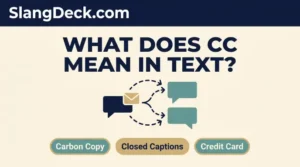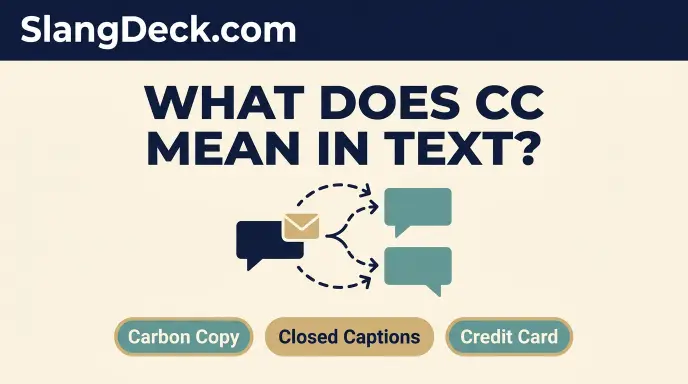
CC usually means “carbon copy” in text and online communication, but its meaning depends on the conversation. In messages, emails, and social media, CC can refer to copying someone into a conversation, adding captions to a video, or other context specific terms.
You may see CC in WhatsApp messages, Instagram comments, TikTok videos, emails, or regular SMS conversations. For example, someone might say “CC me on that email” when they want to receive a copy of it.
Unlike common texting abbreviations such as LOL and BRB, CC does not have just one meaning in every situation. Understanding the topic and the way the sender uses it will help you work out what they mean.
In this guide, you’ll learn the common meanings of CC, how people use it on different platforms, and how to reply when someone sends it to you.
What Does CC Mean in Text?
In many online conversations, CC stands for “carbon copy.” It originally comes from email communication, where someone can add another recipient to receive a copy of a message.
People also use CC informally when they want someone included in an update or conversation.
For example:
A: Can you CC me on the email to the teacher?
B: Sure, I’ll include your email address.
Here, CC means adding someone as a recipient so they receive a copy of the email.
However, CC can have other meanings. On video platforms, it often refers to closed captions or captions that display spoken words as text. The surrounding context helps you identify the correct meaning.
Is CC Slang, an Acronym, or an Abbreviation?
CC is an abbreviation formed from the initials of “carbon copy.” It is commonly used in emails, work messages, and online communication.
Although people use it casually in chats, it is not traditional internet slang like LOL, IDK, or TBH. Its meaning is more closely connected to communication tools and digital media.
Depending on the situation, CC may refer to:
- Carbon copy: Including another recipient in an email.
- Closed captions: Text displayed alongside video or audio content.
- Credit or attribution: Giving someone recognition for their work, sometimes written as “cc” in social media posts.
- Other specialized meanings: In gaming, business, and technical discussions, CC can have meanings specific to the topic.
These meanings are not interchangeable. The conversation determines which one makes sense.
What Does CC Mean in Everyday Chat?
In everyday communication, CC usually means that someone should be included or copied into a message.
For example:
A: Please CC Sarah when you send the report.
B: Okay, I’ll add her to the email.
In this example, the sender wants Sarah to receive a copy of the report by email.
In a video related conversation, however, CC might mean captions.
A: Turn on CC. I can’t hear the dialogue clearly.
B: Done. The captions are showing now.
Here, CC refers to captions rather than an email recipient.
Where Do People Use CC?
CC appears on several platforms, but its meaning can change depending on the features being discussed. Here is how people commonly use it.
CC on TikTok
On TikTok, CC may refer to captions that show spoken words in a video. It can also appear in comments or descriptions when creators credit another person for content or inspiration.
For example:
A: How can I read what the person is saying?
B: Turn on CC if captions are available.
In this conversation, CC refers to captions.
You may also see “CC: @username” in a post description. In that case, the creator may be identifying or crediting someone, depending on the context.
CC on Snapchat
On Snapchat, CC may appear when people discuss captions, video accessibility, or sharing content. The exact meaning depends on the feature or conversation.
For example:
A: Can you add text to the video?
B: I’ll see if captions are available.
If someone uses CC while discussing video settings, they may mean captions. If they are talking about an email or another formal message, carbon copy may be the intended meaning.
CC on Instagram
On Instagram, CC can refer to captions on videos or credit given to another creator.
For example:
A: Who made this edit?
B: Check the caption. It says “CC: @username.”
Here, CC may indicate credit or attribution to the person who created the content.
Creators do not always use CC in exactly the same way, so look at the rest of the caption to understand what they intend.
CC on WhatsApp
On WhatsApp, CC does not have one widely established slang meaning. Its interpretation depends on the subject of the chat.
For example:
A: Can you CC me when you send the document?
B: Sure, I’ll include you in the email.
Here, the conversation is about email, so CC means carbon copy.
If the discussion is about a video, captions may be the intended meaning instead.
CC in SMS and Regular Text Messages
In regular SMS messages, CC can be used when discussing emails, documents, videos, or other communication tasks.
For example:
A: Don’t forget to CC the manager.
B: Okay, I’ll include them.
The sender wants the manager to receive a copy of the email.
Because CC is not a universal texting expression, you should not assume it means the same thing in every SMS conversation.
10 Real Chat Examples of CC
These examples show how CC can appear in different situations. Each conversation includes a short explanation to make the meaning clear.
Example 1: Adding Someone to an Email
A: Can you CC me on the project email?
B: Sure, send me your email address.
A: I’ll send it now.
Meaning: CC means carbon copy. The sender wants to receive a copy of the email.
Example 2: Including a Manager
A: Did you send the final report?
B: Yes, and I CC’d our manager.
A: Great, thanks.
Meaning: The manager was included as another email recipient.
Example 3: Turning on Video Captions
A: I can’t understand the speaker.
B: Try turning on CC.
A: That helps a lot.
Meaning: CC refers to captions that display the spoken words as text.
Example 4: Crediting a Creator
A: Who made this video edit?
B: The description says CC: @Alex.
A: I’ll check their profile.
Meaning: CC is being used to identify or credit the creator.
Example 5: Sharing a Work Update
A: Please CC the whole team on the update.
B: Okay, everyone who needs it will receive a copy.
A: Perfect.
Meaning: CC means adding people to the email as recipients.
Example 6: Asking About Captions
A: Does this video have subtitles?
B: Yes, look for the CC option.
A: Found it!
Meaning: CC refers to the caption feature.
Example 7: Discussing an Email
A: Why did you CC me on that message?
B: I thought you needed to see the details.
A: Thanks for keeping me informed.
Meaning: The sender received a copy of the email.
Example 8: Giving Credit on Social Media
A: Can I repost your design?
B: Yes, just give me credit in the caption.
A: I’ll add CC with your username.
Meaning: CC is being used to indicate credit, although a clear attribution such as “Credit: @username” may be easier to understand.
Example 9: Asking for a Copy
A: Did you include me in the email?
B: Not yet. I’ll CC you now.
A: Thanks!
Meaning: The sender will add the other person as an email recipient.
Example 10: Clarifying the Meaning
A: What does CC mean here?
B: I mean carbon copy, so you get the email too.
A: Got it.
Meaning: The abbreviation refers to including another recipient.
How Should You Reply When Someone Says CC?
Your reply depends on what the other person means. If they want you to include someone in an email, you can confirm that you will do it. If they are discussing captions or credit on social media, your answer should match that context.
Funny Replies
If you’re chatting with a friend, you can use a playful response:
- “Copy that!”
- “Everyone’s getting the update today.”
- “I’ll make sure nobody misses the email.”
- “Captions to the rescue!”
Use these replies when the conversation is casual and the joke fits the situation.
Casual Replies
For everyday communication, try:
- “Sure, I’ll CC you.”
- “Okay, I’ll add you.”
- “I’ll turn the captions on.”
- “I’ll include your username in the credit.”
These answers work because they directly address the intended meaning.
Friendly Replies
If someone asks you to include them in an email or credit their work, you can respond politely:
- “Of course, I’ll include you.”
- “Thanks for letting me know.”
- “Sure, I’ll give you credit.”
- “No problem. I’ll add your name.”
A clear reply helps everyone understand what will happen next.
Neutral Replies
For school, work, or formal communication, use direct wording:
- “Certainly, I’ll add you as a recipient.”
- “I’ll include the relevant people in the email.”
- “I’ll enable captions if the video supports them.”
- “I’ll add the requested attribution.”
These replies are appropriate when clarity matters more than casual language.
Is CC Rude or Offensive?
No, CC is not inherently rude or offensive. It is a standard abbreviation used in communication, captions, and content attribution.
However, the situation can affect how someone feels about being copied into a message.
Can CC Cause Confusion at Work?
Yes, especially when people are included in emails without understanding why.
For example, copying a manager into an email may be useful when they need an update. However, adding unnecessary recipients can create confusion or make a message feel more formal than intended.
It is best to include people who need the information and follow your organization’s communication practices.
Is CC Safe to Use at School or Work?
Yes. CC is widely used in professional communication.
Students may encounter it when sending assignments or communicating with teachers. Employees may use it to keep colleagues informed, while content creators may use CC to give credit.
If your audience may not understand the abbreviation, write the full instruction instead. For example, “Please include me in the email” is clearer than simply saying “CC me.”
Who Uses CC?
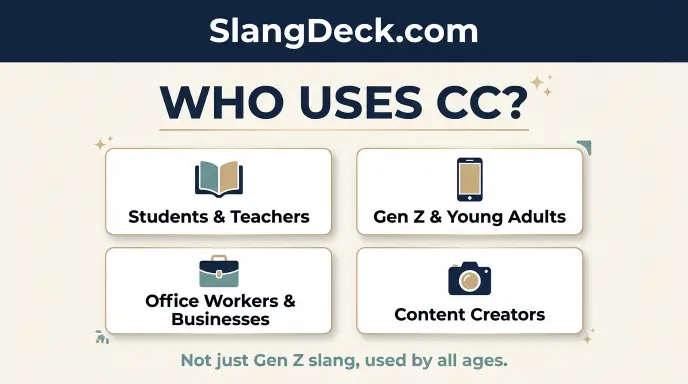
CC is used by many people because it appears in different types of digital communication.
Students and Teachers
Students may see CC when sending emails about assignments, group projects, or school activities. Teachers may use it to keep parents or colleagues informed.
Gen Z and Young Adults
Younger users may encounter CC while watching videos, reading captions, or viewing creator credits on social media.
However, CC is not exclusively Gen Z slang. Its use in email and media technology extends across age groups.
Office Workers and Businesses
Professionals frequently use CC to include colleagues, supervisors, or clients in email conversations.
For example, an employee may CC a manager when sending an important update so the manager receives the same information.
Content Creators
Creators may use CC when discussing captions or crediting someone whose work appears in a post.
On video platforms, the CC button or label commonly refers to closed captions.
How Often Does CC Appear Online?
CC is common in email, workplace communication, and video related settings. Its frequency varies by platform because people use it for different purposes.
It is more likely to appear in an email instruction such as “CC the team” than as a general emotional reaction in a casual text conversation.
Origin of the Term CC
The email meaning of CC comes from carbon copy, a term associated with making duplicate copies of documents using carbon paper.
Before digital communication became widespread, carbon paper was placed between sheets of paper so that writing or typing on the top sheet would create a copy on the sheet below.
The phrase carried over into electronic mail. The CC field allows a sender to send a copy of an email to additional recipients.
As email became a standard communication tool, CC became a familiar abbreviation in workplaces, schools, and everyday online communication.
The caption related use developed separately from the email function. On video platforms, CC is used as a label for closed captions, which display spoken dialogue and sometimes other relevant audio information as text.
Therefore, the different meanings of CC are connected to different communication features rather than one universal slang origin.
CC vs. IDK, IDC, IMO, and BRB
CC is different from common texting abbreviations because it usually refers to a communication feature or action rather than a complete conversational phrase.
| Abbreviation | Meaning | Type | Usage | Popularity |
| CC | Carbon copy; also closed captions in video contexts | Communication abbreviation | Including email recipients or displaying captions | Common in email and video settings |
| IDK | I don’t know | Texting abbreviation | Expressing uncertainty | Very common |
| IDC | I don’t care | Texting abbreviation | Expressing a lack of concern | Common in informal chats |
| IMO | In my opinion | Texting abbreviation | Sharing a personal view | Common online |
| BRB | Be right back | Texting abbreviation | Saying you will return soon | Common in chats and gaming |
The key difference is that CC usually describes a way to include someone or display text, while IDK, IDC, IMO, and BRB represent phrases used during a conversation.
These abbreviations are not interchangeable. If someone writes “CC me,” they usually want to be included in a message, not express an opinion or reaction.
Real World Usage Example
Imagine that you are working on a school group project. Your classmate sends the final presentation to the teacher but forgets to include you in the email.
If you want to receive the same information so you can follow any updates. You send this message:
You: “Can you CC me on the email to the teacher?”
Classmate: “Sure, I’ll add your email address.”
You: “Thanks! I want to make sure I get any replies.”
In this situation, CC means carbon copy. Your classmate adds your email address so you receive the message and can follow the conversation.
Now imagine you’re watching a video in a noisy place. You might tell a friend, “Turn on CC,” meaning you want captions displayed on the screen.
Both examples use the same abbreviation, but the intended meaning changes with the situation.
Common Misunderstandings About CC
1. Assuming CC Always Means Carbon Copy
Carbon copy is a common meaning, especially in email. However, CC can refer to closed captions when discussing videos.
2. Thinking CC Is Always Internet Slang
CC is primarily a communication abbreviation. Although people use it casually online, it is not a typical reaction phrase like LOL or OMG.
3. Confusing CC With a Direct Message
CC usually means including another recipient in an email, not sending a private message directly to someone.
4. Assuming CC Always Gives Credit
On social media, CC may indicate credit or attribution, but its use varies. If you want to acknowledge a creator clearly, write “Credit: @username” or explain the source directly.
5. Thinking CC Has One Meaning on Every Platform
The meaning changes with the subject. An email conversation points toward carbon copy, while a video setting usually points toward closed captions.
Key Takeaways
- CC commonly means “carbon copy” in emails and online communication.
- It can also mean “closed captions” when discussing videos.
- Social media creators may use CC to indicate credit or attribution.
- CC is an abbreviation, not a universal texting slang expression.
- It is not rude or offensive.
- The surrounding message or platform helps identify the intended meaning.
- If the meaning is unclear, ask the sender what they mean.
Frequently Asked Questions
Q1. What does CC mean in text messages?
CC often means carbon copy, especially when someone wants to include another person in an email. In other contexts, it may refer to captions or credit.
Q2. What does CC mean on TikTok?
On TikTok, CC may refer to captions or closed captions. It can also appear in creator descriptions to indicate credit, depending on the context.
Q3. Is CC slang?
CC is mainly an abbreviation used in communication and media. It is not traditional internet slang with one universal meaning.
Q4. Is CC rude or offensive?
No, CC is not inherently rude or offensive. Its meaning depends on the context in which it is used.
Q5. How should you reply to CC?
If someone asks you to CC them, you can say, “Sure, I’ll include you in the email.” If they mean captions, confirm that you will turn them on if available.
Q6. What does CC mean in an email?
In an email, CC stands for carbon copy. It lets the sender include additional recipients who should receive a copy of the message.
Q7. What does CC mean on Instagram?
On Instagram, CC may refer to captions or credit given to a creator. Read the post or comment to determine which meaning applies.
Q8. What does CC mean in video settings?
In video settings, CC usually stands for closed captions. These display spoken dialogue and sometimes relevant sounds as text.
Q9. What does “CC me” mean?
“CC me” usually means “include me as a recipient so I receive a copy of the email.”
Q10. Is CC the same as BCC?
No. CC recipients are generally visible to the other email recipients, while BCC stands for blind carbon copy and hides those recipients’ addresses from other recipients.
Conclusion
CC most commonly means carbon copy when people discuss emails, but it can also refer to closed captions or credit on social media. The correct meaning depends on the conversation and the platform.
If someone asks you to CC them, they usually want to receive a copy of an email. If you see CC in a video setting, it probably refers to captions.
The easiest way to understand the abbreviation is to look at the surrounding message. When the context is unclear, ask a quick question rather than guessing.
Read More Articles

Hey, I’m Jordan. I grew up in a bilingual household in LA, so Spanish and Mexican American slang has always been part of how I talk. I’ve been writing online content for five years, explaining terms the way I’d explain them to a friend meaning, tone, and when it’s actually okay to use.