Definition of PSA in Slang
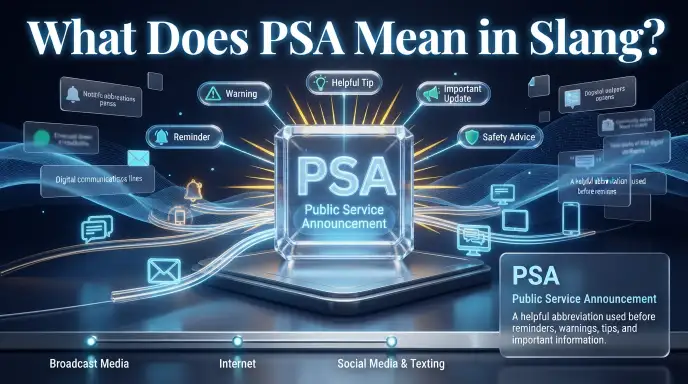
PSA is a slang abbreviation that usually stands for “Public Service Announcement.“ On social media and in text messages, people use it to share important advice, helpful reminders, warnings, or useful information with others.
Unlike many internet slang abbreviations, PSA is not rude or offensive. It has a helpful and informative tone.
Examples:
- PSA: Don’t click suspicious links in your email.
- PSA: The store closes at 6 PM today.
Many people search for “What does PSA mean in slang?” after seeing it in TikTok captions, Instagram posts, X (Twitter), Reddit, or text messages. In casual online conversations, PSA usually introduces a message that the writer thinks everyone should know.
Quick Answer: What Does PSA Mean in Slang?
PSA means “Public Service Announcement.” In slang, people use it before sharing important information, advice, reminders, warnings, or helpful tips in texts, social media posts, and online discussions.
What Does PSA Mean in Slang?
In internet slang, PSA signals that an important message is coming.
People use it to:
- Share helpful advice
- Warn others about scams
- Announce important updates
- Give reminders
- Offer useful tips
- Correct common mistakes
Although the abbreviation began as a formal broadcasting term, it is now common in casual online communication.
Common Meanings of PSA
| Meaning | Explanation | Example |
| Public Service Announcement | An important message for everyone | “PSA: Drink plenty of water today.” |
| Helpful Reminder | A useful tip or notice | “PSA: Back up your files regularly.” |
| Warning | Alerts people about a risk | “PSA: Watch out for fake websites.” |
| Public Update | Shares important information | “PSA: The event starts at 7 PM.” |
What Does PSA Mean in Text?
In text messages, PSA usually introduces information that the sender believes is helpful or important.
It is not an insult or joke. Instead, it grabs attention before the main message.
Example 1
Person A: PSA: Don’t forget tomorrow’s meeting starts at 9 AM.
Meaning: The sender reminds everyone about the meeting.
Example 2
Person A: PSA: Update your phone before installing the new app.
Meaning: The sender shares useful advice.
Example 3
Person A: PSA: The road near the school is closed today.
Meaning: The sender warns others about a temporary road closure.
Does PSA Have a Full Form?
Yes.
PSA stands for:
Public Service Announcement
Unlike words such as cap or sus, PSA is a genuine abbreviation.
People often search for:
- PSA full form
- What does PSA stand for?
- PSA meaning in text
- PSA meaning on social media
The answer is the same in most online conversations: Public Service Announcement.
Is PSA Rude, Offensive, or Neutral?
PSA is neutral and polite.
People use it to help others rather than insult them.
| Situation | Appropriate? |
| Text messages | ✅ Yes |
| Social media | ✅ Yes |
| Family conversations | ✅ Yes |
| School discussions | ✅ Yes |
| Workplace chats | ✅ Yes |
| Business emails | ✅ Usually |
| Formal reports | ⚠ Use the full phrase instead |
In formal documents, writing “Public Service Announcement” instead of “PSA” often looks more professional.
Where Is PSA Commonly Used?
PSA appears in many online and offline settings.
Common places include:
- Text messages
- Instagram captions
- TikTok videos
- X (Twitter) posts
- Facebook posts
- Reddit discussions
- Discord servers
- Workplace chats
- School announcements
- Community groups
It has become one of the most widely recognized internet abbreviations.
Who Uses PSA?
Many different groups use PSA.
Common users include:
- Students
- Teachers
- Parents
- Social media creators
- Bloggers
- Journalists
- Businesses
- Community organizations
- Everyday internet users
Because PSA is easy to understand, people of all ages use it.
Real Life Examples of PSA in Conversations
These examples show how PSA appears in everyday communication.
Friendly Reminder
“PSA: Bring your umbrella today. It’s going to rain.”
Social Media Post
“PSA: Always verify information before sharing it online.”
Workplace Chat
“PSA: The office will close early on Friday.”
Family Group Chat
“PSA: Dinner is ready in 15 minutes.”
Online Community
“PSA: Remember to update your passwords regularly.”
These examples show that PSA introduces useful information rather than casual conversation or humor.
Origin and History of PSA
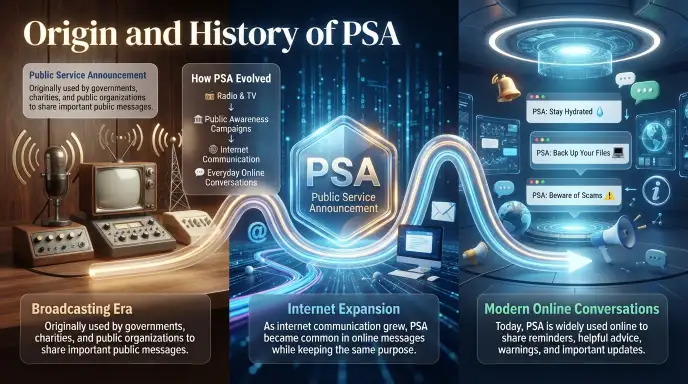
PSA originally stood for Public Service Announcement in radio and television broadcasting.
Government agencies, charities, and public organizations used PSAs to share important messages with the public. These announcements focused on topics such as health, safety, education, and community awareness.
As the internet became more popular, people started using PSA in text messages and online posts. The meaning stayed the same, but the style became more casual.
Today, you can find PSA in everyday online conversations across many platforms.
Why Do People Use PSA?
People use PSA because it quickly tells readers that an important message is coming.
Common reasons include:
- Sharing helpful advice
- Giving reminders
- Warning others about scams
- Posting important updates
- Correcting false information
- Helping friends and followers
The abbreviation makes readers pay attention before reading the rest of the message.
Common Situations Where People Use PSA
People use PSA in many everyday situations.
Sharing a Reminder
“PSA: Set your clocks back this weekend.”
Giving Safety Advice
“PSA: Never share your banking password with anyone.”
Announcing an Update
“PSA: Today’s class starts one hour later.”
Warning About a Scam
“PSA: Ignore fake giveaway messages.”
Helping Others
“PSA: Save your work before restarting your computer.”
These examples show that PSA introduces useful information that may benefit others.
What Does PSA Mean on Different Platforms?
The meaning of PSA stays almost the same across different platforms.
| Platform | Common Meaning |
| TikTok | Helpful tip or reminder |
| Advice or important update | |
| Public announcement | |
| X (Twitter) | Warning or useful information |
| Community reminder or notice | |
| Discord | Server announcement or advice |
| Snapchat | Reminder or update |
| Text Messages | Helpful notice |
The wording may change, but the purpose stays the same.
PSA in Social Media Culture
Social media users often begin a post with “PSA:” to grab attention.
Common examples include:
- Health reminders
- Travel tips
- Shopping advice
- Technology updates
- Scam warnings
- School announcements
- Community notices
Many creators also use PSA before sharing life tips or correcting common myths.
PSA vs Similar Internet Abbreviations
Several abbreviations look similar, but they have different meanings.
| Abbreviation | Meaning | Common Use |
| PSA | Public Service Announcement | Advice or important information |
| FYI | For Your Information | Sharing information |
| BTW | By The Way | Adding extra information |
| IMO | In My Opinion | Sharing a personal opinion |
| TIL | Today I Learned | Sharing a new fact |
| TL;DR | Too Long; Didn’t Read | Giving a short summary |
PSA focuses on helpful announcements, while the others serve different purposes.
Common Misunderstandings About PSA
Many people misunderstand this abbreviation.
Thinking PSA Is Only for Television
Not anymore.
Although PSA started on television and radio, people now use it daily on social media and in text messages.
Thinking PSA Is Always an Official Announcement
No.
Anyone can write “PSA:” before sharing useful advice or a reminder.
For example:
“PSA: Charge your phone before leaving home.”
Thinking PSA Is Slang Only
Not exactly.
PSA is a real abbreviation with an official meaning. Internet users simply adopted it for casual conversations.
Thinking PSA Has Different Meanings Online
In most online conversations, PSA still means Public Service Announcement.
Some industries use PSA for technical or medical terms, but those meanings depend on the context.
Impact of Using PSA in Communication
PSA helps people share important information in a clear and simple way.
Positive Effects
- Grabs attention quickly.
- Makes reminders easy to notice.
- Encourages helpful communication.
- Works across many platforms.
- Keeps messages short and clear.
Possible Drawbacks
- Some people may ignore the message if it is overused.
- Serious topics may lose impact if every post begins with “PSA.”
- Readers unfamiliar with internet abbreviations may not know the meaning.
Use PSA only when the information is genuinely useful or important.
Is PSA Safe to Use on Social Media?
Yes.
PSA is considered safe on almost every social media platform.
People regularly use it on:
- TikTok
- X (Twitter)
- Discord
- Snapchat
Because PSA is helpful rather than offensive, it does not violate community guidelines when used respectfully.
When Should You Avoid Using PSA?
PSA is friendly and easy to understand, but it does not fit every situation.
Avoid using PSA in:
- Legal documents
- Academic research papers
- Official government reports
- Formal business letters
- Contracts
- Professional presentations for external clients
In these situations, write “Public Service Announcement” or use a more formal phrase like Important Notice or Official Announcement.
Polite Alternatives to PSA
Important Notice
Pronunciation: (im-POR-tuhnt NOH-tis)
Meaning:
A formal phrase used to share essential information.
Examples:
- Important Notice: The office will close early today.
- Please read this important notice before registering.
Friendly Reminder
Pronunciation: (FREND-lee ri-MYND-er)
Meaning:
A polite reminder about something people should remember.
Examples:
- Friendly reminder: Submit your assignment by Friday.
- Friendly reminder: Bring your ID to the event.
Heads Up
Pronunciation: (hedz UP)
Meaning:
An informal warning or advance notice.
Examples:
- Heads-up: The website may be offline tonight.
- Just a heads-up, traffic is heavy today.
For Your Information (FYI)
Pronunciation: (for yor in-fer-MAY-shun)
Meaning:
Used when sharing information that may be useful.
Examples:
- FYI, the meeting has moved to Room 12.
- FYI, the new update is now available.
Official Announcement
Pronunciation: (uh-FISH-ul uh-NOUNS-muhnt)
Meaning:
A formal statement shared by an organization or authority.
Examples:
- The school released an official announcement.
- Please wait for the official announcement.
Simple Alternatives Table
| Instead of PSA | Better Alternative |
| PSA: The store closes early. | Important Notice: The store closes early. |
| PSA: Drink more water. | Friendly Reminder: Drink more water. |
| PSA: Watch out for scams. | Heads-up: Watch out for scams. |
| PSA: The meeting starts at 10. | FYI: The meeting starts at 10. |
| PSA: Check the new rules. | Official Announcement: Check the new rules. |
These alternatives work well in both casual and professional communication.
Why Is PSA So Popular?
PSA has remained popular because it is short, clear, and easy to recognize.
People like using it because it:
- Gets attention quickly.
- Introduces useful information.
- Works on every major social platform.
- Saves time when writing.
- Sounds helpful instead of demanding.
Many online users now recognize PSA instantly, making it one of the most common internet abbreviations.
Key Takeaways
- PSA stands for Public Service Announcement.
- It introduces important advice, reminders, or warnings.
- The abbreviation is polite and non-offensive.
- People use PSA in texting, social media, emails, and workplace chats.
- The meaning stays the same across platforms like TikTok, Instagram, Reddit, and Facebook.
- Use more formal phrases in official documents.
Frequently Asked Questions
Q1. What does PSA mean in slang?
PSA stands for Public Service Announcement. People use it before sharing helpful advice, reminders, warnings, or important updates.
Q2. What does PSA stand for in text messages?
In texting, PSA means Public Service Announcement and introduces useful information.
Q3. Is PSA a slang term?
PSA is an abbreviation rather than traditional slang, but many people use it as internet slang in casual conversations.
Q4. Is PSA rude or offensive?
No. PSA is polite, neutral, and suitable for most conversations.
Q5. Can anyone use PSA?
Yes. Anyone can use PSA when sharing helpful or important information.
Q6. Is PSA only used on social media?
No. People also use PSA in text messages, workplace chats, emails, community groups, and public announcements.
Q7. What is the difference between PSA and FYI?
PSA highlights an important announcement or reminder, while FYI simply shares information.
Q8. Is PSA appropriate for business communication?
Yes, in many workplace chats or internal emails. In formal documents, writing Public Service Announcement or Important Notice is often better.
Q9. What does PSA mean on TikTok?
On TikTok, PSA usually introduces a helpful tip, warning, reminder, or important message for viewers.
Q10. Does PSA have other meanings?
Yes. Some industries use PSA for medical, scientific, or technical terms. In internet slang and texting, however, it almost always means Public Service Announcement.
Conclusion
PSA is one of the most useful abbreviations in modern online communication. It stands for Public Service Announcement and helps people share reminders, warnings, advice, and important updates in a clear and friendly way.
If you see PSA in a text message, TikTok caption, Reddit post, or workplace chat, it almost always signals information the writer believes is worth your attention.
Understanding this abbreviation makes it easier to follow online conversations and use it naturally when sharing helpful messages.
Discover Similar Slang
- MS Meaning Slang: What Everyone’s Asking About This Term
- What Does MFM Slang Mean? Uses and Examples
- What Does GMFU Mean in Slang? Meaning in Text & Social Media

Hey, I’m Jordan. I grew up in a bilingual household in LA, so Spanish and Mexican American slang has always been part of how I talk. I’ve been writing online content for five years, explaining terms the way I’d explain them to a friend meaning, tone, and when it’s actually okay to use.