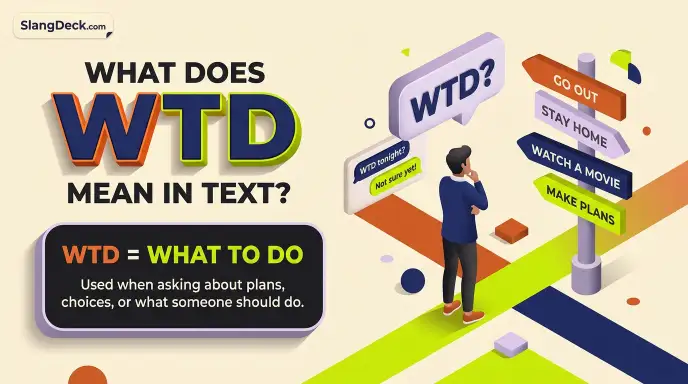
Are you searching for What Does WTD Mean in Text? WTD most commonly means “What’s the Deal?” in casual texting, but it can also mean “What To Do” depending on the conversation. The exact meaning depends on the message and the situation.
You may see WTD in text messages, social media comments, group chats, or online conversations. People use short forms like this to save time and keep messages quick.
For example, someone might text, “WTD with the party tonight?” They are asking what is happening or what the plan is.
If you have received a message containing WTD and are unsure what the sender means, the surrounding words can help you understand it. Let’s look at its meanings, uses, and examples.
WTD Meaning in Text
In everyday texting, WTD can stand for “What’s the Deal?” It is a casual way to ask what is happening, what the situation is, or why something is going on.
For example:
Alex: “WTD with the meeting tomorrow?”
Sam: “It starts at 10 AM.”
Here, Alex wants to know the plan for the meeting.
WTD may also stand for “What To Do.” In this case, it is used when someone is asking about an action, decision, or next step.
For example:
Mia: “I missed the bus. WTD now?”
Emma: “You can take the next one.”
The intended meaning is clear from the rest of the message.
Is WTD an Acronym or Slang?
WTD is an abbreviation made from the first letters of a phrase. It is often treated as internet shorthand or texting slang because people use it in informal digital conversations.
It is not as widely recognized as common abbreviations such as IDK (I Don’t Know) or BRB (Be Right Back). Some people may not understand it without context.
What Does WTD Mean in Everyday Conversations?
The meaning depends on how someone uses it:
- What’s the Deal? Asking about a situation, plan, or problem.
- What To Do? Asking for advice or the next step.
Pay attention to the words around WTD. If someone asks about a plan, they may mean “What’s the Deal?” If they are facing a problem, they may mean “What To Do?”
WTD can also have other meanings in specific communities, workplaces, or personal conversations. It is best not to assume that every sender uses it in the same way.
Where People Use WTD
People may use WTD in different online spaces, but its meaning does not automatically change from one platform to another. The conversation still provides the most useful clue.
WTD on TikTok
On TikTok, WTD may appear in comments, captions, or direct messages. Someone might use it to ask about a video, an event, or a situation they do not understand.
For example:
“WTD is happening in this video?”
The person is asking what is going on.
However, WTD is not a fixed TikTok specific term. Its meaning depends on the creator’s wording and the discussion.
WTD on Snapchat
Snapchat users often send short messages to friends, so abbreviations can make conversations quicker.
A friend might write:
“WTD for tonight?”
They could be asking about the plans or what everyone is going to do.
If the message is unclear, a simple follow up question can prevent confusion.
WTD on Instagram
On Instagram, WTD may appear in comments, story replies, or direct messages.
For example:
“WTD with your new profile picture?”
The sender may be asking about the reason for the change or trying to understand something about it.
The abbreviation is informal, so it is better suited to casual conversations than professional messages.
WTD on WhatsApp
WhatsApp group chats and private messages are common places for shortened expressions.
For example:
“WTD about Saturday’s plan?”
A friend may be asking what the group has decided.
Another person might write:
“I lost my wallet. WTD?”
Here, the intended meaning is likely “What to do?” because the sender needs advice.
WTD in SMS Text Messages
WTD can also appear in regular SMS messages. The same meanings apply: “What’s the Deal?” or “What To Do?”
For instance:
“WTD after school?”
The sender may be asking about the plan for later.
Because SMS messages do not always provide extra context, it is important to read the full conversation before deciding what the abbreviation means.
Real Chat Examples of WTD
The following conversations show how WTD might appear in casual messages. They illustrate possible uses of the abbreviation, not a claim that every example represents a widely established texting convention.
Example 1: Asking About Weekend Plans
Alex: “WTD for this weekend?”
Sam: “We might go to the beach.”
Alex: “Sounds fun!”
Meaning: Alex is asking what the plan is for the weekend. WTD means “What’s the Deal?” in this example.
Example 2: Asking What to Do After Missing a Bus
Mia: “I missed my bus.”
Emma: “Oh no! Are you okay?”
Mia: “WTD now?”
Meaning: Mia is asking what she should do next. WTD means “What To Do?”
Example 3: Discussing a Changed Plan
Jake: “WTD with the dinner plan?”
Noah: “We moved it to Sunday.”
Jake: “Thanks for letting me know.”
Meaning: Jake wants an update about the dinner arrangements.
Example 4: Asking About a School Assignment
Lily: “I don’t understand this question.”
Sara: “Which part?”
Lily: “WTD with number five?”
Meaning: Lily is asking what to do with the fifth question. The intended meaning is “What To Do?”
Example 5: Talking About a Cancelled Event
Ryan: “WTD with the concert?”
Alex: “It got postponed.”
Ryan: “I didn’t know that.”
Meaning: Ryan is asking what is happening with the concert.
Example 6: Asking for Advice
Ben: “My laptop won’t turn on.”
Tom: “Did you charge it?”
Ben: “Yes. WTD?”
Meaning: Ben wants advice about what to do next.
Example 7: Planning a Group Outing
Emma: “WTD on Friday night?”
Mia: “Let’s watch a movie.”
Emma: “I’m in!”
Meaning: Emma is asking about the group’s plans for Friday night.
Example 8: Asking About a Social Media Post
Noah: “WTD with that new post?”
Jake: “I was sharing pictures from my trip.”
Noah: “Oh, nice!”
Meaning: Noah is asking about the post or the reason behind it. The exact meaning depends on their conversation.
Example 9: Dealing With a Late Delivery
Sam: “My order still hasn’t arrived.”
Alex: “Did you contact the seller?”
Sam: “Not yet. WTD?”
Meaning: Sam is asking what action to take about the delayed order.
Example 10: An Unclear Message
Mia: “WTD?”
Emma: “Do you mean what’s the deal or what should I do?”
Mia: “I mean what’s happening with the trip.”
Meaning: The abbreviation is unclear on its own. Emma asks for clarification before responding.
How to Reply When Someone Says WTD
Your reply should match the sender’s intended meaning. First, check if they are asking about a plan or looking for advice.
Here are some natural ways to respond.
Casual Replies
Use these when a friend asks about a plan or situation:
- “We’re meeting at 7.”
- “Nothing much, just waiting.”
- “The plan is still the same.”
- “I’ll let you know soon.”
Friendly Replies
If someone wants advice, you can respond in a helpful way:
- “You should call them first.”
- “Let’s figure it out together.”
- “Don’t worry, we can find a solution.”
- “I think you should try again.”
Funny Replies
If you are chatting with a close friend, a little humor can make the conversation more relaxed:
- “First, take a deep breath!”
- “That’s a mystery even I can’t solve.”
- “Good question. Let me ask my brain.”
- “Let’s pretend we have a plan!”
Neutral Replies
If you are not sure what the sender means, ask for clarification:
- “What do you mean by WTD?”
- “Are you asking about the plan?”
- “Do you mean what to do?”
- “Can you explain a little more?”
Tip: Never guess when the message could have two different meanings. A short question is often the easiest way to understand it.
Is WTD Rude or Offensive?
No, WTD is not generally rude or offensive. Both “What’s the Deal?” and “What To Do?” are neutral expressions.
However, the tone of the full message can change how it sounds. A direct question may feel impatient if someone is already upset.
For example:
“WTD with you?”
Depending on the situation, this could sound like a normal question or a frustrated reaction.
Is WTD Safe to Use With Friends?
Yes. You can use it in casual conversations with friends who understand texting abbreviations.
For example:
- “WTD for tonight?”
- “WTD about the project?”
- “I’m confused. WTD now?”
If the other person does not recognize the abbreviation, write the complete phrase instead.
Is WTD Appropriate at School or Work?
WTD is usually better for informal chats than formal communication.
At school, you might use it in a friendly group chat, but it is clearer to write “What should I do?” when speaking with a teacher.
At work, avoid using it in formal emails, reports, or messages to clients. Instead, write a complete question such as “What is the current plan?” or “What should be the next step?”
Who Uses This Term?
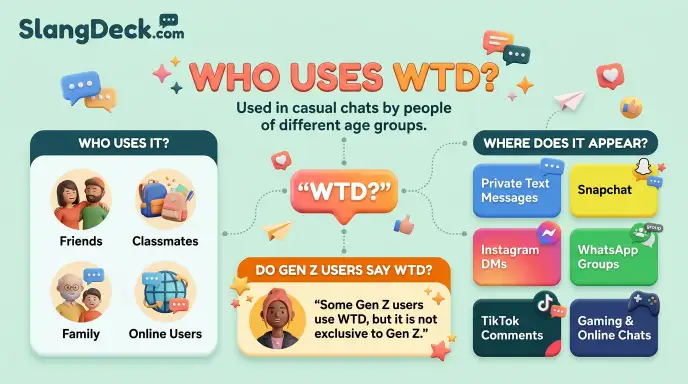
WTD may be used by people who prefer short, quick messages. It can appear in conversations between friends, classmates, family members, and online users.
Do Gen Z Users Say WTD?
Some Gen Z users may use WTD in casual chats, especially when asking about plans or decisions. However, it is not a uniquely Gen Z expression.
People from different age groups use abbreviations in digital communication. Familiarity with WTD can vary from one person or online community to another.
Where Is It Most Likely to Appear?
You may come across WTD in:
- Private text messages
- Snapchat conversations
- Instagram direct messages
- WhatsApp group chats
- TikTok comments
- Gaming or online community chats
These are possible places to encounter the abbreviation, not proof that it is popular on every platform.
Is WTD Common Online?
WTD is less instantly recognizable than abbreviations such as IDK, LOL, and BRB. Some people understand it immediately, while others may need the sender to explain it.
That is why context matters. A short abbreviation can save typing time, but it can also create confusion when the reader does not know the intended phrase.
Origin of WTD
There is no single, clearly documented origin for WTD as a texting abbreviation.
It appears to follow a common pattern in internet communication: people shorten longer phrases by using their first letters. This makes messages faster to type, especially on mobile devices.
The phrases “What’s the Deal?” and “What To Do?” can both be shortened to WTD. However, that does not mean the abbreviation has one universal definition.
Texting, instant messaging, online forums, and social media have all helped make shortened expressions part of everyday digital communication.
Unlike some well known internet abbreviations, WTD does not have a widely established origin story that can confidently be linked to one person, website, or specific year.
The safest approach is to understand it through the message where it appears rather than assume a fixed history or meaning.
WTD vs. IDK, IDC, IMO, and BRB
WTD and other texting abbreviations help people communicate quickly. However, each one has a different purpose.
| Abbreviation | Meaning | Type | Usage | Popularity |
| WTD | What’s the Deal? / What To Do? | Context dependent abbreviation | Asking about a situation or next step | Less widely recognized |
| IDK | I Don’t Know | Texting abbreviation | Showing that you do not know something | Very common |
| IDC | I Don’t Care | Texting abbreviation | Showing a lack of concern or interest | Very common |
| IMO | In My Opinion | Texting abbreviation | Sharing a personal view | Common |
| BRB | Be Right Back | Texting abbreviation | Saying you will return shortly | Very common |
WTD vs. IDK
WTD asks about a situation or what action to take. IDK tells someone that you do not know something.
WTD: “WTD about the cancelled class?”
IDK: “IDK why the class was cancelled.”
WTD vs. IDC
WTD asks for information or advice. IDC expresses that something does not matter to the sender.
WTD: “WTD for dinner?”
IDC: “IDC where we eat.”
IMO vs. WTD
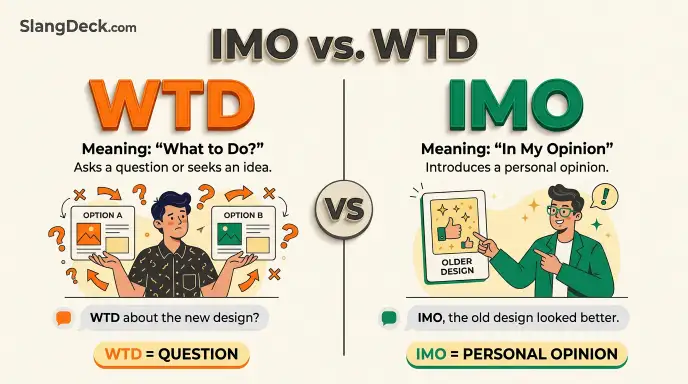
WTD asks a question, while IMO introduces a personal opinion.
WTD: “WTD about the new design?”
IMO: “IMO, the old design looked better.”
WTD vs. BRB
WTD is used to ask about a situation or next step. BRB tells someone that you will be away briefly.
WTD: “WTD now?”
BRB: “BRB, I need to answer the door.”
Real World Usage Example
Imagine that a group of friends is planning a birthday dinner. They have discussed the date, but nobody has chosen a restaurant yet.
One friend sends a message in the group chat:
“WTD for Saturday? Have we decided where to go?”
Another friend replies:
“Not yet. Let’s choose a place tonight.”
In this situation, WTD is being used to ask about the current plan.
Now imagine someone has lost their phone while traveling. They message a friend:
“I can’t find my phone. WTD?”
The friend might reply:
“Call your number from my phone and check the nearby places.”
Here, WTD means “What To Do?” because the sender is asking for advice.
These situations show why reading the complete message is important. The same three letters can point to different phrases.
Common Misunderstandings About What Does WTD Mean in Text?
Short abbreviations can be confusing, especially when they have more than one possible meaning. Here are a few mistakes to avoid.
Thinking WTD Has Only One Meaning
WTD does not always stand for “What’s the Deal?” It may also mean “What To Do?” in a question about a problem or decision.
Assuming It Is a Popular Slang Term
WTD is not as widely recognized as IDK or LOL. Some readers may not understand it without extra context.
Confusing It With IDK
These abbreviations serve different purposes. WTD asks a question, while IDK communicates a lack of knowledge.
Using It in Every Conversation
Not everyone likes abbreviations. In formal messages, school assignments, and workplace communication, complete phrases are usually clearer.
Forgetting to Check the Context
A message such as “WTD?” does not provide enough information by itself. Read the earlier messages or ask the sender what they mean.
Key Takeaways: What Does WTD Mean in Text?
- WTD can mean “What’s the Deal?” in casual conversations.
- It can also mean “What To Do?” when someone asks for advice.
- The intended meaning depends on the surrounding message.
- It may appear in texting and social media conversations.
- WTD is not generally offensive, but it is informal.
- If you are unsure, ask the sender to explain it.
Frequently Asked Questions About What Does WTD Mean in Text?
What does WTD mean in text messages?
WTD can mean “What’s the Deal?” or “What To Do?” It is used to ask about a situation, plan, or next step. The exact meaning depends on the conversation.
What does WTD mean on TikTok?
On TikTok, WTD may be used in comments or messages to ask what is happening or what someone should do. It does not have one fixed TikTok specific meaning.
Is WTD slang?
WTD is an informal abbreviation used in digital communication. It can be considered texting shorthand or internet slang, although it is not universally understood.
Is WTD rude or offensive?
No. WTD is not generally rude or offensive. However, the tone of the complete message can affect how a question sounds.
How should you reply to WTD?
First, work out what the sender means. If they are asking about a plan, give an update. If they need advice, suggest a next step. You can also ask, “Do you mean what’s the deal or what should I do?”
Does WTD mean What To Do?
Yes, WTD can stand for “What To Do?” It is used when someone wants advice or needs help deciding what action to take.
Does WTD mean What’s the Deal?
Yes, it can mean “What’s the Deal?” when someone wants to know what is happening, why something happened, or what the current plan is.
Is WTD the same as IDK?
No. WTD asks about a situation or action, while IDK means “I Don’t Know.” They have different meanings and uses.
Conclusion: What Does WTD Mean in Text?
WTD is a short abbreviation that can mean “What’s the Deal?” or “What To Do?” in casual digital conversations. People may use it when asking about plans, trying to understand a situation, or looking for advice.
Since it can have more than one meaning, always consider the words around it before replying. If the message is unclear, simply ask what the sender means.
WTD is generally safe for friendly chats, but writing the full phrase is a better choice in formal school or workplace communication.
Understanding abbreviations like WTD makes online conversations easier to follow, especially when you come across unfamiliar texting language.
Learn More Articles

Hey, I’m Jordan. I grew up in a bilingual household in LA, so Spanish and Mexican American slang has always been part of how I talk. I’ve been writing online content for five years, explaining terms the way I’d explain them to a friend meaning, tone, and when it’s actually okay to use.