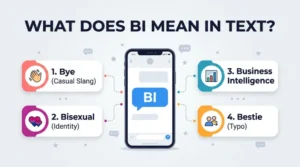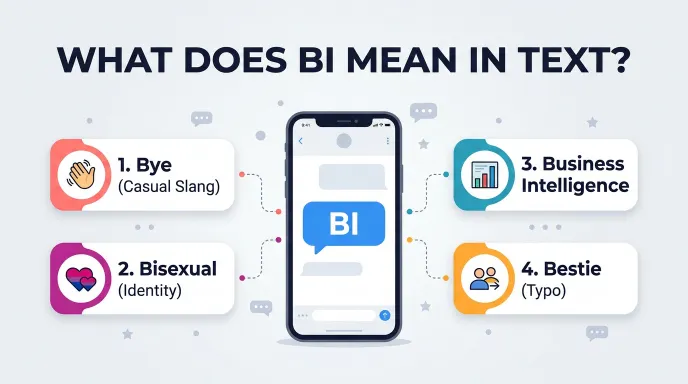
BI usually means “bisexual” in personal text conversations. It describes someone who experiences romantic or sexual attraction to more than one gender. In business or technology discussions, BI can also mean “Business Intelligence,” so the message context matters.
You may see BI in text messages, TikTok comments, Snapchat conversations, Instagram bios, and online discussions. People often use it when talking about identity, relationships, or personal experiences.
The abbreviation is short, but its meaning can change depending on the topic. For example, someone discussing dating might use BI to describe a person’s sexual orientation, while someone talking about company reports may mean Business Intelligence.
If you have received a message containing these two letters, the surrounding conversation can help you understand what the sender means.
BI Meaning in Text
In everyday personal conversations, BI commonly stands for “bisexual.” It refers to a person who can experience romantic or sexual attraction to people of more than one gender.
For example:
A: Are you bi?
B: Yes, I’m bisexual.
In this conversation, BI is simply a shorter way of saying bisexual. People may use it because it is quick to type and widely understood in discussions about sexual orientation.
However, BI does not have just one meaning. It can also stand for Business Intelligence in professional, educational, and technology related conversations.
Is BI Slang, an Acronym, or an Abbreviation?
BI is an abbreviation formed from the first two letters of the word bisexual. It is also commonly described as an initialism because people pronounce the letters separately: “B I.”
It is not traditional internet slang like LOL (Laughing Out Loud) or BRB (Be Right Back). Instead, it is a shortened form of an established word.
In business and technology, BI is also an initialism for Business Intelligence. This refers to the tools and methods companies use to collect, organize, and study data.
What Does BI Mean in Everyday Chat?
The meaning depends on what people are discussing.
Here are the two important uses:
- Bisexual: Used in personal conversations about sexual orientation, identity, dating, and relationships.
- Business Intelligence: Used in conversations about data, reports, companies, analytics, and technology.
For example, consider these messages:
“My friend told me she’s bi.”
Here, BI means bisexual.
“I have a BI presentation tomorrow.”
Here, BI probably means Business Intelligence, especially if the conversation is about work or studies.
The surrounding words usually make the intended meaning clear.
Does BI Always Mean Bisexual?
No. Although bisexual is a common meaning in personal conversations, the abbreviation is not limited to that meaning.
People may also use BI as initials, a username, a name abbreviation, or a term specific to a particular group.
Avoid assuming someone’s identity based on two letters alone. If the meaning is unclear, it is better to look at the conversation or ask politely.
Where Do People Use BI?
BI can appear across different messaging apps and social media platforms. Its meaning usually depends more on the topic than on the platform itself.
Here is how people may use it in different online spaces.
1. BI Meaning on TikTok
On TikTok, BI may appear in videos, captions, comments, and discussions about relationships or LGBTQ+ topics.
For example:
“She’s bi and proud of it.”
In this caption, BI means bisexual.
People may also use the term while discussing representation, personal experiences, dating, or identity. It can appear in educational videos and supportive conversations.
In a technology related video, however, BI could refer to Business Intelligence. The subject of the video provides the clue.
2. BI Meaning on Snapchat
On Snapchat, people may use BI in private messages, group chats, or personal conversations.
For example:
“My cousin is bi, and she recently told our family.”
Here, BI describes the person’s sexual orientation.
Because Snapchat conversations are often informal, people may prefer short forms instead of writing the complete word.
Still, not every use has the same meaning. A conversation about work or data could use BI in its professional sense.
3. BI Meaning on Instagram
Instagram users may include BI in bios, captions, comments, and posts about personal identity.
For example:
“Bi, happy, and living my life.”
In this example, BI means bisexual.
Some people use it to describe themselves, while others mention it when discussing LGBTQ+ awareness, representation, or relationships.
It is important to remember that people choose how much personal information they want to share. Do not pressure someone to explain their identity just because you notice an abbreviation in their profile.
4. BI Meaning on WhatsApp
On WhatsApp, BI can appear in direct messages and group conversations.
For example:
A: Did Sam tell you about their identity?
B: Yes, they said they’re bi.
The abbreviation helps keep the message short while communicating the intended meaning.
In a workplace WhatsApp group, BI may have a completely different meaning, such as Business Intelligence.
5. BI Meaning in SMS Text Messages
In regular SMS messages, BI can also mean bisexual.
For example:
“I think my classmate is bi, but I don’t want to assume anything.”
Here, the sender is discussing sexual orientation.
SMS messages have no special rules for this abbreviation. People use it in much the same way as they do in online chats.
10 Real Chat Examples of BI in Text
The following conversations show how BI may appear in everyday messages. Some examples use the meaning bisexual, while others show the professional meaning Business Intelligence.
1. Talking About Sexual Orientation
A: Did Alex tell you they’re bi?
B: Yes, they mentioned it yesterday.
A: Oh, okay. Thanks for telling me.
Meaning: BI means bisexual. The conversation is about someone’s sexual orientation.
2. Asking Someone Directly
A: Can I ask you something personal?
B: Sure, what’s up?
A: Are you bi?
Meaning: The sender is asking if the other person identifies as bisexual. This is a personal question, so it should be asked respectfully.
3. Supporting a Friend
A: I finally told my best friend I’m bi.
B: That’s great! How did they react?
A: They were really supportive.
Meaning: BI means bisexual. The sender is sharing a personal experience.
4. Discussing an Instagram Bio
A: I noticed BI in your Instagram bio.
B: Yeah, it’s part of how I describe myself.
A: Got it!
Meaning: BI refers to bisexual in this context.
5. Talking About a Relationship
A: My friend said she’s bi.
B: Okay. Is she dating anyone right now?
A: I don’t think so.
Meaning: The abbreviation refers to someone’s sexual orientation.
6. Asking About a TikTok Comment
A: What does bi mean in that comment?
B: It means bisexual.
A: Oh, now I understand.
Meaning: The conversation explains the abbreviation.
7. Sharing Personal News
A: I think I’m ready to tell my family I’m bi.
B: Take your time. You should do it when you feel comfortable.
A: Thanks, that means a lot.
Meaning: BI means bisexual. The conversation is about sharing personal identity with family.
8. Talking About a Business Project
A: Have you finished the BI report?
B: Almost. I just need to check the charts.
A: Please send it before the meeting.
Meaning: BI means Business Intelligence because the conversation is about a report and workplace tasks.
9. Discussing a Course
A: Which course are you taking this semester?
B: I’m studying BI and data analytics.
A: That sounds interesting.
Meaning: BI likely means Business Intelligence in this academic context.
10. Clearing Up Confusion
A: Someone wrote “I’m bi” in the group chat.
B: They probably mean bisexual.
A: Thanks, I wasn’t sure.
Meaning: The sender is using BI as a shortened form of bisexual.
These examples show why context is important. The same abbreviation can have different meanings in personal and professional conversations.
How to Reply When Someone Says BI
Your reply should depend on the conversation. If someone uses BI to describe their identity, respond with respect. If they use it in a work or study discussion, answer according to the topic.
Here are some simple responses.
Funny Replies
Use humor only when you already have a comfortable relationship with the other person and the joke is not about their identity.
- “Okay, thanks for explaining!”
- “Got it. Mystery solved!”
- “Now I understand the abbreviation.”
- “Two letters, one clear explanation!”
Avoid making jokes that could embarrass someone or turn their personal identity into a punchline.
Casual Replies
These responses work well in relaxed conversations:
- “Oh, okay!”
- “Gotcha.”
- “Thanks for telling me.”
- “I understand now.”
- “That makes sense.”
Friendly Replies
If someone shares that they are bisexual, a kind response can make the conversation more comfortable.
- “Thanks for sharing that with me.”
- “I appreciate you trusting me.”
- “I’m happy you feel comfortable telling me.”
- “You’re still the same friend to me.”
- “Thanks for being open with me.”
You do not need to make a big speech. A simple, respectful response is often enough.
Neutral Replies
If you are unsure what the sender means, try one of these:
- “What do you mean by BI here?”
- “Are you referring to bisexual?”
- “Do you mean Business Intelligence?”
- “Can you explain what BI stands for in this message?”
Asking for clarification is better than guessing.
Is BI Rude or Offensive?
No. BI is not generally considered rude or offensive when it is used respectfully to mean bisexual.
It is a common abbreviation in conversations about sexual orientation. Some people use it to describe themselves, while others use it when discussing LGBTQ+ topics.
However, the way someone uses the term matters.
When Is BI Appropriate?
It is generally appropriate when:
- Someone uses it to describe their own identity.
- You are discussing sexual orientation respectfully.
- You are talking about LGBTQ+ representation or awareness.
- You are using BI to mean Business Intelligence in a professional setting.
For example:
“My friend is bi, and I respect her identity.”
This is a neutral and respectful use.
When Can BI Become Disrespectful?
The abbreviation itself is not an insult. However, using it to mock, embarrass, or label someone without their permission can be disrespectful.
For example, sharing someone’s private identity without consent may hurt their trust.
It is also inappropriate to use someone’s sexual orientation as an insult or make assumptions about their relationships.
Is BI Safe to Use at School or Work?
It depends on the conversation.
At school, BI can be used in respectful discussions about identity, relationships, and LGBTQ+ awareness. Students should avoid using it to tease or target classmates.
At work, the term is appropriate when discussing identity respectfully or when referring to Business Intelligence in a professional context.
In formal writing, it is often clearer to write the complete word “bisexual” or “Business Intelligence” the first time, then use BI if the abbreviation is understood.
Who Uses BI?
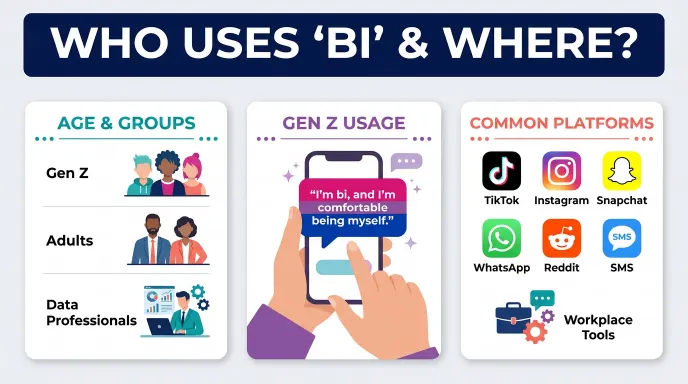
BI is used by different people in different situations. It is not limited to one age group or social media platform.
Age Groups
Adults and younger people may use BI when discussing sexual orientation, personal identity, or relationships.
Professionals, students, and people working with data may use BI to mean Business Intelligence.
The abbreviation is not restricted to teenagers or young adults.
Gen Z Usage
Some Gen Z users use BI in social media bios, online communities, comments, and personal conversations.
For example:
“I’m bi, and I’m comfortable being myself.”
Here, the abbreviation communicates identity in a short and familiar way.
However, BI is not exclusive to Gen Z. People from different generations may understand and use it.
Common Platforms
You may encounter BI on:
- TikTok, in videos and comment sections.
- Instagram, in bios, captions, and posts.
- Snapchat, in private conversations.
- WhatsApp, in individual and group chats.
- Reddit, in discussions and online communities.
- SMS, in regular text messages.
- Workplace platforms, when discussing Business Intelligence.
How Often Does BI Appear Online?
BI is recognizable in LGBTQ+ discussions and professional data related conversations. However, there is no reliable universal figure showing how often it appears across all platforms.
Its frequency depends on the community and subject being discussed.
You are more likely to see BI in a conversation about identity than in a random message about everyday plans. In business or technology groups, the professional meaning may be more relevant.
Origin of the Term BI
The abbreviation BI comes from the word bisexual. The word has a much longer history than modern texting and social media.
People began shortening many established words and expressions as online communication became more common. Abbreviations make messages quicker to type, especially in short comments, bios, and chats.
BI is one example of this pattern.
How Did BI Become Common Online?
The growth of online communities gave people more ways to discuss personal identity and relationships.
Social media profiles, forums, blogs, and messaging apps made short identity labels easier to share. As a result, abbreviations such as BI became familiar in many online conversations.
The letters are also convenient for profile descriptions because they take up less space than the full word.
Is the Origin of BI Clear?
The abbreviation is a shortened form of bisexual, but there is no single confirmed moment when people first started using BI in text messages.
It is best to distinguish between the history of the word bisexual and the later use of its abbreviation in digital communication.
BI also has a separate professional meaning: Business Intelligence. That use developed in the world of business, data analysis, and information technology rather than from social media slang.
BI vs. IDK, IDC, IMO, and BRB
BI and other short forms may appear in the same chat, but they do not serve the same purpose.
Some describe identity or professional topics, while others express reactions or manage everyday conversations.
| Term | Meaning | Type | Usage | Popularity |
| BI | Bisexual; also Business Intelligence | Abbreviation / initialism | Identity or business discussions | Recognizable in relevant contexts |
| IDK | I Don’t Know | Initialism | Showing uncertainty | Very common |
| IDC | I Don’t Care | Initialism | Expressing a lack of concern | Very common |
| IMO | In My Opinion | Initialism | Sharing an opinion | Common |
| BRB | Be Right Back | Initialism | Temporarily leaving a chat | Common |
BI vs. IDK
IDK and BI have different purposes.
BI may describe sexual orientation or refer to Business Intelligence. IDK means “I Don’t Know” and is used when someone does not have an answer.
Example:
A: What does BI mean?
B: I think it means bisexual.
BI vs. IDC
IDC means “I Don’t Care.” It can express disinterest or show that something does not matter to the sender.
BI does not communicate this feeling. It has a separate meaning based on the subject of the conversation.
BI vs. IMO
IMO means “In My Opinion.” People use it before sharing their personal views.
For example:
“IMO, that movie was great.”
BI is not an opinion marker. It is used as an abbreviation for bisexual or Business Intelligence, depending on context.
BI vs. BRB
BRB means “Be Right Back.” Someone may send it before temporarily leaving a conversation.
BI does not indicate that a person is leaving or returning to a chat.
Real World Usage Example
Imagine two friends are chatting after school. One of them notices that another classmate has mentioned being bisexual in a social media post.
The conversation might look like this:
Alex: Did you see Jamie’s new post?
Sam: Yes, they mentioned they’re bi.
Alex: Oh, I understand.
Sam: We should respect their privacy and treat them normally.
In this situation, BI means bisexual. The friends are discussing someone’s identity, so the personal meaning is clear.
Now imagine a different situation at an office:
Employee 1: What does the BI dashboard show?
Employee 2: It shows our monthly sales and customer trends.
Here, BI means Business Intelligence. The dashboard collects and displays information that helps the company understand its performance.
These situations show why you should not decide what BI means without considering the topic.
Common Misunderstandings About BI
Short abbreviations can be confusing, especially when the same letters have different meanings. Here are a few mistakes to avoid.
1. Thinking BI Has Only One Meaning
Many people associate BI with bisexual, but the abbreviation also has a well established professional meaning: Business Intelligence.
Always consider the subject of the message.
2. Assuming Everyone Who Uses BI Is Bisexual
Someone may use BI while discussing another person’s identity, a business project, or a technical subject.
Using the abbreviation does not automatically tell you anything about the sender’s personal identity.
3. Confusing BI With a Random Internet Slang Term
BI is not just a trendy expression. It is an abbreviation of established terms.
Its meaning comes from the words it represents, not from a special internet joke or hidden message.
4. Treating Someone’s Identity as a Joke
When BI means bisexual, it refers to a real aspect of someone’s identity. It should not be used to insult, embarrass, or stereotype people.
A respectful conversation is always the better choice.
5. Assuming the Meaning From the Platform Alone
Seeing BI on TikTok does not guarantee that it means bisexual. A video about data analytics could use the same abbreviation to mean Business Intelligence.
The topic matters more than the app.
Key Takeaways
Here are the most important points to remember:
- BI commonly means bisexual in personal text conversations.
- It describes someone who experiences romantic or sexual attraction to more than one gender.
- In business and technology, BI can mean Business Intelligence.
- You may see it in TikTok comments, Instagram bios, Snapchat messages, WhatsApp chats, and SMS.
- BI is an abbreviation or initialism, not a traditional slang expression.
- It is not inherently rude or offensive.
- The surrounding conversation helps you identify the correct meaning.
Frequently Asked Questions
What does BI mean in text messages?
BI commonly means “bisexual” in personal conversations. It can also mean “Business Intelligence” in professional or technology related messages.
What does BI mean on TikTok?
On TikTok, BI may mean bisexual, especially in videos and comments about identity or relationships. In business or technology content, it may mean Business Intelligence.
Is BI slang?
BI is better described as an abbreviation or initialism than traditional slang. It is a shortened form of bisexual and can also stand for Business Intelligence.
Is BI rude or offensive?
No, BI is not generally rude or offensive. It is a neutral abbreviation when used respectfully. Using it to mock or embarrass someone, however, can be disrespectful.
How should you reply to BI?
If someone uses BI to describe their identity, you can respond with “Thanks for sharing that” or “I understand.” If you are unsure of the meaning, simply ask, “What do you mean by BI here?”
Conclusion
BI commonly means bisexual in personal text messages and social media conversations. It describes someone who experiences romantic or sexual attraction to more than one gender.
You may see it on TikTok, Snapchat, Instagram, WhatsApp, and SMS. In business and technology discussions, BI can also mean Business Intelligence.
The abbreviation is not rude by itself. The most important thing is to understand the context and use it respectfully. If you are unsure what someone means, asking for clarification is always a good choice.
Discover More Articles
- What Do Black Hearts Mean in Text? 🖤 Meaning & Symbolism
- What Does CY Mean in Text? Decode Its Different Meanings
- What Does DND Mean in Text? Discover Its Meaning & Examples

Hey, I’m Jordan. I grew up in a bilingual household in LA, so Spanish and Mexican American slang has always been part of how I talk. I’ve been writing online content for five years, explaining terms the way I’d explain them to a friend meaning, tone, and when it’s actually okay to use.