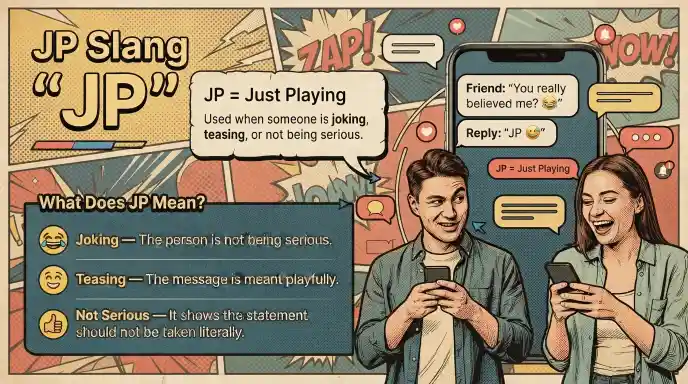
JP slang can mean “just playing” in casual texting, meaning the person is joking or not being serious. It is often used after a playful comment to show that the speaker was not being serious.
You may see JP in text messages, group chats, social media comments, or online conversations. The meaning depends on the context, so it is useful to look at the message around it.
For example, someone might text, “You owe me dinner, JP.” Here, JP tells the other person that the statement was only a joke.
Quick Answer: What Does JP Mean in Slang?
JP can mean “just playing” in slang and texting. It tells the reader that the person is joking, teasing, or not being serious about what they just said.
The abbreviation is casual and works best in friendly online conversations.
What Does JP Slang Mean?
In casual texting, JP can mean “just playing.” It is used to soften a statement that may sound serious, surprising, or teasing.
For example, a friend might say, “I’m never talking to you again, JP.” The JP changes the tone and shows that the person is only joking.
The expression is similar to saying “just kidding” or “I’m joking.” The exact tone depends on the conversation and the relationship between the people.
What Does JP Stand For?
When JP is used with the meaning “just playing,” each letter represents part of the phrase:
| Abbreviation | Meaning |
| J | Just |
| P | Playing |
| JP | Just playing |
In this use, “playing” does not mean playing a sport or video game. It means the speaker is playing around or joking with someone.
JP Meaning in Text
In texts, JP is usually added after a playful or teasing statement. It helps the reader understand that the message should not be taken literally.
For example:
“You better buy me pizza tonight. JP”
The person is not seriously demanding pizza. They are joking with the other person.
Because text messages do not include facial expressions or voice tone, abbreviations like JP can help make the intended tone clearer.
Is JP the Same as Just Kidding?
JP can have a meaning similar to “just kidding,” but the phrases are not exactly the same.
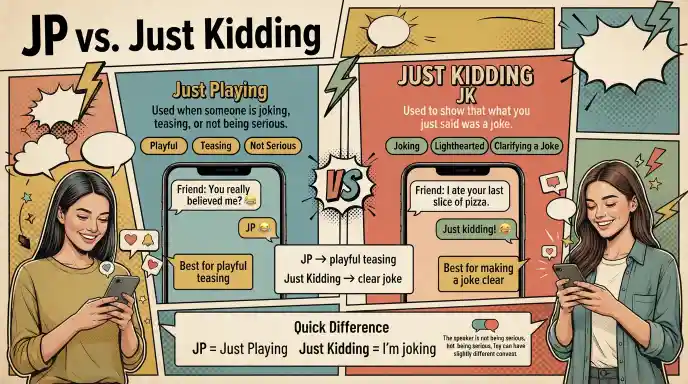
“Just kidding” directly tells someone that the previous statement was a joke. “Just playing” can have a more playful or teasing feel.
Both expressions can be used to show that a person was not being serious.
For example:
- “I hate your new haircut. Just kidding!”
- “I hate your new haircut. JP!”
Both messages can communicate that the speaker is joking.
Is JP Rude or Offensive?
JP is not normally rude or offensive when it means “just playing.” It is simply a casual way to show that a comment was meant as a joke.
However, adding JP does not automatically make an offensive comment harmless. A joke can still hurt someone even if the speaker says they were “just playing.”
The safest approach is to consider the topic, tone, and relationship before making a joke.
Where Is JP Commonly Used?
JP can appear in casual digital communication where short forms are common.
You may see it in:
- Text messages
- Group chats
- Social media comments
- Instagram DMs
- Snapchat conversations
- TikTok comments
- Online communities
- Casual gaming chats
Its use is informal, so it is less suitable for professional or official communication.
JP in Social Media
On social media, JP may appear after a teasing comment or playful reaction.
For example:
“Bro really thought I was going to let that slide. JP”
The abbreviation signals that the person is not being completely serious.
The surrounding words, emojis, and conversation can help make the intended meaning clearer.
JP in Group Chats
Group chats often use short abbreviations because people want to respond quickly.
Someone might write:
“I’m leaving this group forever. JP.”
The statement sounds serious at first, but JP shows that the person is joking.
Friends may also use the abbreviation when teasing each other about plans, mistakes, or funny situations.
JP Slang Examples in Real Conversations
The meaning of JP becomes clearer when you see it in natural conversations. It usually appears after a playful statement or tease.
Friendly Example
Sam: “You’re paying for lunch today.”
Alex: “Wait, what?”
Sam: “JP”
Here, JP shows that Sam was only joking.
Casual Text Example
“I’m blocking you after that game. JP!”
The speaker is not actually saying they will block the other person. The abbreviation changes the statement into a joke.
Playful Teasing
“You really thought you could beat me? JP”
The speaker is teasing the other person rather than making a serious statement.
Social Media Comment
“Delete this picture right now. JP”
The commenter is joking about the picture rather than seriously asking for it to be deleted.
Gaming Chat
“I’m never playing with you again. JP.”
In a gaming conversation, the person may use JP to show that the complaint is playful rather than serious.
JP vs. JK
JP and JK can both show that someone is joking, but they are different abbreviations.
| Slang | Meaning | Common Tone |
| JP | Just playing | Playful or teasing |
| JK | Just kidding | Directly signals a joke |
| LOL | Laughing out loud | Shows amusement |
| LMAO | Laughing very hard | Stronger reaction to something funny |
JK is generally more widely recognized than JP. If someone may not know JP, “just kidding” is clearer.
JP vs. Just Kidding
The main difference is the wording and tone.
“Just kidding” directly tells someone that a previous statement was not serious. “Just playing” can sound more like playful teasing.
For example:
“You’re the worst friend ever. JK!”
This clearly means the speaker is joking.
By comparison:
“You’re the worst friend ever. JP”
This can feel more playful and casual.
Why Do People Use JP?
People use JP because it is short and quick to type. Texting often relies on abbreviations to make conversations faster.
It can also prevent confusion when a playful statement might otherwise sound serious.
For example, saying “I hate you” without context could upset someone. Adding “JP” can signal that the statement was intended as friendly teasing.
Still, context matters. Not every joke will be understood just because JP is added.
Is JP Common or Popular?
JP is understandable in some casual texting contexts, but it is less widely recognized than abbreviations such as JK, LOL, or IDK.
This means you should not assume every reader will immediately know what JP means.
If you are speaking with someone unfamiliar with the abbreviation, writing “just kidding” or “just joking” may avoid confusion.
When Should You Avoid Using JP?
JP is best kept for informal conversations with people who understand your style of texting.
Avoid relying on it in:
- Professional emails
- School assignments
- Formal messages
- Business communication
- Official documents
- Serious conversations
You should also be careful when discussing sensitive subjects. A serious statement should not be dismissed as a joke simply by adding JP.
Can You Use JP at Work?
It is better to avoid JP in formal workplace communication.
A coworker may understand the abbreviation, but not everyone will know what it means. Informal abbreviations can also make professional messages less clear.
If you need to clarify that something was a joke, phrases such as “just kidding” or “I was joking” are easier for everyone to understand.
Can You Use JP With Teachers or Parents?
It depends on the relationship and communication style.
In a casual text with someone who already understands your slang, JP may be fine. However, it is usually better to use clear language with teachers, parents, or other adults in formal situations.
Instead of:
“I forgot the assignment again, JP.”
you could simply say:
“I was joking.”
Clear wording is safer when the message could be misunderstood.
Is JP Safe for Social Media?
When JP means “just playing,” it is generally harmless and safe to use on social media.
It can appear in casual comments, captions, DMs, and conversations between friends.
However, adding JP does not erase the effect of a hurtful statement. If a joke targets someone’s appearance, identity, personal situation, or other sensitive topic, it can still cause harm.
Common Misunderstandings About JP
One common misunderstanding is that JP always means “just playing.” Abbreviations can have different meanings in different communities, so context should always be checked.
Another mistake is assuming that JP is as common as JK. JK is more widely recognized, while JP may require more context.
It is also easy to confuse “playing” with games. In this slang use, playing means joking or teasing, not necessarily playing a video game.
JP in Different Online Settings
JP can work differently depending on where it appears. The basic meaning may stay the same, but the style of conversation can change.
Texting
In texting, JP can quickly show that a statement was a joke.
“I’m stealing your fries. JP”
The message is casual and playful.
TikTok and Instagram
On social media, JP may appear in comments or captions after a teasing statement.
“You really thought that outfit was going to work? JP”
The speaker is signaling that the comment was meant playfully.
Gaming
In gaming chats, players may use JP after joking about another player’s performance.
“You’re carrying the whole team today. JP”
The meaning comes from the playful context.
Group Chats
Friends may use JP when making exaggerated statements that could otherwise be taken seriously.
“I’m leaving this group forever. JP.”
The abbreviation tells the group that the statement was not serious.
Is JP Still Used?
JP can still appear in casual online conversations, but it is not one of the most widely recognized texting abbreviations.
Terms such as JK, LOL, and IDK are more familiar to a broader audience. Because JP is less common, some readers may need context to understand it.
If your goal is clear communication, writing “just kidding” or “I’m joking” is often easier.
Similar Slang to JP
Several texting expressions can communicate a similar idea.
| Slang | Meaning | Best Use |
| JP | Just playing | Playful teasing |
| JK | Just kidding | Showing a statement was a joke |
| J/K | Just kidding | Older-style texting |
| LOL | Laughing out loud | Showing amusement |
| LMAO | Laughing very hard | Strong amusement |
| Joking | Not being serious | Clear and direct |
Among these, JK is usually the closest common alternative to JP.
JP in Casual vs. Formal Communication
| Situation | Is JP Suitable? | Better Choice |
| Texting a close friend | Yes | JP |
| Group chat with friends | Yes | JP |
| Casual social media comment | Usually | JP or JK |
| Gaming chat | Usually | JP or JK |
| School message | Not ideal | “Just kidding” |
| Message to a teacher | No | Clear wording |
| Workplace chat | Usually avoid | “I was joking” |
| Business email | No | Professional wording |
The main issue is not that JP is offensive. It is that the abbreviation is informal and may not be understood by everyone.
Why Context Matters With JP
Slang does not always have one fixed meaning. The same abbreviation can mean different things in different communities.
When you see JP, look at the words before and after it. The topic, platform, and relationship between the speakers can help reveal the intended meaning.
If the conversation is clearly playful, “just playing” is a reasonable interpretation. If the context does not fit, do not assume the meaning automatically.
Key Takeaways
- JP can mean “just playing” in casual texting.
- It is used to show that a previous comment was playful or not serious.
- JP is similar to JK, meaning “just kidding.”
- It can appear in texts, group chats, social media, and gaming conversations.
- JP is less widely recognized than some common texting abbreviations.
- It is generally harmless when used in a suitable context.
- Avoid using it in formal or professional communication.
- A joke can still hurt someone even when followed by “JP.”
Frequently Asked Questions About JP Slang
Q. What does JP stand for in texting?
When used as slang, JP can stand for “just playing.” It shows that the speaker was joking or teasing.
Q. What is the difference between JP and JK?
JP means “just playing,” while JK means “just kidding.” Both can show that a previous statement was not serious.
Q. Does JP mean “just playing” on social media?
It can. The meaning may appear in casual social media conversations, comments, and messages when the context suggests joking or teasing.
Q. Is JP appropriate for work?
JP is usually not the best choice for professional communication. A phrase such as “I was joking” is clearer and more professional.
Q. Can JP mean something else?
Yes. Abbreviations can have different meanings depending on the context or online community. If “just playing” does not fit the conversation, consider other possible meanings.
Q. Is JP offensive?
JP itself is not offensive when it means “just playing.” However, the statement it follows may still be rude or hurtful, so context and tone matter.
Q. What does JP mean in slang?
JP can mean “just playing” in casual slang. It tells someone that a previous comment was meant as a joke or playful tease.
Q. What does JP mean in text?
In text messages, JP can mean “just playing.” People may add it after a teasing or exaggerated statement to show they were not being serious.
Conclusion
JP can mean “just playing” when used in casual texting and online conversations. It usually appears after a playful, exaggerated, or teasing statement to show that the speaker is not being serious.
The abbreviation is harmless in normal casual use, but it is less widely known than some other texting shortcuts. Context matters, especially when the message could have more than one interpretation.
For friends and casual chats, JP can work naturally. For school, work, or formal communication, spelling out “just kidding” or “I was joking” is the clearer choice.
Read More Similar Slang

Hey, I’m Jordan. I grew up in a bilingual household in LA, so Spanish and Mexican American slang has always been part of how I talk. I’ve been writing online content for five years, explaining terms the way I’d explain them to a friend meaning, tone, and when it’s actually okay to use.