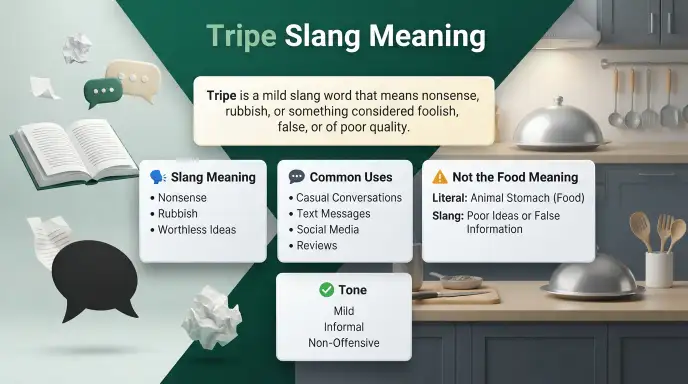
Tripe slang meaning usually describes something that is nonsense, foolish, boring, or of poor quality, depending on the context. People often use the term to dismiss an idea, opinion, movie, or conversation they believe is not worth taking seriously.
Although tripe originally refers to the edible lining of an animal’s stomach, it is commonly used as slang to criticize statements, stories, opinions, movies, books, or other content that someone believes is worthless or ridiculous.
People use tripe in everyday conversations to express disagreement or dismiss something they think lacks value or truth. The tone is usually informal and may sound sarcastic or critical, depending on the situation.
In this guide, you’ll learn the slang meaning of tripe, its origin, how it is used in conversations, example sentences, similar slang words, and when it is appropriate to use this expression.
Quick Answer: What Does Tripe Mean in Slang?
Tripe is a slang word for nonsense, rubbish, or something considered foolish, worthless, or untrue. People often use it to criticize ideas, stories, opinions, or poor-quality writing.
What Does Tripe Mean in Slang?
In everyday English, tripe usually describes something that a person thinks is meaningless or of poor quality.
People may use it when they:
- Disagree with a statement.
- Criticize a book or article.
- Reject a rumor.
- Describe poor advice.
- Express disappointment with low-quality content.
The word often sounds critical, but it is not considered vulgar.
Common Meanings of Tripe
| Meaning | Explanation | Example |
| Nonsense | Something that makes no sense | “That’s complete tripe.” |
| Rubbish | Something considered worthless | “The article was full of tripe.” |
| Poor-quality writing | Writing that lacks value | “I won’t waste time reading that tripe.” |
| False information | Claims that are not true | “Don’t believe that tripe online.” |
What Does Tripe Mean in Text?
In text messages and online conversations, tripe usually means nonsense or something the sender does not believe.
People often use it to dismiss an opinion or rumor without using stronger insults.
Example 1
Person A: I heard the Earth will stop spinning next week.
Person B: That’s tripe.
Meaning: Person B believes the statement is nonsense.
Example 2
Person A: This website says chocolate cures every illness.
Person B: Don’t believe that tripe.
Meaning: The information is considered false or unreliable.
Example 3
Person A: Did you enjoy the movie?
Person B: No, it was complete tripe.
Meaning: Person B thinks the movie was very poor.
Does Tripe Have a Full Form?
No.
Tripe does not have a full form.
It is a regular English word, not an abbreviation or acronym.
People sometimes search for:
- Tripe full form
- What does tripe stand for?
- Tripe abbreviation
The answer is simple. Tripe is a standalone word with both a literal and a slang meaning.
Is Tripe Rude, Offensive, or Neutral?
Tripe is usually mild. Most people do not consider it offensive.
It criticizes an idea instead of insulting a person. Even so, someone may feel offended if you describe their work or opinion as tripe.
| Situation | Appropriate? |
| Talking with friends | ✅ Yes |
| Family conversations | ✅ Yes |
| Text messages | ✅ Yes |
| Social media | ✅ Yes |
| School discussions | ✅ Usually |
| Professional emails | ⚠ Better to avoid |
| Formal reports | ❌ No |
Choose more formal words like incorrect, unreliable, or poor quality in professional settings.
Where Is Tripe Commonly Used?
You can hear or read tripe in many informal situations.
Common places include:
- Everyday conversations
- Text messages
- Social media comments
- Online forums
- News discussions
- Book reviews
- Movie reviews
- Opinion articles
- Podcasts
The word appears more often in British English, but many American English speakers also understand it.
Who Uses the Word Tripe?
Many different people use this slang word.
Common users include:
- Adults
- Writers
- Journalists
- Teachers
- Book reviewers
- Movie critics
- Social media users
- Podcast hosts
Younger people may prefer newer slang words like cap, trash, or BS, but tripe still appears in modern English.
Real Life Examples of Tripe Slang
These examples show how people naturally use the word.
Friendly Conversation
Person A: Did you read that article?
Person B: Yes, but it was complete tripe.
Social Media
“Don’t share that tripe without checking the facts.”
Movie Review
“The acting was great, but the story was tripe.”
News Discussion
“That rumor is nothing but tripe.”
Book Review
“The first chapter was interesting, but the rest felt like tripe.”
These examples show that tripe usually criticizes information, writing, or ideas instead of people.
Origin and History of Tripe Slang
The word tripe first appeared in English as the name for the edible stomach lining of animals such as cows and sheep.
Over time, people started using the word in a different way. They compared worthless ideas or poor-quality writing to something unpleasant. This new meaning slowly became popular in everyday speech.
By the late 1800s and early 1900s, tripe had become a common slang word for nonsense or rubbish.
Today, many English speakers still use it to criticize stories, opinions, books, movies, or false information.
Why Do People Say “Tripe”?
People use tripe when they want to reject an idea without using strong or offensive language.
Common reasons include:
- Dismissing false information
- Criticizing poor writing
- Rejecting rumors
- Expressing disappointment
- Describing low-quality content
- Showing disagreement
The word sounds firm, but it is much milder than many modern insults.
Common Situations Where People Use Tripe
People use tripe in many everyday situations.
Talking About Fake News
“That’s just tripe. Check the facts first.”
Reviewing a Movie
“The special effects looked good, but the story was tripe.”
Discussing a Book
“I couldn’t finish it because it was complete tripe.”
Rejecting a Rumor
“Don’t listen to that tripe.”
Commenting Online
“People keep sharing the same tripe every week.”
These examples show that tripe usually criticizes information rather than people.
Tripe in British and American English
The slang meaning is the same in both countries, but people use it differently.
British English
British speakers use tripe more often.
You may hear it in:
- Daily conversations
- Newspapers
- Television shows
- Political discussions
- Book reviews
Example:
“That’s absolute tripe.”
American English
American speakers understand the word, but they often choose different slang.
Common alternatives include:
- Trash
- Garbage
- Nonsense
- BS
- Junk
Even so, many Americans still recognize tripe from books, films, and news articles.
Tripe vs Similar Slang Words
Several slang words have similar meanings, but each has a different tone.
| Slang | Meaning | Tone | Offensive Level |
| Tripe | Nonsense or worthless ideas | Mild | Very Low |
| Trash | Poor quality | Informal | Low |
| Garbage | Worthless | Critical | Low |
| Junk | Low quality | Neutral | None |
| BS | Nonsense | Strong | Medium |
| Crap | Poor quality or nonsense | Informal | Medium |
Tripe sounds more polite than BS or crap, making it a better choice in many conversations.
Common Misunderstandings About Tripe Slang Meaning
Many people misunderstand this word.
Thinking Tripe Always Means Food
This is the most common mistake.
Tripe has two meanings:
- The edible stomach lining of farm animals.
- A slang word for nonsense or rubbish.
The meaning depends on the conversation.
Thinking Tripe Is a Swear Word
No.
Tripe is not considered profanity.
It is a mild criticism that most people accept in casual conversations.
Thinking Tripe Is an Acronym
Some people search for a full form of tripe.
There isn’t one.
Tripe is a normal English word.
Thinking Everyone Uses It
Not always.
Many younger speakers prefer newer slang such as:
- Cap
- Trash
- BS
Older generations use tripe more often.
Impact of Using Tripe Slang in Communication
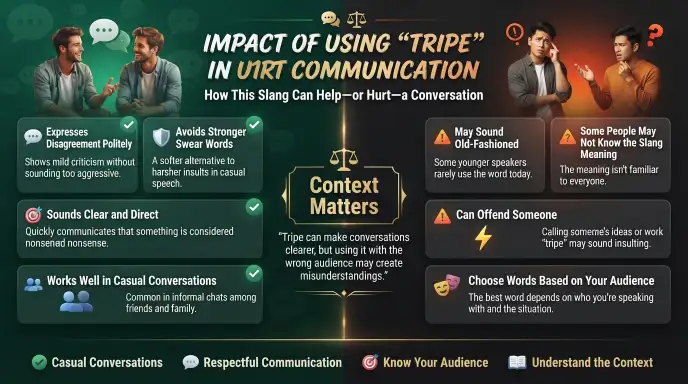
The word tripe changes the tone of a conversation.
Positive Effects
- Expresses disagreement politely.
- Avoids stronger swear words.
- Sounds clear and direct.
- Works well in casual conversations.
Possible Drawbacks
- May sound old-fashioned.
- Some people may not know the slang meaning.
- It can offend someone if you criticize their work.
Choose your words based on your audience.
Is Tripe Slang Meaning Safe to Use on Social Media?
Yes.
In most cases, tripe is safe to use on social media because it is not considered offensive language.
People often use it on:
- X (Twitter)
- Discord
- YouTube comments
Even so, keep your comments respectful. Criticize ideas instead of attacking people.
When Should You Avoid Using Tripe Slang Meaning?
Tripe works well in casual conversations, but it does not fit every situation.
Avoid using tripe in:
- Business emails
- Academic writing
- Professional reports
- Formal presentations
- Legal documents
- Workplace communication with clients
- Official announcements
In these situations, choose more formal words like incorrect, unreliable, or poor quality.
Polite Alternatives to Tripe
Nonsense
Pronunciation: (NON-sens)
Meaning:
A polite word for something that is false, unreasonable, or does not make sense.
Examples:
- That’s complete nonsense.
- I don’t believe that nonsense.
Rubbish
Pronunciation: (RUB-ish)
Meaning:
A common British English word for something that is untrue or of poor quality.
Examples:
- That’s rubbish.
- The report was full of rubbish.
Poor Quality
Pronunciation: (poor KWOL-i-tee)
Meaning:
Describes something that is badly made or below expectations.
Examples:
- The product was poor quality.
- The writing needs improvement because the quality is poor.
Unreliable
Pronunciation: (un-ri-LYE-uh-bul)
Meaning:
Describes information or a source that cannot be trusted.
Examples:
- The website is unreliable.
- Use reliable sources instead.
Incorrect
Pronunciation: (in-kuh-REKT)
Meaning:
A formal way to say that something is wrong or not true.
Examples:
- That statement is incorrect.
- The answer is incorrect.
Simple Alternatives Table
| Instead of Tripe | Better Alternative |
| That’s tripe. | That’s nonsense. |
| Complete tripe. | That’s rubbish. |
| This article is tripe. | This article is poor quality. |
| Don’t believe that tripe. | That information is unreliable. |
| That’s complete tripe. | That statement is incorrect. |
These alternatives work well in workplaces, schools, and professional writing.
Why Does the Word “Tripe” Remain Popular?
People still use tripe because it expresses disagreement without sounding highly offensive.
Many speakers like the word because it:
- Sounds firm but polite.
- Replaces stronger insults.
- Clearly rejects false information.
- Works in everyday conversations.
- Has been part of English for many years.
Although newer slang appears often, tripe remains a familiar expression in modern English.
Frequently Asked Questions
Q1. What does tripe mean in slang?
Tripe is a slang word for nonsense, rubbish, or something considered foolish or worthless.
Q2. Does tripe have a full form?
No. Tripe is a regular English word and not an acronym.
Q3. Is tripe a bad word?
No. It is generally considered a mild and non-offensive expression.
Q4. What does tripe mean in text messages?
In texting, tripe usually means nonsense or something the sender does not believe.
Q5. Is tripe the same as rubbish?
They have similar meanings. Both describe something of little value or something that is not true.
Q6. Is tripe still used today?
Yes. Many English speakers still use it, especially in British English.
Q7. Can tripe describe a person?
Usually, no. People use tripe to criticize ideas, stories, opinions, or writing rather than individuals.
Q8. Is tripe common in American English?
Americans understand the word, but they often choose alternatives like trash, garbage, or BS.
Q9. What is the difference between the literal and slang meanings of tripe?
The literal meaning refers to the edible stomach lining of certain farm animals. The slang meaning refers to nonsense or worthless ideas.
Q10. Is tripe appropriate for professional writing?
No. Formal writing should use words like incorrect, unreliable, or poor quality instead.
Key Takeaways
- Tripe means nonsense, rubbish, or something of poor quality.
- It is a mild slang word, not a swear word.
- The word also has a literal meaning related to food.
- British English uses tripe more often than American English.
- It works well in casual conversations but not in formal writing.
- Professional alternatives include incorrect, unreliable, and poor quality.
Conclusion
Tripe is a long standing slang word that describes nonsense, rubbish, or something of little value. People often use it to criticize ideas, stories, rumors, or poor-quality writing without using strong or offensive language.
The word remains common in casual conversations, especially in British English. Understanding its slang meaning helps you recognize the tone of discussions and use the word naturally when the situation fits.
Read More Articles:

Hi, I’m Sarah. I studied Communications at the University of Texas and have spent the last six years writing about internet culture and Gen Z slang across TikTok, Twitter, and everyday conversations. I focus on real usage, not just dictionary definitions.