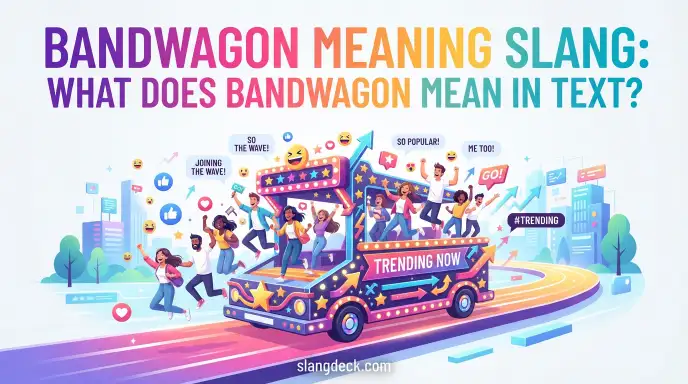
Bandwagon meaning slang is about following what is already popular. If someone suddenly supports a sports team, trend, game, artist, or opinion after seeing many other people support it, someone might say they are jumping on the bandwagon.
You may see this phrase in text messages, social media posts, gaming chats, sports discussions, and everyday conversations. It can describe harmless trend-following, but it can also suggest that someone is copying others without thinking for themselves.
The tone depends on the situation. Friends may use it as a joke, while a serious comment can sound critical.
This guide explains what bandwagon means, where the expression comes from, how people use it online, and how to tell the difference between casual trend-following and genuine support.
Quick Answer
Bandwagon meaning slang refers to joining a popular trend, opinion, activity, or group mainly because many other people are already doing it. Calling someone a “bandwagon” person can suggest they are following the crowd instead of making an independent choice. The term is usually casual and can sound teasing or mildly negative.
| Question | Answer |
| Meaning | Following something because it has become popular |
| Tone | Usually casual, teasing, or mildly negative |
| Used By | General English speakers and online communities |
| Common Places | Texts, social media, sports, gaming, everyday speech |
| Offensive? | Usually no, but it can sound insulting if aimed at someone seriously |
| Main Phrase | “Jump on the bandwagon” |
The important point is that bandwagon does not always mean someone is fake. A person can discover something after it becomes popular and still genuinely like it. The term becomes more critical when the speaker believes popularity is the main reason for the person’s support.
What Does Bandwagon Mean in Slang?
In slang and casual speech, bandwagon describes the idea of following a popular trend, belief, team, person, or activity because many other people are already following it.
The common expression is “jump on the bandwagon.”
For example:
“Everyone started playing that game, so I jumped on the bandwagon.”
Here, the speaker means they started playing because the game had become popular.
Another example:
“You only became a fan after they started winning. You’re such a bandwagon fan.”
This version has a more negative tone. It suggests that the person supports the team because it is successful rather than because they have a long-term connection to it.
Simple Definition
Bandwagon = following something mainly because it is popular or many other people support it.
How Is Bandwagon Used in Text Messages?
In texting, bandwagon is usually used in a short and casual way.
Someone might use it when a friend suddenly likes the same song, game, show, team, or trend that everyone else likes.
For example:
Text:
“Bro, you started watching that show too?”
Reply:
“Yeah, I finally jumped on the bandwagon.”
The phrase does not automatically mean the person dislikes the trend. It can simply mean they joined after seeing its popularity.
It can also be used jokingly:
“You’re wearing those shoes now? Bandwagon much?”
The speaker is teasing the other person for following a popular style.
Bandwagon on Social Media
On social media, bandwagon often appears when people discuss trends, viral topics, challenges, opinions, celebrities, games, or popular products.
A person may accuse another user of jumping on the bandwagon when they start supporting something only after it becomes widely popular.
For example:
“Where were all these fans last year? Everyone is jumping on the bandwagon now.”
The speaker is suggesting that many people became interested only after the subject became successful or widely discussed.
The meaning stays close to its everyday use across platforms. The exact tone comes from the surrounding post or conversation.
Where Is “Bandwagon” Used?
| Context | How It Is Used | Example |
| Text Messages | Teasing someone for following a trend | “You jumped on the bandwagon 😂” |
| TikTok | Following a viral trend or opinion | “Everyone is on this bandwagon now.” |
| Joining a popular style or trend | “I guess I’m on the bandwagon too.” | |
| Gaming | Supporting a popular game, player, or team | “You’re only here because the game is popular. Bandwagon.” |
| Sports | Supporting a successful team | “Lots of bandwagon fans this season.” |
| Everyday Speech | Following a popular idea or activity | “I finally joined the bandwagon.” |
The core meaning does not change much between these settings. What changes is the subject people are following.
Bandwagon in Sports
Sports is one of the clearest places to hear bandwagon.
A bandwagon fan is often someone who starts supporting a team because the team is winning, popular, or receiving lots of attention.
For example:
“They won the championship and suddenly everyone became a fan.”
Someone might respond:
“Those are bandwagon fans.”
This can be playful among friends, but sports fans may take the label seriously. Calling someone a bandwagon fan can suggest that their support is not loyal or genuine.
Still, being a newer fan does not automatically make someone a bandwagon fan. Someone can discover a team during a successful season and become a genuine long-term supporter.
Bandwagon in Gaming
Gamers can also use bandwagon when many people suddenly start playing the same game, using a certain character, or supporting a particular player.
For example:
“Everyone is using that character after the update.”
A reply could be:
“People are just jumping on the bandwagon.”
The phrase may suggest that players are copying a popular choice because it has become successful.
In a joking context, however, it may simply mean:
“I saw everyone playing it, so I decided to try it too.”
Is Bandwagon Positive or Negative?
Bandwagon is usually neutral to mildly negative, depending on context.
The phrase can be harmless when someone admits that they joined a popular trend.
For example:
“I never watched that show before, but everyone recommended it, so I jumped on the bandwagon.”
There is no strong insult here.
The tone becomes more negative when the speaker suggests that someone has no independent opinion or only supports something because it is popular.
For example:
“You don’t even like the team. You’re just a bandwagon fan.”
That statement is clearly more critical.
Is “Bandwagon” Rude or Offensive?
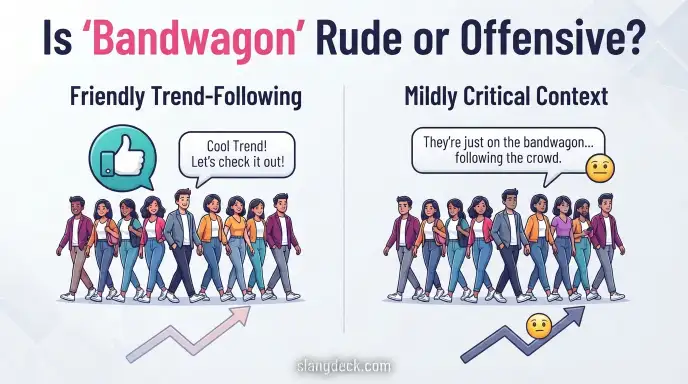
Bandwagon is not normally considered offensive, but it can be rude or insulting when directed at someone in a serious argument.
Calling someone a bandwagon fan may imply that they are fake, easily influenced, or unwilling to form their own opinion.
Among friends, the same phrase can be harmless teasing.
For example:
“You bought the new phone too? Welcome to the bandwagon”
That sounds playful.
In a professional setting, it is usually better to choose neutral wording if you want to avoid sounding judgmental.
Bandwagon vs. Trend Follower
These expressions are related, but they are not exactly the same.
| Term | Meaning | Tone |
| Bandwagon | Following something because it is already popular | Can be critical |
| Trend follower | Someone who follows current trends | Usually neutral |
| Early adopter | Someone who tries something relatively early | Usually positive |
| Fan | Someone who genuinely likes or supports something | Usually positive |
| Follower | Someone who follows another person, idea, or trend | Depends on context |
The key difference is why someone follows something.
“Trend follower” simply describes the behavior. “Bandwagon” often adds the idea that popularity influenced the person’s decision.
Common Examples of Bandwagon Slang
Here are some natural ways people might use the expression:
Text Message
“Everyone is playing it now, so I guess I’m on the bandwagon.”
Sports Chat
“You weren’t supporting them before they started winning. Bandwagon fan!”
TikTok Comment
“Everyone suddenly loves this song. The bandwagon is full.”
Gaming Chat
“You switched characters because everyone else did? Total bandwagon.”
Everyday Conversation
“I didn’t care about the show until my friends recommended it.”
“Same. I jumped on the bandwagon.”
These examples show that the expression can be playful, neutral, or critical depending on the speaker’s intention.
Why Do People Say “Jump on the Bandwagon”?
People use “jump on the bandwagon” to describe joining something after it has already gained support.
The image behind the expression is simple: instead of leading a movement, a person joins something that already has a crowd.
That is why the phrase often carries the idea of following popularity.
The expression can apply to many things:
- A sports team
- A video game
- A music artist
- A TV show
- A fashion trend
- A social media trend
- A public opinion
- A popular product
- A meme
It does not have to involve literal peer pressure. Sometimes people simply discover something because many others are talking about it.
Origin and History of Bandwagon
The modern expression “jump on the bandwagon” comes from the literal idea of a bandwagon, a wagon carrying a musical band.
The expression became associated with joining a popular movement, especially in political contexts. The idea was that people wanted to associate themselves with a successful or popular cause.
The exact details of the phrase’s earliest use can vary across historical sources, so it is better not to attach a precise first-use date without strong evidence.
Today, the expression has moved far beyond politics. People use bandwagon in sports, entertainment, gaming, social media, fashion, and everyday conversations.
Can Bandwagon Mean Following a Popular Opinion?
Yes. Bandwagon can describe someone who adopts a popular opinion because many other people hold it.
For example:
“Everyone started criticizing the movie after that review went viral.”
Someone might call the later criticism bandwagon criticism if they believe people are repeating the popular view without forming their own opinion.
The term is about the perceived reason behind the person’s behavior. It does not prove that the person lacks an independent opinion.
Common Misunderstandings About Bandwagon
Bandwagon Does Not Always Mean Fake
Someone can join a popular trend and genuinely enjoy it. Popularity may simply introduce them to something new.
New Fans Are Not Automatically Bandwagon Fans
A person who discovers a sports team during a winning season can become a real fan. The label depends on the context and the speaker’s judgment.
Bandwagon Is Not Always an Insult
Friends often use it playfully when someone joins a popular trend.
It Is Not Limited to Sports
Although bandwagon fan is common in sports, the expression can describe trends, opinions, games, music, fashion, and many other popular things.
When Should You Avoid Using Bandwagon?
You can use bandwagon freely in casual conversations when the tone is clear. However, be careful when labeling someone else.
In school, work, or professional communication, saying someone is “just following the bandwagon” can sound dismissive.
A neutral alternative might be:
- “following the trend”
- “joining the popular movement”
- “following a popular opinion”
- “trying something because it became popular”
These phrases communicate the idea without directly judging someone’s motives.
Is Bandwagon Still Used in 2026?
Yes. “Bandwagon” remains a familiar English expression in 2026.
Its meaning is not limited to one generation or one social-media platform. People can use it in casual speech, sports discussions, online comments, gaming conversations, and discussions about popular trends.
The phrase “jump on the bandwagon” is especially useful when someone joins something after it has already become popular.
Its current tone still depends heavily on context. Online, it may be used seriously, jokingly, or as light teasing.
Key Takeaways
- Bandwagon means following something because it has become popular.
- “Jump on the bandwagon” means joining an already popular trend, group, idea, or activity.
- It is common in sports, texting, gaming, and social media.
- The term can be playful, neutral, or mildly negative.
- Calling someone a bandwagon fan can suggest that their support is based on popularity.
- New fans or trend followers are not automatically bandwagon followers.
- The expression is generally safe in casual conversation but can sound judgmental in professional settings.
Frequently Asked Questions (FAQs)
Q1. What does bandwagon mean in slang?
In slang and casual speech, bandwagon means following something because many other people already support or enjoy it. The phrase often appears as “jump on the bandwagon.” It can describe joining a trend, supporting a popular team, trying a viral game, or adopting a popular opinion. Depending on context, it may be playful or mildly critical.
Q2. What does “jump on the bandwagon” mean?
“Jump on the bandwagon” means to join something after it has already become popular. For example, if a TV show suddenly becomes popular and you start watching it because everyone is talking about it, you could say you “jumped on the bandwagon.” The phrase does not always mean your interest is fake.
Q3. Is calling someone a bandwagon fan an insult?
It can be. Bandwagon fan often suggests that someone supports a team because it is successful or popular rather than because of genuine loyalty. Among friends, it may be a joke. In a serious argument, however, it can sound dismissive or insulting because it questions the person’s reasons for supporting the team.
Q4. Does bandwagon always have a negative meaning?
No. Bandwagon can be neutral or playful as well as negative. Someone might casually say, “I finally jumped on the bandwagon,” simply because they started enjoying a popular show or game. The negative meaning usually appears when the speaker suggests that another person is following the crowd without thinking independently.
Q5. Can bandwagon be used for social media trends?
Yes. People can use bandwagon for viral social-media trends, popular opinions, memes, challenges, products, or creators. For example, someone might say, “Everyone is jumping on the bandwagon,” when many users suddenly begin posting about the same topic. The expression focuses on joining something because it has gained widespread attention.
Q6. Is bandwagon slang or a normal English word?
Bandwagon is a standard English word that is also common in casual and slang-like expressions. The phrase “jump on the bandwagon” is an established idiom. Because people use it casually online and in everyday speech, it often appears in slang dictionaries, social-media discussions, and informal conversations.
Q7. What is another word for bandwagon?
Depending on the context, alternatives include trend follower, follower, conformist, or someone following the crowd. However, these words are not exact replacements. “Bandwagon” specifically suggests that popularity or widespread support influenced someone’s decision to join or support something.
Q8. What is the opposite of being a bandwagon fan?
A common opposite idea is a loyal or longtime fan who supports a team, artist, game, or community regardless of its current popularity or success. Another related idea is an early adopter, meaning someone who starts using or supporting something relatively early rather than waiting for it to become widely popular.
Conclusion
The bandwagon meaning slang is simple: it describes following something because it has already become popular. You may hear people say someone “jumped on the bandwagon” when that person starts supporting a trend, team, game, opinion, or activity after many others have already done so.
The word can be playful among friends, but it can also sound critical when it suggests that someone is following the crowd instead of thinking independently. That is why context matters.
Remember that joining something after it becomes popular does not automatically make someone a bandwagon follower. A person may simply have discovered something later and developed genuine interest in it.
In casual texts, social media, sports chats, and gaming conversations, bandwagon remains a useful way to describe popularity-driven trend following.
Related Articles

Hi, I’m Sarah. I studied Communications at the University of Texas and have spent the last six years writing about internet culture and Gen Z slang across TikTok, Twitter, and everyday conversations. I focus on real usage, not just dictionary definitions.