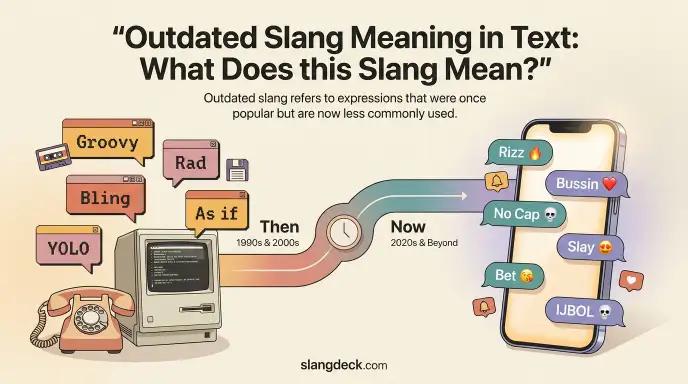
Outdated slang means informal words or phrases that were popular in the past but are now rarely used in everyday conversation. People may still recognize these expressions, but they can sound old-fashioned, unusual, or intentionally funny today.
You may encounter outdated slang in old movies, TV shows, books, songs, social media posts, memes, or conversations about older generations. Some terms disappear almost completely, while others stay recognizable because of pop culture or nostalgia.
For example, words such as “groovy,” “far out,” and “tubular” are strongly connected with earlier periods. A person might still use them today, but often for humor or to create a retro feeling.
Quick Answer
Outdated slang refers to informal language that was once popular but is no longer commonly used today. Some expressions remain understandable and may return through memes, nostalgia, or popular culture.
What Does Outdated Slang Mean in Text?
When someone uses outdated slang in a text, they are usually using an expression that belongs to an older period of informal language.
The term may still be understandable, but it may not sound natural in everyday speech among younger speakers.
For example:
“That movie was totally groovy.”
Most English speakers can understand the sentence, but “groovy” may sound deliberately old-fashioned in modern texting.
Outdated slang can also be used intentionally. A person might choose an old expression because they want their message to sound funny, nostalgic, dramatic, or retro.
What Is the Definition of Outdated Slang?
Outdated slang is informal language that has lost much of its former popularity.
A slang word does not necessarily become outdated because it is completely forgotten. It can remain familiar while becoming less common in normal conversations.
A term may be considered outdated when:
- People rarely use it naturally anymore
- It is strongly connected to an older generation
- Newer slang has replaced it
- It mainly appears in older media
- Younger speakers use it as a joke
- It creates a noticeably retro tone
Language changes gradually, so there is no exact date when a slang term officially becomes outdated.
Is Outdated Slang the Same as Old Slang?
Outdated slang and old slang have similar meanings, but they are not always identical.
“Old slang” simply describes an informal expression from an earlier period. It does not necessarily mean that nobody uses it anymore.
“Outdated slang” usually suggests that the expression has lost its place in normal modern conversation.
For example, a slang term from the 1980s can be called old slang because of its age. If modern speakers rarely use it naturally, it can also be described as outdated slang.
The distinction is mostly about current usage rather than age alone.
Why Does Slang Become Outdated?
Slang becomes outdated because language changes with culture, technology, entertainment, and generations.
People constantly create new ways to express humor, excitement, approval, disagreement, and other feelings.
A phrase can become popular through music or television and then gradually disappear when cultural trends change.
Common reasons include:
- Generational changes
- New technology
- Social media trends
- Popular music
- Movies and television
- Changing cultural attitudes
- New online communities
- New forms of entertainment
- Regional language changes
Internet slang can change particularly quickly because online trends spread and disappear at a rapid pace.
Examples of Outdated Slang
Some older expressions are still recognizable today even though they are not common in everyday modern speech.
Groovy
“Groovy” became strongly associated with 1960s and 1970s culture. It could describe something cool, enjoyable, fashionable, or pleasing.
Example:
“That new design is really groovy.”
The sentence is understandable, but many modern speakers may hear it as retro or playful.
Far Out
“Far out” was used as an expression of surprise, approval, or excitement, especially in older counterculture and youth language.
Example:
“Far out! You actually won!”
A modern speaker might use this expression to imitate an older style rather than as their normal slang.
Tubular
“Tubular” became associated with 1980s surf and youth culture and was used to mean something excellent or impressive.
Example:
“That trick was totally tubular!”
Today, the expression often creates a deliberately 1980s or humorous tone.
Rad
“Rad” developed as a shortened form of “radical” and became popular slang for something excellent or cool.
Example:
“That skateboard is rad.”
Unlike some older slang, “rad” is still understood and occasionally used today, although it can have a retro or old-school feel depending on the speaker and context.
The Bee’s Knees
“The bee’s knees” was an older expression for something considered excellent or outstanding.
Example:
“This restaurant is the bee’s knees.”
Most people today can understand it from context, but it is not a common modern slang expression.
Outdated Slang Meaning in Text Messages
In text messages, outdated slang often appears when someone is being humorous, nostalgic, or intentionally dramatic.
For example:
“That outfit is totally groovy.”
The emoji and wording make it clear that the sender may be using the expression playfully.
Someone might also quote an older movie or song and use its language to recreate the original style.
This means that seeing outdated slang in a message does not necessarily mean the person believes it is modern slang.
They may simply be using it for effect.
Outdated Slang on TikTok and Social Media
Social media has made old slang interesting again.
TikTok, Instagram, Reddit, and other platforms can revive older expressions through memes, nostalgia videos, movie clips, and trend-based content.
A word that was once considered outdated can suddenly appear in thousands of comments because users find it funny or nostalgic.
For example:
“This outfit is totally tubular.”
A user may be intentionally bringing back an old expression rather than using it as normal everyday slang.
This is why outdated does not always mean permanently forgotten.
Is Outdated Slang Rude or Offensive?
Outdated slang is not automatically rude or offensive.
The word “outdated” describes how current or popular an expression is. It does not tell you If the expression is respectful.
For example, “groovy” may sound old-fashioned, but it is generally harmless.
However, some historical slang terms can be offensive because language and social attitudes change over time.
If you find an unfamiliar older expression, it is better to check its meaning and historical context before using it.
Can Outdated Slang Be Offensive?
Yes, some outdated slang can have offensive meanings, especially expressions that were once used to describe particular groups of people.
The fact that a term is old does not make it automatically acceptable.
Before using an unfamiliar historical expression, consider:
- What did it originally mean?
- Who commonly used it?
- Was it used to insult or stereotype people?
- Does it have negative associations today?
- Would the intended audience understand the context?
This is especially important when borrowing language from old movies, books, songs, or online communities.
Why Do People Still Use Outdated Slang?
There are several reasons people continue to use older slang.
Nostalgia is one of the most common reasons. Older speakers may use expressions they remember from their youth.
Younger people may use the same words because they have discovered them through movies, music, memes, or social media.
Outdated slang can also be useful for humor.
For example:
“That was totally tubular, dude!”
Someone saying this today may be deliberately creating an exaggerated 1980s-style voice.
Outdated Slang vs. Modern Slang
The main difference between outdated and modern slang is current popularity and usage.
| Type | Meaning | Example |
| Outdated slang | Older informal language that has lost popularity | “Groovy” |
| Modern slang | Informal language commonly used today | “Fire” |
| Internet slang | Informal language spread through online communication | “LOL” |
| Regional slang | Informal language associated with a particular area | Local expressions |
| Nostalgic slang | Older slang intentionally used to create a retro feeling | “Tubular” |
The categories can overlap. A word can be old but still popular, or outdated but temporarily revived by an online trend.
Outdated Slang vs. Archaic Language
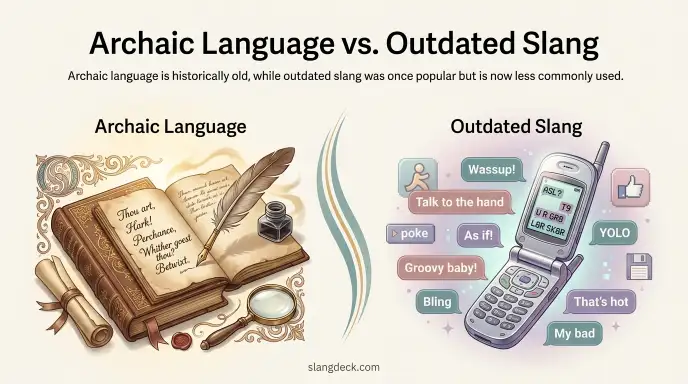
Archaic language and Outdated slangs are different concepts.
Outdated slang is usually an informal expression that has fallen out of common use. Archaic language refers to words, phrases, or grammatical forms associated with much earlier periods of the language.
For example, an expression from the 1980s may still be easy to understand today.
An archaic expression from several centuries ago may require more explanation because modern speakers may no longer recognize it.
This distinction is especially useful when reading historical literature or older documents.
How Can You Tell If Slang Is Outdated?
There is no official expiration date for slang.
However, you can look at how frequently people use the expression and how it sounds in modern conversation.
A slang term may be outdated if:
- It is mostly associated with an older generation
- You rarely hear younger people use it naturally
- It appears mainly in older movies or music
- People use it for jokes or nostalgia
- A newer expression has replaced it
- It immediately creates a retro feeling
Usage can differ by age, region, and community, so one person’s outdated slang may still be normal vocabulary for someone else.
Can Outdated Slang Become Popular Again?
Yes, outdated slang can become popular again.
Language does not always move forward in a straight line. Old expressions can return through memes, movies, television shows, music, fashion, and social media trends.
Sometimes a younger generation discovers an older term and starts using it ironically.
If the expression spreads widely enough, it may temporarily become fashionable again.
However, the revived word may not have exactly the same tone it had originally.
It might move from:
Common → Less common → Outdated → Ironic → Revived
This cycle is one reason slang is constantly changing.
Why Do People Use Outdated Slang Online?
Online communication gives people more freedom to experiment with language.
Using an old slang term can make a post feel funny, nostalgic, sarcastic, or intentionally exaggerated.
For example:
“My weekend was totally groovy.”
A person might use this because the sentence sounds humorous rather than because “groovy” is their everyday word for “good.”
Outdated slang can also help creators establish a specific character or aesthetic.
How Outdated Slang Affects Communication
Using outdated slang can change the personality of a message.
It may make the writer sound:
- Playful
- Nostalgic
- Humorous
- Retro
- Sarcastic
- Old-fashioned
- Exaggerated
That can be useful in casual communication.
However, if readers do not recognize the expression, it can also make the message less clear.
For professional or educational writing, clear modern language is usually the better choice.
When Should You Avoid Outdated Slang?
You do not have to avoid outdated slang completely.
The main consideration is if your audience will understand the expression and if it fits the situation.
It may be better to avoid unfamiliar old slang in:
- Academic assignments
- Business emails
- Job applications
- Professional reports
- Official documents
- Customer communication
- Formal presentations
If you are writing historical fiction or creating dialogue for a particular period, however, outdated slang can make the writing feel more authentic.
Polite Alternatives to Outdated Slang
If an old expression sounds unnatural, you can replace it with a modern alternative.
| Outdated Slang | Modern Alternative |
| Groovy | Cool / Great |
| Far out | Wow / Amazing |
| Tubular | Awesome / Cool |
| The bee’s knees | Excellent / Fantastic |
| Rad | Cool / Excellent |
| Neat | Nice / Cool |
| Swell | Great / Good |
The right replacement depends on the original meaning.
A slang word that once meant “excellent” should be replaced with a modern positive expression rather than simply removing it.
Examples of Outdated Slang in Different Contexts
Friendly Example
“That jacket is totally groovy!”
The speaker is giving a positive reaction but using an older expression for a playful effect.
Casual Example
“Far out! I didn’t expect that.”
Here, the phrase expresses surprise.
Humorous Example
“This game is totally tubular, dude.”
The wording intentionally creates a retro tone.
Social Media Example
“Trying to bring back 80s slang today.”
This makes it clear that the old expressions are being used intentionally.
Nostalgic Example
“My parents used to say ‘groovy’ all the time.”
Here, the phrase is being discussed rather than used as current slang.
Creative Writing Example
“That sounds groovy,” she said, trying to sound like someone from another decade.
In fiction, older slang can help establish a character’s personality or time period.
Why Does Outdated Slang Matter?
Outdated slang provides clues about language, culture, and different generations.
Slang often reflects the interests and experiences of the people who use it.
Music, sports, movies, technology, fashion, and social movements can all influence the development of slang.
Understanding older slang can therefore help you interpret old conversations, movies, songs, books, and cultural references more accurately.
It can also explain why certain phrases sound natural in older media but unusual in modern texting.
Is Outdated Slang Safe for Social Media?
Outdated slang is generally safe for social media when the specific expression is harmless.
Words such as “groovy” or “rad” are generally used as playful or nostalgic expressions.
However, some historical slang may contain offensive, discriminatory, or insulting language.
For that reason, do not assume that every old slang term is harmless simply because it is no longer common.
Always consider the specific meaning, historical background, audience, and context before using an unfamiliar expression.
FAQs About Outdated Slang
What does outdated slang mean?
Outdated slang means informal language that was popular in the past but is now rarely used in everyday modern communication.
Is outdated slang the same as old slang?
They are closely related, but outdated slang usually suggests that an expression has lost its popularity, while old slang simply refers to slang from an earlier period.
Is outdated slang still used?
Yes. People may still use it for nostalgia, humor, creative writing, memes, or references to older popular culture.
Can outdated slang become popular again?
Yes. Social media, movies, music, memes, and nostalgia can bring older expressions back into use.
Is outdated slang offensive?
Not necessarily. Some outdated slang is harmless, while particular historical expressions may have offensive meanings or associations.
How quickly can slang become outdated?
There is no fixed timeline. Some slang remains popular for decades, while internet expressions can lose popularity much faster as online trends change.
Conclusion
Outdated slang refers to informal words and expressions that were once popular but are no longer commonly used in modern everyday communication. Some terms remain recognizable even after they stop being fashionable.
Expressions such as “groovy,” “far out,” and “tubular” can now create a retro or humorous feeling, while other older slang may still appear in specific communities.
The meaning of an outdated expression depends on context, generation, culture, and audience. A word that sounds old-fashioned to one person may still be familiar to another.
When using older slang, focus on the purpose of your message. Use it for humor, nostalgia, historical accuracy, or style when appropriate, but choose clear modern language when your audience needs straightforward communication.
You Might Also Like!
- LAL Slang Meaning: What Does LAL Mean in Text & its Full Form?
- TP Slang Meaning: What Does TP Mean in Text?
- Rad Slang Meaning in Text: What Does “Rad” Mean?

Hi, I’m Sarah. I studied Communications at the University of Texas and have spent the last six years writing about internet culture and Gen Z slang across TikTok, Twitter, and everyday conversations. I focus on real usage, not just dictionary definitions.