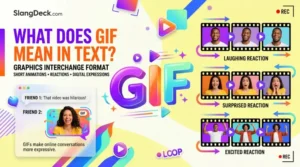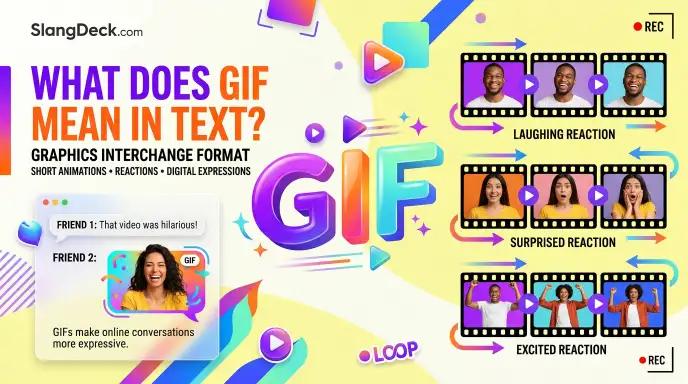
GIF stands for Graphics Interchange Format. In text messages, a GIF is usually a short animated image that people send to express emotions, reactions, jokes, or ideas without typing a long reply.
You may see GIFs in WhatsApp chats, Instagram comments, Snapchat conversations, TikTok posts, and regular SMS messages. People use them to make conversations more entertaining and show exactly how they feel.
For example, someone might send a laughing GIF instead of typing “That is so funny!” Another person may use a surprised GIF to react to unexpected news.
If someone asks you to send a GIF, they are usually asking for a short animated image that matches the conversation. Understanding this term can help you follow everyday online conversations more easily.
GIF Meaning in Text
GIF stands for Graphics Interchange Format. It is an image file format that can display simple animations. In everyday texting, people usually use the word GIF to describe a short moving image, often taken from a movie, TV show, cartoon, or online video.
Unlike a normal photograph, an animated GIF can show movement. It may contain a person laughing, someone dancing, a character waving, or a funny reaction.
For example:
A: I finally passed my driving test!
B: Send me a celebration GIF! 🎉
In this conversation, B wants an animated image that shows excitement or celebration.
Is GIF Slang, an Acronym, or an Abbreviation?
GIF is an acronym formed from the words Graphics Interchange Format. It is a technical term rather than traditional internet slang.
However, it has become a regular part of online communication. People use it as a common word in conversations.
You might see messages such as:
- “Send me a GIF.”
- “That GIF made me laugh.”
- “I can’t find the right GIF.”
- “This GIF explains my mood.”
In these examples, GIF refers to an animated image used to communicate a reaction or feeling.
What Does GIF Mean in Everyday Chat?
In everyday conversations, GIF usually means a short animated image that expresses something.
People often choose one that matches their reaction instead of writing a complete sentence.
For example:
A: I have so much homework tonight.
B: [A GIF of someone looking exhausted]
The animated image communicates that B understands the feeling or shares the same reaction.
A GIF can express many different emotions, including:
- Happiness and excitement
- Laughter and amusement
- Surprise and shock
- Sadness or disappointment
- Anger or frustration
- Love and affection
- Confusion or disbelief
- Celebration and congratulations
The image itself carries the message. The sender may not need to add any extra words.
What Is the Difference Between a GIF and a Regular Image?
A regular image is usually a still picture. It does not move.
An animated GIF contains multiple frames that play in sequence, creating a short animation. Many GIFs repeat automatically, so the movement continues in a loop.
For example, a picture of someone smiling is a regular image. A short animation of that person smiling and laughing can be a GIF.
Not every GIF is animated, though. The format can also store still images. In everyday messaging, people usually mean animated GIFs when they use the term.
How Do You Pronounce GIF?
GIF is commonly pronounced in two ways:
- “JIF” with a soft G sound.
- “GIF” with a hard G sound, like the beginning of “gift.”
Both pronunciations are widely used. The pronunciation has been debated for years, but people generally understand the word either way.
Where Do People Use GIFs?
GIFs are available on many social media platforms and messaging apps. People use them to react to messages, make jokes, share emotions, and add personality to conversations.
Here is how they are commonly used on different platforms.
1. GIF Meaning on TikTok
On TikTok, GIFs can appear in comments, posts, messages, and other forms of online interaction.
People use animated images to react to videos, express excitement, or make a funny comment.
For example:
A: Did you see that unexpected ending?
B: I need a GIF to explain my reaction!
A surprised or shocked GIF might be a perfect response.
TikTok users may also share GIF-style animations through stickers and other visual features. These help make reactions more expressive.
2. GIF Meaning on Snapchat
On Snapchat, people can use GIF stickers in Snaps, Stories, and messages.
These animations can make a picture or conversation more entertaining. Someone might add a dancing GIF to a celebration picture or a laughing animation to a funny Snap.
For example:
A: I finally finished my exams!
B: Congratulations! [Celebration GIF]
The GIF adds excitement without requiring a long message.
3. GIF Meaning on Instagram
Instagram users often add GIF stickers to Stories and use GIFs in supported messaging and sharing features.
They can be used to decorate photos, highlight emotions, or react to something funny.
For example:
A: I posted the vacation pictures.
B: They look amazing! [Heart GIF]
A GIF can make a simple comment feel more personal and expressive.
People also use GIFs in Instagram conversations to communicate reactions such as laughter, surprise, love, and excitement.
4. GIF Meaning on WhatsApp
WhatsApp is one of the common places where people share GIFs in private chats and group conversations.
Users can search for available GIFs and send one that matches the topic.
For example:
A: I accidentally sent that message to the wrong group.
B: [GIF of someone hiding their face]
The GIF communicates embarrassment or secondhand awkwardness.
WhatsApp conversations often move quickly, so a suitable GIF can sometimes express a reaction more naturally than several written sentences.
5. GIF Meaning in SMS Text Messages
GIFs can also be shared through regular text messaging when the phone and messaging service support them.
For example:
A: Happy birthday!
B: Thank you so much!
A: [Birthday celebration GIF]
Some SMS services may handle animated images differently. Depending on the phone, network, and messaging app, a GIF may appear as an animation, a still image, or a link.
The basic meaning remains the same: it is a visual response or animated image.
10 Real Chat Examples of GIF in Text
Here are ten realistic conversations showing how people use the word GIF and animated images in everyday messages.
1. Asking for a Funny GIF
A: I can’t stop laughing at that video.
B: Wait, I have the perfect GIF for this.
A: Send it 😂
Meaning: B wants to share an animated image that matches the funny situation.
2. Celebrating Good News
A: I got the job!
B: That’s amazing!
A: Send me a celebration GIF!
Meaning: The sender wants an animated image that expresses happiness and excitement.
3. Reacting to an Awkward Moment
A: I waved at someone who wasn’t waving at me.
B: That’s so embarrassing.
A: I need an awkward GIF right now.
Meaning: The sender wants a GIF that shows embarrassment or an uncomfortable reaction.
4. Sharing a Romantic Reaction
A: You looked really nice today.
B: Aww, thank you!
A: [GIF of a smiling character with hearts]
Meaning: The GIF adds a sweet and affectionate feeling to the conversation.
5. Showing Surprise
A: Guess who I saw at the mall?
B: Who?
A: Your favorite singer!
B: [GIF of someone looking shocked]
Meaning: The animated image expresses surprise and excitement.
6. Talking About a Movie
A: Have you watched that new movie?
B: Yes, the ending was unbelievable.
A: I know! That reaction GIF describes it perfectly.
Meaning: The sender is talking about an animated image that matches their reaction to the movie.
7. Expressing Tiredness
A: How was your day?
B: So exhausting.
A: [GIF of someone falling asleep]
Meaning: The GIF communicates tiredness without needing a detailed explanation.
8. Making a Group Chat Funny
A: Who forgot to bring the snacks?
B: Not me!
A: [GIF of someone running away]
Meaning: The GIF adds humor to the group conversation.
9. Asking Someone to Send a GIF
A: I don’t know how to react to this news.
B: Just send a GIF 😂
A: Good idea!
Meaning: B suggests using an animated image to express a reaction.
10. Finding the Right GIF
A: I searched for a birthday GIF, but none looks right.
B: Try searching for a funny birthday animation.
A: Found one! Sending it now.
Meaning: The conversation is about finding an animated image that fits a birthday message.
These examples show that GIFs can communicate many feelings. They are especially useful when a person wants to respond with humor, emotion, or a visual reaction.
How to Reply When Someone Says GIF
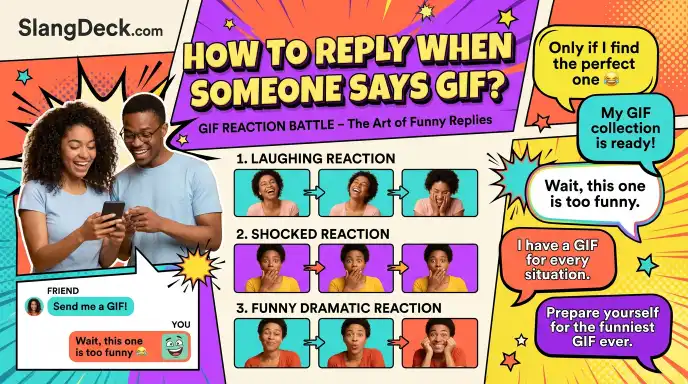
The right response depends on what the other person is asking.
If someone says “Send me a GIF,” they want you to share an animated image. If they send you a GIF, you can respond with words, another GIF, or an emoji.
Here are some natural replies.
Funny Replies
If the conversation is playful, try these:
- “Only if I find the perfect one 😂”
- “My GIF collection is ready!”
- “Wait, this one is too funny.”
- “I have a GIF for every situation.”
- “Prepare yourself for the funniest GIF ever.”
These replies keep the conversation lighthearted.
Casual Replies
For everyday conversations, you can say:
- “Sure, sending one now.”
- “Let me find one.”
- “Okay, give me a second.”
- “I know the perfect GIF.”
- “Here you go!”
These are simple responses that work with friends and family.
Friendly Replies
If someone sends you a GIF, you can respond warmly:
- “Haha, I love this!”
- “That is so cute.”
- “This made my day.”
- “Perfect reaction!”
- “I needed that laugh.”
You can also send another GIF to continue the conversation.
Neutral Replies
If you are not sure what the person means, try:
- “Do you mean an animated image?”
- “Which kind of GIF do you want?”
- “Can you send me an example?”
- “Are you asking me to share one?”
These responses help clear up confusion.
Is GIF Rude or Offensive?
No, GIF is not a rude or offensive term. It is the name of an image format used to share short animations and visual reactions.
Most GIFs are harmless and used for entertainment. However, the content of a particular GIF can be inappropriate, offensive, or disrespectful.
The important difference is between the word GIF and the actual animation someone chooses to send.
When Is a GIF Appropriate?
GIFs are generally appropriate when:
- You are sharing a funny reaction.
- You want to congratulate someone.
- You are expressing happiness or excitement.
- You are responding to a friendly message.
- You are sharing a harmless joke.
- You want to make a casual conversation more entertaining.
For example, sending a birthday celebration GIF to a friend is usually perfectly fine.
Can a GIF Be Offensive?
Yes. Although the format itself is harmless, an animation can contain offensive language, insulting gestures, inappropriate images, or content that makes someone uncomfortable.
A GIF may also be disrespectful if it is used to mock someone’s appearance, identity, feelings, or personal situation.
Think about the person receiving it before sending an animation.
Is GIF Appropriate at School?
GIFs are generally fine in casual conversations between students, especially when they are funny, educational, or friendly.
However, students should avoid sending inappropriate animations in school groups or using them to bully classmates.
Teachers may also use educational GIFs to explain movement, scientific processes, or other visual ideas.
Is GIF Appropriate at Work?
GIFs can be acceptable in informal workplace chats, especially when coworkers have a friendly communication style.
For example, a celebration GIF can be a fun way to congratulate a teammate after completing a project.
However, formal emails, professional reports, and serious conversations usually need clear written language. Avoid sending animations that could appear unprofessional or offensive.
Who Uses GIFs?
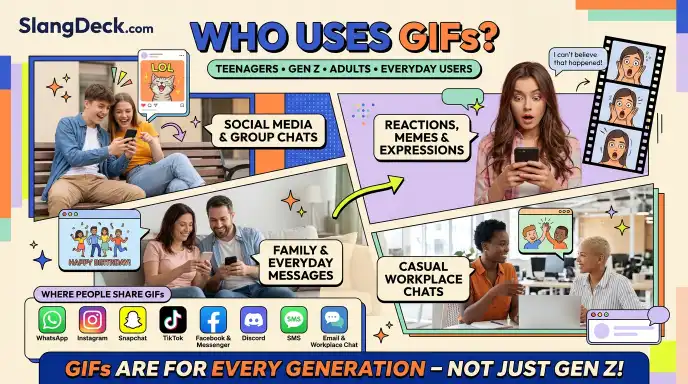
GIFs are used by people of different ages and backgrounds. They are not limited to a particular generation or social media platform.
Their popularity comes from the simple way they help people express emotions and reactions.
Age Groups
Teenagers, young adults, and older people all use GIFs.
Younger users may share them in social media comments, group chats, and private messages. Adults may use them to make workplace conversations or family chats more entertaining.
The format is flexible, so people can use it in many different situations.
Gen Z Usage
Gen Z users often communicate through a mix of text, emojis, stickers, memes, and GIFs.
A reaction GIF can be an easy way to respond to a joke, show excitement, or express disbelief.
For example, instead of typing “I can’t believe that happened,” someone might send a GIF showing a character looking completely shocked.
However, GIFs are not exclusive to Gen Z. People from many generations use them.
Common Platforms
You may encounter GIFs on:
- WhatsApp, in private and group chats.
- Instagram, in Stories and supported messaging features.
- Snapchat, through animated stickers and visual messages.
- TikTok, in comments and other visual content.
- Facebook, in posts, comments, and Messenger.
- Discord, in servers and direct messages.
- SMS, when the messaging service supports animated images.
- Email and workplace chat tools, for casual reactions.
How Often Are GIFs Used Online?
GIFs are a familiar part of online communication. They are used for reactions, entertainment, storytelling, and visual expression.
However, usage varies by platform, audience, and conversation. There is no single reliable number that describes how often every person uses GIFs.
Some people send them regularly, while others prefer ordinary text messages or emojis.
Origin of GIF
GIF stands for Graphics Interchange Format. It was developed in the 1980s as a digital image format that could store and display graphics efficiently.
The format later became popular on websites because it supported simple animations and was useful for sharing small visual files.
Who Created GIF?
The GIF format was introduced by CompuServe in 1987. It was developed as a way to share digital images across different computer systems.
An updated version, GIF89a, followed in 1989 and included support for animation and other features.
These developments helped GIF become an important part of early internet graphics.
How Did GIF Become Popular Online?
As websites and online communities grew, people started using GIFs for more than simple pictures.
Animated banners, moving decorations, funny images, and short visual loops became common on websites and forums.
Later, social media and messaging platforms made it easier to search for and share GIFs directly in conversations.
Today, people use them as quick reactions, much like emojis and stickers.
Why Do People Use GIFs Instead of Words?
Sometimes an image can express a feeling more clearly than a sentence.
For example, a GIF of someone laughing may communicate amusement immediately. An animation showing a person celebrating can express excitement without needing a long reply.
GIFs also add personality to conversations. They make messages feel more expressive, entertaining, and personal.
GIF vs. Emoji, Sticker, Meme, and Video
GIFs are often confused with emojis, stickers, memes, and short videos. Although they can serve similar purposes, they are not exactly the same.
| Term | Meaning | Type | Usage | Popularity |
| GIF | Graphics Interchange Format | Image file format | Animated reactions and short visuals | Very common online |
| Emoji | Small digital symbol or pictograph | Character or symbol | Expressing feelings and ideas | Very common |
| Sticker | Digital graphic or illustration | Image or animated graphic | Decorating messages and showing reactions | Very common |
| Meme | A humorous or relatable idea shared online | Image, video, text, or other media | Jokes and internet culture | Very common |
| Video | Recorded or generated moving images | Video file | Longer or more detailed visual content | Very common |
GIF vs. Emoji
An emoji is usually a small symbol, such as 😂, ❤️, or 👍.
A GIF is often a moving image showing a person, character, or scene.
For example:
- 😂 is an emoji.
- A short animation of someone laughing is a GIF.
Both can express happiness or amusement, but they do so in different ways.
GIF vs. Sticker
A sticker is a graphic that people add to messages. It may be a still picture or an animation.
Some animated stickers look very similar to GIFs. The main difference is how the platform creates, stores, and displays them.
In everyday conversation, people sometimes use the terms loosely.
GIF vs. Meme
A meme is a humorous or relatable piece of online content. It can be a picture, video, GIF, or text-based joke.
A GIF can become a meme when people reuse it to communicate a particular joke or reaction.
For example, an animation of someone dramatically falling off a chair might be shared whenever something surprising happens.
GIF vs. Video
A video can contain longer scenes, sound, and more detailed movement.
A typical reaction GIF is shorter and often repeats automatically. Many GIFs do not include sound.
This makes them useful for quick responses in chats.
Real-World Usage Example
Imagine you have just finished an important exam. You message your friend:
You: Finally, my exams are over!
Friend: That’s great! How are you feeling?
You: Like I can sleep for a week.
Friend: [GIF of someone celebrating and jumping around]
In this conversation, the friend uses a GIF to express excitement and share your happiness.
Now consider another situation at work:
Employee 1: We finished the project before the deadline.
Employee 2: Amazing work! [Celebration GIF]
Here, the animation is a fun way to congratulate the team.
In both situations, the GIF communicates a reaction without requiring a long written response.
Common Misunderstandings About GIF
Although GIF is a simple term, people sometimes misunderstand what it means or how it works.
1. Thinking GIF Is a Type of Slang
GIF is not originally slang. It is a technical name for an image format.
People use it in slang-related conversations because it has become part of everyday internet language.
2. Thinking Every GIF Is Animated
GIF files can contain still images as well as animations.
However, when someone asks for a GIF in a chat, they usually mean a short animated image.
3. Thinking GIF and Video Mean the Same Thing
Both can show movement, but they are different formats.
GIFs are often short, silent, and designed to repeat. Videos can be longer and may include sound.
4. Thinking GIFs Always Have a Hidden Meaning
A GIF usually communicates the reaction shown in the animation. It does not automatically contain a secret message.
For example, a laughing GIF generally shows amusement. It does not necessarily mean the sender is laughing at you.
5. Thinking GIF Is an Abbreviation for a Reaction
GIF stands for Graphics Interchange Format, not “Good Internet Feeling” or another invented phrase.
Its meaning comes from the actual name of the image format.
6. Confusing GIFs With Stickers
Some messaging apps display animated stickers and GIFs in similar ways.
Although they may look alike, they can be different types of digital content. The platform may also label them differently.
Key Takeaways
Here are the main points to remember:
- GIF stands for Graphics Interchange Format.
- In texting, it usually refers to a short animated image.
- People use GIFs to express emotions, reactions, jokes, and ideas.
- You can find them on WhatsApp, Instagram, Snapchat, TikTok, and other platforms.
- GIF is a technical acronym, not traditional internet slang.
- GIFs can be funny, romantic, friendly, or informative.
- The format is not offensive, but individual GIFs can contain inappropriate content.
- A GIF is different from an emoji, sticker, meme, and regular video.
Frequently Asked Questions
What does GIF mean in text messages?
GIF stands for Graphics Interchange Format. In text messages, it usually means a short animated image used to express feelings, reactions, jokes, or emotions.
What does GIF mean on TikTok?
On TikTok, GIF usually refers to an animated image or reaction animation. People use GIFs and GIF-style visuals to make content more expressive and entertaining.
Is GIF slang?
No. GIF is a technical acronym for Graphics Interchange Format. However, it has become a common part of internet communication.
Is GIF rude or offensive?
No, the term GIF is not rude or offensive. However, a particular GIF may contain inappropriate, insulting, or offensive content.
How should you reply to GIF?
You can respond with “Haha, that’s funny!”, “I love this GIF,” or send another GIF. If someone asks you to send one, choose an animation that matches the conversation.
Conclusion
GIF means Graphics Interchange Format. In everyday texting, it usually refers to a short animated image that people share to express emotions, reactions, jokes, and ideas.
You may see GIFs on TikTok, Snapchat, Instagram, WhatsApp, and regular messaging services. They make conversations more visual and entertaining, especially when a simple image can communicate a reaction better than words.
GIF is not a rude term or traditional slang. It is a technical acronym that has become a familiar part of online communication. Just remember to choose appropriate animations for the person and situation.
Read More Articles
- What Do Blue Hearts Mean in Text? 💙 Emotions & Examples
- What Do Black Hearts Mean in Text? 🖤 Meaning & Symbolism
- What Do Cherries Mean in Text? Decoding 🍒 Emoji in Bios & DMs

Hi, I’m Sarah. I studied Communications at the University of Texas and have spent the last six years writing about internet culture and Gen Z slang across TikTok, Twitter, and everyday conversations. I focus on real usage, not just dictionary definitions.