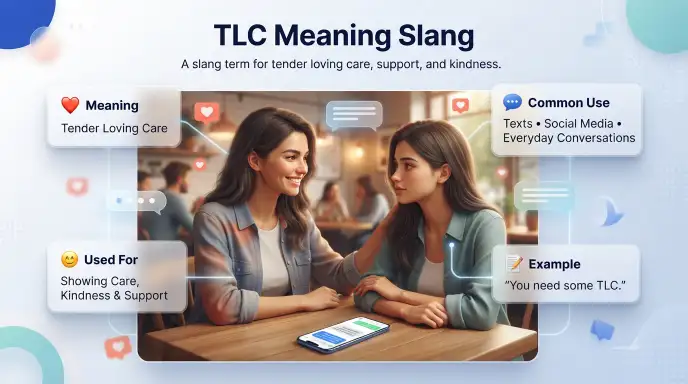
TLC meaning slang is “Tender Loving Care.” People use this phrase when someone or something needs extra love, kindness, patience, or attention.
You may see TLC in text messages, social media posts, or everyday conversations. It is one of the most positive abbreviations in English because it shows care instead of anger or disrespect.
Many people search for TLC meaning slang after reading a message like, “That old car needs some TLC” or “You deserve a little TLC.” The meaning changes slightly with the situation, but the main idea stays the same.
It always refers to giving extra care or support. Knowing this slang helps you understand conversations and use the phrase naturally.
Quick Answer: TLC Meaning Slang
TLC stands for Tender Loving Care. In slang, it means giving a person, pet, relationship, or object extra care, kindness, and attention.
What Does TLC Mean in Text?
When people use TLC in a text message, they usually mean someone or something needs extra care.
The phrase can describe:
- A person who feels tired
- A friend who needs support
- A relationship that needs attention
- A pet recovering from illness
- A car or house that needs repairs
The meaning is always positive.
Example:
Emma: I’ve been feeling stressed all week.
Lily: You need some TLC this weekend.
Here, TLC means Emma should rest and take care of herself.
Another example:
Dad: This old bike still works.
Son: It just needs a little TLC.
In this sentence, TLC means repairing and looking after the bike.
Full Form or Definition of TLC
TLC stands for Tender Loving Care.
It describes giving someone or something:
- Kindness
- Love
- Patience
- Attention
- Gentle care
People use this phrase in many situations. It can describe caring for a person, an animal, a home, a vehicle, or even a friendship.
| Abbreviation | Full Form | Meaning |
| TLC | Tender Loving Care | Extra care and attention |
TLC Full Form in Slang and Everyday Conversations
If you are searching for tlc full form slang, TLC stands for Tender Loving Care. The abbreviation is used when someone wants to describe extra kindness, attention, patience, or support.
The meaning of tender loving care stays the same even when the situation changes. For example, a person may need extra TLC after a stressful week, while an old car may need TLC because it needs repairs or maintenance.
You may also see the phrase tlc full form in love when people talk about caring for a partner or showing affection in a relationship. In this context, TLC can include emotional support, patience, kindness, and spending quality time together.
Another simple way to understand it is:
TLC = Tender Loving Care = Extra care, kindness, and attention.
The exact situation tells you who or what is receiving that care.
Is TLC Rude, Offensive, or Neutral?
TLC is a positive expression.
It is not rude or offensive.
People use it in both casual and professional conversations.
| Situation | Can You Use TLC? |
| Text messages | ✅ Yes |
| Social media | ✅ Yes |
| Family chats | ✅ Yes |
| Workplace | ✅ Yes |
| School | ✅ Yes |
| Professional emails | ✅ Yes |
Because the phrase is respectful, it is suitable for almost every audience.
Where Is TLC Commonly Used?
You can see TLC in many places.
It is common on:
- TikTok
- Snapchat
- Text messages
- Lifestyle blogs
- Pet care websites
- Home improvement articles
People also use it in face to face conversations.
Real Life Examples of TLC
1. Text Message
Ava: I haven’t had a day off in weeks.
Mia: You need some TLC.
2. Family Conversation
Dad: The garden looks dry.
Mom: It needs a little TLC.
3. Pet Care
Owner: My puppy isn’t feeling well.
Friend: Give him plenty of TLC.
4. Home Improvement
Neighbor: Your old house looks great now.
Owner: It just needed some TLC.
5. Social Media Caption
“Today is all about self care and a little TLC.”
These examples show that TLC can describe caring for people, animals, relationships, homes, cars, and many other things that need extra attention.
Origin and Background of TLC

The phrase Tender Loving Care has been part of English for many years. People first used the full phrase in everyday speech. Later, they shortened it to TLC because it was easier to write and say.
Today, TLC is common in text messages, social media posts, books, magazines, and daily conversations. Many people understand the abbreviation without seeing the full phrase.
Some people also know TLC as the name of a TV channel or a music group. In everyday conversations, however, TLC usually means Tender Loving Care.
Different Ways People Use TLC
People use TLC in many situations. The meaning stays the same. Only the subject changes.
1. For People
Someone may need TLC after a busy week, an illness, or a difficult day.
Example:
“You’ve worked hard all week. You deserve some TLC.”
2. For Relationships
Friends or couples may say a relationship needs TLC when it needs more time and attention.
Example:
“Their friendship needs a little TLC.”
3. For Pets
Pet owners often use TLC when an animal is sick or recovering.
Example:
“The kitten is getting lots of TLC.”
4. For Homes and Cars
People also use TLC for things that need repairs or maintenance.
Example:
“This old car still runs. It just needs some TLC.”
What Is TLC in a Relationship?
If you are wondering what is tlc in a relationship, it means giving a partner or relationship extra care, attention, patience, and emotional support.
TLC in a relationship can be as simple as listening to your partner, spending quality time together, showing appreciation, or being supportive during a difficult period.
For example:
“We have both been busy lately, so our relationship needs some TLC.”
Here, TLC means the relationship needs more time, care, and attention.
People may also use TLC when talking about friendship. A friendship can need extra TLC when friends have been distant or have not had enough time to connect.
The phrase tlc full form in love has the same basic meaning. It refers to showing care and affection rather than describing a separate type of slang.
What Does TLC Mean in a Relationship?
If someone asks what does tlc mean in a relationship, the answer is usually Tender Loving Care. It can describe small actions that make another person feel valued and supported.
For example:
- Listening when someone needs to talk
- Spending time together
- Showing appreciation
- Offering emotional support
- Being patient during difficult moments
This use of TLC is warm and positive, which is why the abbreviation often appears in messages about relationships and personal care.
Comparison with Similar Expressions
Some expressions have a similar meaning to TLC, but they are not exactly the same.
| Expression | Meaning | Common Use |
| TLC | Tender Loving Care | People, pets, homes, cars |
| Self care | Looking after yourself | Health and wellness |
| Care | General attention | Everyday situations |
| Support | Helping someone | Emotional support |
| Kindness | Being nice to others | Daily conversations |
TLC is more personal because it combines care, patience, and affection.
Why People Use TLC
People use TLC because it is short and easy to remember.
It also sounds warm and friendly.
Common reasons include:
- Showing kindness
- Offering support
- Talking about self care
- Describing repairs
- Caring for pets
- Encouraging someone
The phrase works well in both speech and writing.
Impact of Using TLC in Communication
TLC makes conversations feel more caring.
It shows concern without using many words.
Some benefits include:
- Creates a positive tone
- Shows empathy
- Builds stronger relationships
- Makes messages sound supportive
- Encourages kindness
Because of its simple meaning, people of different ages understand it easily.
Is TLC Safe for Social Media?
Yes. TLC is safe for every major social media platform.
People use it on:
- TikTok
- Snapchat
- X (formerly Twitter)
Example posts:
“My plants finally got the TLC they needed.”
“Everyone deserves a little TLC after a busy week.”
“Our rescue dog is getting lots of TLC.”
The abbreviation has a positive meaning, so it is suitable for public posts.
More Real Life Examples
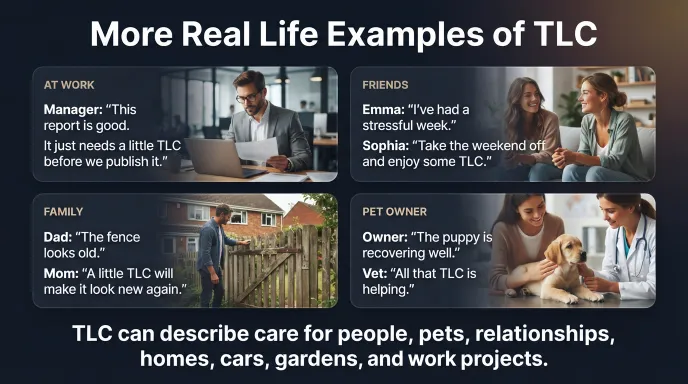
1. At Work
Manager: This report is good. It just needs a little TLC before we publish it.
2. Friends
Emma: I’ve had a stressful week.
Sophia: Take the weekend off and enjoy some TLC.
3. Family
Dad: The fence looks old.
Mom: A little TLC will make it look new again.
4. Pet Owner
Owner: The puppy is recovering well.
Vet: All that TLC is helping.
These examples show that TLC is useful in many situations. It can describe caring for people, pets, relationships, homes, cars, gardens, and even work projects.
When Should You Avoid Using TLC?
You can use TLC in most situations. Still, there are times when the full phrase is a better choice.
Avoid using only TLC when:
- Writing academic papers
- Creating legal documents
- Preparing official reports
- Speaking to people who may not know the abbreviation
- Writing for an international audience
In these cases, writing Tender Loving Care makes your message clearer.
TLC Slang Meaning in Different Contexts
The phrase tlc slang meaning is usually connected to Tender Loving Care, but people may understand the abbreviation differently when they see it outside a normal conversation.
For example, someone searching what is a tlc may be asking about the abbreviation itself, while another person may see TLC in a relationship, social media post, or message about an object that needs attention.
You may also find tlc abbreviation used in dictionaries, online slang references, or general language discussions. The surrounding words help show what the writer means.
Some people also search for tlc urban dictionary when they want to compare online slang definitions. However, slang websites may contain user-submitted meanings, so the context and common usage are important when understanding an abbreviation.
In everyday English, the most common meaning discussed in this article is Tender Loving Care.
The phrase extra tlc simply means giving something more care or attention than usual.
For example:
“This old garden needs some extra TLC.”
Here, extra TLC means additional care and attention.
Polite Alternatives to TLC
You can also use these expressions instead of TLC.
| TLC | Alternative |
| TLC | Tender Loving Care |
| TLC | Extra care |
| TLC | Loving attention |
| TLC | Gentle care |
| TLC | Special care |
| TLC | Care and support |
| TLC | Kindness |
| TLC | Compassion |
These alternatives work well in both formal and informal writing.
Why People Use TLC
People use TLC because it is short and easy to understand.
It also adds a warm and caring tone to a conversation.
Common reasons include:
- Showing love and kindness
- Offering emotional support
- Talking about self care
- Describing repairs
- Caring for pets
- Encouraging someone
The phrase has stayed popular because it works in many different situations.
Common Misunderstandings About TLC Meaning Slang
Some people misunderstand the meaning of TLC. Here are a few common examples.
1. TLC is only used for people.
No. People also use TLC for pets, homes, cars, gardens, furniture, and relationships.
2. TLC is only internet slang.
No. Tender Loving Care was already a common English phrase before texting and social media became popular.
3. TLC always means the TV channel or music group.
No. Those are different meanings. In everyday conversations, TLC usually means Tender Loving Care.
4. TLC is too informal for work.
Not always. Many workplaces use TLC when talking about projects, equipment, products, or customer service that need extra attention.
Frequently Asked Questions
Q1. What does TLC mean in slang?
TLC stands for Tender Loving Care. It means giving someone or something extra care, kindness, patience, and attention.
Q2. What does TLC mean in texting?
In text messages, TLC usually means someone needs extra love, support, rest, or care.
Q3. Is TLC a positive expression?
Yes. TLC has a positive meaning and is used to show kindness and compassion.
Q4. Can TLC be used for objects?
Yes. People often say a house, car, garden, or piece of furniture needs TLC when it needs repairs or maintenance.
Q5. Is TLC safe to use on social media?
Yes. TLC is family friendly and commonly used on Instagram, TikTok, Facebook, Reddit, and other social media platforms.
Q6. Is TLC appropriate at work?
Yes. Many professionals use TLC when describing projects, equipment, or services that need extra care or improvement.
Q7. What is the difference between TLC and self care?
Self care focuses on looking after yourself. TLC can mean caring for yourself, another person, a pet, or even an object.
Q8. Why do people say something needs TLC?
They mean it needs more care, attention, maintenance, or affection to improve its condition.
Q9. Is TLC modern slang?
No. Tender Loving Care has been used for many years. The abbreviation TLC became more popular with texting and social media.
Q10. What are some alternatives to TLC?
You can use extra care, loving attention, gentle care, care and support, kindness, or compassion instead of TLC.
Conclusion
Understanding the TLC meaning slang is simple because it has a positive and caring message. TLC stands for Tender Loving Care. It describes giving someone or something extra love, patience, and attention.
People use TLC in text messages, social media posts, and everyday conversations. The phrase can describe people, pets, relationships, homes, cars, and many other things that need care.
Since it is polite and easy to understand, TLC is one of the most useful and widely accepted slang terms in English.
Trending Slang Terms Right Now

Hi, I’m Sarah. I studied Communications at the University of Texas and have spent the last six years writing about internet culture and Gen Z slang across TikTok, Twitter, and everyday conversations. I focus on real usage, not just dictionary definitions.