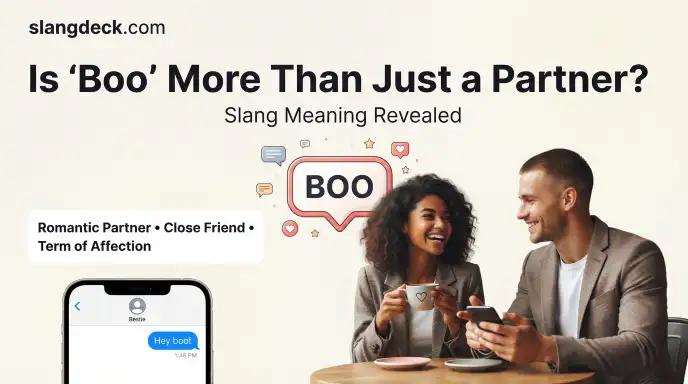
Boo slang usually means a person you love, like, or feel close to, such as a boyfriend, girlfriend, spouse, or romantic interest. It is commonly used as a sweet nickname in texting and casual conversation.
You may see “boo” in text messages, TikTok, Instagram, Snapchat, Reddit, Discord, and everyday conversations. Depending on the relationship and tone, someone can call their partner, crush, close friend, or even a family member “boo.”
For example, if someone texts, “I’m going out with my boo tonight,” they usually mean they are spending time with their boyfriend, girlfriend, or romantic partner.
Quick Answer:
In slang, “boo” is an affectionate nickname for someone you care about, especially a romantic partner or crush. Its exact meaning can change slightly depending on the relationship and context.
What Does Boo Mean in Text?
In texting, “boo” is usually a term of affection for someone you love or feel emotionally close to.
The word often works like other pet names, such as “babe,” “baby,” “honey,” or “love.” It can sound sweet, playful, romantic, or friendly.
For example:
“Good morning, boo ”
In this context, “boo” is a warm and affectionate way to address someone.
The relationship between the two people is important. A person calling someone “boo” may be referring to a serious partner, a new romantic interest, or simply someone they feel close to.
What Does Boo Stand For?
Unlike abbreviations such as LOL or BRB, “boo” does not usually stand for a longer phrase.
It is a slang word and nickname, not an acronym.
So, if you are searching for the boo full form, there is generally no official full form to remember.
Its meaning comes from how people use it in conversation, particularly as an affectionate name for another person.
For example:
“My boo is coming over later.”
Here, “boo” simply means my romantic partner or someone I care about.
Boo Meaning Slang: Romantic Partner or Crush
The most common slang meaning of boo is a boyfriend, girlfriend, partner, or someone with whom a person has a romantic connection.
However, the relationship does not always have to be serious.
Someone might say:
“I think he might be my new boo.”
This could mean they are dating, talking romantically, or developing feelings for the person.
Similarly:
“She posted a picture with her boo.”
This usually suggests that the person in the photo is her romantic partner.
The exact level of commitment is not always clear from the word alone.
Can Boo Mean a Crush?
Yes, “boo” can sometimes refer to a crush or someone a person is romantically interested in.
For example:
“I’m meeting my boo after class.”
Depending on the situation, this could mean a boyfriend or girlfriend.
In another conversation, someone might say:
“My boo finally replied to my message.”
This may refer to someone they like, even if they are not officially in a relationship.
The surrounding conversation usually tells you if boo means a partner, crush, or someone casually being called an affectionate name.
Is Boo Romantic or Friendly?
“Boo” can be romantic, but it can also be friendly.
Among couples, the word usually has a romantic meaning.
Among close friends, however, someone might jokingly say:
“Hey, boo! How have you been?”
In this case, there may be no romantic meaning at all.
Some people also use “boo” as a general affectionate nickname, especially in playful or warm conversations.
This is why you should not automatically assume that two people are dating just because one calls the other “boo.”
Is Boo Rude, Offensive, or Neutral?
“Boo” is generally positive, affectionate, and harmless. It is not usually considered rude or offensive.
However, it may feel too personal or overly familiar when used with someone you do not know well.
For example, calling a close friend “boo” may feel natural.
Calling a stranger “boo” could make some people uncomfortable, depending on the situation and tone.
The safest approach is to consider your relationship with the person and the setting.
Where Is Boo Commonly Used?
Boo is widely used in casual communication, especially when people want to sound affectionate or playful.
You may see it in:
- Text messages
- Instagram captions
- TikTok comments
- Snapchat messages
- Discord chats
- Social media posts
- Casual conversations
- Relationship related content
It is especially common in messages between couples and close friends.
For example:
“Miss you, boo ”
The heart emoji makes the affectionate tone even clearer.
Boo Meaning on TikTok and Social Media
On social media, “boo” often refers to a romantic partner, crush, or someone the user finds attractive or lovable.
A person might post:
“Date night with my boo ”
Here, “boo” almost certainly means their romantic partner.
Another person might comment:
“Okay boo, you look amazing!”
In this case, the word may simply be a friendly and supportive form of address.
Social media language is flexible, so the relationship and overall tone matter more than the word by itself.
Boo Meaning on Snapchat and in Texting
In private messages, “boo” can sound more personal because it is often used directly to address someone.
Examples include:
“Goodnight, boo ”
“Where are you, boo?”
“I miss my boo.”
These messages can sound romantic, but close friends may also use similar language jokingly.
Emojis, previous messages, and the relationship between the speakers can help explain the intended meaning.
Real Life Examples of Boo Slang
The meaning of “boo” becomes easier to understand when you see it used in different situations.
Friendly Example
“Hey boo! I haven’t seen you in forever.”
Here, “boo” is a warm and friendly nickname.
Romantic Example
“I’m going on vacation with my boo.”
In this sentence, “boo” most likely means a boyfriend, girlfriend, or partner.
Casual Example
“That’s my boo right there!”
The speaker may be referring affectionately to a close friend or partner.
Flirty Example
“You looking good today, boo 👀.”
This can sound flirtatious, especially if there is already romantic interest between the two people.
Social Media Example
“My boo surprised me with flowers 🥹.”
The context strongly suggests that “boo” means a romantic partner.
Playful Example
“Okay, boo, calm down .”
Here, the word can simply make the message sound more playful.
Why Do People Call Someone Boo?
People use “boo” because it creates a feeling of warmth and closeness.
Using someone’s name can sometimes feel neutral, while a nickname can make a conversation feel more personal.
“Boo” may communicate:
- Affection
- Love
- Friendship
- Romantic interest
- Playfulness
- Emotional closeness
The meaning can also change based on how the word is spoken or written.
For example, “Thanks, boo!” sounds different from “I miss you, boo .”
The first may be friendly, while the second is more likely to be romantic.
Where Did Boo Slang Come From?
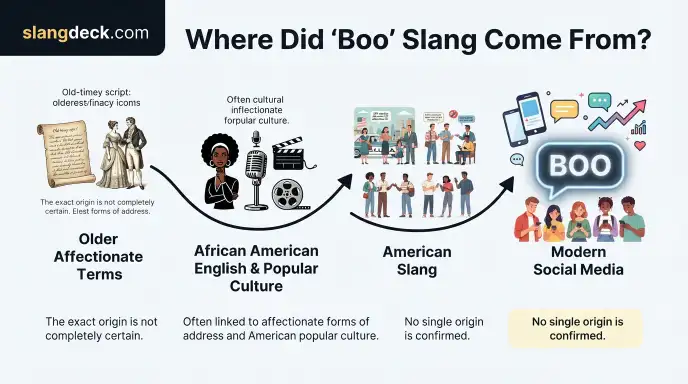
The exact history of “boo” as an affectionate nickname is not completely simple, and different explanations have been suggested.
It is often associated with the development of African American English and African American popular culture, where affectionate forms of address have played an important role in everyday speech and later influenced wider American slang.
Some explanations connect “boo” with older affectionate words such as “beau,” while others describe its development through spoken forms and cultural usage.
Because slang often develops through speech before being widely recorded, it is safer not to treat one explanation as the only certain origin.
What is clear is that “boo” became widely recognized in American popular culture as an affectionate term for a loved one or romantic partner.
Boo vs. Babe vs. Bae
These affectionate terms have similar meanings, but their tone and usage can differ.
| Term | Common Meaning | Typical Tone |
| Boo | Partner, crush, or loved one | Sweet and casual |
| Babe | Romantic partner or attractive person | Romantic and common |
| Baby | Loved one or romantic partner | Very affectionate |
| Bae | Partner or someone special | Casual and internet friendly |
| Honey | Loved one or person addressed warmly | Sweet and traditional |
“Boo” often feels more playful and casual than some of these alternatives.
The best choice depends on your relationship and the style of conversation.
When Should You Avoid Calling Someone Boo?
Although “boo” is generally harmless, it is not appropriate for every situation.
You may want to avoid it when speaking to:
- A stranger
- A professional contact
- A teacher or supervisor
- A customer
- Someone who has not shown that they are comfortable with informal nicknames
For example, writing “Hello, boo” in a professional email could sound inappropriate.
A person’s comfort level is also important. Not everyone enjoys pet names, even from people they know.
Polite Alternatives to Boo
If “boo” feels too casual or personal, you can choose another word based on your relationship.
For a romantic partner, you could use:
- Babe
- Love
- Honey
- Sweetheart
- Dear
For a friend, you might simply use:
- Bestie
- Friend
- Girl
- Bro
- Buddy
In professional situations, using the person’s actual name is usually the safest option.
What Is the Difference Between My Boo and Boo?
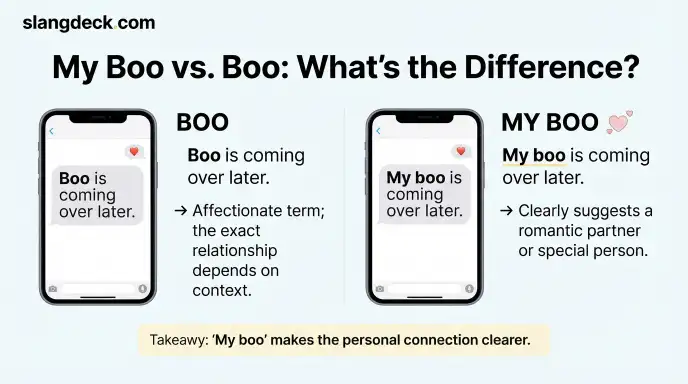
Both expressions are affectionate, but “my boo” usually makes the sense of closeness or possession clearer.
For example:
“Boo is coming over later.”
This could mean someone is being addressed directly, or the context may explain who “boo” is.
However:
“My boo is coming over later.”
This clearly refers to someone the speaker considers a romantic partner or special person.
The word “my” often makes the relationship sound more personal.
Can You Call a Friend Boo?
Yes, you can call a close friend “boo,” especially in a playful or affectionate friendship.
For example:
“Happy birthday, boo! Hope you have the best day.”
This does not automatically mean the two people are dating.
However, the word can still sound romantic in some situations. If the relationship is unclear, a reader may interpret it differently.
This is why context and shared communication style matter.
Why People Use Slang Like Boo in Communication
Slang terms such as “boo” can make messages feel more personal, relaxed, and emotionally expressive.
A short nickname may communicate warmth without requiring a long explanation.
For example:
“Thank you.”
sounds polite and neutral.
“Thank you, boo!”
can sound more affectionate and playful.
However, slang can also create confusion when people have different cultural backgrounds, ages, or expectations.
Using the right word for the audience helps communication feel natural rather than forced.
Impact of Using Boo in Communication
Using “boo” can strengthen the emotional tone of a message.
It may make someone feel:
- Appreciated
- Loved
- Included
- Comfortable
- Close to the speaker
At the same time, using an affectionate nickname with the wrong person can feel awkward.
For this reason, relationship boundaries are important.
A nickname that feels sweet between partners may feel inappropriate in a professional or unfamiliar relationship.
Is Boo Safe for Social Media?
Yes, “boo” is generally safe for social media. It is a common affectionate slang term and does not normally contain profanity or offensive language.
People often use it in captions, comments, and messages.
Examples include:
“Weekend with my boo .”
“You did amazing, boo!”
However, public posts can sometimes create confusion about relationships. If you call someone “my boo” online, other people may assume that you are romantically involved.
If that matters, choose your wording carefully.
Does Boo Have Other Meanings?
Yes. Context is important because “boo” can have meanings outside romantic slang.
For example, “boo!” is the sound people traditionally make when trying to scare someone.
A crowd can also boo to show disapproval or dislike.
However, when someone writes:
“Good morning, boo ”
the affectionate slang meaning is clearly intended.
Looking at the full sentence makes it easy to identify which meaning applies.
FAQs About Boo Slang
What does boo mean in slang?
Boo usually means someone you love, like, or feel close to. It often refers to a boyfriend, girlfriend, partner, or romantic interest.
Is boo a boyfriend or girlfriend?
It can mean either. “Boo” is gender neutral and can refer to a boyfriend, girlfriend, spouse, partner, or sometimes a crush.
Can boo mean a friend?
Yes. Some people use “boo” as a friendly and affectionate nickname for close friends.
Is boo romantic?
It can be romantic, but not always. The relationship and tone of the conversation determine if it means a partner, crush, or close friend.
What does my boo mean?
“My boo” usually refers to a person the speaker feels especially close to, often a romantic partner or love interest.
Is boo safe to use on social media?
Yes, generally. “Boo” is a common and harmless affectionate term, although the context may make people assume a romantic relationship.
Conclusion
Boo slang usually means a person you love, like, or feel emotionally close to. It is commonly used as an affectionate nickname for a boyfriend, girlfriend, partner, crush, or sometimes a close friend.
The meaning depends heavily on context and tone. A message such as “Good morning, boo ” may sound romantic, while “Hey boo, how are you?” can simply sound friendly and playful.
“Boo” is generally positive, harmless, and safe for casual communication and social media. Still, it may feel too personal in formal settings or when used with someone you do not know well.
The best way to understand or use the term is to consider the relationship between the people, the tone of the conversation, and the surrounding words.
Read More
- D1 Slang Meaning in 2026: What Does D1 Mean in Text & TikTok?
- “Tough” Slang Meaning in 2026: Texting, TikTok & Social Media
- Corny Meaning in Slang: Definition, Uses & Examples

Hey, I’m Jordan. I grew up in a bilingual household in LA, so Spanish and Mexican American slang has always been part of how I talk. I’ve been writing online content for five years, explaining terms the way I’d explain them to a friend meaning, tone, and when it’s actually okay to use.