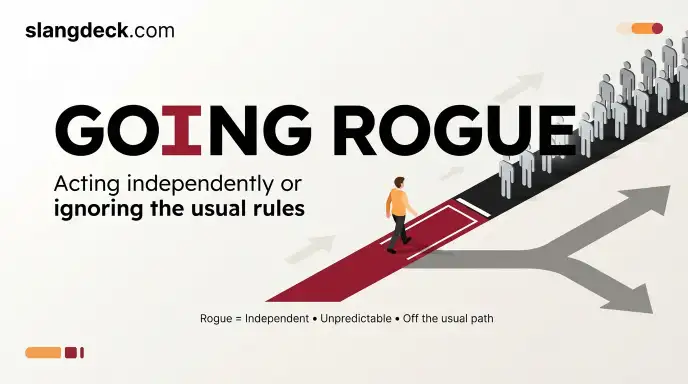
The rogue meaning in slang isn’t complicated, but it does shift a little depending on where you see it.At its core, “rogue” is about independence, someone doing their own thing instead of sticking to the plan.
If you’ve seen someone described as “going rogue” in a group chat, a video game, or a news headline, you might be wondering what it actually means.
In this guide, you’ll learn exactly what rogue means as slang, how it’s used differently across gaming, texting, and everyday conversation, where the word actually comes from, and when it’s fine (or not fine) to use it yourself.
Quick Answer
In slang, “rogue” describes someone who breaks away from a group, ignores the usual rules, or acts independently and unpredictably. The phrase “going rogue” means choosing to act on your own instead of following orders, plans, or expectations. It’s often used playfully, though it can also describe genuinely risky behavior.
What Does “Rogue” Mean in Slang?
As slang, “rogue” is usually used in one of two ways:
- As an adjective describing a person, action, or thing that’s unpredictable, independent, or acting outside normal rules (“a rogue employee,” “a rogue wave”).
- As part of the phrase “go rogue” meaning to suddenly stop following a group, a plan, or instructions and start acting on your own terms.
The tone can range from lighthearted (“she went rogue and ordered pizza instead of salad”) to serious (“a rogue agent leaked the files”). Context is everything.
Different Meanings of “Rogue”
“Rogue” isn’t a single definition word, so it helps to separate its meanings out clearly.
1. Rogue as “Acting independently or unpredictably”
This is the most common slang use today. It describes someone who stops following a group’s plan, a boss’s orders, or the expected script, and does their own thing instead.
- Context: Casual conversation, workplace talk, social media.
- Tone: Can be playful, admiring, or critical depending on the situation.
- Example: “The intern went rogue and pitched her own idea in the meeting.”
- Popularity: Very common; one of the most widely used senses of the word.
2. Rogue as a Gaming Character Class
In many role playing games (like Dungeons & Dragons, World of Warcraft, and other RPGs), a “Rogue” is a specific character class typically a stealthy, agile character who relies on sneak attacks, lockpicking, and speed rather than brute strength.
- Context: Gaming communities, Discord servers, tabletop games.
- Tone: Neutral and technical it’s a game term, not an insult.
- Example: “I’m building a rogue this campaign so I can sneak past the guards.”
- Popularity: Extremely common inside gaming spaces; less known outside them.
3. Rogue as “Untrustworthy or Dangerous”
In news, politics, and formal writing, “rogue” often describes something or someone acting outside legal or ethical boundaries: a “rogue state,” a “rogue trader,” a “rogue employee.”
- Context: News headlines, formal or professional writing.
- Tone: Serious, sometimes alarming.
- Example: “The company fired the rogue employee who mishandled client funds.”
- Popularity: Common in journalism; less common in everyday texting.
4. Rogue as an Old Fashioned Word for “Mischievous Person”
Historically, “rogue” simply meant a dishonest wanderer or a charming troublemaker, think of a “lovable rogue” character in old novels and films.
- Context: Classic literature, older films, character descriptions.
- Tone: Affectionate, a little old fashioned.
- Example: “He’s a bit of a rogue, but everyone likes him.”
- Popularity: Rare in modern slang, but it’s the original root of all the other meanings.
Where Is “Rogue” Commonly Used?
| Platform | How “Rogue” Is Used |
| Texting | Usually “go rogue” is someone changing plans suddenly. |
| TikTok / Instagram | Captions about doing something unexpected or breaking a routine (“went rogue with my hair today”). |
| Discord / Gaming | Refers to the Rogue character class, or a teammate ignoring the team’s strategy. |
| Both the independence meaning and gaming meaning show up depending on the subreddit. | |
| Workplace chat | Usually means someone acting without approval can be a mild joke or a real concern. |
| News/formal writing | The more serious “acting outside rules” meaning (“rogue nation,” “rogue employee”). |
Is “Rogue” Rude, Offensive, or Harmless?
“Rogue” itself is not offensive. It’s not a slur, an insult, or inappropriate language. Most of the time, calling someone “rogue” is neutral or even a little complimentary; it can suggest boldness or independence.
That said, context still matters:
- Calling a coworker “rogue” after they skipped a process could sound like light teasing or a real criticism, depending on tone.
- In serious contexts (security, finance, government), “rogue” can describe genuinely harmful behavior, so it’s worth reading the room before using it lightly.
There’s no age restriction or safety concern tied to this word; it’s fine for kids, teens, and adults alike.
Real Life Examples
Text message between friends:
“Where are you?? We said 6pm.” “Went rogue, decided to grab tacos instead”
Gaming (Discord):
“Don’t push forward alone!” “Too late, I’m going rogue”
TikTok caption:
“Skipped the gym and went rogue with a nap instead.”
Workplace Slack:
“Heads up, marketing went rogue on the campaign copy and didn’t run it legally first.”
School group project:
“Sam went rogue and redid the whole slide deck without telling us.”
Each example uses the same core idea breaking away from the plan but the seriousness shifts with the setting.
Origin and History
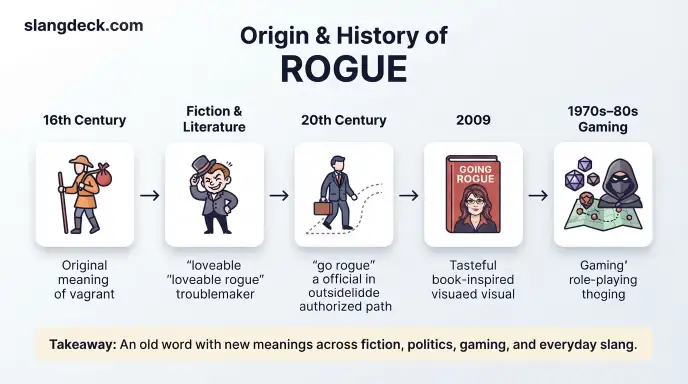
The word “rogue” is centuries old, dating back to 16th century English, where it originally referred to a vagrant or a dishonest wanderer, someone without a fixed home or trade who lived by their wits.
Over time, it softened in fiction into the “charming troublemaker” archetype (a “loveable rogue”).
The modern slang phrase “go rogue” is more recent. Its widespread use is often linked to political and military contexts from the 20th century, where a “rogue agent” or “rogue state” meant someone or something acting outside authorized control.
Sarah Palin’s memoir Going Rogue (2009) is frequently cited as a moment that pushed the phrase further into everyday pop culture usage in the U.S.
The gaming class meaning developed separately, growing out of tabletop role playing games in the 1970s–80s, where “rogue” (and its older cousin “thief”) became a standard character archetype.
Because these meanings developed through different paths, it’s inaccurate to credit “rogue” to any single generation or online community; it’s a genuinely old word that picked up new life in gaming, politics, and everyday internet slang at different points.
Similar Slang or Related Terms
- Off script: acting outside the expected plan, similar to “going rogue” but usually without the independence undertone.
- Wildcard: an unpredictable person, closer to the “chaotic” side of rogue.
- Lone wolf: is someone who prefers to work or act alone, close to the independence meaning.
- Freelancing it: is an informal way of saying you’re improvising instead of following instructions.
When Should You Avoid Using “Rogue”?
- In formal writing about real misconduct: If you’re describing something serious (fraud, security breaches, legal violations), make sure “rogue” doesn’t understate the seriousness of what happened.
- When precision matters, “rogue” is vague. If you need to explain exactly what someone did wrong, spell it out instead of relying on the label.
- In gaming contexts, avoid confusing the class name with the slang meaning telling a teammate “don’t go rogue” during a Rogue class game session could genuinely confuse someone.
Otherwise, “rogue” is safe to use casually in texting, gaming chat, and everyday conversation.
Why Do People Use “Rogue”?
People reach for “rogue” because it captures a specific feeling in one word: doing something unplanned, independent, or a little bit bold. It’s shorter and punchier than saying “I decided to do something different from what we agreed on,” and it carries a hint of playful rebellion that makes casual writing feel more expressive.
Common Misunderstandings
- “Rogue always means something bad.” Not true, it’s often neutral or even admiring.
- “Rogue is new internet slang.” Not true the word is centuries old; only some of its uses are recent.
- “Rogue and ‘rouge’ are the same word.” No “rouge” is a shade of red or a type of makeup. They’re pronounced differently and unrelated.
- “Rogue is a gaming only term.” It has a much wider everyday meaning outside of games too.
Frequently Asked Questions
What does “rogue” mean in texting?
It usually means someone did something unplanned or acted independently, as in “going rogue.”
Is “rogue” offensive?
No. It’s a neutral or mildly playful word, not a slur or insult.
Can I use “rogue” at work?
Yes, casually. Just be careful using it to describe genuinely serious misconduct, where more precise language may be needed.
What does “rogue” mean in gaming?
It’s usually a character class, a stealthy, fast character who relies on sneak attacks rather than brute strength.
Where does “going rogue” come from?
It comes from military and political language describing someone acting outside authorized control, later popularized further by pop culture in the 2000s.
Is “rogue” the same as “rouge”?
No “rouge” refers to a red color or blush makeup. “Rogue” refers to independent or unpredictable behavior (or a game character class).
Conclusion
The rogue meaning in slang comes down to one idea: breaking away and doing your own thing, if that’s skipping the plan with friends, playing a stealthy class in a game, or acting without approval at work.
It’s rarely offensive and usually just means “unexpected” or “independent” though in serious contexts, it can describe genuinely risky behavior.
Knowing which meaning fits the situation is really the only skill you need to use “rogue” correctly.
Continue Reading

Hey, I’m Jordan. I grew up in a bilingual household in LA, so Spanish and Mexican American slang has always been part of how I talk. I’ve been writing online content for five years, explaining terms the way I’d explain them to a friend meaning, tone, and when it’s actually okay to use.