People frequently search for wey mexican slang meaning in text because the term seems to change its meaning depending on who says it and how it is delivered.
Sometimes it sounds like a warm, friendly greeting between best friends. Other times, it comes off as a mild insult, a sharp complaint, or a filler word used every three sentences.
If you have ever scrolled through TikTok comments, joined a gaming lobby, or texted a Spanish speaking friend, you have almost certainly seen the word wey (or güey). It pops up everywhere: “¿Qué onda, wey?“, “No mames, wey!”, or simply “Oye, wey.“
If you are learning modern Mexican Spanish, analyzing digital subcultures, or deciphering a confusing direct message, this comprehensive guide breaks down the true meaning of wey, its phonetic origins, real world examples, and proper social etiquette.
Quick Answer
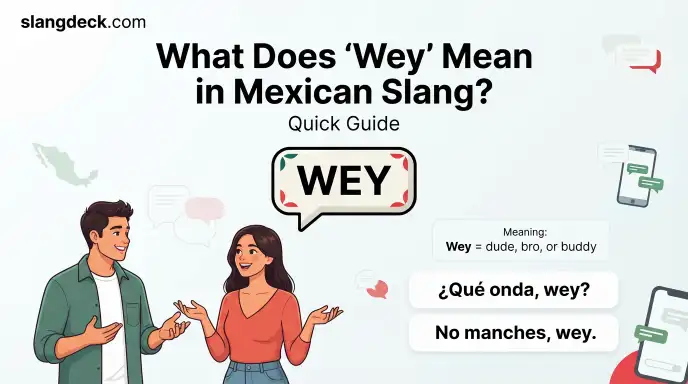
In text messaging and informal conversation, wey (pronounced like the English word “way”) is Mexican slang that primarily means “dude,” “bro,” “guy,” or “man.” Depending on tone and context, it can also act as a casual insult meaning “fool” or “dummy.”
What Does Mexican Slang Mean in Text?
In digital text conversations, wey functions as the ultimate conversational multi tool of Mexican Spanish. At its core, it is an informal vocative, a word used to address someone directly without using their formal name.
When typing out a quick message on WhatsApp, iMessage, or Snapchat, speakers use wey to establish rapport, signal casual intimacy, or add emotional emphasis to a sentence.
Beyond acting as a simple noun for “dude,” wey acts as an emotional punctuation mark in text messages. Placing wey at the end of a sentence often signals excitement, shock, disbelief, or urgency.
Full Form / Definition of the Slang
If you are wondering about the wey full form or what does wey stand for, it is important to clarify that wey is not an acronym. It does not stand for a sequence of separate words like standard internet abbreviations (such as LOL or BRB).
Instead, wey is a phonetic, colloquial spelling of the dictionary Spanish word güey, which itself evolved from buey.
Literal Meaning
Buey literally translates to ox or steer (a castrated bull).
Historical Slang Meaning
Historically in 19th and early 20th century Mexico, calling someone a buey meant calling them slow, dumb, or docile like a work ox. Over time, the sound shifted from buey $\rightarrow$ güey $\rightarrow$ wey.
Modern Slang Definition
Today, wey means “dude,” “guy,” “bro,” or “fool.”
Is It Rude, Offensive, or Neutral?
The risk level of wey depends entirely on the relationship between speakers, the setting, and the accompanying tone of voice or emojis.
1. Friendly and Affectionate (Neutral/Positive)
Among close peers, teenagers, and young adults, wey carry zero negative intent. It is equivalent to saying “bro” or “man” in English.
2. Mild Insult (Context Dependent)
If spoken with a sharp, annoyed, or aggressive tone or paired with words like qué (“¡Qué wey eres!”) it translates directly to “What an idiot you are!” or “Don’t be a fool!”
3. Offensive in Formal Settings
Using wey in a professional environment, with an elder, or toward a stranger is considered disrespectful and vulgar. It breaks standard rules of politeness (cortesía) in Spanish speaking cultures.
Where Is It Commonly Used?
While wey originated strictly in regional Mexican vernacular, global digital media has spread its usage worldwide.
Texting Apps (WhatsApp, iMessage)
The most common venue for wey, used between friends as informal punctuation or greeting.
TikTok & Instagram Reels
Frequently used in captions, voiceovers, and comment sections across Latin American and Spanglish pop culture content.
Gaming Lobbies (Discord, Twitch, Call of Duty)
Gamers use wey heavily in fast paced voice chats and text lobbies across North and Latin America.
Reddit & Online Forums
Subreddits like r/Mexico, r/Spanish, and meme pages regularly feature wey in post titles and comments.
Real Life Examples of wey Slang
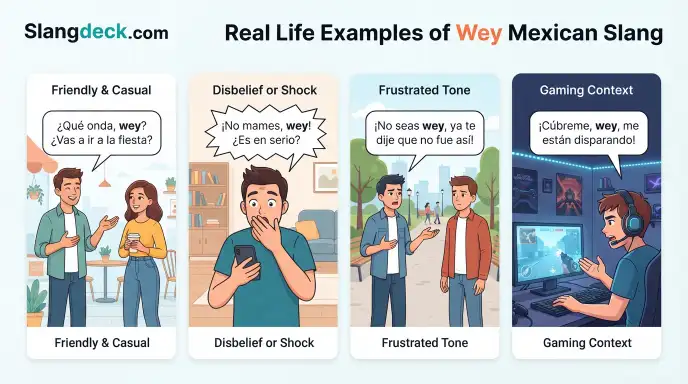
To understand how wey mexican slang works in natural text conversations, review these examples categorized by tone and scenario:
1. Friendly & Casual Tone
Person A: ¿Qué onda, wey? ¿Vas a ir a la fiesta?
Translation: “What’s up, dude? Are you going to the party?”
Context: A standard, friendly check in between close acquaintances.
2. Disbelief or Shock (High Emotion)
Person B: ¡No mames, wey! ¿Es en serio?
Translation: “No way, man! Are you serious?”
Context: Reacting to surprising news or unexpected drama in a group chat.
3. Frustrated or Argumentative Tone
Person A: ¡No seas wey, ya te dije que no fue así!
Translation: “Don’t be a dummy, I already told you it didn’t happen like that!”
Context: Used as a mild insult during a casual dispute between friends.
4. Gaming Context (Urgency)
Person B: ¡Cúbreme, wey, me están disparando!
Translation: “Cover me, bro, they’re shooting at me!”
Context: In game voice or text chat while playing multiplayer shooters.
Origin and Background of the Slang
The linguistic journey of wey is a textbook example of how languages transform over time.
The Agricultural Roots
The word began as buey (ox), referring to draft animals known for their slow, plodding nature.
The Insult Era
By the mid 1800s, buey was adopted as a slang insult for a foolish person or a cuckold.
Phonetic Softening
Over decades of spoken use, the hard “B” sound softened into a “G” sound, creating güey.
The Internet Era
With the rise of SMS texting and social media, users dropped the formal Spanish diaeresis (ü) and simplified the spelling to wey or guey for faster typing on digital keyboards.
Comparison with Similar Slang
Different Spanish speaking regions have their own equivalent terms for “dude” or “bro.” Here is how wey compares to similar slang across the globe:
| Slang Term | Country / Region | Primary Meaning | Tone / Vibe |
| Wey / Güey | Mexico | Dude, Bro, Fool | Very informal, versatile |
| Vato | Northern Mexico / US Chicano | Guy, Dude | Casual street slang |
| Chabón | Argentina | Guy, Dude | Informal, friendly |
| Tío | Spain | Dude, Man | Standard casual speech |
| Wón / Weón | Chile | Dude, Idiot | Highly versatile (similar to wey) |
| Parce / Parcero | Colombia | Pal, Bro | Warm, friendly |
When to Avoid Using It
While wey is a fixture of modern youth culture, using it in the wrong environment can cause social friction or offense:
In Professional Environments
Avoid using wey in office emails, Slack channels, or client calls. It sounds overly familiar and unpolished.
With Elders or Superiors
Addressing parents, grandparents, teachers, or bosses as wey is widely regarded as disrespectful.
When Meeting Someone for the First Time
Unless you are in an extremely casual setting (like a party with mutual friends), wait until a comfortable rapport is established before using wey.
In Formal Writing
Never use wey in academic essays, official documents, or journalistic writing (unless directly quoting someone).
Polite Alternatives to Wey
If you are communicating in professional, formal, or neutral settings where slang is inappropriate, use these polite alternatives:
| Slang Word | Polite / Standard Substitute | English Equivalent |
| Wey | Amigo / Amiga | Friend |
| Wey | Joven | Young man / Young lady |
| Wey | Señor / Señora | Sir / Ma’am |
| Wey | (Use the person’s real name) | Direct address |
Why People Use This Slang
Linguists and sociologists note that words like wey serve several crucial functions in everyday communication:
Building Social Connection
Using slang signals that two speakers belong to the same social group or share cultural background.
Sentence Fillers
Much like the word “like” or “you know” in English, wey acts as a mental bridge while speakers formulate their next thought.
Softening Direct Statements
Adding wey to a command or request can make a statement feel less demanding and more casual.
Expressing High Emotion
It provides an auditory punch when conveying extreme shock, joy, or frustration.
Impact of Using Slang in Communication
Slang enlivens language, but balance is key:
Positive Impact
Builds immediate rapport among peers, adds humor, and makes messaging feel authentic and unscripted.
Negative Impact
Overusing wey can make your vocabulary sound limited. If every third word in a message is wey, it dilutes the point of your message and can annoy the listener.
Is It Safe for Social Media?
Yes, wey is entirely safe for social media platforms including TikTok, Instagram, YouTube, X (Twitter), and Facebook.
Unlike severe profanity or hate speech, wey is not flagged or censured by social media moderation algorithms. It is viewed as standard informal vernacular across Latin American digital media.
Frequently Asked Questions
Q1. Can you call a girl “wey”?
Yes. “Wey” can be used for girls too, especially in casual Mexican Spanish.
Q2. Is güey a curse word?
Not exactly. “Güey” is informal slang and can sound rude depending on the tone and context.
Q3. Do Spanish people say “oy vey”?
Not usually. “Oy vey” is a Yiddish expression, not common Spanish slang.
Q4. What does “ya güey” mean?
“Ya güey” can mean “enough, dude” or “come on, dude,” depending on the situation and tone.
Q5. What does wey mean in Mexican Spanish?
In Mexican Spanish, wey means “dude,” “bro,” “man,” or “guy.” Depending on the tone of voice, it can also be a lighthearted insult meaning “fool” or “dummy.”
Q6. Is wey a bad word?
Wey is not considered a heavy swear word, but it is informal slang. It is inappropriate in formal, academic, or professional settings, but safe among friends.
Q7. How do you spell wey correctly?
The traditional dictionary spelling is güey (with a diaeresis over the u). However, in text messages and on social media, people usually spell it wey or guey for speed.
Q8. How do you pronounce wey?
It is pronounced like the English word “way” (or /weɪ/).
Conclusion
Understanding wey Mexican slang meaning in text opens up a clear window into authentic Mexican pop culture and modern digital communication.
If used to greet a close friend (“¿Qué onda, wey?”), express dramatic surprise (“¡No mames, wey!”), or gently poke fun at a mistake (“No seas wey”), wey remains one of the most versatile words in spoken and typed Spanish.
Remember that context and audience are everything. Keep wey in your casual group chats, gaming sessions, and social media captions, but stick to standard Spanish when stepping into formal or professional spaces.
Explore More Slang
- Mexican Slang for Cocaine: Meaning, Examples & Regional Usage
- Chale Mexican Slang: What Does “Chale” Mean in Text?
- Hyna Mexican Slang: Mexican & Chicano Term Explained

Hi, I’m Sarah. I studied Communications at the University of Texas and have spent the last six years writing about internet culture and Gen Z slang across TikTok, Twitter, and everyday conversations. I focus on real usage, not just dictionary definitions.