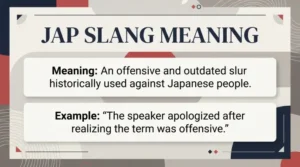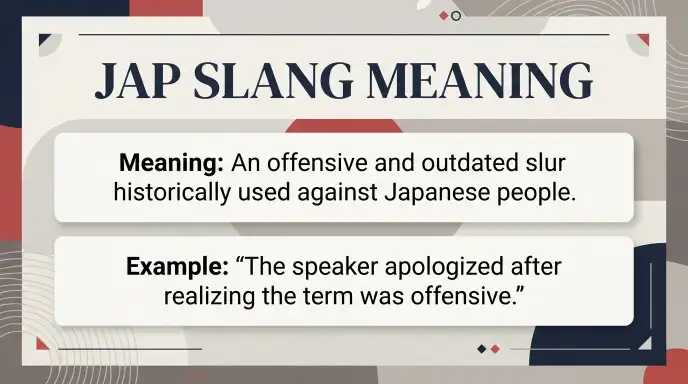
Jap slang Meaning is most commonly an offensive term historically used to refer to a Japanese person, and it is generally considered derogatory and inappropriate today.
People may search for “jap slang meaning” after seeing the word in a text, comment, movie, historical document, gaming chat, or social-media post. The confusion often comes from the fact that the word originally developed as a shortened form of “Japanese,” but its meaning and social impact changed over time.
Today, especially in American English, using “Jap” for a Japanese person can be deeply offensive because of its association with anti-Japanese racism and World War II- era propaganda. Modern writers should use Japanese, Japanese person, or Japanese people instead.
Quick Answer: Jap Slang Meaning
Jap slang usually refers to an offensive ethnic slur for a Japanese person. It was once used as a shortened form of “Japanese,” but it is now widely considered derogatory and should generally be avoided.
What Does Jap Mean in Slang?
In modern English, “Jap” is an offensive slang term referring to a Japanese person or someone of Japanese descent.
Although the word began as a shortened form of “Japanese,” its historical use gave it strongly negative associations, particularly in the United States during World War II.
Because of this history, “Jap” should not be treated like neutral abbreviations such as “Brit” or “Aussie.”
If someone is referring to a person from Japan today, Japanese is the appropriate and respectful term.
What Does Jap Mean in Text?
If you see “Jap” in a text message, the meaning depends on the surrounding conversation, but it can refer to a Japanese person in a derogatory way.
For example, a message containing the term alongside comments about nationality, ethnicity, Japan, or Japanese people may be using it as an ethnic slur.
Because the word is offensive, it is better not to repeat it when referring to Japanese people in ordinary conversation.
A safer alternative is simply:
“Japanese person”
or:
“Japanese people”
Jap Full Form and Meaning
“Jap” does not have a modern, respectful full form when it is used as the ethnic slur.
Historically, it developed as a shortened form of Japanese.
This historical origin can sometimes cause confusion because people may assume that shortening a nationality name automatically makes the result neutral.
In this case, historical usage changed the word’s social meaning.
Today, the complete word Japanese should be used instead.
Why Is Jap Meaning Slang Considered Offensive?
The term became strongly associated with anti-Japanese hostility, particularly during World War II.
It was frequently used in wartime propaganda and hostile descriptions of Japanese people and soldiers. That history gave the shortened form a derogatory meaning that continues to affect how it is understood today.
This is why simply saying that “Jap” is short for “Japanese” does not make it acceptable in modern communication.
The history and context of a word matter as much as its original formation.
Is Jap a Racial Slur?
Yes. When “Jap” refers to a Japanese person, it is widely regarded as an ethnic or racial slur.
Major English dictionaries classify this use as offensive or disparaging.
That means the word should not normally be used to describe Japanese people, even if the speaker does not personally intend to insult anyone.
Intent matters, but so does the established meaning of the language being used.
Is Jap Rude or Offensive?
Yes, in its ethnic sense, “Jap” is offensive.
The term can be particularly hurtful to Japanese people and Japanese Americans because of its history of discrimination and wartime hostility.
Someone may encounter the word in a historical book or documentary without the writer endorsing it.
That is different from using the term casually toward a Japanese person today.
Was Jap Always Offensive?
The history is more complicated than simply saying that the word was always a slur.
“Jap” originated as a shortened form of “Japanese” and was used in some contexts before World War II without the same level of hostility it later acquired.
Its negative associations became much stronger during World War II as anti-Japanese sentiment increased.
Historical context therefore helps explain why the word can no longer be treated as an ordinary abbreviation.
Jap During World War II
World War II played a major role in changing the social meaning of the term.
In the United States and other Allied countries, “Jap” was widely used in wartime propaganda and hostile references to Japan and Japanese people.
The word appeared alongside negative stereotypes and anti-Japanese messaging.
Because of this history, the term became connected with racial hostility rather than functioning simply as a short form of “Japanese.”
Jap in Historical Documents
You may still encounter the word in historical sources.
For example, it may appear in:
- World War II newspapers
- Military records
- Propaganda posters
- Historical books
- Memoirs
- Films depicting the war
- Archival documents
Seeing the word in a historical source does not mean the modern reader should use it casually.
When discussing historical material, it is useful to explain that the term was offensive or derogatory in the relevant context.
Jap in Movies and Television
Movies and television programs set during World War II may use the term when portraying historical characters or wartime dialogue.
In such cases, the purpose may be to accurately represent the language of the period or demonstrate a character’s prejudice.
That does not make the word acceptable in modern everyday speech.
The difference between depicting offensive language and using offensive language toward someone is important.
Jap in Social Media
Seeing “Jap” on social media does not automatically mean the person is using it neutrally.
On platforms such as TikTok, Reddit, Instagram, X, Discord, and Facebook, the word may appear in:
- Historical discussions
- Arguments
- Racist comments
- Discussions about offensive language
- Quotes from older material
- World War II content
Context matters, but when the term is directed at Japanese people, it should generally be recognized as offensive.
Jap in Gaming Chats
Gaming communities can sometimes create confusion because users may type short words without considering how they are interpreted by automated moderation systems.
If “Jap” appears in an English-language gaming chat, it may be interpreted as the ethnic slur rather than as a harmless abbreviation.
For this reason, players should avoid using it when they mean Japanese.
Writing the full word is clearer and prevents unnecessary misunderstandings.
A Different Meaning: JAP as Jewish American Princess
There is another meaning of JAP, especially in American slang.
In this usage, JAP stands for “Jewish American Princess.” It is a derogatory stereotype describing a Jewish American woman as spoiled, privileged, demanding, or overly concerned with money or status.
This usage is also considered offensive.
It is important not to confuse this meaning with the ethnic slur referring to Japanese people. They have different histories and target different groups.
Is JAP the Same as Jap?
The capitalization can sometimes help distinguish meanings, but it does not make either offensive usage acceptable.
Jap commonly refers to the anti-Japanese ethnic slur.
JAP can refer to the offensive phrase Jewish American Princess.
The surrounding conversation is therefore important.
If someone is discussing Japan, Japanese people, or World War II, the first meaning may be intended. If the discussion concerns American Jewish stereotypes, the second meaning may be intended.
Jap vs. Japanese
The safest comparison is simple:
| Term | Meaning | Modern Use |
| Jap | Offensive term for a Japanese person | Avoid |
| Japanese | Person, language, or culture of Japan | Neutral/respectful |
| Japanese person | A person from Japan or of Japanese background | Neutral |
| Japanese people | People of Japanese nationality or heritage | Neutral |
There is no practical reason to use “Jap” when Japanese communicates the meaning clearly and respectfully.
Jap vs. Nip
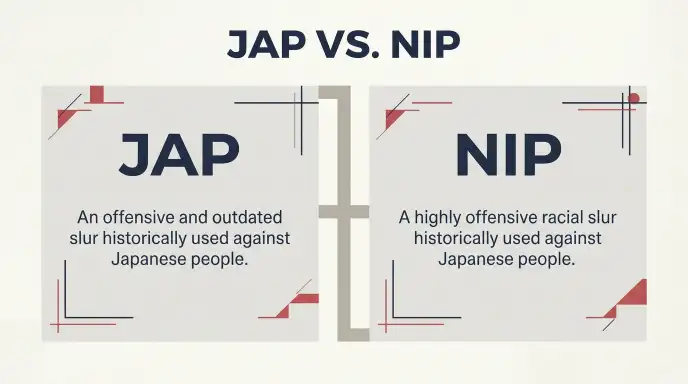
Another historical offensive term for Japanese people is “Nip,” derived from “Nippon,” a Japanese name for Japan.
Like “Jap,” it has derogatory historical associations and should generally be avoided when referring to Japanese people.
Using Japanese is the respectful alternative.
The fact that both words have historical origins as shortened forms does not make them appropriate today.
What Is the Polite Alternative to Jap?
The best alternative is simply Japanese.
Depending on the sentence, you can also say:
- Japanese person
- Japanese people
- Person from Japan
- Japanese citizen
- Japanese American, when that specific identity is relevant
For example, instead of:
“He is a Jap.”
say:
“He is Japanese.”
Or:
“He is a Japanese person.”
The second versions are clear and respectful.
When Should You Avoid Using Jap?
In modern communication, it is best to avoid using the term when referring to Japanese people.
You should especially avoid it in:
- Professional communication
- School assignments
- Social media posts
- Workplace conversations
- Public comments
- Gaming chats
- News writing
- Customer communication
- Conversations with Japanese people
If you are discussing the word itself, mentioning it as the subject of a language discussion is different from using it as a label for a person.
Why Do People Still Use Jap?
People may use the term for different reasons.
Some may be unaware of its offensive history and mistakenly believe it is simply a shortened form of “Japanese.”
Others may encounter it in older movies, books, historical documents, or online communities and repeat it without understanding its implications.
In some cases, however, it is deliberately used as an insult.
Understanding the history helps explain why the word can cause offense even when someone claims they did not intend it that way.
Is Jap Safe to Use on Social Media?
No, not when referring to Japanese people.
Social-media platforms have international audiences, and readers may interpret the term as an ethnic slur.
Even if someone claims to be using it as a harmless abbreviation, other users may understand its established offensive meaning.
Using Japanese instead is both clearer and safer.
Can Jap Be Used in Historical Discussion?
Yes, the word may need to be mentioned when discussing historical documents, World War II, propaganda, or the history of racial language.
The important point is to identify it as an offensive historical term rather than presenting it as a normal synonym for Japanese.
For example:
“The historical source used an offensive term for Japanese people.”
This approach gives readers the necessary context without normalizing the slur.
Real-Life Examples of Jap Slang
Because the term is offensive, examples should focus on explaining how it appears rather than encouraging people to use it.
Historical Context
“The documentary discusses the offensive language used in World War II propaganda.”
Here, the term may be discussed as part of historical analysis.
Language Discussion
“Why is the word Jap considered offensive?”
This is a neutral question about the word itself.
Modern Insult
“He used an ethnic slur against a Japanese person.”
In this situation, using the slur would be inappropriate.
Respectful Alternative
“She is Japanese.”
This is the preferred modern wording.
Is Jap a Bad Word?
When “Jap” is used to refer to Japanese people, yes, it is considered a bad or offensive word.
It is more accurate to call it an ethnic slur rather than simply saying it is a rude word.
This distinction matters because an ethnic slur targets a particular ethnic or national group and can carry a history of discrimination.
Is Jap a Swear Word?
“Jap” is not a swear word in the same sense as profanity.
It is an ethnic slur.
That means its offensiveness comes from the group it targets and its historical use, rather than from being a general profanity.
This is why content filters may treat it differently from ordinary swear words.
Why Context Matters With Jap
Context can tell you whether someone is discussing the word historically or using it as an insult.
For example:
“The author explains why the term Jap became offensive.”
This is a discussion about language.
By contrast:
“He called the Japanese man a Jap.”
This describes the use of the term as an ethnic insult.
The word remains offensive in the second context.
How to Respond If Someone Uses Jap
If someone uses the term casually without realizing its meaning, a calm explanation may be enough.
You could say:
“That term is considered offensive. It is better to say Japanese.”
If the person is deliberately using it to insult someone, engaging further may not be useful.
On social platforms, you can also report abusive content when appropriate.
Common Misunderstandings About Jap Slang
Misunderstanding 1: It Is Just Short for Japanese
Historically, the word did develop from “Japanese,” but its modern social meaning is offensive.
Misunderstanding 2: Capitalizing It Makes It Acceptable
Writing JAP instead of Jap does not remove the offensive meaning when referring to Japanese people.
Misunderstanding 3: It Is the Same as “Brit”
Not every shortened nationality term has the same history or social meaning.
“Brit” is generally neutral, while “Jap” carries derogatory historical associations.
Misunderstanding 4: It Is Only Offensive During World War II
The term remains widely regarded as offensive today, even though its historical use is especially important to understanding its development.
Misunderstanding 5: Every Use of “JAP” Means Japanese
No. In American slang, JAP can also refer to “Jewish American Princess,” which is itself a derogatory stereotype.
Frequently Asked Questions About Jap Slang
Q1. What does Jap mean in slang?
“Jap” is an offensive slang term historically used to refer to a Japanese person or someone of Japanese descent. It is generally considered an ethnic slur today.
Q2. What is the full form of Jap?
Historically, “Jap” developed as a shortened form of Japanese. It is not recommended as a modern abbreviation because of its offensive associations.
Q3. Is Jap a racial slur?
Yes. When used to refer to Japanese people, it is widely regarded as an offensive ethnic or racial slur.
Q4. Is JAP an abbreviation for something else?
Yes. In American slang, JAP can stand for Jewish American Princess, a derogatory stereotype. This meaning is separate from the slur directed at Japanese people.
Q5. Can I use Jap in a historical article?
You may need to mention the term when discussing historical language, World War II, or propaganda. It should be clearly identified as offensive rather than presented as a neutral term.
Q6. What should I say instead of Jap?
Use Japanese, Japanese person, Japanese people, or another accurate and respectful description.
Final Conclusion
The Jap slang meaning is important to understand because the word has a complicated linguistic history but a clear modern social meaning.
“Jap” originated as a shortened form of Japanese, but it became strongly associated with anti-Japanese racism, especially during World War II. Today, when it is used to refer to a Japanese person, it is widely considered an offensive ethnic slur.
There is also a separate American slang meaning of JAP, short for Jewish American Princess, which is a derogatory stereotype and should also be avoided.
If you encounter “Jap” in a historical document, movie, book, or discussion about offensive language, context can explain why it appears. In modern everyday communication, however, Japanese is the respectful and appropriate choice.
Understanding the Jap slang meaning is not only about knowing what the word refers to. It is also about recognizing its history, tone, and potential impact on other people.
Some More Related Slang
- Japanese Slang for Thank You: Casual Ways to Say Thanks
- Relax in Spanish Slang: Casual Words, Meanings & Examples
- Yinzer Slang: Meaning, Definition, Origin and Everyday Usage

Hi, I’m Sarah. I studied Communications at the University of Texas and have spent the last six years writing about internet culture and Gen Z slang across TikTok, Twitter, and everyday conversations. I focus on real usage, not just dictionary definitions.