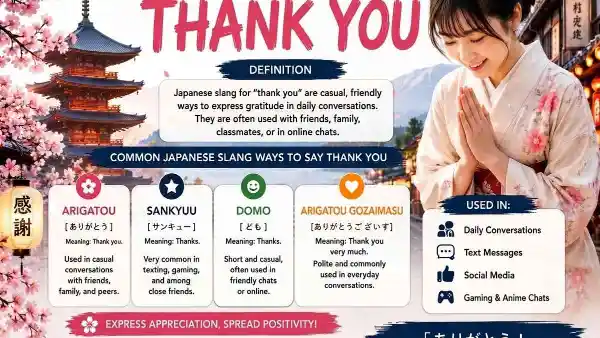
Japanese Slang for Thank You refers to casual and informal ways of expressing gratitude in Japanese. Instead of the formal arigatou gozaimasu, people often use shorter expressions like arigatou, sankyu, or other friendly variations when talking to friends, family, classmates, or online.
If you’re learning Japanese, you’ve probably heard arigatou (ありがとう). While it’s the standard way to say “thank you,” native speakers often use shorter and more casual expressions with friends, classmates, coworkers, and family. Because of that, using Japanese slang can make your conversations sound more natural.
The most common Japanese slang for thank you includes sankyuu (サンキュー), azasu (あざす), arigato (ありがと), and 39 (サンキュー) in online chats. Each expression fits a different situation, so choosing the right one depends on who you’re speaking with.
In this guide, you’ll learn the meaning of these slang terms, their UK and US pronunciations, where they’re commonly used, real life examples, and when you should avoid using them.
Quick Answer: Japanese Slang for Thank You
The most popular Japanese slang for thank you is azasu (あざす), arigato (ありがと), sankyuu (サンキュー), and 39 (サンキュー) in texting. These expressions are informal and are best used with friends or in casual conversations.
What Does “Thank You” Mean in Japanese Slang?
Japanese slang for thank you includes shortened, borrowed, or playful expressions that people use instead of the formal arigatou gozaimasu (ありがとうございます).
These slang words make conversations feel relaxed and friendly. However, they are not appropriate in business meetings, formal emails, or official situations.
Formal vs. Slang
The standard ways to say thank you are:
- Arigatou (ありがとう): Thank you (casual)
- Arigatou gozaimasu (ありがとうございます): Thank you very much (polite)
However, younger speakers often replace them with shorter slang expressions.
Some of the most popular alternatives are:
- Azasu
- Arigato
- Sankyuu
- 39 (Sankyuu)
- Domo
Japanese Slang for Thank You Alternatives
1. Azasu (あざす)
Meaning:
Azasu is a shortened version of arigatou gozaimasu. Young people often use it with close friends, teammates, or coworkers.
Pronunciation (UK): AH-zah-soo
Pronunciation (US): AH-zuh-soo
Example:
Japanese:
あざす!
English:
“Thanks!”
2. Arigato (ありがと)
Meaning:
Arigato is the shortened form of arigatou. It sounds warm and casual.
Pronunciation (UK): ah-ree-GAH-toh
Pronunciation (US): ah-ree-GAH-doh
Example:
Japanese:
ありがと!
English:
“Thanks!”
3. Sankyuu (サンキュー)
Meaning:
Sankyuu comes from the English phrase thank you and is popular among younger Japanese speakers.
Pronunciation (UK): SAN-kyoo
Pronunciation (US): SAN-kyoo
Example:
Japanese:
サンキュー!
English:
“Thank you!”
4. 39 (サンキュー)
Meaning:
The number 39 is read as san-kyuu, making it a fun internet slang way to say thank you.
Pronunciation (UK): SAN-kyoo
Pronunciation (US): SAN-kyoo
Example:
Text Message:
39 😊
English:
“Thanks!”
5. Domo (どうも)
Meaning:
Domo means thanks or many thanks in casual conversations. It is shorter than domo arigatou.
Pronunciation (UK): DOH-moh
Pronunciation (US): DOH-moh
Example:
Japanese:
どうも!
English:
“Thanks!”
Where Is Japanese Slang for Thank You Commonly Used?
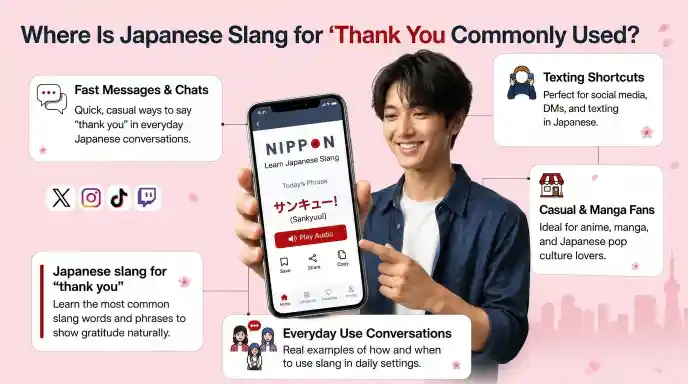
People use these casual expressions in many everyday situations.
Text Messages
Friends often send:
- Azasu
- 39
- Sankyuu
because they are quick to type.
Social Media
You’ll frequently see these words on:
- TikTok
- X (Twitter)
- YouTube comments
- Discord
Many creators use them to thank followers.
Everyday Conversations
Young people often say arigato, azasu, or domo while talking with classmates, teammates, siblings, or close friends.
Which Japanese Slang for “Thank You” Sounds Most Natural?
Different expressions sound natural in different situations. Therefore, choosing the right one helps you speak Japanese more naturally.
With Close Friends
Young Japanese speakers often say azasu or arigato because both expressions sound relaxed and friendly.
Example:
Japanese:
あざす!また明日!
English:
“Thanks! See you tomorrow!”
On Social Media
People frequently use sankyuu or 39 in captions, comments, and direct messages.
Example:
Japanese:
39! みんな!
English:
“Thanks, everyone!”
In Everyday Conversations
Domo is a simple and natural way to thank someone during casual conversations.
Example:
Japanese:
どうも!
English:
“Thanks!”
With Teachers or Employers
Avoid slang in formal situations.
Instead, say:
- Arigatou gozaimasu (ありがとうございます)
This expression sounds polite and respectful.
Is Japanese Slang for Thank You Rude, Offensive, or Harmless?
Most Japanese slang for thank you is friendly and harmless. Native speakers use these expressions every day with friends and family.
However, using slang in formal settings may sound disrespectful because Japanese culture places great importance on polite language.
| Expression | Tone | Safe to Use? |
| Arigatou gozaimasu | Formal | Yes |
| Arigato | Casual | Yes |
| Azasu | Very Casual | Yes |
| Sankyuu | Friendly | Yes |
| 39 | Internet Slang | Yes |
| Domo | Casual | Yes |
Real Life Examples of Japanese Slang for Thank You
These examples show how native speakers naturally express thanks.
Example 1: Friend Helps With Homework
Japanese:
ありがと!
English:
“Thanks!”
Example 2: Sports Team
Japanese:
あざす!助かった!
English:
“Thanks! That really helped!”
Example 3: Social Media Comment
Japanese:
サンキュー!
English:
“Thank you!”
Example 4: Text Message
Japanese:
39😊
English:
“Thanks!”
Example 5: Leaving a Store
Japanese:
どうも!
English:
“Thanks!”
Origin and History of Japanese Thank You Slang
Japanese expressions for thanks have changed over time. Younger generations continue to create shorter and more casual ways to show appreciation.
Traditional Japanese
The traditional expression is arigatou, while arigatou gozaimasu became the polite form used in schools, workplaces, and businesses.
Shortened Expressions
Over time, people shortened arigatou into arigato and later created azasu, especially among students, athletes, and coworkers.
As a result, conversations became quicker and more informal.
English Influence
Western culture also influenced Japanese slang.
The borrowed word sankyuu comes directly from the English phrase thank you. Today, many younger speakers use it naturally in casual conversations.
Internet Culture
Social media introduced creative abbreviations like 39, which sounds like san-kyuu when pronounced in Japanese.
Consequently, this number became a playful way to write thank you online.
Similar Japanese Slang or Related Terms
| Japanese Expression | English Meaning | Common Use |
| Arigatou | Thanks | Everyday conversations |
| Arigatou gozaimasu | Thank you very much | Formal situations |
| Azasu | Thanks | Friends and teammates |
| Sankyuu | Thank you | Youth slang |
| 39 | Thanks | Texting and social media |
| Domo | Thanks | Casual conversations |
| Domo arigatou | Thank you very much | Semi-formal situations |
| Ossu | Thanks / Greeting (depends on context) | Sports clubs |
In some sports clubs or martial arts settings, Ossu can occasionally imply appreciation depending on the context, but it is primarily a greeting rather than a direct way to say “thank you.”
Why Do People Use Japanese Slang for Thank You?
People choose slang because it makes conversations feel more natural and relaxed.
Common reasons include:
- Texting friends.
- Replying on social media.
- Thanking classmates.
- Talking with teammates.
- Playing online games.
- Sending quick messages.
- Following modern Japanese internet culture.
In addition, these expressions help younger speakers communicate faster without sounding overly formal.
When Should You Avoid Using Japanese Slang for “Thank You”?
Japanese slang is friendly and useful in casual conversations. However, it is not appropriate in every situation. Therefore, you should know when to choose polite Japanese instead.
Avoid using Japanese slang for thank you in these situations:
- Business meetings.
- Job interviews.
- Professional emails.
- School presentations.
- Government offices.
- Speaking with customers.
- Formal ceremonies.
Instead, use Arigatou gozaimasu (ありがとうございます) because it shows respect and good manners.
Platform Usage Comparison
Different online platforms use Japanese slang for thank you in different ways.
| Platform | Common Usage | Popularity |
| TikTok | Short videos, comments, trends | ⭐⭐⭐⭐⭐ |
| Captions, Reels, Stories | ⭐⭐⭐⭐⭐ | |
| Personal chats | ⭐⭐⭐⭐⭐ | |
| X (Twitter) | Posts and replies | ⭐⭐⭐⭐☆ |
| Japanese language discussions | ⭐⭐⭐⭐☆ | |
| Discord | Gaming and community chats | ⭐⭐⭐⭐☆ |
| YouTube | Comments and livestream chats | ⭐⭐⭐⭐⭐ |
Is It Safe to Use Japanese Slang for Thank You on Social Media?
Yes. Most Japanese slang for thank you is completely safe on social media.
Expressions such as arigato, azasu, sankyuu, 39, and domo are friendly and positive. As a result, they appear regularly in comments, captions, gaming chats, and direct messages.
However, remember that these expressions are informal. If you are writing to a teacher, employer, customer, or someone older, use Arigatou gozaimasu instead.
Common Misunderstandings About Japanese Slang for Thank You
Many Japanese learners misunderstand these casual expressions. The following points explain the most common mistakes.
Thinking “Arigato” Is Always Formal
Many beginners believe arigato works in every situation.
However, arigato is casual. In professional or respectful settings, Arigatou gozaimasu is the better choice.
Assuming “39” Means the Number Thirty-Nine
Online, 39 often represents san-kyuu, which sounds like thank you.
Therefore, the number may express gratitude rather than an actual number.
Believing “Sankyuu” Is Traditional Japanese
Although sankyuu is common today, it comes from the English phrase thank you.
Traditional Japanese speakers often choose arigatou instead.
Using Slang With Everyone
Japanese culture values respectful language.
For that reason, slang should stay between friends, classmates, teammates, and people you know well.
Key Takeaways
- Arigatou gozaimasu is the standard polite way to say thank you.
- Arigato is a casual version used with friends.
- Azasu is popular among younger speakers and teammates.
- Sankyuu comes from the English phrase thank you.
- 39 is a playful internet abbreviation for sankyuu.
- Domo is a short and friendly way to express thanks.
- Formal situations require polite Japanese instead of slang.
Frequently Asked Questions
Q1. What is the most common Japanese slang for thank you?
The most common slang expressions are azasu, arigato, sankyuu, 39, and domo.
Q2. What does “azasu” mean?
Azasu is a shortened version of arigatou gozaimasu and simply means thanks.
Q3. Is “sankyuu” a Japanese word?
Sankyuu comes from the English phrase thank you, but it is widely used in casual Japanese conversations.
Q4. Why do Japanese people write “39” instead of thank you?
Because 39 is pronounced san-kyuu, which sounds similar to thank you in Japanese.
Q5. Is “domo” the same as “arigato”?
Not exactly. Domo is a short casual way to say thanks, while arigato is the standard casual expression.
Q6. Can I use Japanese thank-you slang at work?
No. Professional situations require polite expressions like Arigatou gozaimasu.
Q7. Which slang is most common on social media?
Azasu, sankyuu, 39, and arigato are very common on TikTok, Instagram, Discord, and X.
Q8. Is Japanese thank-you slang rude?
No. These expressions are friendly and harmless when used in casual conversations.
Q9. How do you pronounce “arigato”?
UK Pronunciation: ah-ree-GAH-toh
US Pronunciation: ah-ree-GAH-doh
Q10. How can I learn Japanese slang faster?
Watch Japanese YouTubers, anime, TV shows, and TikTok videos. You can also practice with native speakers and read social media comments.
Q11. How do you politely say thanks in Japanese?
The most polite way is Arigatou gozaimasu (ありがとうございます). It is commonly used in formal situations and when speaking to someone respectfully.
Q12. What does “I suki you” mean?
“I suki you” is not correct Japanese. People usually mean “Suki da yo,” which means “I like you” or “I love you,” depending on the context.
Q13. What is informal thank you in Japanese?
An informal way to say thank you is Arigatou (ありがとう). Friends, classmates, and family members commonly use this expression.
Q14. How do you say “thanks” in slang?
Common slang ways to say thanks include “Thanks!”, “Thx,” “TY,” “TYSM,” and “Cheers” (mainly in British English). These are widely used in text messages and social media.
Conclusion
Learning Japanese slang for thank you helps you sound more natural when talking with friends or chatting online. While Arigatou gozaimasu remains the standard polite expression, casual alternatives such as arigato, azasu, sankyuu, 39, and domo appear frequently in everyday conversations and on social media.
Understanding when to use each one will make your Japanese feel more authentic.As you continue learning Japanese, pay attention to the situation and the person you’re speaking with.
Using slang with friends is perfectly natural, but polite language is always the better choice in formal settings.
Discover Related Articles:

Hey, I’m Jordan. I grew up in a bilingual household in LA, so Spanish and Mexican American slang has always been part of how I talk. I’ve been writing online content for five years, explaining terms the way I’d explain them to a friend meaning, tone, and when it’s actually okay to use.