Definition of Tone Deaf Slang Meaning
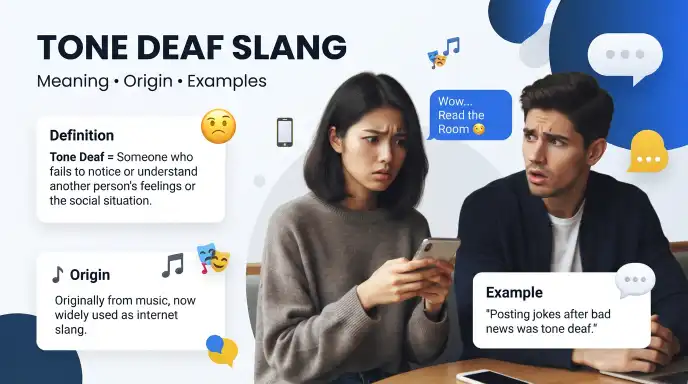
Tone deaf is a slang expression used to describe someone who says or does something that seems insensitive, unaware, or inappropriate for a particular situation. Rather than referring to music, the slang meaning focuses on a person’s lack of awareness about how their words or actions affect others.
Example:
- Posting vacation photos during a natural disaster felt tone deaf.
- His joke during the serious meeting came across as tone deaf.
People often search for tone deaf slang meaning after seeing the phrase on social media, in news articles, online discussions, or comments about celebrities, brands, or public figures. In these situations, the phrase usually criticizes someone for failing to recognize the emotions, circumstances, or concerns of others.
Although tone deaf originally described a person who cannot accurately recognize musical notes, its modern slang meaning is much more common in everyday conversations. Today, it usually means socially unaware rather than musically unable.
Quick Answer: Tone Deaf Slang Meaning
Tone deaf is a slang term that describes someone who is insensitive, socially unaware, or out of touch with a situation. It is commonly used when a person’s words, jokes, or actions seem inappropriate or fail to consider other people’s feelings.
What Does Tone Deaf Mean in Slang?
In slang, tone deaf means a person fails to understand the mood, emotions, or social context of a situation. It often suggests that someone made a comment or took an action that others consider insensitive or poorly timed.
For example, if a company launches an expensive luxury product during a major economic crisis, many people may call the campaign tone deaf because it ignores what people are experiencing.
Likewise, someone who makes a joke during a sad event may also be described as tone deaf, even if they did not intend to offend anyone.
Common Meanings of Tone Deaf
| Meaning | Explanation | Example |
| Socially unaware | Doesn’t recognize how others may feel | His comment sounded tone deaf after the announcement. |
| Insensitive | Says or does something inappropriate | Posting party photos after the tragedy seemed tone deaf. |
| Poor judgment | Fails to read the situation correctly | The advertisement was criticized as tone deaf. |
| Original meaning | Unable to recognize musical pitch | She isn’t actually tone deaf, but she struggles to sing in tune. |
Tone Deaf Meaning in Text
In text messages, online chats, and social media, tone deaf is usually used to criticize someone’s message, opinion, or behavior.
For example:
“That tweet was so tone deaf.”
This means the tweet ignored people’s feelings or the seriousness of the situation.
Another example:
“The brand’s apology felt tone deaf.”
Here, the writer believes the apology failed to address what people were actually upset about.
Because online conversations spread quickly, the phrase is commonly used on platforms like X (Twitter), Instagram, Reddit, TikTok, Facebook, and Discord whenever users believe someone has responded in an insensitive way.
Tone Deaf Full Form
Tone deaf does not have a full form.
Unlike abbreviations such as LOL, BRB, or IMO, tone deaf is not an acronym.
Many people search for:
- Tone deaf full form
- What does tone deaf stand for?
- Tone deaf abbreviation
The answer is simple:
Tone deaf is a regular English phrase and does not stand for any other words.
Is Tone Deaf Offensive or Just Critical?
In most situations, tone deaf is considered criticism rather than profanity.
It is commonly used to point out that someone’s words or actions seem insensitive, unaware, or poorly timed. While the phrase itself is not a swear word, being called tone deaf can feel insulting because it suggests poor judgment or a lack of empathy.
Here’s a quick overview.
| Situation | Appropriate? |
| Casual conversations | ✅ Yes |
| Social media | ✅ Yes |
| News articles | ✅ Yes |
| Workplace discussions | ✅ Usually |
| Professional emails | ⚠️ Use carefully |
| Academic writing | ⚠️ Better with explanation |
| Formal legal documents | ❌ Generally avoid |
The phrase works best when you are describing behavior rather than attacking a person’s character.
Where Is Tone Deaf Slang Meaning Commonly Used?
Today, tone deaf appears in many types of conversations because it describes social awareness rather than musical ability.
You will often hear or read it in:
- Social media posts
- News headlines
- Celebrity interviews
- Political discussions
- Workplace conversations
- Brand marketing criticism
- Online forums
- Reddit discussions
- YouTube comments
- Podcasts
- Everyday conversations
It is especially common whenever people believe a person, company, or public figure failed to understand how others would react.
Who Uses Tone Deaf Slang Meaning the Most?
The phrase tone deaf is most commonly used by social media users, journalists, bloggers, commentators, and young adults discussing current events, public statements, advertising campaigns, or online behavior. It is especially popular on platforms where people react quickly to news and trending topics.
Real-Life Examples of Tone Deaf Slang Meaning
Here are some natural examples showing how tone deaf is used in different situations.
1. Social Media
“Posting luxury shopping photos during the financial crisis felt tone deaf.”
2. Workplace
“His joke during the meeting was completely tone deaf.”
3. Friends
“It was tone deaf to complain about being bored while your friend was dealing with a family emergency.”
4. Marketing
“Many customers thought the advertisement was tone deaf after the recent events.”
5. News
“The politician’s comments were criticized as tone deaf by several news outlets.”
6. Family
“Making fun of someone’s mistake at dinner seemed tone deaf.”
7. Online Gaming
“His comments after the team lost sounded tone deaf to everyone in the chat.”
These examples show that tone deaf usually describes behavior that ignores the emotions or circumstances of others.
Origin and History of Tone Deaf Slang
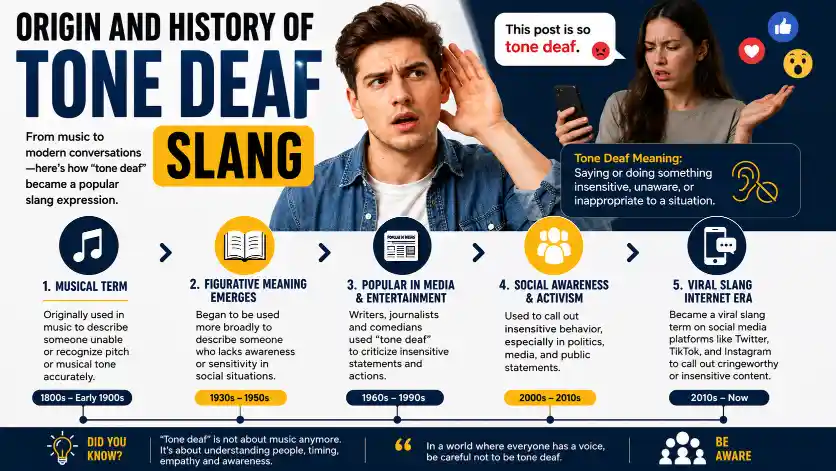
The phrase tone deaf originally comes from music. It described a person who had difficulty recognizing musical notes or singing in tune, a condition sometimes called amusia.
Its figurative meaning began appearing in English during the mid-20th century, when people started using tone deaf to describe someone who failed to recognize the “tone” of a social or emotional situation.
Over time, the expression became popular in politics, journalism, advertising, and everyday conversations. Today, the slang meaning is far more common than the original musical definition.
With the rise of social media, the phrase became even more widespread because users frequently describe celebrities, brands, influencers, and public figures as tone deaf when their posts or statements appear insensitive or out of touch with current events.
Tone Deaf vs Similar Slang Terms
Although tone deaf means someone is socially unaware or insensitive, it is different from several related expressions.
| Slang | Meaning | Tone | When It’s Used |
| Tone Deaf | Socially unaware or insensitive | Critical | Someone ignores the feelings or situation of others |
| Out of Touch | Unaware of what ordinary people experience | Critical | Often used for leaders, celebrities, or companies |
| Insensitive | Shows little concern for others’ feelings | Serious | Direct criticism of behavior |
| Clueless | Doesn’t understand what’s happening | Casual | Someone lacks awareness or information |
| Oblivious | Doesn’t notice obvious things | Neutral | Someone unintentionally misses what’s happening |
| Read the Room | Understand the mood before speaking | Advice | Used when someone fails to judge the situation |
While these expressions are similar, tone deaf specifically focuses on missing the emotional or social context, not simply lacking knowledge.
When Should You Avoid Using Tone Deaf?
Although tone deaf is widely accepted, there are situations where it may not be the best choice.
Avoid using it when:
- Writing legal or official documents.
- Preparing academic or research papers without explanation.
- Sending formal business emails.
- Giving professional feedback where more specific language would be clearer.
- Talking about someone with the actual medical condition of being unable to recognize musical pitch.
In formal settings, consider using clearer alternatives such as:
- Insensitive
- Poorly timed
- Lacking awareness
- Inappropriate
- Out of touch
- Not considerate of the situation
These phrases sound more professional and avoid possible misunderstandings.
Polite Alternatives to Tone Deaf
1. Out of Touch
Pronunciation: (out-uhv-touch)
Meaning:
Describes someone who does not understand what other people are experiencing or feeling.
Examples:
- The company’s response seemed out of touch with customer concerns.
- His comments sounded out of touch.
2. Insensitive
Pronunciation: (in-SEN-suh-tiv)
Meaning:
Shows little concern for another person’s feelings.
Examples:
- The joke was insensitive.
- Her remarks seemed insensitive after the announcement.
3. Poorly Timed
Pronunciation: (poor-lee tymd)
Meaning:
Something said or done at the wrong moment.
Examples:
- The announcement was poorly timed.
- His comment was poorly timed during the meeting.
4. Lacking Awareness
Pronunciation: (LAK-ing uh-WAIR-ness)
Meaning:
Not recognizing what is happening around you or how others feel.
Examples:
- The campaign showed a lack of awareness.
- His response lacked awareness of the situation.
5. Inappropriate
Pronunciation: (in-uh-PROH-pree-ut)
Meaning:
Not suitable for a particular situation.
Examples:
- The joke was inappropriate.
- Her comments were inappropriate for the occasion.
Quick Alternatives
| Instead of… | You Can Say… |
| That’s tone deaf. | That’s insensitive. |
| His comment was tone deaf. | His comment was poorly timed. |
| The campaign was tone deaf. | The campaign was out of touch. |
| That joke was tone deaf. | That joke was inappropriate. |
| Their response was tone deaf. | Their response lacked awareness. |
These alternatives work better in professional writing while expressing a similar idea.
Why Do People Use Tone Deaf?
People use the phrase tone deaf because it quickly describes behavior that seems socially unaware or insensitive. Instead of saying someone “didn’t understand the situation,” people simply say they were tone deaf.
Common reasons people use this phrase include:
- It points out a lack of social awareness.
- It describes comments that seem insensitive.
- It criticizes poor timing.
- It explains why people reacted negatively.
- It is widely understood on social media and in everyday conversations.
Because it is short and descriptive, tone deaf has become a common way to discuss public statements, advertisements, and online posts.
Common Misunderstandings About Tone Deaf Slang Meaning
The phrase tone deaf is often misunderstood because it has both a literal and a figurative meaning.
Misunderstanding 1: It Always Refers to Music
Not anymore. While the phrase originally described someone who struggles to recognize musical pitch, today’s slang meaning usually refers to social awareness, not musical ability.
Misunderstanding 2: Being Tone Deaf Means Someone Is a Bad Person
Not necessarily.
Calling someone tone deaf usually criticizes a specific comment or action rather than their entire personality. A person may simply have misunderstood the situation or chosen the wrong words.
Misunderstanding 3: It’s the Same as Being Rude
Not always.
Someone who is rude may intentionally offend others. A tone deaf person often causes offense without realizing it.
Misunderstanding 4: It’s Only Used for Celebrities
Although the phrase is common in news stories about celebrities, politicians, and brands, it can describe anyone whose words or actions seem out of place.
Understanding the context helps you interpret if the phrase is referring to music or social behavior.
Impact of Using Tone Deaf in Communication
Like many slang expressions, tone deaf can influence how a message is received.
Positive Effects
- Clearly describes social insensitivity.
- Encourages people to think about others’ feelings.
- Helps explain why a comment or action received criticism.
- Makes discussions about communication more specific.
Possible Drawbacks
- Can sound judgmental if used too quickly.
- May oversimplify a complex situation.
- Some people may confuse it with the medical or musical meaning.
- Overusing the phrase can weaken constructive discussions.
Using the expression thoughtfully helps keep conversations respectful and focused on behavior rather than personal attacks.
Is Tone Deaf Safe for Social Media?
Yes. Tone deaf is generally considered safe to use on social media platforms.
People frequently use it on:
- X (Twitter)
- Discord
- TikTok
- YouTube comments
- Threads
Because it is not profanity or hate speech, the phrase rarely causes moderation issues. However, it is best used respectfully and only when describing behavior that genuinely seems insensitive or out of touch.
Frequently Asked Questions
Q1. What does tone deaf mean in slang?
Tone deaf is a slang term for someone whose words or actions seem insensitive, socially unaware, or inappropriate for the situation.
Q2. Does tone deaf have a full form?
No. Tone deaf is a regular English phrase and not an acronym or abbreviation.
Q3. Is tone deaf an insult?
It can be. While it is not a swear word, calling someone tone deaf is a form of criticism that suggests they failed to understand other people’s feelings or the situation.
Q4. Is tone deaf the same as rude?
No. A rude person may intentionally offend others, while a tone deaf person often says or does something insensitive without realizing it.
Q5. Can tone deaf refer to music?
Yes. The original meaning describes someone who has difficulty recognizing musical pitch. Today, however, the slang meaning usually refers to social awareness.
Q6. Is tone deaf commonly used on social media?
Yes. It is widely used on platforms like X, Instagram, Reddit, TikTok, Facebook, and YouTube to criticize comments, posts, or campaigns that seem out of touch.
Q7. Can companies or brands be called tone deaf?
Yes. Businesses are often described as tone deaf when their advertisements, marketing campaigns, or public statements appear insensitive to current events or customer concerns.
Q8. Is tone deaf offensive?
The phrase itself is not offensive, but it can feel hurtful because it criticizes someone’s judgment or awareness.
Q9. Can I use tone deaf in professional communication?
You can, but use it carefully. In formal settings, alternatives like insensitive, poorly timed, or lacking awareness are often more professional.
Q10. Who uses the phrase tone deaf the most?
Journalists, social media users, bloggers, commentators, and young adults commonly use tone deaf when discussing public statements, online behavior, advertising, or current events.
Conclusion
Tone deaf is a slang expression that describes someone whose words or actions seem insensitive, socially unaware, or out of touch with a situation. Although it began as a musical term, its modern meaning is now far more common in everyday conversations, news stories, and social media.
The phrase is useful for describing poor judgment or a lack of awareness, but it should be used thoughtfully. Before calling someone tone deaf, consider the context and if they intended to cause offense. Understanding both the literal and slang meanings will help you use the expression accurately and avoid misunderstandings.
Learn More:
- What Does “Dude” Mean in Slang? Meaning, Origin & Texting Uses
- Car Terms Slang: Words Every Car Enthusiast Should Know
- Tina Slang Meaning: What This Term Really Refers To?

Hi, I’m Sarah. I studied Communications at the University of Texas and have spent the last six years writing about internet culture and Gen Z slang across TikTok, Twitter, and everyday conversations. I focus on real usage, not just dictionary definitions.