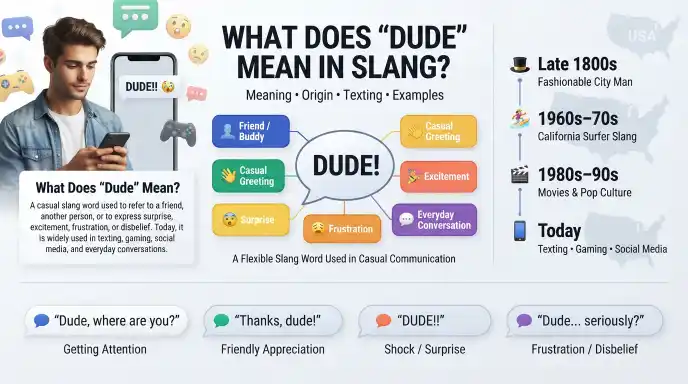
What does “dude” mean in slang? At its core, “dude” is a casual, friendly way to refer to a guy, a friend, or literally anyone, regardless of gender in modern usage.
What started as 19th century slang for a fashionable city guy has transformed into one of the most versatile words in everyday English, used to express excitement (Dude, that’s awesome!), get someone’s attention (Dude, wait up!), or simply address a close friend.
In this guide, we’ll break down where “dude” really came from, how its meaning has evolved over time, and the many ways people use it in casual conversation today.
Quick Answer: What Does “Dude” Mean in Slang?
“Dude” is an informal slang word used to refer to a person or to express surprise, excitement, frustration, or emphasis. In modern English, it is widely considered gender-neutral and is commonly used among friends in casual conversations, texting, gaming, and social media.
What Does “Dude” Mean in Slang?
“Dude” is a casual slang term that has several meanings depending on how it is used.
Most commonly, it works in three ways:
- To address someone in a friendly way
- To refer to another person
- To express an emotional reaction
Unlike many modern slang terms, “dude” is not an acronym or internet abbreviation. It is a standalone word that has remained popular for decades.
Today, millions of English speakers use it naturally in both spoken and online conversations.
Why Do People Say “Dude”?
People use “dude” because it is simple, expressive, and easy to understand.
The word helps make conversations feel relaxed and friendly.
Common reasons people use it include:
- Getting someone’s attention
- Showing surprise
- Expressing excitement
- Reacting to shocking news
- Speaking casually with friends
- Making conversations sound natural
Because it is so flexible, the same word can express several different emotions.
What Does “Dude” Mean in Text?
In text messages, “dude” usually appears at the beginning of a sentence or as a message by itself.
Its meaning depends on the conversation.
For example:
1. As a greeting
“Dude, what’s up?”
Here, it simply means friend or hey.
2. To show surprise
“DUDE!!”
This expresses excitement, shock, or disbelief.
3. To show frustration
“Dude… seriously?”
In this case, it shows disappointment or annoyance.
4. As a casual reaction
“Dude, that’s awesome.”
Here, the word adds enthusiasm without changing the main meaning of the sentence.
Texting slang often depends more on tone than dictionary definitions. Capital letters, punctuation, and emojis can completely change how “dude” is understood.
Does “Dude” Have a Full Form?
No.
“Dude” does not have a full form because it is not an abbreviation or acronym.
It is a standalone English slang word.
Depending on the sentence, it can function as:
- A noun referring to a person
- A casual way to address someone
- An interjection that expresses emotion
Examples include:
- “That dude is really funny.”
- “Dude, look at this.”
- “Dude!”
Each example uses the same word in a slightly different way.
Is “Dude” the Same as “Bro”?
Not exactly.
Both words are casual slang, but they are used differently.
| Slang Word | Meaning | Common Use |
| Dude | Person or emotional reaction | Everyday conversations |
| Bro | Close male friend or buddy | Friends and gaming |
| Bruh | Strong reaction or disbelief | Memes and social media |
| Man | Casual form of address | General conversation |
Although these words overlap, “dude” is generally more flexible because it can describe a person or simply express emotion.
Where Is “Dude” Commonly Used?
You can hear “dude” almost everywhere people communicate casually.
Common places include:
- Text messages
- WhatsApp chats
- Instagram comments
- TikTok videos
- Snapchat messages
- Discord servers
- Reddit discussions
- Online gaming
- YouTube comments
- Everyday conversations
Because of movies, television, and social media, “dude” is recognized in many countries, even outside the United States.
Who Uses the Word “Dude”?
People of almost every age use “dude.”
Although it became famous through American surfer culture, today it is part of everyday English.
Common users include:
- Teenagers
- College students
- Adults
- Gamers
- Content creators
- Friends
- Family members
- Social media users
In modern English, many people also use “dude” as a gender-neutral way to address someone, although individual preferences may differ.
Is “Dude” Rude, Offensive, or Neutral?
In most situations, “dude” is a neutral and friendly slang word.
People usually use it to sound relaxed, approachable, and informal. It is rarely considered offensive on its own. However, the speaker’s tone, facial expression, and the situation can change how the word is received.
For example:
- Friendly: “Dude, thanks for helping me.”
- Excited: “DUDE! You actually won!”
- Annoyed: “Dude… I already explained that.”
- Frustrated: “Dude, seriously?”
Although “dude” is widely treated as gender-neutral today, some people do not like being addressed this way. If someone asks you not to use it, it is best to respect their preference.
| Situation | Tone |
| Talking with friends | Friendly |
| Gaming chats | Casual |
| Social media comments | Relaxed |
| Family conversations | Informal |
| Professional meetings | Usually inappropriate |
Real-Life Examples of “Dude” in Conversations
The meaning of “dude” changes depending on the conversation.
1. Friendly Conversation
Alex: “Dude, thanks for picking me up.”
Ryan: “No problem.”
2. Text Message
Emma: “Dude, where are you?”
Jake: “Almost there.”
3. Surprise
Friend: “I got free concert tickets.”
You: “DUDE!! That’s awesome!”
4. Gaming Chat
Player 1: “Dude, that was an incredible shot.”
Player 2: “Thanks!”
5. Mild Frustration
Sarah: “Dude, I told you about this yesterday.”
Mark: “Sorry, I completely forgot.”
Common Situations Where “Dude” Changes Meaning
The same word can express different emotions depending on the context.
| Expression | Meaning |
| Dude! | Surprise or excitement |
| Dude… | Disappointment or frustration |
| Dude, listen. | Getting someone’s attention |
| That dude over there. | Referring to a person |
| Dude, seriously? | Disbelief or annoyance |
| Thanks, dude. | Friendly appreciation |
This flexibility is one reason why “dude” has remained popular for decades.
Origin and History of “Dude”
The word “dude” first appeared in American English during the late 1800s.
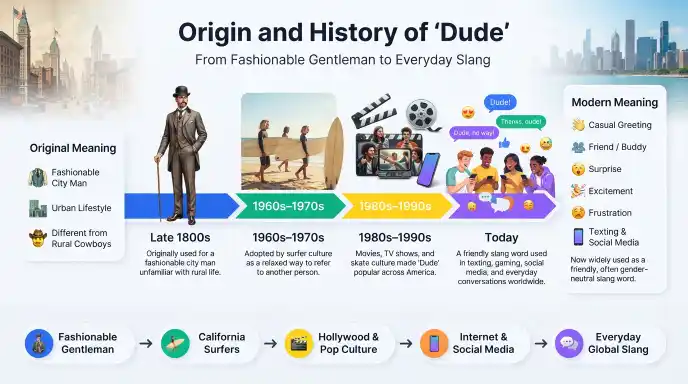
Originally, it described a fashionable city man who was unfamiliar with country life or the American West. During that time, the word often referred to someone who dressed in expensive clothes and seemed out of place on a ranch.
Later, the meaning began to change.
During the 1960s and 1970s, surfers in California started using “dude” as a relaxed way to refer to another person.
By the 1980s and 1990s, movies, television shows, and skateboarding culture helped spread the word across the United States.
Today, “dude” is one of the most recognizable slang words in English and is understood by people around the world.
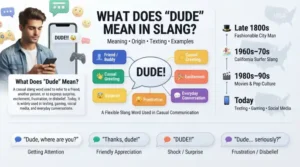
Etymology Timeline of “Dude”
| Time Period | Meaning |
| Late 1800s | Stylish city man unfamiliar with rural life |
| 1960s 1970s | Popular in surfer culture |
| 1980s 1990s | Spread through movies and television |
| 2000s Today | Casual, gender-neutral slang used worldwide |
“Dude” in Pop Culture
Pop culture played a major role in making dude famous.
Movies, television shows, and internet culture introduced the word to millions of people around the world.
Some well-known examples include:
- The Big Lebowski, where the main character is known as The Dude.
- Dude, Where’s My Car?, which made the word part of the movie’s identity.
- Bill & Ted’s Excellent Adventure, where characters frequently use relaxed California-style slang.
- That ’70s Show, which helped reinforce casual American speech.
These references helped turn dude into one of the most recognizable words in modern slang.
How Different Generations Use “Dude”
Although almost everyone understands “dude,” different generations use it in slightly different ways.
| Generation | Typical Usage |
| Boomers | Less frequent, often linked to its early meaning |
| Gen X | Casual everyday speech influenced by surfer culture |
| Millennials | Common gender-neutral way to address friends |
| Gen Z | Frequently used in texting, memes, gaming, and social media |
Today, Gen Z often combines “dude” with newer slang like “bruh,” “bro,” and “no cap,” but the word remains just as popular.
Regional Usage of “Dude” Across the United States
Although “dude” is strongly linked to California and West Coast culture, it is now used throughout the United States.
Different regions may use it slightly differently.
| Region | How “Dude” Is Commonly Used |
| West Coast | Relaxed, surfer-inspired everyday speech |
| East Coast | Casual, sometimes more direct or sarcastic |
| Midwest | Friendly conversations among friends |
| Southern US | Common, though words like “buddy” or “man” are also popular |
| Nationwide | Everyday slang in texting, gaming, and social media |
Today, “dude” is considered part of everyday American English rather than belonging to just one region.
“Dude” vs Similar Slang Words
Many slang words have similar meanings, but each has its own tone.
| Slang Term | Meaning | Tone | Gender-Neutral? |
| Dude | Person or reaction | Casual and friendly | Yes (modern usage) |
| Bro | Close male friend | Casual | Usually male |
| Bruh | Surprise or disbelief | Humorous | Usually yes |
| Man | Casual form of address | Relaxed | Traditionally male |
| Bestie | Best friend | Affectionate | Yes |
| Homie | Close friend | Informal | Yes |
Although these words overlap, “dude” is one of the most flexible because it works as both a noun and an exclamation.
Related Texting Phrases With “Dude”
People often combine “dude” with other expressions to show stronger emotions.
Some common examples include:
- Dude, no way! Shows surprise.
- Dude, seriously? Expresses disbelief or frustration.
- Dude, same. Shows agreement.
- Dude, chill. Asks someone to calm down.
- Thanks, dude. Shows appreciation.
- Come on, dude! Expresses annoyance or impatience.
- Dude, that’s awesome! Shows excitement.
- Dude, what happened? Asks for an explanation.
These phrases are common in text messages, gaming chats, and social media comments.
How to Respond When Someone Calls You “Dude”
Most of the time, “dude” is simply a friendly way to start a conversation.
Here are some natural responses.
| Someone Says | Natural Reply |
| Dude, look at this! | Wow, that’s amazing! |
| Dude, where are you? | I’m almost there. |
| Dude, seriously? | I know, right? |
| Thanks, dude. | Anytime! |
| Dude, that’s awesome. | Glad you liked it! |
If you do not like being called “dude,” you can politely let the other person know. Most people will respect your preference.
Common Mistakes When Using “Dude”
Although “dude” is easy to understand, people sometimes use it incorrectly.
Using It in Professional Communication
“Dude” sounds too casual in business emails, job interviews, and formal meetings.
Calling Everyone “Dude”
Some people do not like being addressed as “dude.” It is always a good idea to respect personal preferences.
Using It Too Often
Repeating “dude” in every sentence can make your speech sound repetitive. Mixing it with other natural expressions creates smoother conversations.
When Should You Avoid Using “Dude”?
There are situations where a more formal word is a better choice.
Avoid using “dude” in:
- Business emails
- Job interviews
- Academic writing
- Professional presentations
- Legal documents
- Official letters
- Formal customer communication
Choosing more professional language helps create a better impression.
Polite Alternatives to “Dude”
If you want a more neutral or professional tone, consider these alternatives.
| Instead of “Dude” | Better Alternative |
| Dude | Hello |
| Dude | Hi |
| Dude | Hey there |
| Dude | Use the person’s name |
| Dude | Friend (informal) |
| Dude | Everyone (group conversations) |
The best option depends on your relationship with the other person.
Why Do People Use “Dude”?
People continue to use “dude” because it is simple, expressive, and versatile.
Common reasons include:
- It sounds friendly.
- It gets someone’s attention quickly.
- It expresses surprise or excitement.
- It makes conversations feel relaxed.
- It fits naturally in texting and social media.
- It is easy for almost everyone to understand.
Its flexibility has helped it remain popular for many decades.
Impact of Using “Dude” in Communication
Using “dude” can make conversations feel more personal and relaxed.
Benefits include:
- Creates a friendly tone.
- Makes conversations sound natural.
- Helps express emotions quickly.
- Builds a sense of familiarity.
However, using it in formal situations may sound unprofessional.
Knowing your audience is the key to using slang effectively.
Is “Dude” Safe to Use on Social Media?
Yes.
“Dude” is considered safe on all major social media platforms.
It is commonly used on:
- TikTok
- Snapchat
- Discord
- YouTube
- X (formerly Twitter)
The word is not considered offensive or inappropriate by itself. As with any slang, the overall message and tone matter more than the word itself.
Frequently Asked Questions
Q1. What does “dude” mean in slang?
“Dude” is an informal slang word used to address someone casually or express surprise, excitement, frustration, or emphasis.
Q2. Is “dude” an offensive word?
No. It is generally friendly and neutral, although tone and context can change how it is received.
Q3. Can “dude” be used for girls?
Yes. In modern English, many people use “dude” as a gender-neutral term, although some individuals prefer not to be called that.
Q4. Does “dude” have a full form?
No. “Dude” is a standalone slang word and is not an acronym or abbreviation.
Q5. Where did the word “dude” originate?
It first appeared in American English during the late 1800s and later became popular through surfer culture, movies, and television.
Q6. Is “dude” appropriate for professional communication?
Generally, no. It is best used in casual conversations rather than formal or business settings.
Q7. Why do Americans say “dude” so often?
The word became deeply rooted in American culture through surfing, skateboarding, movies, television, and everyday conversation. Today, it is simply a natural part of casual American English.
Q8. Is “dude” still popular today?
Yes. It remains one of the most widely used slang words in texting, gaming, social media, and everyday conversations.
Q9. Do Gen Z say Dude?
Yes. Gen Z still uses “dude” in casual conversations, texting, gaming, and social media, often alongside slang like bro, bruh, and no cap.
Q10. What does calling someone a Dude mean?
Calling someone “dude” is a friendly, informal way to refer to a person or get their attention. It can also express surprise, excitement, or frustration, depending on the context.
Key Takeaways
- “Dude” is a casual slang word used to address someone or express emotion.
- It does not have a full form because it is not an abbreviation.
- The word is generally friendly and gender-neutral in modern English.
- It is widely used in texting, gaming, social media, and casual conversations.
- Avoid using it in formal or professional settings.
- Context, tone, punctuation, and capitalization can change its meaning.
Conclusion
“Dude” has grown from a regional American expression into one of the most recognizable slang words in modern English. If it is used to greet a friend, react to surprising news, or simply refer to someone, the word remains friendly, flexible, and easy to understand.
Today, “dude” appears in text messages, social media posts, gaming chats, and everyday conversations around the world. While it is generally safe and appropriate in casual settings, it is still important to consider your audience and the situation. Using “dude” naturally and at the right time will help your conversations sound more relaxed without feeling out of place.
Learn More Slang

Hi, I’m Sarah. I studied Communications at the University of Texas and have spent the last six years writing about internet culture and Gen Z slang across TikTok, Twitter, and everyday conversations. I focus on real usage, not just dictionary definitions.