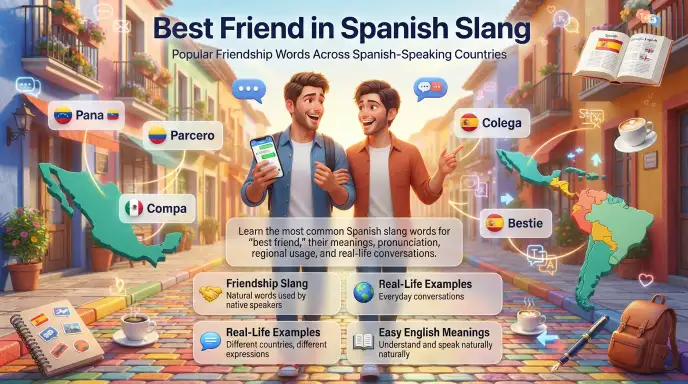
Best friend in Spanish slang isn’t just “mejor amigo”, native speakers often use much more casual, affectionate, and region-specific words to describe their closest friends.
If you’ve ever heard someone say “mano,” “cuate,” or “parcero” and wondered what it actually means, you’re picking up on a whole layer of everyday Spanish that textbooks rarely teach. These slang terms carry warmth, closeness, and personality that a formal translation just can’t capture.
In this guide, we’ll break down the most common Spanish slang words for best friend, where they’re used, and how to use them naturally in real conversations.
In this guide, you’ll learn the most common Spanish slang words for best friend, their meanings, UK and US pronunciations, real life examples, and the countries where people use them most.
Quick Answer: Best Friend in Spanish Slang
The most common ways to say best friend in Spanish slang are pana, parcero, compa, carnal, and bestie. However, mejor amigo and mejor amiga remain the safest choices because Spanish speakers understand them everywhere.
What Does “Best Friend” Mean in Spanish Slang?
In Spanish slang, a best friend is someone you trust deeply and spend a lot of time with. Rather than using the formal phrase mejor amigo, native speakers often choose shorter and more natural slang words.
Although every country has its own favorite expression, the meaning stays almost the same. Each term describes a close friend who feels like family.
Formal vs. Slang
The standard Spanish translations are:
- Mejor amigo: Best friend (male)
- Mejor amiga: Best friend (female)
However, casual conversations usually include regional slang instead.
Some of the most popular alternatives are:
- Pana
- Parcero
- Compa
- Carnal
- Bestie
- Bro
- Colega
Best Friend in Spanish Slang Alternatives
1. Pana
Pronunciation (UK): PAH-nah
Pronunciation (US): PAH-nuh
Meaning:
Pana means buddy, close friend, or best friend. It is one of the most popular slang words in Venezuela and Puerto Rico.
Example:
Él es mi pana desde la escuela.
English:
“He has been my best friend since school.”
2. Parcero / Parcera
Pronunciation (UK): par-SEH-ro / par-SEH rah
Pronunciation (US): par-SEH-ro / par-SEH-rah
Meaning:
Parcero (male) and parcera (female) mean best buddy or close friend. These words are very common in Colombia.
Example:
Mi parcero siempre está conmigo.
English:
“My best friend is always with me.”
3. Compa
Pronunciation (UK): KOM-pah
Pronunciation (US): KAHM-puh
Meaning:
Compa means pal, buddy, or close friend. People in Mexico use this word every day.
Example:
Voy al partido con mi compa.
English:
“I’m going to the game with my buddy.”
4. Carnal
Pronunciation (UK): kar-NAHL
Pronunciation (US): kar-NAHL
Meaning:
Carnal describes a friend who feels like a brother. This slang is especially popular in Mexico.
Example:
Ese carnal siempre me ayuda.
English:
“That friend always helps me.”
5. Bestie
Pronunciation (UK): BES-tee
Pronunciation (US): BES-tee
Meaning:
Bestie is a modern slang word borrowed from English. Young people often use it on TikTok, Instagram, and WhatsApp.
Example:
Mi bestie vive cerca de mi casa.
English:
“My bestie lives near my house.”
6. Bro
Pronunciation (UK): broh
Pronunciation (US): broh
Meaning:
Many Spanish speakers also use bro for a very close male friend.
Example:
Ese bro nunca llega tarde.
English:
“That bro is never late.”
7. Colega
Pronunciation (UK): koh-LEH-gah
Pronunciation (US): koh-LAY-gah
Meaning:
Colega means mate, friend, or buddy. It is especially common in Spain.
Example:
Mi colega trabaja conmigo.
English:
“My friend works with me.”
Where Is Best Friend Spanish Slang Commonly Used?
Spanish slang for best friend appears in many casual situations.
Social Media
People frequently use these words on:
- TikTok
- X (Twitter)
- Snapchat
Many captions, comments, and short videos include these expressions because they sound friendly and natural.
Text Messages
Friends often replace mejor amigo with regional slang while chatting.
Example:
A: ¿Dónde está tu pana?
B: Ya viene.
English:
A: “Where’s your best friend?”
B: “He’s on his way.”
Everyday Conversations
Native speakers also use these slang words with classmates, neighbors, coworkers, teammates, and lifelong friends. As a result, you’ll hear them regularly in daily conversations throughout Spanish speaking countries.
Which Spanish Slang for “Best Friend” Sounds Most Natural by Country?
Spanish slang changes from one country to another. Therefore, choosing the right word makes your Spanish sound more natural.
Mexico
People in Mexico often say compa or carnal when talking about a close friend.
Example:
Mi compa viene conmigo.
English: “My buddy is coming with me.”
Colombia
Colombians usually prefer parcero or parcera.
Example:
Ese parcero es como mi hermano.
English: “That best friend is like my brother.”
Venezuela and Puerto Rico
The word pana is one of the most common choices.
Example:
Ella es mi pana desde hace años.
English: “She has been my best friend for years.”
Spain
People in Spain commonly use colega. Younger speakers may also say bestie or bro in casual conversations.
Example:
Mi colega vive en Madrid.
English: “My friend lives in Madrid.”
Argentina
Many people simply say amigo, amiga, or bro in relaxed conversations.
Although Argentina has its own slang, these words remain common among younger speakers.
Is Best Friend Spanish Slang Rude, Offensive, or Harmless?
Most Spanish slang for best friend is friendly and respectful. Native speakers use these words with family members, classmates, coworkers, teammates, and close friends.
However, you should always choose slang that matches the country. Otherwise, people may understand the word but rarely use it themselves.
| Expression Type | Tone | Safe to Use? |
| Mejor amigo/a | Neutral | Yes |
| Pana | Friendly | Yes |
| Parcero/a | Friendly | Yes |
| Compa | Casual | Yes |
| Carnal | Informal | Yes |
| Bestie | Modern | Yes |
| Bro | Casual | Yes |
| Colega | Friendly | Yes |
Real Life Examples of Best Friend in Spanish Slang
These conversations show how native speakers naturally use the slang.
Example 1: School Friends
Spanish:
Mi pana siempre estudia conmigo.
English:
“My best friend always studies with me.”
Example 2: Weekend Plans
Spanish:
Voy al cine con mi compa.
English:
“I’m going to the movies with my buddy.”
Example 3: Childhood Friend
Spanish:
Mi parcero y yo crecimos juntos.
English:
“My best friend and I grew up together.”
Example 4: Social Media Caption
Spanish:
Feliz cumpleaños, bestie.
English:
“Happy birthday, bestie.”
Example 5: Talking About Friendship
Spanish:
Ese carnal siempre está cuando lo necesito.
English:
“That friend is always there when I need him.”
Origin and History of Best Friend Spanish Slang
Spanish slang has changed for hundreds of years. Every region developed its own words for friendship, and many expressions are still popular today.
Regional Influence
Countries created their own slang over time.
For example:
- Mexico popularized compa and carnal.
- Colombia became known for parcero.
- Venezuela made pana famous.
- Spain commonly uses colega.
As a result, Spanish speakers quickly recognize where someone is from by the slang they use.
Influence of Music and Movies
Latin music, television series, and movies introduced many slang words to international audiences.
Today, reggaeton artists, YouTubers, and streamers regularly use expressions like bro, bestie, and compa.
Social Media
Platforms such as TikTok, Instagram, WhatsApp, and YouTube continue to spread new friendship slang every year.
Consequently, younger generations often mix English and Spanish words in the same conversation.
Similar Slang or Related Terms
| Slang | Meaning | Popular Region |
| Amigo | Friend | All Spanish speaking countries |
| Mejor amigo | Best friend | All countries |
| Pana | Buddy | Venezuela, Puerto Rico |
| Parcero | Close friend | Colombia |
| Compa | Buddy | Mexico |
| Carnal | Brother like friend | Mexico |
| Colega | Mate | Spain |
| Bro | Bro | Many countries |
| Bestie | Best friend | Worldwide |
| Hermano | Brother (close friend) | Many countries |
Why Do People Use Spanish Slang for Best Friend?
People use friendship slang because it sounds warmer and more personal.
Some common reasons include:
- Talking with close friends.
- Sending text messages.
- Posting on social media.
- Playing online games.
- Meeting new people.
- Showing local culture.
- Sounding more like a native speaker.
In addition, regional slang helps speakers feel connected to their community because many expressions reflect local culture and traditions.
When Should You Avoid Using Spanish Slang for “Best Friend”?
Spanish slang sounds natural in casual conversations. However, it is not suitable for every situation. Therefore, you should know when formal language is the better choice.
Avoid using friendship slang in these situations:
- Business meetings.
- Job interviews.
- School essays.
- Academic presentations.
- Professional emails.
- Government offices.
- Formal speeches.
Instead, use mejor amigo or mejor amiga when you need clear and professional Spanish.
Platform Usage Comparison
Different platforms use friendship slang in different ways.
| Platform | Common Usage | Popularity |
| TikTok | Short videos, trends, comments | Very High |
| Captions, Reels, Stories | Very High | |
| Personal chats | Very High | |
| Casual conversations | High | |
| X (Twitter) | Posts and replies | Medium |
| Language discussions | High | |
| Discord | Gaming and community chats | High |
Although each platform has its own style, words like bestie, bro, and compa appear frequently across social media.
Is It Safe to Use Best Friend Spanish Slang on Social Media?
Yes. Most Spanish slang for best friend is safe to use on social media because it is friendly and respectful.
However, remember that regional slang can confuse readers from other countries. For example, a Colombian immediately understands parcero, while someone from Spain may not use that word in daily conversations.
If your audience comes from different Spanish speaking countries, bestie, mejor amigo/a, or amigo/a are usually the easiest options to understand.
Common Misunderstandings About Best Friend in Spanish Slang

Many learners make small mistakes when using friendship slang. The points below explain the most common ones.
Thinking “Amigo” Means Best Friend
Amigo simply means friend.
If you want to say best friend, use mejor amigo/a or a regional slang word like pana or parcero.
Assuming Every Country Uses the Same Slang
Spanish slang changes from country to country.
For example:
- Pana is common in Venezuela.
- Parcero is popular in Colombia.
- Compa is widely used in Mexico.
- Colega is common in Spain.
Therefore, choosing regional slang makes your Spanish sound more natural.
Believing “Bestie” Is Traditional Spanish
Although bestie is popular today, it is borrowed from English.
Older Spanish speakers often prefer traditional expressions like mejor amigo/a instead.
Using Slang in Formal Situations
Friendship slang works well with friends and family.
However, formal situations require standard Spanish because it sounds more professional.
Key Takeaways
- Mejor amigo and mejor amiga are the standard ways to say best friend.
- Pana is popular in Venezuela and Puerto Rico.
- Parcero is the natural choice in Colombia.
- Compa and carnal are common in Mexico.
- Colega is widely used in Spain.
- Bestie and bro are modern slang used by younger speakers.
- Regional slang helps your Spanish sound more authentic.
Frequently Asked Questions
Q1. How do you say best friend in Spanish slang?
Popular slang words include pana, parcero, compa, carnal, bestie, and bro, depending on the country.
Q2. What is the formal way to say best friend in Spanish?
The formal translation is mejor amigo (male) or mejor amiga (female).
Q3. What does “pana” mean in Spanish slang?
Pana means buddy, close friend, or best friend. It is especially common in Venezuela and Puerto Rico.
Q4. What does “parcero” mean?
Parcero means close friend or best buddy. People in Colombia use it every day.
Q5. Is “compa” common in Mexico?
Yes. Compa is one of the most common slang words for a close friend in Mexico.
Q6. What does “carnal” mean in Mexican slang?
Carnal describes a friend who feels like family or a brother.
Q7. Is “bestie” used by Spanish speakers?
Yes. Many younger Spanish speakers use bestie, especially on TikTok, Instagram, and WhatsApp.
Q8. Which Spanish slang works in every country?
Mejor amigo/a is understood everywhere. However, regional slang changes from country to country.
Q9. Can I use friendship slang in business conversations?
No. Formal situations require standard Spanish instead of slang.
Q10. How can I learn Spanish friendship slang faster?
Watch Spanish movies, follow native speakers on social media, listen to Latin music, and practice conversations with people from different Spanish speaking countries.
Conclusion
Learning best friend in Spanish slang helps you speak more naturally and understand real conversations. While mejor amigo and mejor amiga remain the standard translations, regional slang such as pana, parcero, compa, carnal, and colega adds personality and reflects local culture. As a result, choosing the right word makes your Spanish sound more authentic.
If you’re traveling, chatting online, or learning Spanish for fun, understanding these friendship terms will improve your communication. Finally, remember to match the slang to the country and use formal Spanish whenever the situation calls for a more professional tone.
Explore More Related Slang

Hi, I’m Sarah. I studied Communications at the University of Texas and have spent the last six years writing about internet culture and Gen Z slang across TikTok, Twitter, and everyday conversations. I focus on real usage, not just dictionary definitions.