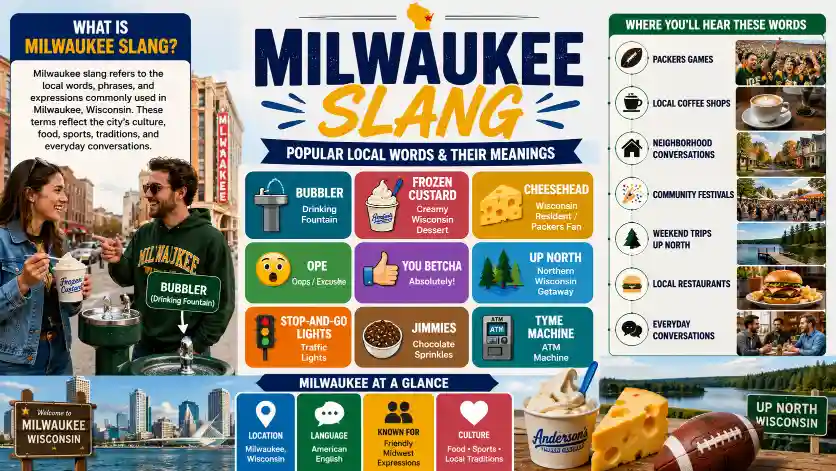
Milwaukee slang refers to the local words, expressions, and phrases commonly used by people in Milwaukee, Wisconsin, to reflect the city’s culture, community, and everyday conversations.
Some terms are unique to the area, while others have become popular through local traditions, sports, and neighborhood life. Understanding Milwaukee slang can help you communicate more naturally with locals and better appreciate the city’s identity.
If you are visiting Milwaukee, moving there, or simply curious about regional American English, learning these expressions makes conversations easier to follow.
In this guide, you’ll discover the meanings of popular Milwaukee slang words, how to pronounce them, real-life examples, and when to use them. By the end, you’ll have a better understanding of the local language and the culture that shapes it.
Quick Answer: What Is Milwaukee Slang?
Milwaukee slang is a collection of local words and expressions used by people in Milwaukee and nearby parts of Wisconsin. Many of these terms are unique to the region, while others are Midwestern expressions with slightly different meanings. They help locals communicate naturally and also reflect the city’s history and identity.
What Does Milwaukee Slang Mean?
Milwaukee slang includes informal words, sayings, and pronunciations that are popular among local residents. Some expressions describe everyday objects, while others refer to food, weather, sports, or places around the city.
Unlike internet slang, Milwaukee slang is regional. It is mostly heard in conversations between family members, friends, neighbors, classmates, and coworkers.
Many visitors notice these expressions because they sound different from the words used in other parts of the United States.
Why Does Milwaukee Have Its Own Slang?
Every city develops its own way of speaking over time. Milwaukee is no different.
Several factors have shaped local language, including:
- German heritage
- Polish communities
- Midwestern English
- Blue-collar traditions
- Sports culture
- Local businesses and landmarks
These influences have created expressions that many Wisconsin residents recognize immediately.
Where Is Milwaukee Slang Commonly Used?
You are most likely to hear Milwaukee slang during everyday conversations rather than in formal writing.
Common places include:
- Schools
- Homes
- Local restaurants
- Neighborhood gatherings
- Sporting events
- Bars and breweries
- Community festivals
- Farmers markets
Many expressions are also shared on Facebook, TikTok, Reddit, Instagram, and local community groups when people talk about Wisconsin life.
Who Uses Milwaukee Slang?
People of all ages use Milwaukee slang, although some expressions are more common among older generations.
You may hear it from:
- Lifelong Milwaukee residents
- Wisconsin families
- College students
- Local business owners
- Brewers fans
- Packers fans
- Hunters and campers
- Outdoor enthusiasts
Some words have been passed from one generation to another, while newer expressions spread through social media and local communities.
Is Milwaukee Slang Different From Wisconsin Slang?
Yes. Milwaukee slang and Wisconsin slang overlap, but they are not exactly the same.
Wisconsin slang covers the entire state, while Milwaukee slang focuses on expressions that are especially popular in Milwaukee and nearby areas.
| Milwaukee Slang | Wisconsin Slang |
| Often connected to city life and local landmarks | Covers rural and urban communities across the state |
| Influenced by Milwaukee history and culture | Includes traditions from all regions of Wisconsin |
| Common in Milwaukee neighborhoods | Used throughout the state |
Because Milwaukee is Wisconsin’s largest city, many of its expressions eventually become familiar across the state.
Most Common Milwaukee Slang Words
Many local expressions are easy to understand once you know the meaning. Here are some of the best-known examples.
1. Bubbler (BUB-ler)
A bubbler is a drinking fountain.
This is one of the most famous Wisconsin words. Visitors are often surprised when someone says, “The bubbler is down the hall.”
Example
- “I need a drink. Where’s the bubbler?”
- “The school installed a new bubbler.”
2. Tyme Machine (TYME muh-SHEEN)
A Tyme Machine originally referred to an ATM connected to Wisconsin’s TYME banking network.
Even though banking technology has changed, many local residents still call an ATM a Tyme Machine.
Example
- “I’m stopping at the Tyme Machine before dinner.”
- “There’s a Tyme Machine outside the grocery store.”
3. Up North (UP NORTH)
For many Wisconsin residents, up north means traveling to cabins, lakes, forests, or vacation areas in northern Wisconsin.
It represents more than a direction. It often means relaxing, fishing, camping, or spending time with family.
Example
- “We’re heading up north this weekend.”
- “My grandparents have a cabin up north.”
4. Stop-and-Go Lights (STOP and GO LITES)
Some Milwaukee residents say stop-and-go lights instead of traffic lights.
Although younger speakers often use “traffic lights,” the older phrase is still recognized.
Example
- “Turn left at the next stop-and-go lights.”
- “The stop-and-go lights are backed up today.”
5. Jimmies (JIM-eez)
Jimmies are chocolate sprinkles used on ice cream or desserts.
While many Americans simply say “sprinkles,” this local term is still common in parts of Wisconsin.
Example
- “Can I get chocolate jimmies on my ice cream?”
- “The kids wanted extra jimmies.”
6. Cheesehead (CHEEZ-hed)
A Cheesehead is a nickname for people from Wisconsin, especially loyal Green Bay Packers fans.
The name began as a joke but later became a symbol of state pride. Today, many fans proudly wear foam cheese hats during football games.
Example
- “He’s a proud Cheesehead who never misses a Packers game.”
- “Thousands of Cheeseheads traveled to support the team.”
7. Ope (OHP)
Ope is a quick word people say after a small mistake or when they accidentally get in someone’s way.
It does not have a direct meaning. Instead, it works like saying “oops” or “sorry.”
Example
- “Ope, I didn’t see you there.”
- “Ope, let me grab that for you.”
8. You Betcha (YOO BET-chuh)
You betcha means “absolutely,” “of course,” or “you’re welcome.”
It is common across the Upper Midwest and sounds friendly and welcoming.
Example
- “Can you help me tomorrow?”
- “You betcha.”
9. Frozen Custard (FROH-zən KUSS-terd)
In Milwaukee, people often talk about custard instead of regular ice cream.
Frozen custard is one of the city’s best-known desserts, so locals usually shorten the name.
Example
- “Let’s grab some custard after dinner.”
- “This place has the best chocolate custard.”
Is Milwaukee Slang Rude, Offensive, or Harmless?
Most Milwaukee slang is harmless.
It usually describes everyday life, local traditions, or familiar places rather than insulting people.
However, context still matters.
| Expression | Offensive? | Notes |
| Bubbler | No | Everyday local word |
| Ope | No | Friendly expression |
| Up North | No | Refers to vacation areas |
| Cheesehead | Usually No | Often used proudly, but tone matters |
| Jimmies | No | Regional word for chocolate sprinkles |
Most expressions are safe to use in casual conversations with friends, neighbors, classmates, and coworkers.
Real-Life Examples of Milwaukee Slang
Here are realistic conversations showing how locals use Milwaukee slang.
Family Conversation
Mom: “Don’t forget your water bottle.”
Son: “It’s okay. I’ll use the bubbler at school.”
Friends Planning a Weekend
Emma: “Any plans this weekend?”
Liam: “Yeah, we’re heading up north for a fishing trip.”
At a Football Game
Fan 1: “Nice Cheesehead hat.”
Fan 2: “I’ve worn it to every Packers game.”
At an Ice Cream Shop
Customer: “Can I get chocolate custard with extra jimmies?”
Worker: “Of course.”
Walking Through a Store
Person 1: “Ope, excuse me.”
Person 2: “No problem.”
Origin and History of Milwaukee Slang

Milwaukee slang developed over many generations.
The city’s language reflects its unique history and the people who settled there.
Several influences helped shape local expressions:
- German immigrants
- Polish immigrants
- Irish communities
- Scandinavian settlers
- Midwestern English
- Wisconsin traditions
Many local words became popular long before social media existed. Families passed them down through everyday conversations.
Some expressions, such as bubbler, have been used in Wisconsin for more than a century. Others, like Cheesehead, became widely recognized after the success of Wisconsin sports teams.
Today, social media helps preserve regional language. Local residents often share Milwaukee expressions on TikTok, Reddit, Facebook, and Instagram, introducing them to people outside Wisconsin.
Why Do People Use Milwaukee Slang?
People use Milwaukee slang because it feels natural and familiar.
Local expressions also create a sense of belonging.
Common reasons include:
- Showing local pride
- Connecting with family traditions
- Speaking naturally with neighbors
- Reflecting Wisconsin culture
- Celebrating local sports
- Keeping regional traditions alive
For many residents, these expressions are simply part of everyday speech.
Similar Slang and Related Terms
Milwaukee slang shares similarities with other Midwestern expressions.
| Milwaukee Slang | Related Term | Meaning |
| Bubbler | Drinking fountain | Water fountain |
| Ope | Oops | Small apology |
| You betcha | Absolutely | Strong agreement |
| Up north | Cabin trip | Vacation in northern Wisconsin |
| Cheesehead | Packers fan | Wisconsin supporter |
Some words are understood across the Midwest, while others remain closely associated with Wisconsin.
Common Misunderstandings About Milwaukee Slang
Visitors sometimes misunderstand local expressions.
Here are a few common myths.
Milwaukee Slang Is Internet Slang
It is not.
Most Milwaukee slang comes from regional culture rather than online communication.
Everyone in Wisconsin Uses Every Expression
Not always.
Some words are more common in Milwaukee, while others are used throughout the state.
Only Older People Use Milwaukee Slang
This is also false.
Many younger residents still use popular expressions like ope, up north, and Cheesehead, especially in casual conversations and on social media.
When Should You Avoid Using Milwaukee Slang?
Most Milwaukee slang is friendly and easy to understand. Even so, it is not the best choice in every situation.
Avoid using it when:
- Speaking with people who are unfamiliar with Wisconsin culture.
- Writing formal emails or business documents.
- Giving academic presentations.
- Communicating with international audiences.
- Writing legal or professional reports.
Using standard English is often the better option when clear communication is the goal.
When Is It Appropriate to Use Milwaukee Slang?
Milwaukee slang works well in casual settings.
Good situations include:
- Talking with local friends
- Family conversations
- Community events
- Sports discussions
- Social media posts
- Local online groups
- Casual text messages
Knowing your audience helps you decide if local expressions will be understood.
Polite Alternatives to Milwaukee Slang
If your audience may not recognize Milwaukee slang, you can use more common English words.
| Milwaukee Slang | Standard English |
| Bubbler | Drinking fountain |
| Tyme Machine | ATM |
| Ope | Excuse me / Oops |
| Jimmies | Chocolate sprinkles |
| You betcha | Absolutely |
| Stop-and-go lights | Traffic lights |
| Up north | Northern Wisconsin |
These alternatives are easier for people outside Wisconsin to understand.
Frequently Asked Questions
Q1. What is Milwaukee slang?
Milwaukee slang is a collection of regional words and expressions commonly used by people in Milwaukee and nearby parts of Wisconsin. These terms reflect local culture, history, traditions, and everyday life.
Q2. Is Milwaukee slang the same as Wisconsin slang?
No. Milwaukee slang is part of Wisconsin slang, but it focuses on expressions that are especially common in Milwaukee. Some words are used across the state, while others are more closely connected to the city.
Q3. What is the most famous Milwaukee slang word?
Bubbler is one of the best-known Milwaukee and Wisconsin slang terms. It refers to a drinking fountain and is often the first regional word visitors notice.
Q4. Why do people say “ope” in Milwaukee?
People say ope after a small mistake, when bumping into someone, or before saying “excuse me.” It is a polite habit that is common throughout much of the Midwest.
Q5. Is “Cheesehead” an insult?
Usually, no. Today, Cheesehead is mostly a positive nickname for Wisconsin residents and Green Bay Packers fans. Many people proudly use the term.
Q6. Is Milwaukee slang still used today?
Yes. Many local expressions remain part of everyday conversations. Some are also shared on social media, helping younger generations keep them alive.
Q7. Can tourists use Milwaukee slang?
Yes. Locals usually appreciate visitors who use these expressions respectfully and in the right context. Learning a few common terms can also make conversations feel more natural.
Q8. Why is Milwaukee slang different from other American slang?
Milwaukee slang developed through the city’s history, immigrant communities, Midwestern English, and local traditions. This combination created expressions that are uncommon in many other parts of the United States.
Q9. What is Milwaukee slang?
Milwaukee slang refers to local words and expressions commonly used by people in Milwaukee, Wisconsin. It often reflects the city’s culture, neighborhoods, and Midwest speech.
Q10. What are some hood slang words?
Some common hood slang words include bro, opp, cap, lit, and drip. Their meanings can vary depending on the community and context.
Q11. What does “Milwaukee” mean?
The name Milwaukee comes from an Algonquian language and is commonly understood to mean “good land” or “gathering place by the water.”
Q12. What are 5 slang words?
Five popular slang words are lit (exciting), cap (lie), bet (okay), flex (show off), and vibe (feeling or atmosphere).
Conclusion
Milwaukee slang is more than a collection of unusual words. It reflects the city’s history, traditions, and community spirit. Expressions like bubbler, ope, Cheesehead, and up north continue to shape everyday conversations and help preserve Wisconsin’s regional identity.
If you are visiting Milwaukee, moving to Wisconsin, or simply curious about regional American English, learning these local expressions can make conversations easier and more enjoyable. Understanding when and where to use Milwaukee slang will also help you communicate naturally while respecting local culture.
Read More:
Hey, I’m Jordan. I grew up in a bilingual household in LA, so Spanish and Mexican American slang has always been part of how I talk. I’ve been writing online content for five years, explaining terms the way I’d explain them to a friend meaning, tone, and when it’s actually okay to use.