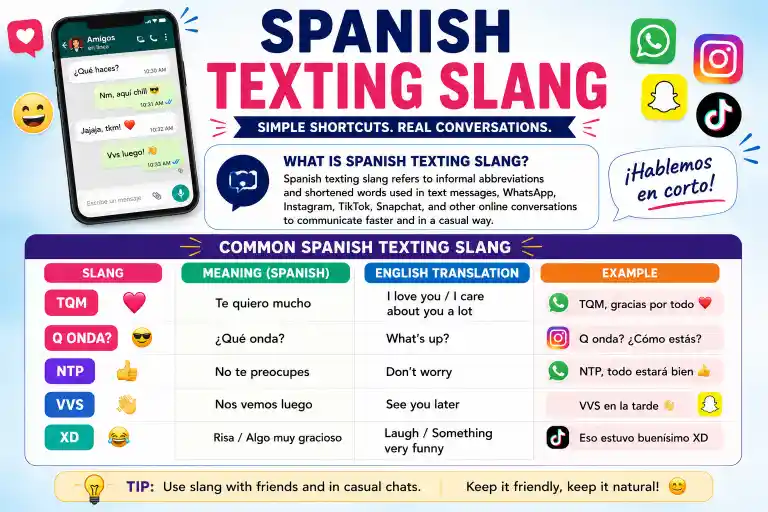
Spanish texting slang is a collection of shortened words, abbreviations, and informal expressions used in text messages, social media, and online chats. Native Spanish speakers use these shortcuts to type faster while keeping conversations casual and friendly.
If you are learning Spanish or chatting with Spanish-speaking friends, you may come across terms like xq, tqm, ntp, or bn. At first, they can look confusing.
This guide explains what Spanish texting slang means, where people use it, and how to understand it in everyday conversations.
Quick Answer: What Is Spanish Texting Slang?
Spanish texting slang is informal language used in digital communication. It includes abbreviations, shortened spellings, acronyms, and internet expressions that help people send messages more quickly. Most of these terms appear in text messages, WhatsApp chats, Instagram, TikTok, Facebook Messenger, Snapchat, Discord, and online gaming.
What Does Spanish Texting Slang Mean?
Spanish texting slang refers to the shortened words and expressions that Spanish speakers use when chatting online.
Instead of writing complete sentences, people often remove letters, replace words with abbreviations, or use initials that represent longer phrases. This saves time and makes conversations feel more relaxed.
Unlike formal Spanish, texting slang follows no strict grammar rules. Many expressions depend on the situation and the relationship between the people chatting.
Why Do People Use Spanish Texting Slang?
People use Spanish texting slang because it is quick and convenient.
It also makes conversations sound more natural between friends and family.
Common reasons include:
- Typing messages faster
- Saving space in chats
- Sounding casual
- Following social media trends
- Expressing emotions quickly
- Keeping conversations friendly
Many abbreviations have become so common that native speakers use them every day.
Where Is Spanish Texting Slang Commonly Used?
Spanish texting slang appears in many online platforms.
The most common places include:
- TikTok
- Snapchat
- Facebook Messenger
- Discord
- Telegram
- X (formerly Twitter)
- Online gaming chats
Some abbreviations are understood almost everywhere, while others are more popular in certain Spanish-speaking countries.
Who Uses Spanish Texting Slang?
People of different ages use Spanish texting slang, but it is especially common among teenagers and young adults.
You may see it used by:
- Students
- Friends
- Family members
- Online gamers
- Social media creators
- College students
- Spanish language learners
- Online communities
Many adults also use common abbreviations in casual conversations.
Is Spanish Texting Slang the Same in Every Country?
No. Spanish texting slang changes from one country to another.
Many abbreviations are shared across Spain and Latin America, but some expressions are unique to a specific region.
For example, a slang term that is common in Mexico may sound unusual in Argentina or Spain.
| Region | Texting Slang |
| Spain | Some local abbreviations and internet slang |
| Mexico | Many popular chat abbreviations and casual expressions |
| Argentina | Regional slang mixed with common texting shortcuts |
| Colombia | Everyday abbreviations with local vocabulary |
| Latin America | Many shared internet abbreviations |
Because Spanish is spoken in many countries, context is important when reading online conversations.
Most Popular Spanish Texting Slang
Below are some of the most common Spanish texting abbreviations that you are likely to see in messages and social media posts.
1. TQM (Te Quiero Mucho)
TQM stands for “Te Quiero Mucho.”
It means “I love you very much” or “I care about you a lot.” Friends, family members, and couples often use it in casual conversations.
Example
- “TQM. Have a great day!”
- “Thanks for always helping me. TQM.”
2. XQ (Porque)
XQ is short for “Porque” or “Por qué,” depending on the sentence.
It means “because” or “why.”
Example
- “No puedo ir xq estoy ocupado.”
- “Xq llegaste tan tarde?”
3. NTP (No Te Preocupes)
NTP means “No Te Preocupes.”
It translates to “Don’t worry.”
People use it to reassure someone.
Example
- “NTP, everything is fine.”
- “NTP, I’ll handle it.”
4. BN (Bien)
BN is a short form of “Bien.”
It simply means “good” or “fine.”
Example
- “Todo bn?”
- “Sí, estoy bn.”
5. K (Que)
Many Spanish speakers write K instead of Que because it is quicker to type.
This shortcut is very common in informal chats.
Example
- “K haces?”
- “K bueno verte.”
6. TMB (También)
TMB stands for “También.”
It means “also” or “too.”
Example
- “Yo tmb quiero ir.”
- “Tmb me gusta esa canción.”
7. DND (De Nada)
DND means “De Nada.”
It is the Spanish equivalent of “You’re welcome.”
Example
- “Gracias por tu ayuda.”
- “DND.”
8. SALU2 (Saludos)
SALU2 is a creative way of writing “Saludos.”
The number 2 replaces the ending because it sounds similar when spoken.
It simply means “Greetings” or “Best wishes.”
Example
- “Hablamos luego. Salu2.”
- “Salu2 para todos.”
9. PQ (Porque)
PQ is another common abbreviation for “Porque.”
It has the same meaning as XQ in many conversations.
Example
- “No fui pq estaba enfermo.”
- “Llegué tarde pq había tráfico.”
10. XD
Although XD is not exclusive to Spanish, it is widely used in Spanish chats.
It represents a laughing face and shows that something is funny.
Example
- “Eso fue muy gracioso XD.”
- “No puedo creerlo XD.”
11. OMW (On My Way)
OMW stands for “On My Way.” While it comes from English, many bilingual Spanish speakers use it in text messages.
It means you are traveling to meet someone.
Example
- “OMW. Llego en cinco minutos.”
- “Espera un poco. OMW.”
12. BB (Bebé)
BB is short for “Bebé.”
It means “baby” or “babe.” Couples and close friends often use it as a nickname.
Example
- “Hola bb, ¿cómo estás?”
- “Buenas noches, bb.”
What Do the Most Common Spanish Texting Abbreviations Mean?
Many Spanish abbreviations replace longer words with just a few letters.
| Abbreviation | Full Meaning | English Meaning |
| TQM | Te Quiero Mucho | Love you very much |
| XQ | Porque / Por qué | Because / Why |
| PQ | Porque | Because |
| NTP | No Te Preocupes | Don’t worry |
| BN | Bien | Fine |
| TMB | También | Also |
| DND | De Nada | You’re welcome |
| K | Que | What / That |
| SALU2 | Saludos | Greetings |
| BB | Bebé | Babe |
| XD | Laughing face | That’s funny |
These abbreviations are widely understood across many Spanish-speaking communities, although some are more common in certain countries.
Is Spanish Texting Slang Rude, Offensive, or Harmless?
Most Spanish texting slang is harmless.
It simply makes conversations shorter and more casual.
However, some slang words can sound rude if they include insults or offensive language. Those expressions are different from common texting abbreviations like TQM, NTP, or BN.
| Expression | Offensive? | Notes |
| TQM | No | Friendly expression |
| NTP | No | Reassuring phrase |
| BN | No | Everyday abbreviation |
| XQ | No | Informal spelling |
| XD | No | Shows laughter |
| BB | No | Affectionate nickname |
Most common texting abbreviations are safe to use with friends and family.
Real-Life Examples of Spanish Texting Slang
These examples show how Spanish texting slang appears in everyday conversations.
1. Friends Chatting
Sofia: “Vienes hoy?”
Luis: “Sí, OMW.”
2. Family Chat
Mom: “¿Todo bn?”
Daughter: “Sí, ntp.”
3. School Conversation
Carlos: “¿Xq faltaste ayer?”
Mateo: “Pq estaba enfermo.”
4. Couple Chat
Ana: “Buenas noches bb.”
David: “TQM”
5. Group Chat
Emma: “Nos vemos mañana.”
Lucas: “Salu2 a todos.”
Origin and History of Spanish Texting Slang
Spanish texting slang began to grow in the late 1990s and early 2000s.
At that time, mobile phones had small keyboards and text messages often had character limits. People started shortening common words to save time and space.
As smartphones became popular, these abbreviations remained because they were already part of everyday online communication.
Social media platforms also helped spread texting slang across different Spanish-speaking countries.
Today, millions of people use these shortcuts on:
- TikTok
- Facebook Messenger
- Telegram
- Discord
- Snapchat
- Online gaming chats
Some abbreviations are nearly universal, while others are more common in specific regions.
Why Do People Use Spanish Texting Slang?
People use Spanish texting slang because it makes digital conversations faster and more natural.
It also creates a relaxed and friendly tone.
Common reasons include:
- Saving time while typing
- Writing shorter messages
- Following online trends
- Expressing emotions quickly
- Sounding more casual
- Matching the style of friends
Many native speakers switch between standard Spanish and texting slang depending on the situation.
Similar Slang and Related Terms
Spanish texting slang shares many similarities with internet abbreviations used in English.
| Spanish Slang | English Equivalent | Meaning |
| TQM | LY / Love ya | Love you very much |
| NTP | No worries | Don’t worry |
| XQ | BC / Because | Because |
| BN | Fine | Good |
| XD | XD | Laughing face |
| BB | Babe | Affectionate nickname |
Some abbreviations stay the same across languages, while others are unique to Spanish.
Common Mistakes When Using Spanish Texting Slang

Many learners make small mistakes when using Spanish chat abbreviations.
Using Texting Slang in Formal Writing
Texting abbreviations should not appear in school essays, business emails, or official documents.
Write the full words instead.
Assuming Every Country Uses the Same Slang
Spanish differs across many countries.
Some abbreviations are common almost everywhere, but regional slang may not be understood by every Spanish speaker.
Overusing Abbreviations
Using too many shortcuts in one message can make it difficult to read.
Mixing normal Spanish with common abbreviations usually creates the clearest conversation.
When Should You Avoid Using Spanish Texting Slang?
Spanish texting slang is great for casual conversations, but it is not appropriate in every situation.
Avoid using it when:
- Writing business emails
- Completing school assignments
- Sending formal letters
- Applying for a job
- Communicating with teachers or clients
- Writing official documents
Using complete Spanish words in formal situations shows professionalism and helps avoid confusion.
When Is It Appropriate to Use Spanish Texting Slang?
Spanish texting slang works best in relaxed conversations.
Good situations include:
- Text messages with friends
- Family group chats
- WhatsApp conversations
- Instagram direct messages
- TikTok comments
- Snapchat chats
- Discord servers
- Online gaming
- Casual social media posts
Always consider your audience before using abbreviations.
Polite Alternatives to Spanish Texting Slang
If you are speaking in a formal setting, replace texting abbreviations with complete Spanish words.
| Texting Slang | Standard Spanish | English Meaning |
| TQM | Te quiero mucho | I love you very much |
| XQ / PQ | Porque | Because |
| NTP | No te preocupes | Don’t worry |
| BN | Bien | Fine |
| TMB | También | Also |
| K | Que | What / That |
| BB | Bebé | Baby / Babe |
| DND | De nada | You’re welcome |
| SALU2 | Saludos | Greetings |
Using the full words makes your writing clearer and more professional.
Spanish Texting Slang vs Standard Spanish
Understanding the difference between casual texting and standard Spanish helps you choose the right style.
| Spanish Texting Slang | Standard Spanish |
| Used in casual chats | Used in formal communication |
| Contains abbreviations | Uses complete words |
| Common on social media | Common in schools and workplaces |
| Focuses on speed | Focuses on clarity |
| Informal tone | Professional or neutral tone |
Both styles are useful. The best choice depends on who you are talking to.
Frequently Asked Questions
Q1. What is Spanish texting slang?
Spanish texting slang is a collection of abbreviations, acronyms, and shortened words used in text messages, social media, and online chats. It helps people communicate more quickly and casually.
Q2. Is Spanish texting slang the same in every Spanish-speaking country?
No. Many abbreviations are shared across Spain and Latin America, but some slang terms are unique to specific countries or regions.
Q3. What does TQM mean in Spanish texting?
TQM stands for “Te Quiero Mucho.” It means “I love you very much” or “I care about you a lot.”
Q4. What does XQ mean in Spanish messages?
XQ is a short form of “Porque” or “Por qué.” It usually means “because” or “why,” depending on the sentence.
Q5. Is Spanish texting slang appropriate for work?
Generally, no. Texting slang is best for casual conversations. In professional emails and workplace communication, it is better to use complete Spanish words.
Q6. Do native Spanish speakers still use texting slang?
Yes. Millions of native Spanish speakers use texting slang every day on WhatsApp, Instagram, TikTok, Facebook Messenger, Telegram, and other messaging apps.
Q7. Is Spanish texting slang difficult to learn?
No. Most abbreviations are easy to remember because they are shortened versions of common Spanish words. Learning a few popular terms can make online conversations much easier to understand.
Q8. Can Spanish learners use texting slang?
Yes. Spanish learners can use common texting slang in casual conversations with friends. However, they should first understand the meaning and use each abbreviation in the correct context.
Conclusion
Spanish texting slang makes online conversations faster, friendlier, and more natural. Common abbreviations like TQM, XQ, NTP, BN, and TMB appear every day in WhatsApp messages, social media posts, and online chats across the Spanish-speaking world.
Although these shortcuts are useful in casual communication, they should be avoided in formal writing and professional settings. Learning the most common Spanish texting slang will help you understand native speakers, communicate more confidently, and enjoy online conversations with ease.
Read More:

Hi, I’m Sarah. I studied Communications at the University of Texas and have spent the last six years writing about internet culture and Gen Z slang across TikTok, Twitter, and everyday conversations. I focus on real usage, not just dictionary definitions.