OSS Meaning slang is a casual online expression that usually means ‘Got it,’ ‘Understood,’ or ‘Okay.’ People commonly use it in chats, gaming, and online communities to show agreement or acknowledgment.
OSS meaning slang can vary depending on where you see it. People widely know OSS in martial arts as a respectful greeting or acknowledgment. OSS appears in online conversations, text messages, and social media with different meanings.
The context determines its intended meaning.Many people search for OSS meaning slang after seeing it in a message, YouTube comment, martial arts class, or online forum.
This guide explains the meaning of OSS, its common uses, when to use it in casual conversations, and how to identify its intended meaning.
Quick Answer For OSS Meaning Slang
In slang and casual online use, OSS most commonly refers to the martial arts expression ‘Osu‘ or ‘Oss,’ which people use to show respect, agreement, acknowledgment, or determination. OSS has different meanings depending on the context, making the surrounding conversation important.
What Does OSS Mean in Text?
In text messages and online conversations, OSS usually means:
- I understand.
- Got it.
- Yes.
- I agree.
- Respect.
People who practice karate, judo, Brazilian jiu-jitsu (BJJ), and other combat sports commonly use OSS as a respectful greeting or acknowledgment.
OSS has meanings outside martial arts. The intended meaning depends on the conversation or situation.
Full Form or Definition of OSS
OSS does not have one universally accepted full form. Its meaning depends on the context in which it is used.
In martial arts, OSS (or Osu) generally expresses:
- Respect
- Acknowledgment
- Determination
- Perseverance
- Agreement
Many people believe OSS comes from Japanese words expressing perseverance under pressure. Its exact origin remains uncertain. Different martial arts schools interpret it slightly differently.
Is OSS Rude, Offensive, or Neutral?
OSS is generally neutral and respectful.
| Situation | Appropriate? |
| Martial arts class | ✅ Yes |
| Casual conversation with martial artists | ✅ Yes |
| Online martial arts forums | ✅ Yes |
| Professional business email | ⚠️ Better to avoid |
| Formal academic writing | ❌ No |
Using OSS with people unfamiliar with martial arts may confuse them, even though it is not offensive.
Where Is OSS Commonly Used?
You’ll most often see OSS in:
- Karate schools
- Brazilian Jiu Jitsu (BJJ) academies
- Judo clubs
- Martial arts competitions
- MMA communities
- Martial arts YouTube channels
- Reddit discussions
- Discord servers for combat sports
- Group chats between martial artists
Although it sometimes appears on social media, it is not a mainstream internet slang term like LOL or OMG.
Real Life Examples of OSS Meaning Slang
1. Martial Arts Class
Instructor: Practice this technique ten more times.
Student: OSS!
Meaning: “Understood.”
2. Text Message
Coach: Training starts at 6 PM tomorrow.
Student: OSS.
Meaning: “Got it.”
3. Online Discussion
User 1: Great performance at today’s tournament.
User 2: OSS! Thank you.
Meaning: Showing appreciation and respect.
4. Training Group Chat
Captain: Everyone arrives early tomorrow.
Team: OSS!
Meaning: The team agrees with the instruction.
Origin and Background of OSS Meaning Slang
OSS (also written as Osu) is closely associated with Japanese martial arts. It has been used for many years in disciplines such as karate, Brazilian Jiu Jitsu (BJJ), Kyokushin karate, and some other combat sports.
The exact origin of the word is not universally agreed upon. Some martial arts instructors believe it comes from Japanese expressions related to perseverance, patience, and respect, while others explain it simply as a traditional response that shows acknowledgment and willingness to learn.
Because there are different theories about its origin, it’s best not to claim that one explanation is the only correct one.
Today, OSS is recognized worldwide by many martial artists as a respectful expression rather than internet slang.
Different Meanings of OSS
The meaning of OSS changes depending on the situation.
1. OSS as Respect
In martial arts, OSS is often used to show respect toward an instructor, teammate, or opponent.
Example:
Instructor: Good work today.
Student: OSS!
2. OSS as Agreement
It can also mean “I understand” or “I agree.”
Example:
Coach: Practice every day this week.
Student: OSS.
3. OSS as Motivation
Some athletes say OSS to encourage themselves or teammates before training or competition.
Example:
“OSS! Let’s give it our best.”
4. OSS Outside Martial Arts

Outside martial arts communities, OSS is much less common. If someone uses it in a regular text message, they may simply be repeating the martial arts expression or referring to a completely different abbreviation unrelated to slang.
Comparison with Similar Expressions
Although OSS is unique to martial arts culture, it shares similarities with other short expressions of agreement.
| Expression | Meaning | Common Use |
| OSS | Respect, understood, yes | Martial arts |
| OK | Agreement | Everyday conversation |
| Got it | I understand | Texting and speech |
| Roger | Message received | Military and aviation |
| Copy | Understood | Radio communication |
| Yes, sir | Respectful agreement | Formal situations |
Unlike OK or Got it, OSS carries a stronger sense of respect and discipline within martial arts.
Why Do People Use OSS?
People use OSS because it is a quick and respectful way to communicate.
Common reasons include:
- Showing respect
- Acknowledging instructions
- Expressing agreement
- Motivating teammates
- Demonstrating discipline
- Supporting martial arts traditions
In many martial arts schools, saying OSS is part of the culture and helps build respect between students and instructors.
Impact of Using OSS in Communication
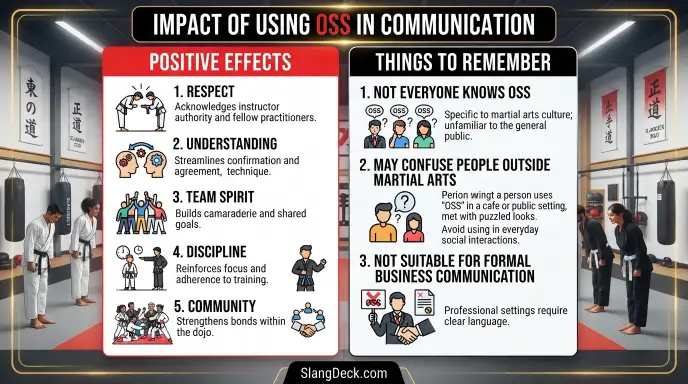
Using OSS can make communication more efficient in the right environment.
Positive Effects
- Shows respect
- Confirms understanding
- Creates team spirit
- Reinforces discipline
- Builds a sense of community
Things to Remember
- Not everyone knows what OSS means.
- It may confuse people outside martial arts.
- It isn’t suitable for formal business communication.
Knowing your audience helps you decide if using OSS is appropriate.
Is OSS Safe for Social Media?
Yes. OSS is generally safe to use on social media because it is not offensive and is commonly associated with martial arts culture.
You may see it on:
- TikTok
- YouTube
- Discord
- X (formerly Twitter)
For example:
“Great seminar today. OSS! “
or
“OSS to everyone competing this weekend!”
These posts usually express respect, support, or encouragement within the martial arts community.
More Real Life Examples
1. Karate Class
Sensei: Excellent technique today.
Student: OSS!
2. Brazilian Jiu Jitsu Training
Coach: Keep practicing your escapes.
Student: OSS, Coach.
3. Competition Day
Teammate: Good luck out there!
Fighter: OSS!
4. Group Chat
Captain: Training begins at 7 AM tomorrow.
Everyone: OSS!
OSS vs. Common Texting Responses
| OSS | Common Text Response |
| Shows respect | OK |
| Indicates understanding | Got it |
| Expresses discipline | Sure |
| Used mainly in martial arts | Used everywhere |
While OK and Got it are understood almost everywhere, OSS is best reserved for martial arts settings or conversations with people who recognize its meaning.
When Should You Avoid Using OSS?
Although OSS is respectful and positive, it is not appropriate in every situation.
Avoid using OSS when:
- Writing formal business emails
- Preparing academic papers or reports
- Speaking with people who are unfamiliar with martial arts
- Giving professional presentations
- Communicating in situations where a simple “Yes,” “OK,” or “I understand” would be clearer
Using standard English in these settings helps avoid confusion.
Polite Alternatives
If you’re not in a martial arts environment, these alternatives are usually more appropriate.
| OSS | Polite Alternative |
| OSS | I understand |
| OSS | Got it |
| OSS | Thank you |
| OSS | Yes |
| OSS | Certainly |
| OSS | Understood |
These expressions are widely understood and work well in both casual and professional conversations.
Why People Use OSS
People use OSS because it is more than just a word—it reflects the values of many martial arts communities.
Common reasons include:
- Showing respect to instructors and teammates
- Confirming they understand instructions
- Encouraging others during training
- Demonstrating discipline and commitment
- Preserving martial arts traditions
- Building a sense of teamwork and community
For many practitioners, saying OSS is a sign of mutual respect rather than just a greeting.
Common Misunderstandings About OSS Meaning Slang
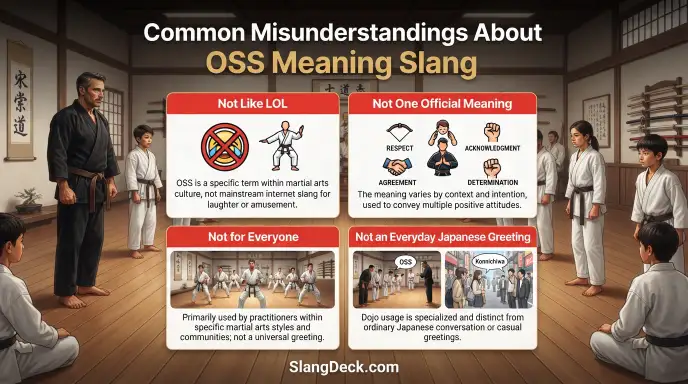
1. OSS is an internet slang abbreviation like LOL.
No. While OSS may appear online, it is primarily a martial arts expression, not a mainstream internet acronym.
2. OSS has one official meaning.
Not exactly. Different martial arts organizations explain OSS in slightly different ways. It is commonly understood to express respect, acknowledgment, agreement, or determination, but there is no single universally accepted definition.
3. Everyone should use OSS.
No. OSS is most appropriate for people involved in martial arts. Outside that community, many people may not recognize its meaning.
4. OSS is a Japanese greeting used in everyday life.
Not generally. Although it comes from Japanese martial arts culture, OSS is not commonly used in everyday Japanese conversations. Its use is mostly limited to martial arts settings.
Frequently Asked Questions
1. What does OSS mean in slang?
In slang and casual conversation, OSS usually refers to the martial arts expression Osu, which is used to show respect, acknowledgment, agreement, or determination.
2. Is OSS an abbreviation?
Although it’s often written in capital letters, OSS is generally treated as the Romanized spelling of Osu rather than a standard internet acronym like LOL or BRB.
3. Is OSS only used in martial arts?
Mostly, yes. OSS is strongly associated with martial arts such as karate, Brazilian Jiu Jitsu (BJJ), and judo, though it occasionally appears in online discussions related to these communities.
4. Is OSS respectful?
Yes. In martial arts, OSS is widely considered a respectful expression that shows understanding, discipline, and appreciation.
5. Can I use OSS in everyday texting?
You can, but only if the other person understands its meaning. Otherwise, responses like “OK,” “Got it,” or “Understood” are usually clearer.
6. Is OSS offensive?
No. OSS is not an offensive or rude term. It is generally viewed as a respectful expression within martial arts culture.
7. What is the difference between OSS and OK?
OK is a general response used in everyday conversations, while OSS carries a stronger sense of respect, discipline, and acknowledgment in martial arts settings.
8. Why do martial artists say OSS?
Martial artists say OSS to acknowledge instructions, show respect, encourage teammates, and maintain the traditions of their training environment.
9. Is OSS used on social media?
Yes. You may see OSS on platforms like Instagram, YouTube, TikTok, Reddit, and Discord, especially in posts related to martial arts training and competitions.
10. Should beginners use OSS?
Yes, if their martial arts school or instructor uses it. Following the customs of your dojo or academy is a respectful way to participate in the training culture.
Conclusion
Understanding the OSS meaning slang helps you recognize one of the most respected expressions in martial arts culture. Rather than being a typical internet abbreviation, OSS is commonly used to show respect, agreement, acknowledgment, and determination during training and competitions.
Because its meaning is closely tied to martial arts, it’s best to use OSS in the appropriate setting and with people who understand the expression. Knowing the context ensures you communicate respectfully and avoid confusion.
Related Slang Guides:
- Meeting in Slang: The Real Meaning Behind This Common Word
- What Does GMFU Mean in Slang? Meaning in Text & Social Media
- What Does MFM Slang Mean? Uses and Examples

Hi, I’m Sarah. I studied Communications at the University of Texas and have spent the last six years writing about internet culture and Gen Z slang across TikTok, Twitter, and everyday conversations. I focus on real usage, not just dictionary definitions.