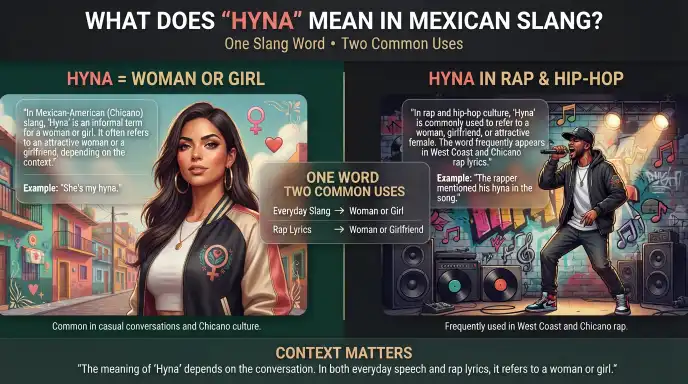
“Hyna” is Mexican/Chicano slang meaning “girl” or “girlfriend.” It comes from Caló (street slang) and is used affectionately, as in: “Esa es mi hyna” (That’s my girl). It’s commonly heard in rap and reggaeton songs too.
If you’ve seen someone call a woman “hyna”, you may wonder if it’s a compliment, an insult, or simply another word for “girl.”
The answer depends on the context. Hyna is a slang term most commonly used in Chicano (Mexican-American) communities and parts of the U.S. Southwest. While many people associate it with Mexican culture, it is not standard Spanish and is not used the same way throughout Mexico.
In most cases, it refers to a woman or girlfriend, but its tone can range from respectful and affectionate to disrespectful depending on who says it and how it’s used.
In this guide, you’ll learn what hyna means in slang, where it came from, how people use it, and when it’s appropriate to use.
Quick Answer
Hyna is a Mexican/Chicano slang term for a girl, woman, or girlfriend. It is commonly used in Mexican-American communities and its meaning depends on the speaker, relationship, and tone.
What Does Hyna Mean in Text?
When someone uses hyna in a text message or online conversation, they are usually referring to a woman or girlfriend.
For example:
“Who’s that hyna?”
This usually means:
- “Who’s that girl?”
- “Who’s that woman?”
Another example:
“That’s my hyna.”
This often means:
- “That’s my girlfriend.”
Unlike internet abbreviations such as LOL or BRB, hyna is a slang word rather than an acronym.
What Does Hyna Mean?
Hyna is a Chicano slang word that usually means girl, woman, or girlfriend. It is most commonly used in Mexican-American communities, and its tone can be friendly, affectionate, or disrespectful depending on the context.
Does Hyna Have a Slang Meaning?
Yes.
Hyna is a well-known slang term in Chicano English, especially in California, Texas, Arizona, New Mexico, and other parts of the southwestern United States.
Although many people call it Mexican slang, it is more accurate to describe it as Mexican-American or Chicano slang because it isn’t commonly used across all Spanish-speaking regions.
Today, you’ll often hear hyna in:
- Casual conversations
- Rap lyrics
- Hip-hop culture
- Movies
- TV shows
- TikTok videos
- Instagram captions
Hyna Full Form
Many people search for:
- Hyna full form
- What does hyna stand for?
- Is hyna an acronym?
The answer is simple.
Does Hyna Stand for Anything?
No.
Hyna is not an acronym or abbreviation.
Unlike internet slang such as:
| Slang | Full Form |
| LOL | Laugh Out Loud |
| BRB | Be Right Back |
| TBH | To Be Honest |
| IMO | In My Opinion |
Hyna has no official full form.
It is simply a slang word used to refer to a woman or girlfriend.
Different Meanings of Hyna in Slang
The meaning of hyna changes depending on the relationship between the speakers and the situation.
Girl or Young Woman
The most common meaning is simply girl or young woman.
Example:
“Who’s that hyna over there?”
Meaning:
“Who’s that girl over there?”
This is one of the oldest and most common uses of the word.
Girlfriend
Many people use hyna when talking about their girlfriend or romantic partner.
Example:
“I’m going out with my hyna tonight.”
Meaning:
“I’m going out with my girlfriend tonight.”
In this context, the word is affectionate.
Attractive Woman
Sometimes hyna refers to a woman whom the speaker finds attractive.
Example:
“She’s a fine hyna.”
Meaning:
“She’s a very attractive woman.”
if this sounds respectful or objectifying depends on the tone and the audience.
Female Friend
In some social circles, hyna can simply refer to a female friend without romantic meaning.
Example:
“My hyna is coming over later.”
Here, the speaker is simply referring to a female companion or friend.
This usage is less common than referring to a girlfriend.
Is Hyna Always Positive?
Not necessarily.
The word itself is not automatically offensive, but its meaning changes depending on how it is used.
For example:
“That’s my hyna.”
This usually sounds affectionate.
However:
“Look at that hyna.”
Depending on the tone, it could sound respectful, casual, or objectifying.
Because of this, some women are comfortable with the term, while others dislike it.
The relationship between the speakers plays an important role.
Why Is Hyna Sometimes Controversial?
Unlike neutral words such as woman or girl, hyna comes from street slang and Chicano culture.
Some people see it as:
- Friendly
- Affectionate
- Part of cultural identity
Others believe it:
- Objectifies women
- Sounds disrespectful
- Reinforces stereotypes
For this reason, it’s important to understand your audience before using the word.
Is Hyna Used Throughout Mexico?
Not exactly.
This is one of the biggest misconceptions.
Although many people search for hyna Mexican slang, the word is most strongly associated with Mexican-American communities rather than everyday Spanish spoken across Mexico.
You are more likely to hear hyna in:
- Southern California
- Texas
- Arizona
- New Mexico
- Nevada
- Chicano neighborhoods
- U.S. hip-hop culture
In Mexico itself, people are generally more likely to use words such as:
- Chica (girl)
- Muchacha (young woman)
- Morra (Mexican slang for girl in many regions)
Because slang varies by region, hyna is better described as Chicano slang with Mexican cultural roots than as slang used throughout Mexico.
Is Hyna Rude, Offensive, or Neutral?
The meaning and tone of hyna depend on who is saying it, who they are talking to, and the situation.
In many Chicano communities, hyna is simply an informal word for a girlfriend, female friend, or woman. Among friends or partners, it is often meant as a term of affection.
However, some people dislike the word because they feel it objectifies women or sounds disrespectful when used by strangers.
Quick Answer
Hyna is generally informal rather than offensive. It can sound affectionate when used by someone close to you, but it may be considered disrespectful if used to refer to a woman you don’t know or if it’s said in a rude tone.
Tone Guide
| Situation | Tone | Appropriate? |
| Talking about your girlfriend | Affectionate | ✅ Usually |
| Friends using it casually | Informal | ✅ Depends on the group |
| Referring to a stranger | Can sound disrespectful | ⚠️ Use caution |
| Professional conversations | Too informal | ❌ No |
| Academic or business writing | Inappropriate | ❌ No |
Because opinions vary, it’s always best to consider your audience before using the word.
Where Is Hyna Commonly Used?
Unlike many internet slang terms, hyna is closely connected to Chicano culture and is heard more often in certain regions than others.
Hyna in Text Messages
People may use hyna in casual texts with friends or romantic partners.
Example:
“I’m picking up my hyna after work.”
Meaning:
“I’m picking up my girlfriend after work.”
Hyna on TikTok
TikTok creators sometimes use hyna in:
- Relationship videos
- Comedy skits
- Chicano lifestyle content
- Lip-sync videos
- Street culture content
Example caption:
“POV: Your hyna says she’s ready but still isn’t outside.”
Hyna on Instagram
On Instagram, you may see captions like:
“My beautiful hyna “
or
“Date night with my hyna.”
In these cases, the word is being used affectionately.
Hyna in Rap and Hip-Hop
Many people first hear hyna in rap music and Chicano hip-hop.
Artists often use it when referring to:
- A girlfriend
- An attractive woman
- A romantic partner
Because music sometimes exaggerates language for artistic effect, the tone can vary from respectful to objectifying.
Hyna in Everyday Conversation
Within some Mexican-American communities, hyna is part of everyday speech.
You may hear it among:
- Friends
- Couples
- Family members
- Community gatherings
Outside these communities, however, many people may never use the word.
Why Do People Use Hyna?
People continue using hyna because it has become part of the vocabulary in many Chicano communities.
To Refer to a Girlfriend
One of the most common reasons is to talk about a romantic partner.
Example:
“That’s my hyna.”
The speaker is referring to his girlfriend.
To Sound Casual
Like many slang terms, hyna creates a relaxed and informal tone.
Instead of saying:
“My girlfriend.”
Someone may simply say:
“My hyna.”
To Express Cultural Identity
For many speakers, hyna is more than slang.
It reflects:
- Chicano heritage
- Community identity
- Shared culture
- Regional language
Using the word can create a sense of belonging within those communities.
Because of Music and Social Media
Rap songs, podcasts, movies, and social media have introduced hyna to people who are not part of Chicano culture.
As a result, the word has become more recognizable around the world.
Real Life Examples of Hyna Usage
The following examples show how hyna is used in different situations.
Friendly Examples
“My hyna is coming over later.”
“Have you met his hyna?”
These examples refer to someone’s girlfriend or partner.
Romantic Examples
“I bought flowers for my hyna.”
“My hyna always supports me.”
Here, the word is affectionate and positive.
Casual Conversation Examples
“That hyna works at the coffee shop.”
“Who’s that hyna talking to Carlos?”
Depending on the tone, these examples may sound neutral or slightly informal.
Social Media Examples
TikTok:
“My hyna caught me watching football instead of texting back “
Instagram:
“Weekend vibes with my hyna.”
Text Message:
“Tell your hyna we’re leaving at seven.”
These examples reflect common informal usage.
Origin and History of Hyna
The exact origin of hyna is debated, but language experts generally connect it to Chicano English and Mexican-American communities in the southwestern United States.
Many linguists believe it developed from “jaina” (also spelled heina), a slang term that has existed in Chicano speech for decades.
Over time, alternative spellings such as hyna became popular in texting, music lyrics, and online conversations.
Influence of Chicano Culture
As Chicano culture grew through music, art, and film, many regional slang words spread beyond their original communities.
Hyna became one of the most recognizable examples.
Popularity Through Music
Hip-hop and Chicano rap introduced the word to millions of listeners.
Today, many people recognize hyna even if they have never lived in a Mexican-American community.
Social Media Growth
Platforms such as TikTok, Instagram, and YouTube have helped keep the slang alive.
Short videos and viral clips continue introducing hyna to younger audiences.
Hyna vs Similar Slang Terms
Several slang words refer to women or girlfriends, but they are not used in exactly the same way.
| Slang | Typical Meaning | Common Usage |
| Hyna | Girl, woman, or girlfriend | Chicano slang |
| Jaina (Heina) | Girl or girlfriend | Original Chicano spelling |
| Morra | Girl or young woman | Mexican slang |
| Chica | Girl | Standard Spanish |
| Mija | My girl / dear | Family or affectionate term |
| Babe | Romantic partner | English slang |
Although these words overlap, hyna is the one most closely associated with Chicano culture and Mexican-American communities.
Why Context Matters
The same word can sound very different depending on how it’s used.
For example:
“She’s my hyna.”
This usually sounds affectionate.
But:
“Look at that hyna.”
Depending on the speaker’s tone and relationship with the woman, it may sound casual, disrespectful, or objectifying.
Because of these differences, it’s important to use the word thoughtfully and understand the cultural context in which it originated.
When Should You Avoid Using Hyna?
Although hyna is a common slang term in some Chicano communities, it isn’t appropriate for every situation. Since not everyone is familiar with the word or comfortable with it, using it in the wrong context can cause misunderstandings.
Here are some situations where you should avoid using hyna.
Professional Communication
Avoid using hyna in:
- Business emails
- Workplace meetings
- Job interviews
- Client conversations
Instead, use words like woman, girlfriend, partner, or the person’s name.
Formal Writing
If you’re writing:
- School assignments
- Research papers
- News articles
- Business documents
Standard English or standard Spanish is the better choice.
Referring to Someone You Don’t Know
Calling a stranger “hyna” may make them uncomfortable because it can sound overly familiar or objectifying.
If you don’t know the person, respectful terms such as woman, lady, or young woman are usually more appropriate.
Cross Cultural Conversations
Because hyna is mostly associated with Chicano culture, many Spanish speakers outside Mexican-American communities may not recognize the word or may interpret it differently.
When speaking with an international audience, using more universal language helps avoid confusion.
Polite Alternatives to Hyna
If you’re unsure if hyna is appropriate, consider using one of these alternatives.
| Instead of Hyna | Meaning | Best Used For |
| Girlfriend | Romantic partner | Everyday English |
| Woman | Adult female | Formal and informal |
| Girl | Young female | Casual conversations |
| Lady | Respectful term | Professional settings |
| Partner | Romantic companion | Neutral language |
| Chica | Girl (Spanish) | Informal Spanish |
| Muchacha | Young woman | Standard Spanish |
| Morra | Girl (Mexican slang) | Informal Mexican Spanish |
These alternatives are easier for a wider audience to understand and are less likely to be misunderstood.
Why Do People Continue Using Hyna?
Despite changes in language over time, hyna remains popular in certain communities.
It Reflects Cultural Identity
For many speakers, hyna is more than just slang.
It represents:
- Chicano heritage
- Community traditions
- Regional identity
- Everyday speech
Using the word helps preserve a unique cultural vocabulary.
It Creates a Casual Tone
Slang often makes conversations feel more relaxed.
Instead of saying:
“My girlfriend.”
Someone might naturally say:
“My hyna.”
Among people who understand the term, this sounds informal and friendly.
Music Keeps It Popular
Many rap and hip-hop artists continue using hyna in their lyrics.
As new listeners discover these songs, the slang continues reaching younger generations.
Social Media Spreads the Word
TikTok videos, Instagram posts, podcasts, and YouTube channels have introduced hyna to audiences around the world.
Even people outside Chicano communities now recognize the term because of online content.
Impact of Using Hyna Slang in Communication
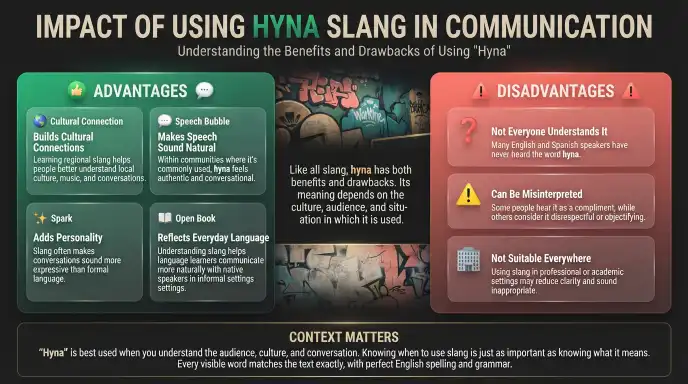
Like all slang, hyna has both benefits and drawbacks.
Advantages
1. Builds Cultural Connections
Learning regional slang helps people better understand local culture, music, and conversations.
2. Makes Speech Sound Natural
Within communities where it’s commonly used, hyna feels authentic and conversational.
3. Adds Personality
Slang often makes conversations sound more expressive than formal language.
4. Reflects Everyday Language
Understanding slang helps language learners communicate more naturally with native speakers in informal settings.
Disadvantages
1. Not Everyone Understands It
Many English and Spanish speakers have never heard the word hyna.
2. Can Be Misinterpreted
Some people hear it as a compliment, while others consider it disrespectful or objectifying.
3. Not Suitable Everywhere
Using slang in professional or academic settings may reduce clarity and sound inappropriate.
Is Hyna Safe for Social Media?
Yes, hyna is generally safe to use on social media.
You’ll often see it on:
- TikTok
- X (formerly Twitter)
- YouTube
- Snapchat
However, the surrounding message is important.
Appropriate Examples
“Date night with my hyna “
“My hyna always has my back.”
These examples are affectionate and positive.
Less Appropriate Example
Using hyna to describe women you don’t know or using it in a disrespectful way could offend some readers.
Always consider your audience before posting.
Comparison Table
| Feature | Hyna | Jaina (Heina) | Morra | Chica | Girlfriend |
| Chicano Slang | ✅ Yes | ✅ Yes | ❌ No | ❌ No | ❌ No |
| Mexican-American Usage | ✅ Common | ✅ Common | Sometimes | Yes | Yes |
| Means Girl or Woman | ✅ Yes | ✅ Yes | ✅ Yes | ✅ Yes | ❌ No |
| Means Girlfriend | ✅ Often | ✅ Often | Sometimes | Sometimes | ✅ Yes |
| Suitable for Formal Use | ❌ No | ❌ No | ❌ No | ✅ Sometimes | ✅ Yes |
Frequently Asked Questions
1. What does hyna mean in slang?
Hyna is a Chicano slang word that usually means girl, woman, or girlfriend. The exact meaning depends on the context.
2. What does hyna stand for?
Nothing. Hyna is not an acronym and has no full form.
3. Is hyna Mexican slang?
It is more accurate to describe hyna as Chicano (Mexican-American) slang rather than slang used throughout Mexico.
4. Is hyna a compliment?
It can be. Many people use it affectionately for their girlfriend or partner, but some women may find it disrespectful depending on the situation.
5. Is hyna offensive?
Not automatically. The word itself isn’t a swear word, but using it to refer to strangers or in a disrespectful tone may offend some people.
6. Where is hyna commonly used?
It is most commonly used in California, Texas, Arizona, New Mexico, and other areas with strong Chicano communities. It also appears in rap music and social media.
7. Is hyna the same as girlfriend?
Sometimes. Hyna can mean girlfriend, but it can also simply mean girl or woman.
8. Can I use hyna in professional conversations?
No. It is considered informal slang and isn’t appropriate for business or academic settings.
9. Is hyna still used today?
Yes. The word remains popular in Chicano culture, rap lyrics, TikTok videos, Instagram posts, and everyday conversations within some communities.
10. Is hyna safe to use on social media?
Yes, but use it respectfully. Since some people view the word differently, it’s best to avoid using it in a way that could objectify or disrespect women.
Conclusion
If you’ve been wondering what hyna means in slang, the answer is that it usually refers to a girl, woman, or girlfriend in Chicano (Mexican-American) slang. While many people search for hyna Mexican slang, the term is more closely connected to Mexican-American communities than to everyday Spanish spoken across Mexico.
Understanding the context is essential. Hyna can be affectionate when used between partners or friends, but it may sound disrespectful if used carelessly or toward someone you don’t know.
By learning its meaning, origin, and cultural background, you can better understand conversations in music, movies, social media, and everyday Chicano culture.
Explore More Articles:

Hey, I’m Jordan. I grew up in a bilingual household in LA, so Spanish and Mexican American slang has always been part of how I talk. I’ve been writing online content for five years, explaining terms the way I’d explain them to a friend meaning, tone, and when it’s actually okay to use.