Definition of Volleyball Slang Terms
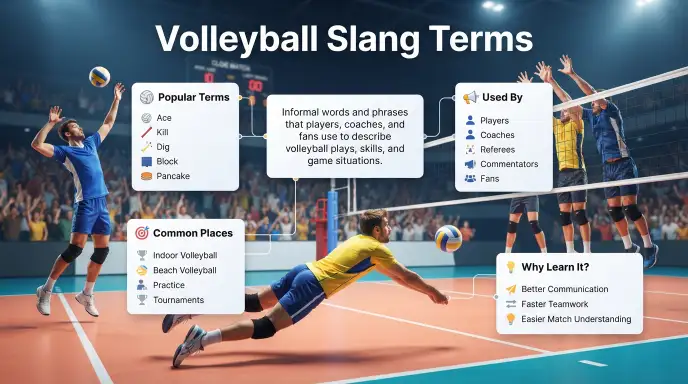
Volleyball slang terms are informal words and phrases that players, coaches, commentators, and fans use during matches and practice. These expressions make communication faster and help describe different plays, skills, and game situations.
You may hear volleyball slang in:
- Volleyball matches
- Team practices
- School tournaments
- Beach volleyball games
- Sports broadcasts
- Social media videos
- Online volleyball communities
Many slang terms are easy to understand once you learn the game. Some describe powerful plays, while others explain player positions or mistakes.
Examples:
- She got an ace on her first serve.
- That was a huge pancake save.
This guide explains the most common volleyball slang terms, their meanings, examples, and when people use them.
Quick Answer: What Are Volleyball Slang Terms?
Volleyball slang terms are informal expressions used to describe plays, techniques, players, and game situations. Players and coaches use them to communicate quickly during matches and practice sessions.
What Are Volleyball Slang Terms?
Volleyball slang includes unofficial words that make the game easier to discuss. Many of these expressions come from real game actions.
Players use slang to:
- Call plays
- Describe skills
- Encourage teammates
- Explain mistakes
- Celebrate great moments
Some slang terms are common around the world. Others are popular only in certain teams or leagues.
Common Types of Volleyball Slang
| Type | Purpose | Example |
| Serving | Describes serves | Ace |
| Attacking | Refers to spikes and hits | Kill |
| Defense | Explains defensive plays | Dig |
| Team Communication | Quick calls during play | Mine! |
| Mistakes | Describes errors | Shank |
What Do Volleyball Slang Terms Mean During a Match?
Players often shout slang terms while the ball is still in play. Quick communication helps teammates react faster.
For example:
Setter: “Free ball!”
The team knows an easy ball is coming.
Another example:
Player: “Mine!”
This tells teammates not to touch the ball.
These short calls help teams avoid confusion.
Do Volleyball Slang Terms Have Full Forms?
Most volleyball slang terms do not have full forms.
Words like:
- Ace
- Kill
- Dig
- Stuff
- Pancake
are complete terms by themselves.
Some volleyball abbreviations exist on scoreboards or statistics, but common slang words are not abbreviations.
Are Volleyball Slang Terms Offensive?
No.
Most volleyball slang terms are friendly sports expressions. Players of all ages use them during games and practice.
| Situation | Appropriate? |
| Volleyball practice | ✅ Yes |
| School tournaments | ✅ Yes |
| Professional matches | ✅ Yes |
| Coaching sessions | ✅ Yes |
| Sports discussions | ✅ Yes |
| Formal business writing | ❌ Not suitable |
Sports slang works best in volleyball conversations.
Where Are Volleyball Slang Terms Commonly Used?
You can hear these expressions in many places.
Common examples include:
- Indoor volleyball matches
- Beach volleyball tournaments
- School games
- College competitions
- Professional leagues
- Coaching clinics
- Sports broadcasts
- YouTube volleyball videos
- Social media clips
Fans also use volleyball slang while discussing exciting plays online.
Who Uses Volleyball Slang Terms?
Many people use volleyball slang every day.
Common users include:
- Volleyball players
- Coaches
- Referees
- Commentators
- Sports journalists
- Fans
- Physical education teachers
- Volleyball content creators
Learning these terms helps new players understand the game more quickly.
Most Common Volleyball Slang Terms
Here are some of the most popular volleyball slang terms every player and fan should know.
Ace
Meaning:
A serve that lands in bounds without the other team touching it successfully.
Example:
“She scored an ace to win the match.”
Kill
Meaning:
A successful attack that results in an immediate point.
Example:
“His powerful kill ended the rally.”
Dig
Meaning:
A defensive pass that keeps a hard-hit ball in play.
Example:
“The libero made an amazing dig.”
Block
Meaning:
A defensive play where players stop the opponent’s attack at the net.
Example:
“The middle blocker made a perfect block.”
Shank
Meaning:
A poor pass that sends the ball in the wrong direction.
Example:
“The serve caused a shank in the back row.”
More Common Volleyball Slang Terms
Learning more volleyball slang helps you understand matches and communicate with teammates.
Pancake
Meaning:
A defensive move where a player places a flat hand on the floor to keep the ball from touching the court.
Example:
“She made a perfect pancake and saved the rally.”
Stuff Block
Meaning:
A block that sends the ball straight back to the attacking team for an immediate point.
Example:
“The middle blocker finished the rally with a stuff block.”
Free Ball
Meaning:
An easy ball sent over the net without a hard attack.
Example:
“Get ready! Free ball!”
Roof
Meaning:
A powerful block that stops the attack and sends the ball straight down.
Example:
“The hitter got roofed at the net.”
Tool
Meaning:
A smart attack that hits the opponent’s block before going out of bounds to score a point.
Example:
“She used the blocker for a perfect tool shot.”
Joust
Meaning:
A play where two players push against the ball above the net at the same time.
Example:
“The rally ended after a long joust.”
Six Pack
Meaning:
A hard spike that hits a player directly in the face.
Example:
“The hitter gave the defender a six pack.”
Float Serve
Meaning:
A serve that moves unpredictably through the air without much spin.
Example:
“Her float serve confused the receivers.”
Pipe
Meaning:
An attack from the middle back row.
Example:
“The setter called a pipe attack.”
Chicken Wing
Meaning:
A defensive save made by lifting the elbow to keep the ball in play.
Example:
“He saved the point with a chicken wing.”
Real-Life Examples of Volleyball Slang
These examples show how players use volleyball slang during matches.
Practice Session
Coach: “Keep your serves deep.”
Player: “I’ll try for another ace.”
Match
Setter: “Free ball!”
Team: Players move into attacking positions.
Defense
Commentator: “What an incredible dig by the libero!”
Attack
Coach: “Finish the rally with a strong kill.”
Block
Player: “Let’s get another roof!”
These short calls help players react quickly during fast rallies.
Origin and History of Volleyball Slang
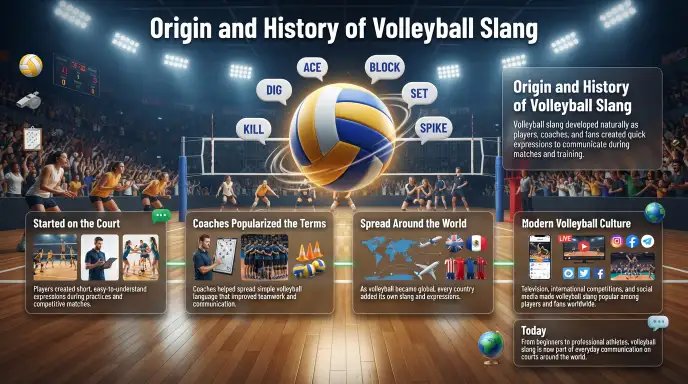
Volleyball slang has grown alongside the sport.
Players created many of these expressions during practices and competitive matches. Coaches also helped popularize simple words that players could understand instantly.
As volleyball spread around the world, new slang appeared in different countries and leagues.
Sports television, international tournaments, and social media made many of these expressions popular among fans.
Today, players of all skill levels use volleyball slang.
Beach Volleyball vs Indoor Volleyball Slang
Many slang terms appear in both versions of volleyball. Some expressions are more common in one format.
| Beach Volleyball | Indoor Volleyball |
| Jumbo Shot | Pipe |
| Pokey | Quick Set |
| Cut Shot | Middle Attack |
| Sky Ball | Stuff Block |
| Cobra Shot | Double Block |
Players often learn additional slang as they switch between indoor and beach volleyball.
Team Communication Slang
Teams use short calls to communicate during rallies.
Mine
A player calls “Mine!” before passing the ball.
Example:
“Mine! I’ve got it.”
Help
Players call “Help!” when they cannot reach the ball alone.
Example:
“Help! Short ball!”
Out
Players shout “Out!” if they believe the ball will land outside the court.
Example:
“Out! Let it go!”
Short
Players warn teammates about a short serve.
Example:
“Short! Move forward!”
Line
This call warns that the attack is heading toward the sideline.
Example:
“Line! Watch the corner!”
Regional Differences in Volleyball Slang
Volleyball slang can change between countries, clubs, and leagues.
- American players often use terms like roof, tool, and stuff block.
- Beach volleyball players commonly say pokey and cut shot.
- College teams may create their own slang for drills or plays.
- International players sometimes translate local expressions into English.
The basic meaning stays the same, but the wording may change from one team to another.
Volleyball Slang vs Official Volleyball Terms
Slang and official terms are different.
| Volleyball Slang | Official Term |
| Kill | Successful Attack |
| Ace | Service Ace |
| Dig | Defensive Save |
| Roof | Winning Block |
| Shank | Poor Pass |
| Stuff Block | Block Point |
Official rulebooks use technical terms, while players often use slang during matches.
Why Do Players Use Volleyball Slang?
Volleyball is a fast game. Players need short and clear words during every rally.
Common reasons include:
- Communicating quickly
- Calling plays
- Encouraging teammates
- Describing game situations
- Explaining skills during practice
- Celebrating great plays
These short expressions help teams stay organized and react faster.
Common Misunderstandings About Volleyball Slang
Misunderstanding 1: Volleyball Slang Is Official Volleyball Language
No.
Most slang terms are informal. Official volleyball rules use technical terms instead.
Misunderstanding 2: Every Team Uses the Same Slang
Not always.
Different clubs, schools, and countries may use different words for the same play.
Misunderstanding 3: Beginners Should Already Know These Terms
No.
Most players learn volleyball slang through practice and experience.
Coaches often explain new terms during training sessions.
Misunderstanding 4: Volleyball Slang Only Belongs to Professional Players
No.
Players of every skill level use volleyball slang.
School teams, college players, and recreational clubs all use these expressions.
Impact of Volleyball Slang on Communication
Volleyball slang improves communication when everyone understands the terms.
Positive Effects
- Speeds up communication.
- Helps players react faster.
- Builds teamwork.
- Makes coaching easier.
- Creates confidence during matches.
Possible Drawbacks
- New players may feel confused.
- Different teams may use different words.
- Too much slang can confuse beginners.
Learning common terms makes the game easier to understand.
Is Volleyball Slang Good for Beginners?
Yes.
Beginners can learn volleyball slang little by little.
Start with simple terms like:
- Ace
- Kill
- Dig
- Block
- Mine
These words appear in almost every match and practice session.
When Should You Avoid Using Volleyball Slang?
Volleyball slang works well in sports settings. It does not fit every situation.
Avoid using it in:
- Business meetings
- Academic essays
- Formal presentations
- Professional reports
- Non-sports conversations
Standard language works better outside volleyball.
Simple Alternatives to Volleyball Slang
Ace
Better Term: Service Point
Meaning:
A serve that scores a point without a successful return.
Example:
“She won the point with a service ace.”
Kill
Better Term: Successful Attack
Meaning:
An attack that wins the rally immediately.
Example:
“The successful attack gave the team another point.”
Dig
Better Term: Defensive Save
Meaning:
A defensive play that keeps the ball in play.
Example:
“The defensive save kept the rally alive.”
Shank
Better Term: Poor Pass
Meaning:
A pass that goes in the wrong direction.
Example:
“The poor pass gave the other team an easy point.”
Roof
Better Term: Winning Block
Meaning:
A block that scores a point immediately.
Example:
“The winning block finished the rally.”
Quick Alternatives Table
| Volleyball Slang | Standard Term |
| Ace | Service Point |
| Kill | Successful Attack |
| Dig | Defensive Save |
| Roof | Winning Block |
| Shank | Poor Pass |
| Pancake | One-Hand Defensive Save |
These alternatives work well in coaching guides, articles, and formal sports writing.
Frequently Asked Questions
Q1. What are volleyball slang terms?
Volleyball slang terms are informal words players and coaches use to describe plays, skills, and game situations.
Q2. What is an ace in volleyball?
An ace is a serve that scores a point without the receiving team making a successful return.
Q3. What does “kill” mean in volleyball?
A kill is a successful attack that ends the rally and earns a point.
Q4. What is a dig in volleyball?
A dig is a defensive play that keeps a hard-hit ball from touching the court.
Q5. What does “shank” mean in volleyball?
A shank is a poor pass that sends the ball away from the intended target.
Q6. What is a pancake in volleyball?
A pancake is a defensive move where a player places a flat hand on the floor to keep the ball in play.
Q7. Is volleyball slang used in professional matches?
Yes. Professional players, coaches, and commentators use many volleyball slang terms during matches.
Q8. Do beach and indoor volleyball use the same slang?
Many terms are the same, but each version of the game also has unique expressions.
Q9. Should beginners learn volleyball slang?
Yes. Learning common slang helps beginners understand coaching instructions and match commentary.
Q10. Why is volleyball slang important?
Volleyball slang improves communication, speeds up decision-making, and helps teammates work together during matches.
Key Takeaways
- Volleyball slang makes communication faster.
- Players use these terms during matches and practice.
- Many slang words describe serves, attacks, blocks, and defensive plays.
- Some expressions differ between indoor and beach volleyball.
- Beginners can learn the most common terms quickly.
- Understanding volleyball slang makes watching and playing the game more enjoyable.
Conclusion
Volleyball slang terms help players, coaches, and fans communicate quickly during matches. Words like ace, kill, dig, and pancake describe important plays in a simple way.
Learning these expressions makes it easier to follow games, understand coaching instructions, and enjoy volleyball at every level.
If you are new to the sport or already play regularly, knowing common volleyball slang will improve your understanding of the game and help you communicate more confidently on the court.
Discover Related Articles:

Hi, I’m Sarah. I studied Communications at the University of Texas and have spent the last six years writing about internet culture and Gen Z slang across TikTok, Twitter, and everyday conversations. I focus on real usage, not just dictionary definitions.