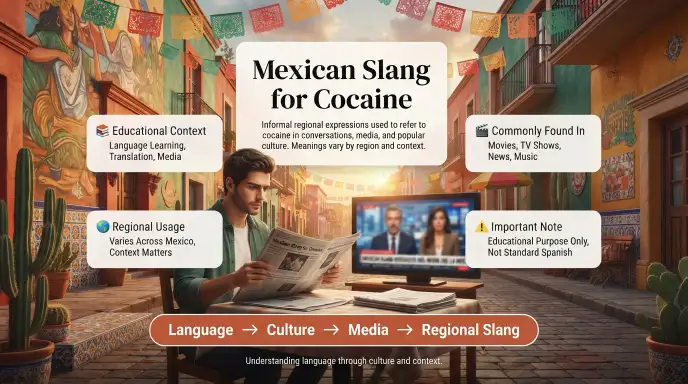
Many people search for Mexican slang for cocaine after hearing unfamiliar words in Mexican films, crime dramas, songs, social media, or news reports. In most cases, they simply want to understand the meaning of a term rather than learn anything about illegal drugs.
It is important to remember that slang changes over time, and the same word may have different meanings in different parts of Mexico or other Spanish-speaking countries. Some expressions are widely recognized, while others are only used in specific cities or communities.
This article explains the topic from an educational and language-learning perspective without encouraging or promoting illegal drug use.
Quick Answer: Mexican Slang for Cocaine
Mexican slang for cocaine includes informal words and nicknames that some people use to refer to cocaine in casual conversations, movies, music, or online discussions. The exact terms vary by region and social group, and many are also used in other Spanish-speaking countries.
Examples:
- The movie used Mexican slang instead of the actual drug name.
- I heard the term in a Spanish-language TV series and wanted to know what it meant.
What Does Mexican Slang for Cocaine Mean?
Mexican slang for cocaine refers to non-standard vocabulary used instead of the drug’s formal name. These expressions are often heard in entertainment, media, and everyday conversations where people choose slang over direct language.
For example, someone watching a Mexican crime series may hear a slang word and search its meaning because it is unfamiliar.
The meaning depends on the context. Sometimes a slang term clearly refers to cocaine, while in other situations the same word may have an entirely different meaning.
Because of these regional differences, it is important not to assume every slang word has the same meaning everywhere in Mexico.
Common Contexts
| Context | Explanation | Example |
| Movies & TV | Slang used in fictional dialogue | The character used slang instead of saying the drug name. |
| Music | Informal references in lyrics | Some songs contain coded slang expressions. |
| News Reports | Journalists may explain slang used in investigations | The report explained the meaning of the street term. |
| Social Media | Users may discuss slang they heard online | Someone asked what the slang word meant. |
What Does Mexican Slang for Cocaine Mean in Text?
In text messages, online forums, or social media, slang terms related to cocaine are usually mentioned in discussions, translations, news, or entertainment, rather than in everyday conversation.
For example:
“What does that Mexican slang word mean?”
or
“I heard the term in a Netflix series.”
In these situations, people are often trying to understand the language rather than encouraging illegal activity.
Because many slang words have multiple meanings, context is essential before deciding what a particular term refers to.
Does Mexican Slang for Cocaine Have a Full Form?
No.
Mexican slang terms for cocaine do not have a full form because they are informal words or nicknames, not abbreviations or acronyms.
People sometimes search for:
- Mexican slang for cocaine full form
- Cocaine abbreviation in Mexican slang
- What does it stand for?
The answer is simple:
These slang terms are informal expressions and do not stand for longer phrases.
Is Mexican Slang for Cocaine Offensive?
The slang words themselves are not necessarily offensive, but they refer to an illegal drug, so they should be used carefully.
If a term is appropriate depends on the situation.
| Situation | Appropriate? |
| Language learning | ✅ Yes |
| Translation | ✅ Yes |
| News articles | ✅ Yes |
| Educational discussions | ✅ Yes |
| Casual jokes | ⚠️ Better to avoid |
| Workplace conversations | ❌ No |
| School presentations | ⚠️ Use only with context |
| Professional communication | ❌ No |
Using these expressions for educational or translation purposes is generally acceptable, but they are not suitable for formal or professional communication.
Where Is Mexican Slang for Cocaine Commonly Encountered?
People are most likely to encounter Mexican slang related to cocaine in:
- Mexican movies
- Crime dramas
- Television series
- News reports
- Documentaries
- Podcasts
- Spanish-language music
- Social media discussions
- Online forums
- Translation websites
Most people searching for these expressions are trying to understand dialogue, lyrics, or cultural references rather than use the slang themselves.
Who Encounters This Slang the Most?
This type of slang is most commonly encountered by Spanish learners, translators, journalists, travelers, movie and TV viewers, researchers, and people interested in Mexican culture or language. It is usually seen in media, entertainment, or educational contexts rather than everyday formal communication.
Real Life Examples of Mexican Slang for Cocaine
Below are examples showing how people may mention or discuss Mexican slang for cocaine in educational, media, or translation contexts. These examples focus on understanding the language rather than encouraging illegal activity.
1. Watching a Movie
“I didn’t understand the Mexican slang term they used for cocaine in the film.”
2. Reading the News
“The news article explained that suspects were using street slang instead of the drug’s actual name.”
3. Learning Spanish
“My teacher explained that some Mexican slang words can refer to cocaine depending on the context.”
4. Social Media
“Can someone explain the slang word they mentioned in that Mexican TV series?”
5. Translation
“The translator added a note explaining that the expression was Mexican slang for cocaine.”
6. Documentary
“The documentary discussed how criminal groups often use coded slang terms.”
7. Podcast
“The host explained the meaning of several Mexican street expressions heard in crime documentaries.”
These examples show that the slang is most often encountered while watching media, studying Spanish, reading the news, or translating conversations.
Origin and History of Mexican Slang for Cocaine
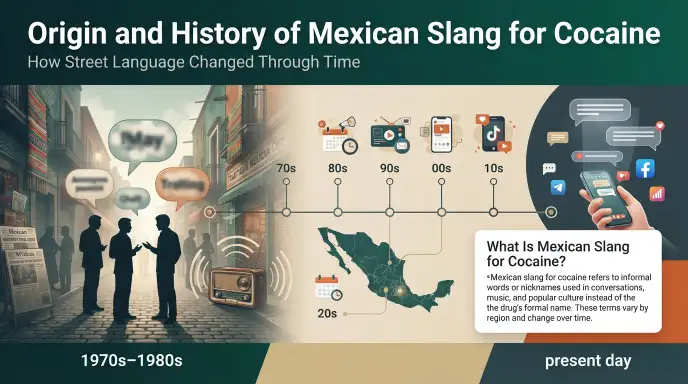
Like many forms of street language, Mexican slang for cocaine developed as part of informal communication within certain communities. Over time, different regions created their own nicknames and coded expressions, many of which later appeared in popular culture.
The use of slang became more widely recognized through:
- Mexican movies
- Crime dramas
- Television series
- Investigative journalism
- Music
- Online discussions
Because slang constantly changes, there is no single official Mexican slang word for cocaine. New expressions appear, older ones disappear, and some terms spread to other Spanish-speaking countries.
Today, many people encounter these words through entertainment or news rather than everyday conversation.
Mexican Slang for Cocaine vs Standard Spanish
Although people sometimes use slang instead of the standard word, the meanings and situations are different.
| Expression Type | Purpose | Where It’s Common |
| Standard Spanish | Formal or educational discussions | Schools, dictionaries, news |
| Mexican Street Slang | Informal or coded conversations | Movies, music, crime dramas |
| Regional Nicknames | Local expressions that vary by area | Specific communities |
| Media References | Used to reflect authentic dialogue | TV shows, films, podcasts |
Remember that many slang terms are regional, so a word used in one part of Mexico may not have the same meaning elsewhere.
Regional Differences in Mexican Slang for Cocaine
Mexico is linguistically diverse, and slang changes from one region to another. Local culture, neighboring dialects, and social groups all influence the words people use.
Northern Mexico
Some slang expressions reflect local speech patterns and may differ from those used in central or southern Mexico.
Central Mexico
Large cities often introduce new slang through popular culture, music, and social media, causing expressions to spread quickly.
Southern Mexico
Regional vocabulary is influenced by local traditions and Indigenous languages, creating slang that may be unfamiliar elsewhere.
Border Areas
Communities near the U.S.–Mexico border sometimes mix Spanish and English, leading to unique slang expressions that are different from those used in other regions.
Because of these differences, the same slang word may not have the same meaning across all of Mexico.
When Should You Avoid Using Drug-Related Slang?
Even when discussing language, it is best to avoid drug-related slang in certain situations.
Avoid using these expressions when:
- Writing business emails.
- Preparing school assignments unless the topic requires it.
- Speaking in professional meetings.
- Communicating with clients.
- Writing official documents.
- Talking with children without educational context.
If you are translating or discussing the topic, use the slang only when necessary and explain its meaning clearly.
Neutral Alternatives of Mexican Slang for Cocaine
When writing or speaking in educational or professional settings, use neutral language instead of slang.
Cocaine
Pronunciation: (koh-KAYN)
Meaning:
The standard English term used in dictionaries, educational materials, and news reports.
Example:
“The documentary discussed the history of cocaine trafficking.”
Illegal Drug
Pronunciation: (ih-LEE-guhl drug)
Meaning:
A broad term used when referring to prohibited substances without using slang.
Example:
“The report focused on illegal drug trafficking.”
Controlled Substance
Pronunciation: (kuhn-TROHLD SUB-stuhns)
Meaning:
A legal and medical term for substances regulated by law.
Example:
“The law regulates controlled substances.”
Narcotic (General Context)
Pronunciation: (nar-KOT-ik)
Meaning:
A term sometimes used in legal or law enforcement contexts, although its exact meaning varies depending on the jurisdiction.
Example:
“The investigation involved suspected narcotics offenses.”
Quick Alternatives
| Instead of Street Slang | You Can Say |
| Mexican street term | Cocaine |
| Informal nickname | Illegal drug (when appropriate) |
| Local slang | Controlled substance (legal context) |
| Coded expression | Drug-related slang |
| Street nickname | Standard Spanish or English term |
Using standard terminology makes communication clearer and more appropriate in educational, professional, and formal settings.
Why Do People Use Mexican Slang for Cocaine?
People use slang terms instead of formal names for different reasons. In many cases, slang develops naturally within communities and later appears in music, movies, or everyday conversations.
Common reasons include:
- It makes informal conversations sound more natural.
- It reflects regional language and local culture.
- It appears in movies, TV shows, and music for authenticity.
- It can be part of coded or informal communication.
- It changes over time as new expressions become popular.
Today, many people learn these slang terms through entertainment and news rather than personal use.
Common Misunderstandings About Mexican Slang for Cocaine
Because slang changes from place to place, people often misunderstand these expressions.
1: There Is One Official Mexican Slang Term
No.
There is no single official Mexican slang word for cocaine. Different regions and communities use different expressions, and some terms are only understood locally.
2: Every Slang Word Has Only One Meaning
Not always.
Some slang words have multiple meanings depending on the conversation. A word that refers to cocaine in one situation may mean something completely different in another.
3: Everyone in Mexico Uses These Terms
No.
Most people in Mexico do not use drug-related slang in everyday conversations. Many people only encounter these expressions in movies, music, news reports, or online discussions.
4: These Terms Are Used Only in Mexico
Not necessarily.
Some slang expressions are shared across several Spanish-speaking countries, while others are unique to particular regions of Mexico.
Understanding the context is essential before interpreting any slang term.
Impact of Using Drug-Related Slang in Communication
Like any slang, drug-related expressions can influence how a conversation is understood.
Positive Effects
- Helps explain language used in movies and TV shows.
- Improves understanding of regional slang.
- Useful for translation and language learning.
- Provides cultural context in educational discussions.
Possible Drawbacks
- Can be misunderstood outside the intended context.
- May sound inappropriate in formal conversations.
- Some terms have different meanings in different regions.
- Using slang casually may confuse people unfamiliar with it.
Knowing your audience helps you decide if discussing slang is appropriate.
Is Mexican Drug Slang Safe for Social Media?
Educational discussions about Mexican slang for cocaine are generally acceptable on social media when the purpose is translation, language learning, or cultural understanding.
People often discuss the topic on:
- X (Twitter)
- YouTube
- Language-learning forums
- Translation communities
- Educational blogs
However, avoid using drug-related slang to promote or encourage illegal activities. Always keep the discussion educational and respectful.
Frequently Asked Questions
Q1. What is Mexican slang for cocaine?
Mexican slang for cocaine refers to informal or street expressions that some people use instead of the drug’s formal name. These terms vary by region and context.
Q2. Is there one official Mexican slang word for cocaine?
No. There is no single official slang term. Different communities and regions use different expressions.
Q3. Why do people use slang instead of the actual name?
People may use slang because it is part of informal speech, regional culture, or dialogue in movies, music, and television.
Q4. Are these slang terms used throughout Mexico?
Not always. Many expressions are regional and may not be understood everywhere in the country.
Q5. Can the same slang word have different meanings?
Yes. Many slang words have multiple meanings, so context is important when interpreting them.
Q6. Where do people usually hear these slang terms?
Most people encounter them in Mexican movies, TV series, documentaries, music, news reports, and online discussions.
Q7. Are these terms appropriate for formal communication?
No. Drug-related slang should generally be avoided in business, academic, and professional settings.
Q8. Is it okay to discuss these terms for educational purposes?
Yes. Discussing slang for language learning, translation, journalism, or cultural understanding is appropriate.
Q9. Is Mexican drug slang the same as standard Spanish?
No. Standard Spanish uses formal vocabulary, while slang consists of informal regional expressions that vary by location.
Q10. Why do these slang terms change over time?
Like all slang, new expressions appear while older ones fade away. Popular culture, media, and regional language all influence how slang evolves.
Conclusion
Mexican slang for cocaine refers to informal regional expressions that people may encounter in movies, music, television, news reports, and online discussions. Because slang varies across Mexico, there is no single term that everyone uses, and many expressions depend on the local culture and context.
If you come across these words, remember that they are best understood from a language-learning or cultural perspective. Using standard terminology is usually the better choice in formal, educational, and professional communication.
You May Also Like!
- Milwaukee Slang: Meaning, Popular Terms and Examples
- Japanese Slang for Thank You: Casual Ways to Say Thanks
- Spanish Texting Slang: Meanings, Abbreviations & Examples

Hi, I’m Sarah. I studied Communications at the University of Texas and have spent the last six years writing about internet culture and Gen Z slang across TikTok, Twitter, and everyday conversations. I focus on real usage, not just dictionary definitions.