Definition of Grass UK Slang Meaning
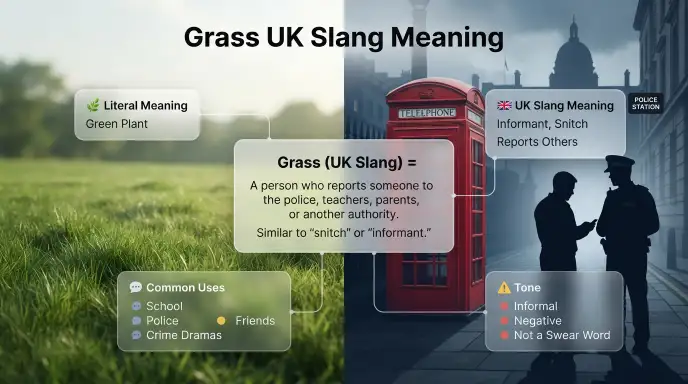
In British slang, grass is a word used to describe someone who tells the police or another authority about another person’s wrongdoing. In simple terms, a grass is an informant, snitch, or someone who reports others.
The word usually has a negative meaning because it suggests someone has betrayed another person by sharing information.
Examples:
- Don’t be a grass and tell the teacher.
- He was called a grass after speaking to the police.
Many people search for “grass UK slang” after hearing the word in British TV shows, crime dramas, movies, football discussions, or everyday conversations. The meaning is very different from the literal meaning of grass, which refers to the green plant that grows on the ground.
Quick Answer for Grass UK Slang Meaning
In UK slang, a grass is someone who informs on another person by telling the police, teachers, parents, or other authorities about their actions. It is similar to “snitch” or “informant.”
What Does Grass Mean in UK Slang?
In British English, grass refers to a person who reports someone else’s secret or illegal activity.
People may use the word when someone:
- Tells the police about a crime.
- Reports classmates to a teacher.
- Tells parents about someone’s behavior.
- Reveals private information to authorities.
- Betrays a friend by sharing secrets.
The slang often carries a strong sense of betrayal.
Common Meanings of Grass
| Meaning | Explanation | Example |
| Informant | Someone who gives information to the police | “The gang thought he was a grass.” |
| Snitch | A person who tells on others | “Don’t be a grass.” |
| Betrayer | Someone who reveals another person’s actions | “His friends called him a grass.” |
| Police Informer | A person helping law enforcement | “The criminals were looking for the grass.” |
What Does Grass Mean in Text?
In text messages and online conversations, grass usually means someone who tells on another person.
It often appears jokingly between friends, but it can also be serious.
Example 1
Person A: Who told the teacher?
Person B: I think Jack was the grass.
Meaning: Jack reported someone.
Example 2
Person A: Mum found out about the party.
Person B: Someone must have grassed.
Meaning: Someone informed on the group.
Example 3
Person A: The police knew everything.
Person B: There was definitely a grass.
Meaning: Someone secretly gave information to the police.
Does Grass Have a Full Form?
No.
Grass does not have a full form.
It is not an abbreviation or acronym.
People sometimes search for:
- Grass full form
- What does grass stand for?
- Grass abbreviation
The answer is simple. Grass is a regular English word that also has a British slang meaning.
Is Grass Rude, Offensive, or Neutral?
Grass is generally a negative slang word, but it is not considered a swear word.
Calling someone a grass can offend them because it suggests they betrayed others.
| Situation | Appropriate? |
| Talking with friends | ✅ Yes |
| British TV shows | ✅ Common |
| Text messages | ✅ Yes |
| Social media | ✅ Yes |
| School conversations | ⚠ Depends on context |
| Workplace | ❌ Better to avoid |
| Formal writing | ❌ No |
Use the word carefully because it may sound like an accusation.
Where Is Grass Commonly Used?
The slang grass appears mostly in the United Kingdom.
Common places include:
- Everyday conversations
- British TV dramas
- Crime series
- Police documentaries
- Movies
- Social media
- Text messages
- Football discussions
- Online forums
The term is much more common in Britain than in the United States.
Who Uses Grass UK Slang?
Several groups regularly use this slang.
Common users include:
- British teenagers
- Adults in the UK
- Football fans
- Crime drama viewers
- Social media users
- Prison communities
- Police and legal discussions
- Journalists writing about crime
Outside the UK, many people prefer words like snitch, rat, or informant.
Real-Life Examples of Grass UK Slang Meaning
These examples show how people naturally use the word.
School
“Don’t grass on your classmates.”
Family
Person A: Who told Mum?
Person B: Your little brother grassed on you.
Crime Drama
“The gang discovered there was a grass among them.”
Text Message
Person A: Who reported us?
Person B: Somebody grassed.
Football Conversation
“Fans accused him of being a grass after he spoke to security.”
These examples show that grass almost always refers to someone who reports another person to an authority.
Origin and History of Grass UK Slang Meaning
The slang word grass has been part of British English for many years.
Many language experts believe it comes from the old rhyming slang phrase “grasshopper,” which rhymed with “copper,” an old British word for a police officer. Over time, the meaning changed. Instead of referring to the police, grass came to mean someone who gives information to the police.
By the mid-1900s, the word had become common in British crime culture, newspapers, and television.
Today, grass remains one of the best-known British slang words for an informant or snitch.
Why Do People Say “Grass”?
People use grass to describe someone who reports another person’s actions to an authority.
Common reasons include:
- Reporting someone to the police
- Telling a teacher about classmates
- Informing parents about someone’s behavior
- Revealing secrets
- Warning authorities about illegal activity
- Accusing someone of betrayal
The word often carries a negative tone because many people view informing on others as disloyal.
Common Situations Where People Use Grass
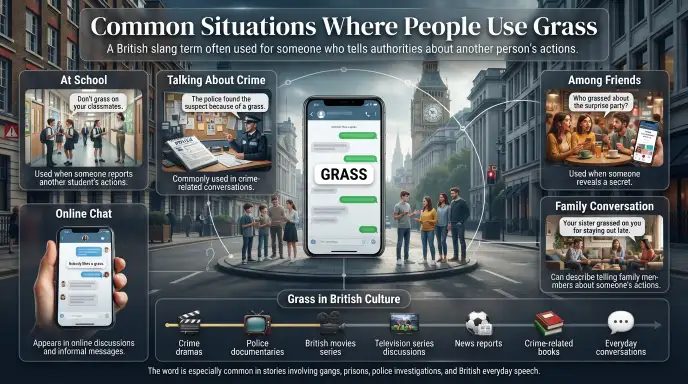
People use grass in many informal situations.
At School
“Don’t grass on your classmates.”
Talking About Crime
“The police found the suspect because of a grass.”
Among Friends
“Who grassed about the surprise party?”
Family Conversation
“Your sister grassed on you for staying out late.”
Online Chat
“Nobody likes a grass.”
These examples show that grass almost always refers to someone who tells an authority about another person’s actions.
Grass in British Culture
The slang grass appears frequently in British culture.
You may hear it in:
- Crime dramas
- Police documentaries
- British movies
- Television series
- Football discussions
- News reports
- Books about crime
- Everyday conversations
The word is especially common in stories involving gangs, prisons, or police investigations.
Grass vs Similar Slang Terms
Several slang words have similar meanings, but each has a slightly different use.
| Slang | Meaning | Commonly Used In | Offensive Level |
| Grass | Someone who informs on others | UK | Low |
| Snitch | Someone who tells on others | US & UK | Low |
| Rat | Betrayer or informant | US & UK | Medium |
| Informant | Person giving information to authorities | Formal English | None |
| Stool Pigeon | Police informer | Mainly US | Low |
Although these words are similar, grass is the most common choice in British slang.
Common Misunderstandings About Grass UK Slang Meaning
Many people misunderstand this word.
Thinking It Refers to the Plant
Not always.
The literal meaning is the green plant that grows on the ground.
In British slang, grass usually means someone who informs on others.
The conversation makes the meaning clear.
Thinking Grass Is a Swear Word
No.
Grass is not profanity.
It is simply a negative slang term.
Thinking Grass Means the Same Everywhere
Not exactly.
In the United Kingdom, grass means an informant.
In the United States, people are more likely to say:
- Snitch
- Rat
- Informant
Many Americans understand grass, but they do not use it as often.
Thinking Grass Always Refers to Crime
No.
Someone can also grass by telling:
- A teacher
- A parent
- A coach
- A manager
The slang is not limited to police situations.
Impact of Using Grass in Communication
The word grass changes the tone of a conversation.
Positive Effects
- Clearly describes someone who reports others.
- Common in British English.
- Easy for UK audiences to understand.
- Adds authenticity to British conversations.
Possible Drawbacks
- Can offend the person being described.
- Sounds informal.
- May confuse people outside the UK.
- Does not fit professional communication.
Think about your audience before using this slang.
Is Grass Safe to Use on Social Media?
Yes.
The word grass is generally safe to use on social media because it is not considered offensive profanity.
People commonly use it on:
- X (Twitter)
- TikTok
- Discord
- YouTube comments
Even so, avoid falsely calling someone a grass, as it may upset them or start unnecessary arguments.
When Should You Avoid Using Grass UK Slang Meaning?
Although grass is a common British slang word, it does not fit every situation.
Avoid using grass in:
- Business emails
- Professional meetings
- Academic papers
- Legal documents
- Official reports
- Workplace communication
- Formal presentations
In formal settings, use words like informant, witness, or person who reported the incident instead.
Polite Alternatives to Grass UK Slang Meaning
Informant
Pronunciation: (in-FOR-muhnt)
Meaning:
A person who gives information to the police or another authority.
Examples:
- The police received information from an informant.
- The informant remained anonymous.
Witness
Pronunciation: (WIT-nis)
Meaning:
Someone who saw an event and shared what they knew.
Examples:
- A witness spoke to the police.
- The witness described what happened.
Reporter
Pronunciation: (ri-POR-ter)
Meaning:
Someone who reports information to an authority.
Examples:
- The reporter informed the school principal.
- A reporter shared the details with the manager.
Whistleblower
Pronunciation: (WIS-ul-bloh-er)
Meaning:
A person who reports illegal or unethical behavior to protect others.
Examples:
- The whistleblower exposed the fraud.
- The company investigated the whistleblower’s claims.
Person Who Reported It
Pronunciation: (PUR-sun hoo ri-POR-tid it)
Meaning:
A neutral way to describe someone who informed an authority.
Examples:
- The person who reported it stayed anonymous.
- Police thanked the person who reported the crime.
Simple Alternatives Table
| Instead of Grass | Better Alternative |
| He’s a grass. | He’s an informant. |
| She grassed on us. | She reported us. |
| Don’t be a grass. | Don’t report us. |
| They found the grass. | They found the informant. |
| Someone grassed. | Someone reported it. |
These alternatives sound more professional and work well in formal writing.
Why Is Grass Still Popular?
The slang grass has stayed popular because it is short and easy to understand in the UK.
People continue using it because it:
- Has been part of British slang for decades.
- Appears in crime dramas and TV shows.
- Is common in everyday conversations.
- Clearly describes someone who reports others.
- Remains popular in British media and online discussions.
Frequently Asked Questions
Q1. What does grass mean in UK slang?
In UK slang, grass means someone who tells the police, teachers, parents, or another authority about someone else’s actions.
Q2. Why is someone called a grass?
A person is called a grass because they reported someone else’s behavior or shared information with an authority.
Q3. Is grass the same as snitch?
Yes. Both words have similar meanings. Grass is more common in British English, while snitch is more common in American English.
Q4. Is grass a rude word?
It is not a swear word, but it has a negative meaning because it suggests betrayal.
Q5. What does “grassed up” mean?
Grassed up means reported someone to the police, teacher, or another authority.
Q6. Where is grass slang most common?
The slang is most common in the United Kingdom, especially in England.
Q7. Can grass be used in text messages?
Yes. British speakers often use it in casual texts and online chats.
Q8. Is grass used in American English?
Not very often. Americans usually say snitch, rat, or informant instead.
Q9. Is grass offensive?
The word itself is not offensive, but calling someone a grass may upset them because it implies they betrayed someone.
Q10. Does grass have another meaning?
Yes. The literal meaning of grass is the green plant that grows on the ground. In British slang, it means an informant or snitch.
Key Takeaways
- Grass is British slang for someone who reports another person to an authority.
- It has a negative meaning because it suggests betrayal.
- The slang is common in UK conversations, crime dramas, and social media.
- Snitch is the closest American equivalent.
- The word is informal but not considered profanity.
- Avoid using it in professional or formal communication.
Conclusion
Grass is one of the best-known slang words in British English. It refers to someone who reports another person’s actions to the police, teachers, parents, or another authority. Although it is not a swear word, it often carries a negative meaning because it suggests someone has betrayed another person’s trust.
If you hear the word in a British TV show, a crime novel, or a casual conversation, the context will usually make the meaning clear. Knowing this slang can help you better understand British culture and everyday English.
See Related Articles
- Mot Slang Meaning: What Does “Mot” Mean?
- Strawberry Slang Meaning: Cute, Sweet or Something Else?
- SMD Meaning in Slang: What It Means, Uses, and Examples

Hey, I’m Jordan. I grew up in a bilingual household in LA, so Spanish and Mexican American slang has always been part of how I talk. I’ve been writing online content for five years, explaining terms the way I’d explain them to a friend meaning, tone, and when it’s actually okay to use.