
Chale Mexican slang is a popular search because many people hear the word “chale” in Mexican conversations, movies, songs, TikTok videos, or social media posts and want to know what it means.
At first, the word may sound confusing because it doesn’t have a single definition. Instead, its meaning changes depending on the speaker’s tone and the situation.
People in Mexico often use chale to express disappointment, surprise, frustration, disagreement, or sympathy. Because it appears in everyday conversations, many non-native Spanish speakers become curious after hearing it online or while traveling.
In this guide, you’ll learn what chale means in Mexican slang, where people use it, how its meaning changes in different situations, and when it’s appropriate to use it.
Quick Answer: What does Chale Mexican Slang Mean?
Chale is a common Mexican slang expression that usually shows disappointment, frustration, disbelief, or sympathy. Unlike an abbreviation, chale is a standalone slang word, and its exact meaning depends on the context and the speaker’s tone.
What Does Chale Mean in Text?
When someone writes chale in a text message, they usually express an emotion instead of giving information.
For example:
Friend: “I failed my driving test.”
Reply: “Chale.”
Here, chale expresses sympathy and disappointment. In English, it is similar to saying:
- “That sucks.”
- “Oh no.”
- “That’s unfortunate.”
Now consider another example:
Friend: “We have homework all weekend.”
Reply: “Chale.”
In this conversation, the word expresses frustration.
Quick Definition
Chale is a Mexican slang expression that people use to show disappointment, frustration, sympathy, surprise, or mild disagreement. The intended meaning depends on the conversation.
Does Chale Have a Slang Meaning?
Yes. In fact, chale is one of the best-known slang expressions in Mexican Spanish.
Unlike internet abbreviations such as LOL or BRB, chale developed through spoken language rather than online messaging. Later, social media, music, and television helped introduce it to people outside Mexico.
Today, you may hear chale in:
- Everyday conversations
- Text messages
- TikTok videos
- Instagram reels
- YouTube videos
- Mexican TV shows
- Podcasts
Although many people now discover the word online, Mexicans have used it in everyday speech for many years.
Chale Full Form
Many users search for:
- Chale full form
- What does chale stand for?
- Chale Mexican slang
- Chale meaning in text
The answer is simple.
Does Chale Stand for Anything?
No.
Chale is not an acronym or abbreviation.
Unlike internet slang such as:
| Slang | Full Form |
| LOL | Laugh Out Loud |
| BRB | Be Right Back |
| TBH | To Be Honest |
| IDK | I Don’t Know |
Chale does not have a full form.
Instead, it is a standalone Mexican slang expression.
Different Meanings of Chale
Although disappointment is the most common meaning, chale can express several emotions. Therefore, context always matters.
Chale Meaning 1: Disappointment
People often say chale after hearing bad news.
Example:
“Chale, I really wanted to go.”
Meaning:
“That’s disappointing.”
Chale Meaning 2: Frustration
Sometimes people use chale when something doesn’t go as planned.
Example:
“Chale, my phone just died.”
Here, the speaker feels frustrated.
Chale Meaning 3: Sympathy
People also say chale to show they feel sorry for someone.
Example:
Friend: “I lost my wallet.”
Reply: “Chale.”
The response shows understanding and sympathy.
Chale Meaning 4: Mild Disagreement
Occasionally, chale expresses polite disagreement or refusal.
Example:
Friend: “Let’s skip class.”
Reply: “Chale.”
In this situation, the speaker politely rejects the idea.
Chale Meaning 5: Surprise or Disbelief
People sometimes say chale after hearing unexpected news.
Example:
“Chale, I didn’t expect that!”
Here, the word shows surprise rather than disappointment.
Why Does Chale Have Different Meanings?
Many slang words express emotions instead of fixed definitions. Chale works the same way.
For example:
“Chale, that’s sad.”
The word expresses sympathy.
However:
“Chale, not again.”
Now it shows frustration.
Likewise:
“Chale, really?”
Here, it expresses surprise or disbelief.
Because the meaning depends on tone, listening to the entire conversation helps you understand the speaker’s intention.
Is Chale Only Used in Mexico?
Mostly, yes.
People use chale primarily in Mexico. However, you may also hear it in Mexican-American communities and among Spanish speakers who are familiar with Mexican culture.
Outside these communities, many Spanish speakers recognize the word through:
- Mexican movies
- TV shows
- Music
- TikTok creators
- YouTube channels
As Mexican entertainment reaches a global audience, more people search for chale Mexican slang to understand its meaning.
Why Is Chale Becoming More Popular Online?
Social media has introduced chale to millions of people around the world.
First, Mexican creators frequently use it in videos and livestreams. In addition, memes and reaction videos have made the expression even more recognizable.
Consequently, many people hear chale for the first time online and immediately search for its meaning.
Is Chale Rude, Offensive, or Neutral?
In most situations, chale is considered a neutral and informal Mexican slang expression. People usually say it to react to bad news, disappointment, frustration, or surprise. Since the word is not a swear word, it is generally safe to use in casual conversations.
However, the speaker’s tone plays an important role. For example, saying “Chale.” with a friendly voice can show sympathy. On the other hand, saying it with annoyance may express frustration or disagreement.
Quick Answer
Chale is generally informal and neutral. Although it isn’t offensive by itself, it belongs in casual conversations rather than professional or academic settings.
Tone Guide
| Situation | Tone | Appropriate? |
| Texting friends | Casual | ✅ Yes |
| Family conversations | Friendly | ✅ Yes |
| Social media comments | Informal | ✅ Yes |
| Talking with coworkers | Depends on the relationship | ⚠️ Sometimes |
| Business meetings | Too informal | ❌ No |
| Academic writing | Not appropriate | ❌ No |
If you’re speaking with someone you don’t know well, using standard Spanish expressions is usually the better choice.
Where Is Chale Mexican Slang Commonly Used?
People use chale most often in Mexico. Nevertheless, the expression has become familiar in many other places because of Mexican movies, music, and social media.
Chale in Text Messages
Friends often use chale when reacting to disappointing news.
Example:
Friend: “Our trip got canceled.”
Reply: “Chale.”
The response shows disappointment and sympathy.
Chale on TikTok
Many Mexican creators include chale in comedy videos, reaction clips, and everyday conversations.
Example:
“Chale, I forgot my wallet again.”
Because the expression sounds natural, viewers immediately recognize the emotion.
Chale on Instagram
You’ll often find chale in captions, comments, and direct messages.
Example:
“Chale, I wanted to go too.”
Here, the word expresses disappointment.
Chale on Reddit
People discussing Mexican culture or Spanish slang frequently use chale in Reddit threads.
Common questions include:
- What does chale mean?
- Is chale Mexican slang?
- Is chale rude?
These discussions help language learners understand the expression more clearly.
Chale in Everyday Conversations
In Mexico, people naturally use chale while talking with friends and family.
For instance:
“Chale, it’s raining again.”
The speaker simply reacts to an unfortunate situation.
Chale in Movies, Music, and TV Shows
Mexican films, television series, and songs often include chale because it reflects authentic everyday speech.
As a result, international audiences hear the word and later search for its meaning online.
Why Do People Use Chale Mexican Slang?
People continue using chale because it communicates emotions quickly and naturally. Instead of explaining how they feel, they can express the same reaction with a single word.
It Expresses Disappointment
Many speakers say chale after hearing bad news.
Example:
“Chale, we missed the concert.”
The word immediately shows disappointment.
It Shows Sympathy
Sometimes people use chale to comfort someone.
Example:
Friend: “I failed my exam.”
Reply: “Chale.”
Rather than offering a long response, the speaker shows understanding with one simple word.
It Adds Emotion to Conversations
Slang often makes conversations sound more natural.
Instead of saying:
“That’s unfortunate.”
Many Mexicans simply say:
“Chale.”
As a result, conversations feel more relaxed and authentic.
It Reflects Mexican Culture
Like many regional expressions, chale represents everyday Mexican Spanish.
People continue using it because it reflects local culture and identity.
Real Life Examples of Chale Mexican Slang
The meaning of chale changes slightly depending on the situation. These examples show how native speakers use it in everyday conversations.
Friendly Examples
Friend: “I can’t come tonight.”
You: “Chale, we’ll miss you.”
“Chale, I was really looking forward to that.”
Casual Examples
“Chale, my phone battery died.”
“Chale, I forgot my keys again.”
Sympathetic Examples
Friend: “My team lost the final.”
You: “Chale.”
Friend: “I didn’t get the job.”
You: “Chale, I’m sorry to hear that.”
Social Media Examples
TikTok Caption:
“Chale… Monday already. “
Instagram Caption:
“Chale, vacation ended too fast.”
X (formerly Twitter):
“Chale, that episode was heartbreaking.”
These examples show how one simple word can express disappointment, sympathy, or frustration.
Origin and Background of Chale Mexican Slang
The exact origin of chale remains uncertain. However, language experts generally agree that it developed as part of Mexican Spanish and has been used in everyday conversations for many years.
Unlike internet slang, chale existed long before social media became popular.
A Long History in Spoken Mexican Spanish
People have used chale in casual speech for generations.
Although younger people still use it today, older generations also recognize the expression. Therefore, it remains one of Mexico’s most familiar slang words.
Growth Through Entertainment
Mexican television, films, and music introduced chale to audiences outside the country.
Later, streaming services made this content available worldwide. Consequently, more international viewers became familiar with the expression.
Social Media Increased Its Popularity
Today, TikTok, Instagram, YouTube, and Reddit expose millions of users to Mexican slang.
Because creators frequently use chale in videos and comments, many people search online to learn its meaning.
Chale vs Similar Mexican Slang
Several Mexican expressions communicate emotions similar to chale. Even so, each one has its own tone and purpose.
| Slang | Meaning | Typical Emotion |
| Chale | Oh no / That’s unfortunate | Disappointment, sympathy |
| Ni modo | It can’t be helped | Acceptance |
| Híjole | Wow / Oh no | Surprise |
| Uy | Oh! | Surprise |
| Qué mal | That’s bad | Sympathy |
| No manches | No way! | Surprise or disbelief |
Although these expressions are similar, chale usually emphasizes disappointment or frustration more than the others.
Why Context Matters
Context always determines the meaning of chale.
For example:
“Chale, I forgot my homework.”
Here, the speaker feels frustrated.
Meanwhile:
“Chale, I’m sorry that happened.”
Now the word expresses sympathy.
Likewise:
“Chale, seriously?”
In this situation, it shows surprise or disbelief.
Therefore, listening to the speaker’s tone and reading the surrounding conversation will help you understand the intended meaning.
Common Misunderstandings About Chale
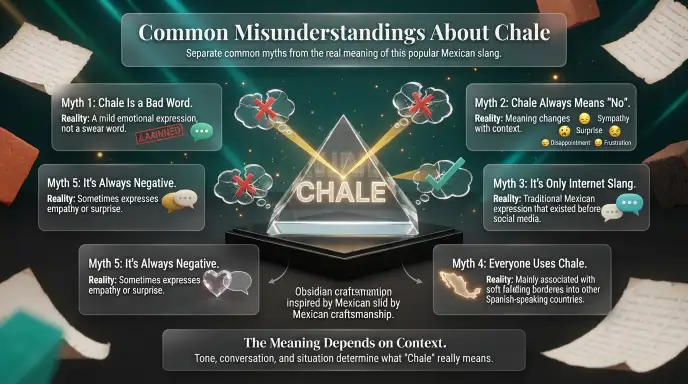
Because chale is a regional slang expression, many people misunderstand its meaning. Here are some of the most common misconceptions.
Many People Think Chale Is a Bad Word
This is one of the biggest misunderstandings.
Although chale often expresses frustration or disappointment, it is not a swear word. Instead, people use it as a mild emotional reaction in everyday conversations.
For example:
“Chale, I forgot my wallet.”
Here, the speaker simply expresses frustration.
Some People Believe Chale Always Means “No”
Another common misconception is that chale always means “no.”
In reality, the word has several meanings. Depending on the situation, it can express:
- Disappointment
- Sympathy
- Surprise
- Frustration
- Mild disagreement
Therefore, you should always read the entire conversation before deciding what the speaker means.
Chale Is Not an Internet Abbreviation
Many people assume chale is modern internet slang because they first see it on TikTok or Instagram.
However, chale existed long before social media became popular. It has been part of spoken Mexican Spanish for many years.
Today, social media simply helps more people discover the expression.
Chale Is Not Used in Every Spanish-Speaking Country
Some learners believe every Spanish speaker uses chale.
Actually, chale is strongly associated with Mexico. Although people in other countries may recognize the word, they often use different expressions in everyday conversations.
For this reason, don’t expect every Spanish speaker to understand or use chale regularly.
Chale Is Not Always Negative
Because people often hear chale after bad news, they assume it always has a negative meaning.
However, that’s not always true.
Sometimes the word simply shows surprise or empathy.
For example:
Friend: “I didn’t get the job.”
Reply: “Chale.”
Here, the speaker is showing sympathy rather than complaining.
When Should You Avoid Using Chale?
Although chale is a common Mexican slang word, it isn’t suitable for every situation.
Professional Communication
Avoid using chale in:
- Business emails
- Job interviews
- Workplace meetings
- Client conversations
Instead, use standard Spanish or English expressions that sound more professional.
Academic Writing
School assignments, research papers, and official reports should avoid regional slang.
Formal language improves clarity and suits a wider audience.
International Conversations
Many Spanish learners outside Mexico may not understand chale.
Therefore, if you’re speaking with an international audience, choose more universal expressions whenever possible.
Formal Public Speaking
Speeches, presentations, and official events usually require standard language.
Using chale in these settings may sound too casual.
Polite Alternatives to Chale
If you prefer a more neutral expression, these alternatives work well.
| Instead of Chale | Meaning | Best Used For |
| Qué mal | That’s unfortunate | Everyday conversations |
| Lo siento | I’m sorry | Showing sympathy |
| Qué pena | What a shame | Casual and formal settings |
| Ni modo | It can’t be helped | Accepting a situation |
| Híjole | Wow / Oh no | Informal reactions |
| Oh no | Expressing disappointment | English conversations |
These alternatives are easier for a wider audience to understand.
Why Do People Continue Using Chale?
Despite changing language trends, chale remains one of Mexico’s best-known slang expressions.
It Expresses Emotions Quickly
One short word can communicate disappointment, sympathy, or frustration without a long explanation.
It Sounds Natural
Native speakers often choose chale because it feels more conversational than formal expressions.
It Reflects Mexican Culture
Regional slang helps preserve local identity.
For many speakers, chale is simply part of everyday Mexican Spanish.
Social Media Keeps It Popular
TikTok, Instagram, YouTube, and memes continue introducing chale to younger generations.
Consequently, the expression remains popular both online and offline.
Impact of Using Slang in Communication
Slang makes conversations more expressive. However, people should still consider their audience before using regional expressions.
Advantages
1. Makes Conversations Feel Natural
Regional slang helps everyday conversations sound authentic.
2. Shows Cultural Identity
Expressions like chale reflect Mexican culture and local traditions.
3. Adds Emotion
A single word can communicate feelings more effectively than a longer sentence.
4. Builds Social Connections
Friends often feel more connected when they share familiar slang.
Disadvantages
1. Not Everyone Understands It
People outside Mexico may misunderstand the expression.
2. Doesn’t Fit Formal Situations
Professional communication usually requires standard language instead of slang.
3. Meaning Depends on Context
Because chale has several meanings, readers need context to understand the speaker’s intention.
Is Chale Safe for Social Media?
Yes. Chale is generally safe to use on social media because it is not a swear word or offensive expression.
You’ll often see it on:
- TikTok
- X (formerly Twitter)
- YouTube
Even so, it’s best to use chale naturally and respectfully.
Appropriate Example
“Chale, I can’t believe the weekend is over.”
Another Appropriate Example
“Chale, I hope things get better soon.”
These examples sound natural and respectful.
Comparison Table
| Expression | Meaning | Emotion | Region |
| Chale | Oh no / That’s unfortunate | Disappointment, sympathy, frustration | Mexico |
| Ni modo | It can’t be helped | Acceptance | Mexico |
| Híjole | Wow / Oh no | Surprise | Mexico |
| No manches | No way! | Surprise or disbelief | Mexico |
| Qué mal | That’s bad | Sympathy | Spanish-speaking countries |
| Lo siento | I’m sorry | Sympathy | Standard Spanish |
Frequently Asked Questions
1. What does chale mean in Mexican slang?
Chale is a Mexican slang expression that usually shows disappointment, frustration, sympathy, or surprise. Its exact meaning depends on the context.
2. What does chale stand for?
Chale does not stand for anything. It is not an acronym or abbreviation.
3. Is chale a bad word?
No. Chale is not a swear word. Most people use it as a mild emotional expression in casual conversations.
4. Is chale only used in Mexico?
It is mainly used in Mexico. However, many people outside the country recognize it through Mexican movies, music, and social media.
5. Can chale mean different things?
Yes. Depending on the situation, chale can express disappointment, sympathy, frustration, surprise, or mild disagreement.
6. Is chale rude?
Generally, no. It is considered an informal but polite slang expression.
7. Can I use chale in professional conversations?
No. Since chale is informal slang, formal settings require standard language.
8. Why do people say chale?
People say chale because it expresses emotions quickly and naturally in everyday conversations.
9. Is chale still popular today?
Yes. Chale remains popular in Mexico and frequently appears in conversations, music, movies, and social media.
10. Is chale safe to use on social media?
Yes. Chale is generally safe to use on social media because it is not offensive or vulgar.
Conclusion
If you’re searching for chale Mexican slang, the simplest answer is that chale is a popular Mexican expression used to show disappointment, frustration, sympathy, surprise, or mild disagreement. Although the word has several meanings, the surrounding conversation usually makes its purpose clear.
Because chale reflects everyday Mexican Spanish, you’ll often hear it in conversations, TV shows, music, memes, and social media. By understanding its meaning and context, you can recognize the expression more easily and use it naturally when appropriate.
Read Next!
- Volleyball Slang Terms: Meanings, Examples & Volleyball Phrases
- Mexican Slang for Cocaine: Meaning, Examples & Regional Usage
- Top Punjabi Slang Words You’ll Hear in Everyday Conversations

Hi, I’m Sarah. I studied Communications at the University of Texas and have spent the last six years writing about internet culture and Gen Z slang across TikTok, Twitter, and everyday conversations. I focus on real usage, not just dictionary definitions.