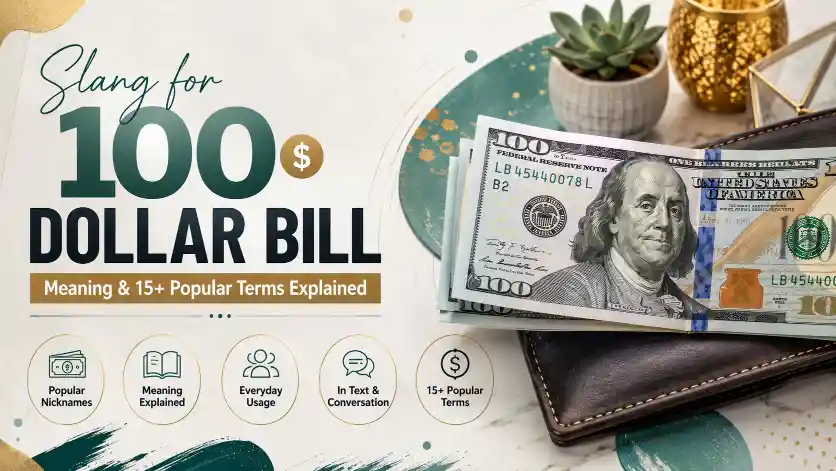
Slang for 100 dollar bill includes a wide range of popular terms like Benjamin, C-note, hunnid, blue face, and franklin.
If you hear them in hip-hop lyrics, read them in text messages, or spot them on social media platforms like TikTok, Instagram, and Reddit, street terms for money have a rich history and culture behind them.
Money is one of the most frequently discussed topics in human communication, so it is no surprise that people have invented dozens of nicknames for cash.
When discussing the highest-denomination bill in common US circulation, the $100 bill, slang terms allow speakers to express wealth, financial success, or casual business transactions with local flair and urban style.
Understanding what slang for 100 dollar bill means in text messages, songs, and social media helps you keep up with modern conversations, interpret lyrics accurately, and avoid confusing money terms with other slang concepts.
Quick Answer: Slang for 100 Dollar Bill
The most popular slang for 100 dollar bill terms are Benjamin (referring to Benjamin Franklin’s portrait), C-note (from the Roman numeral ‘C’ meaning 100), hunnid (a phonetic spelling of hundred), and blue face (referring to the 3D security ribbon on newer $100 notes).
What Does Slang for 100 Dollar Bill Mean in Text?
In text messaging, gaming chats, and online forums, slang for 100 dollar bill terms are used as quick, casual shortcuts to talk about money, prices, payouts, or financial flexes.
Because typing out “one hundred dollars” can feel overly formal or stiff, people naturally substitute terms like benji, c-note, or hunnid. Depending on the specific word chosen, the text message can convey different vibes ranging from urban street slang to old-school gangster nostalgia or modern online gaming culture.
The Most Popular Slang Terms for a $100 Bill
While there are many regional and historical nicknames for money, a handful of specific terms refer directly to the one hundred dollar bill.
1. Benjamin (or Benji)
- Full Form / Concept: Benjamin Franklin
- Meaning: Named after Benjamin Franklin, whose face has been featured on the front of the US $100 bill since 1914.
- Vibe: Universal, widely understood, and extremely popular in rap and pop culture.
2. C-Note
- Full Form / Concept: Century Note
- Meaning: Derived from the Roman numeral “C”, which represents the number 100.
- Vibe: Classic, mid century American slang, often associated with mob movies, vintage crime novels, and traditional poker games.
3. Blue Face
- Full Form / Concept: Blue faced $100 bill
- Meaning: Refers to the redesigned Series 2009 $100 bill featuring a prominent blue 3D security ribbon down the center and a large blue watermarked 100.
- Vibe: Modern hip hop culture, popularized heavily by West Coast rappers (such as Blueface) and modern social media flex posts.
4. Hunnid / Huni / Hun
- Full Form / Concept: Phonetic variation of “Hundred”
- Meaning: A casual, stylistic spelling and pronunciation of the word “hundred.”
- Vibe: Highly informal, common in text conversations, hip-hop, and casual gaming circles.
5. Franklin
- Full Form / Concept: Benjamin Franklin
- Meaning: Similar to Benjamin, this term simply uses the Founding Father’s surname to denote the $100 bill.
- Vibe: Direct, casual, and mainstream.
Is Slang for 100 Dollar Bill Rude, Offensive, or Neutral?
terms for the $100 bill are generally neutral and completely non offensive. They are informal expressions used to describe currency without any inherent profanity or insult.
However, appropriateness depends entirely on context and social setting:
- Neutral / Safe: Terms like C-note, Benjamin, or hunnid are safe to use among friends, in creative writing, on social media, or in casual conversations.
- Context Sensitive: Using terms like blue face or benjis in formal settings such as job interviews, courtrooms, or corporate banking transactions can make you sound unprofessional or overly casual.
Where Is Slang for 100 Dollar Bill Commonly Used?
You will encounter these terms across almost every modern communication channel:
1. Text Messaging (WhatsApp, iMessage, SMS)
Friends often use short money slang when splitting bills, talking about prices, or selling items privately:
“I can sell you the console for two benjis if you pick it up today.”
2. Social Media (TikTok, Instagram, Snapchat)
On video platforms, creators use slang like blue faces or hunnids in captions, overlay text, and tags when displaying purchases, side hustles, or lifestyle content.
3. Hip-Hop and Pop Culture
Music is the largest driver of money slang. Rappers and songwriters regularly reference Benjamins and C-notes to symbolize success, wealth, and hustle.
4. Online Gaming & Streaming (Discord, Twitch)
In gaming communities, players often trade virtual items or real world currency using terms like hunnid or C-note to negotiate trades quickly in live chat windows.
Origin and Background of $100 Bill Slang

The nicknames for the $100 bill have evolved alongside American currency history:
- The Birth of “C-Note”: Dating back to the early 20th century, bank tellers and traders used Roman numerals on financial documents. The Roman letter C stood for 100 (from the Latin word centum). The term quickly leaked into underworld slang and classic cinema.
- The Rise of “Benjamin”: When Benjamin Franklin’s portrait replaced Abraham Lincoln on the $100 bill in 1914, people began calling the bill a “Franklin” or “Benjamin.” The term exploded in global pop culture following the 1997 hip-hop hit “It’s All About the Benjamins” by Puff Daddy.
- The “Blue Face” Redesign: In October 2013, the US Department of the Treasury released a redesigned $100 bill with advanced anti-counterfeiting features, including a vertical blue 3D ribbon. Almost immediately, youth culture dubbed the new bills “blue faces.”
Comparison Table: Popular Slang Terms for a $100 Bill
To help you quickly compare how different terms are used, refer to this breakdown:
| Slang Term | Origin / Meaning | Common Context | Formality Level |
| Benjamin | Benjamin Franklin’s face on the bill | Hip-hop, general conversation | Informal |
| C-note | Roman numeral “C” = 100 | Poker, vintage cinema, casual trade | Informal / Classic |
| Blue Face | 2013 blue security ribbon design | Modern rap, TikTok, youth culture | Very Informal |
| Hunnid | Phonetic spelling of “hundred” | Texting, gaming, social media | Very Informal |
| Franklin | Surname of Benjamin Franklin | General casual conversation | Informal |
| Bean / Yard | Regional variations (UK / US niche) | Street trade, regional slang | Niche Slang |
Real-Life Examples Showing Different Tones
Here are practical examples showing how money slang appears in real-world scenarios across different communication styles:
1. Friendly / Casual Text Message
- Sender: “Hey, thanks for helping me move yesterday! Just sent you a hunnid on Venmo.”
- Receiver: “Appreciate it, bro! Let me know if you need help next week.”
2. Social Media / Instagram Caption
- Post Caption: “Worked 60 hours this week, but seeing those blue faces makes it all worth it. “
3. Gaming / Discord Trade Chat
- Player A: “Selling my rare skin in-game. DM me offers.”
- Player B: “I’ll give you two C-notes for it right now.”
4. Casual Negotiation / Marketplace
- Buyer: “Would you take $80 for the bike?”
- Seller: “Nah, price is firm at one Benjamin.”
Related Money Slang Concepts to Know
When learning slang for 100 dollar bill, it helps to understand how other money amounts are described in casual English:
- Buck: A standard slang word for one dollar ($1).
- Fin / Five-spot: Slang for a $5 bill.
- Sawbuck: Classic slang for a $10 bill (referring to the Roman numeral X).
- Jackson: Slang for a $20 bill (featuring Andrew Jackson).
- Grand / Stack / Rack: Slang terms representing $1,000 (e.g., “5 racks” = $5,000).
When to Avoid Using Money Slang
While slang adds color and personality to casual talk, you should avoid using slang for 100 dollar bill in specific environments:
- Banking and Financial Institutions: When depositing, withdrawing, or applying for loans, always use standard financial terms (“one hundred dollars” or “$100”).
- Legal and Official Documents: Contracts, receipts, and agreements must state numerical figures clearly without informal jargon.
- Professional Work Environments: In corporate emails, customer service interactions, or salary negotiations, stick to professional monetary phrasing.
Polite Alternatives to Money Slang
If you are in a formal setting and want to express amounts clearly without sounding overly casual, use these standard terms:
| Informal / Slang Term | Professional Alternative | Usage Setting |
| Benjamin / C-note | One hundred dollar bill | Banking, retail |
| Hunnid | One hundred dollars | General polite talk |
| Blue face | $100 USD note | Official transactions |
| Rack / Stack | One thousand dollars | Finance, business |
Why Do People Use Slang for Money?
People use slang for the $100 bill for several reasons:
- Efficiency: Shorter words like benji or hun are faster to type on touchscreens than typing full numbers out in words.
- Cultural Connection: Using contemporary terms creates a sense of shared subculture, especially in music, gaming, and online communities.
- Discretion: In certain contexts, using coded language or street slang allows people to discuss money without sounding loud or overly explicit to outsiders.
Impact of Using Money Slang in Communication
Using modern slang correctly can make your writing and text messages feel natural, culturally aware, and engaging. It builds rapport with peers and helps you understand subtle humor, music lyrics, and video content online.
However, misusing slang or using older terms incorrectly can make you sound forced. The key to effective communication is matching your vocabulary to your audience and platform.
Is Money Slang Safe for Social Media?
Yes, using slang for 100 dollar bill terms like benjamin, c-note, or hunnid is completely safe across social media channels (TikTok, Instagram, YouTube, X, and Facebook).
Unlike profanity or restricted keywords, money slang terms do not trigger content warnings or community guideline strikes on major platforms, making them completely safe for captions, comments, and post titles.
Frequently Asked Questions (FAQs)
1. What does C-note stand for in money slang?
C-note stands for a $100 bill. The “C” comes from the Roman numeral for 100, which is C (short for the Latin word centum).
2. What does “blue face” mean in slang?
A blue face is a slang term for the current US $100 bill design, which features a prominent 3D blue security ribbon printed down the front of the note.
3. What is the full form of “hunnid”?
“Hunnid” does not have a formal acronym full form; it is a phonetic slang spelling of the word hundred, representing $100.
4. Why is a $100 bill called a Benjamin?
It is called a Benjamin because the front of the US $100 bill features a portrait of Benjamin Franklin, one of America’s Founding Fathers.
5. What is a “stack” or a “rack” compared to a Benjamin?
While a Benjamin refers to a single $100 bill, a stack or a rack typically refers to $1,000 (usually banded together in ten $100 bills).
Conclusion
Understanding slang for 100 dollar bill terms like Benjamin, C-note, blue face, and hunnid gives you a clearer view of modern language, music culture, and digital communication. Each term carries its own unique history, from Roman numerals and 20th century history to modern currency redesigns and hip-hop culture.
When using these terms in text messages, social posts, or casual chats, keep your environment and audience in mind. Save the slang for friends, social feeds, and casual conversations, and stick to standard terms when conducting formal business or financial transactions.
Read Similar Slang:

Hey, I’m Jordan. I grew up in a bilingual household in LA, so Spanish and Mexican American slang has always been part of how I talk. I’ve been writing online content for five years, explaining terms the way I’d explain them to a friend meaning, tone, and when it’s actually okay to use.