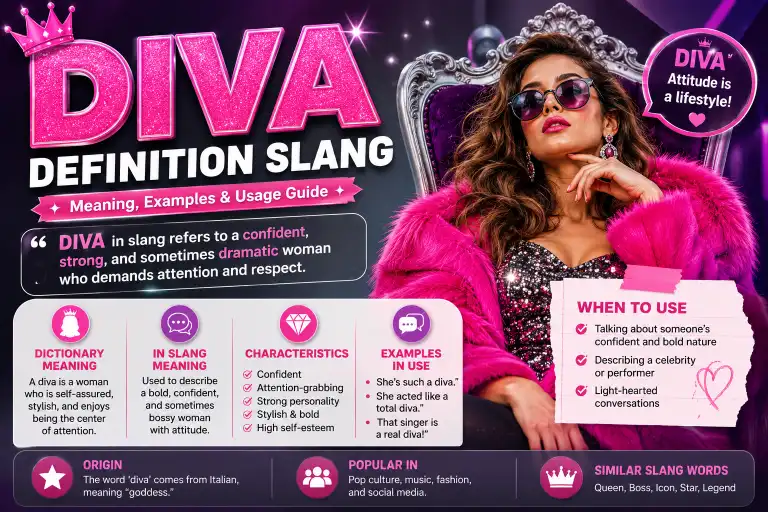
Diva definition slang usually refers to someone who acts as if they are very important, demanding, dramatic, or expects special treatment.
Depending on the situation, calling someone a diva can be either a compliment or a playful insult. In some conversations, it describes a confident, stylish person with a strong personality. In others, it refers to someone who is difficult to please or behaves dramatically.
Many people search for diva definition slang after seeing the word on TikTok, Instagram, Reddit, Snapchat, or in text messages. Because the tone changes with the context, it can sometimes be confusing. This guide explains the modern slang meaning of diva, where it is commonly used, if it is rude, and how to use it naturally in everyday conversations.
Quick Answer
In modern slang, diva describes someone who is talented, confident, glamorous, or dramatic. It can be a compliment for a confident person or a criticism for someone who behaves as though they deserve special treatment. The meaning depends entirely on the tone and context.
What Does Diva Definition Slang Mean?
In slang, diva is used to describe a person with a big personality. The word often suggests confidence, style, or talent, but it can also imply that someone is overly demanding or dramatic.
Today, people commonly use diva in several different ways.
Meaning 1: Someone Who Is Confident and Stylish
This is one of the most positive meanings.
A diva may be someone who:
- Dresses confidently
- Has a bold personality
- Enjoys being the center of attention
- Carries themselves with confidence
Example:
“She walked into the party looking like a total diva.”
Here, diva is a compliment that praises someone’s confidence and appearance.
Meaning 2: Someone Who Is Dramatic
Sometimes diva describes a person who overreacts or creates unnecessary drama.
Example:
“Don’t be such a diva just because your coffee is cold.”
In this example, the word suggests that the person is making a bigger issue than necessary.
Meaning 3: Someone Who Expects Special Treatment
Another common slang meaning refers to people who expect everyone else to accommodate them.
For example:
“He’s acting like a diva today.”
This suggests the person is behaving in a demanding or high maintenance way.
Although this meaning is usually playful, it may sound rude depending on your relationship with the other person.
Meaning 4: A Highly Talented Performer
The word diva originally described a famous female opera singer with exceptional talent. Over time, it expanded to include successful performers in music, television, film, and entertainment.
Today, fans sometimes call their favorite singers or celebrities divas as a sign of admiration.
Example:
“She’s one of the biggest pop divas in the world.”
Here, the word highlights talent and star power rather than negative behavior.
Full Form or Complete Meaning
Diva is not an acronym, so it does not have a full form.
The word comes from the Italian language, where diva means “goddess.” It was originally used to describe celebrated female opera singers because of their exceptional talent and stage presence.
Over time, the meaning expanded beyond music.
Today, diva can refer to someone who is:
- Glamorous
- Stylish
- Confident
- Talented
- Dramatic
- High maintenance
- Attention seeking
The exact meaning depends on the conversation.
Where Is Diva Slang Commonly Used?
The slang term diva appears across many online platforms and in everyday conversations.
1. TikTok
TikTok users often use diva in a positive and humorous way.
Examples include:
- “Entering my diva era.”
- “Main character diva energy.”
- “Serving diva vibes.”
These phrases usually celebrate confidence, fashion, or self expression.
2. Instagram
On Instagram, diva frequently appears in:
- Captions
- Fashion posts
- Beauty content
- Celebrity fan pages
- Comments
Example:
“Absolutely diva behavior.”
This often praises someone’s confidence or glamorous style.
3. Snapchat
Friends may jokingly call each other divas during casual conversations.
Example:
“You’re such a diva when choosing a restaurant.”
Here, the word is playful rather than offensive.
4. Reddit
On Reddit, the meaning depends on the discussion.
People may use diva when talking about:
- Celebrities
- Music
- Reality TV
- Workplace behavior
- Family relationships
Some users use it positively, while others criticize demanding behavior.
5. Discord and Gaming
Although less common in gaming communities, diva may describe someone who expects special treatment or constantly wants attention.
For example:
“Our teammate is being a diva again.”
In this context, it usually refers to demanding behavior rather than confidence.
6. Text Messages
Friends often use diva affectionately.
Examples:
“Looking like a diva today!”
“Stop being such a diva.”
if these messages are compliments or jokes depends on the relationship between the people involved.
Is Diva Slang Rude, Offensive, or Harmless?
Diva is generally neutral, but its tone depends on how it is used.
| Context | Tone |
| Complimenting confidence | Positive |
| Praising talent | Positive |
| Fashion or beauty discussions | Positive |
| Calling someone dramatic | Slightly Negative |
| Saying someone is demanding | Negative |
| Friendly jokes | Playful |
For example:
“She’s a fashion diva.”
This is usually complimentary.
Compare that with:
“He’s acting like a diva.”
This usually criticizes someone’s behavior.
Because the meaning changes with context, it’s important to consider your audience and tone before using the word.
Real Life Examples of Diva Slang
Here are some realistic examples showing how diva is used in different situations.
1. Friendly Conversation
Emma: “Your outfit looks amazing today!”
Sophia: “Thanks! I’m feeling like a diva.”
In this example, diva expresses confidence and style.
2. Casual Conversation
“She spent an hour getting ready because she’s a total diva.”
Here, the word is used humorously to describe someone who enjoys looking their best.
3. Social Media
“Serving diva energy all summer. 💅”
This caption celebrates confidence, fashion, and self expression.
4. Workplace
“He’s brilliant at his job, but some people think he’s a bit of a diva.”
In a workplace, diva often describes someone who is talented but difficult to work with because they expect special treatment.
5. Family Conversation
Mom: “Your little sister refuses to wear anything except her favorite dress.”
Dad: “She’s becoming quite the little diva.”
Here, the word is playful and affectionate rather than insulting.
Origin and History
The word diva comes from the Italian language, where it literally means “goddess.” It was first used in the world of opera to describe exceptionally talented female singers who were admired for their powerful performances.
During the 20th century, the meaning expanded beyond opera. Journalists and fans began calling famous actresses and singers divas because of their talent, popularity, and glamorous public image.
As the term became more common in popular culture, it also developed a second meaning. People started using diva to describe someone who behaves in a demanding, dramatic, or high maintenance way.
Today, both meanings exist:
- A confident, talented, or glamorous person.
- Someone who expects special treatment or behaves dramatically.
The intended meaning depends on the context and tone of the conversation.
Similar Slang or Related Terms
Several slang words share similarities with diva, but each has its own meaning.
| Slang | Meaning | Tone |
| Queen | Confident, admired person | Positive |
| Icon | Highly respected or influential person | Positive |
| Boss | Someone who is confident or in control | Positive |
| Main Character | Someone acting like the center of attention | Neutral |
| Drama Queen | Someone who overreacts | Negative |
| High maintenance | Someone difficult to satisfy | Negative |
| Slay | To perform exceptionally well | Positive |
| Legend | Someone admired for achievements | Positive |
Although these expressions are related, diva is unique because it can describe both admirable confidence and demanding behavior.
Why Do People Use Diva Slang?
People use diva because it quickly describes a strong personality.
Common reasons include:
- Complimenting confidence.
- Praising fashion or style.
- Describing talented performers.
- Teasing friends in a playful way.
- Referring to dramatic or demanding behavior.
- Celebrating someone’s glamorous personality.
For example:
Instead of saying:
“She has incredible confidence.”
Someone might say:
“She’s a diva.”
The slang makes the description more expressive and memorable.
When Should You Avoid Using It?
Although diva is usually harmless, there are situations where it may be misunderstood.
Avoid using it:
- During job interviews.
- In formal business emails.
- In academic writing.
- With people who may interpret it as criticism.
- When describing someone you don’t know well.
For example:
Instead of saying:
“Our manager is a diva.”
A more professional alternative would be:
“Our manager has high expectations.”
This avoids sounding disrespectful.
Polite Alternatives
If you want to avoid slang, these alternatives may work better depending on the situation.
| Diva Slang | Polite Alternative |
| Diva | Confident person |
| Diva | Stylish person |
| Diva | Talented performer |
| Diva | Strong personality |
| Diva | Professional |
| Diva | Glamorous |
| Diva (negative) | Demanding |
| Diva (negative) | High maintenance |
| Diva (negative) | Particular |
| Diva (positive) | Star performer |
Choose the alternative that best matches the tone you want to communicate.
Platform Usage Comparison Table
| Platform | Common Meaning | Popularity |
| TikTok | Confidence, fashion, “diva era” | Very High |
| Glamour, beauty, style | Very High | |
| Snapchat | Playful teasing | High |
| Celebrity discussions or personality traits | Medium | |
| Discord | Demanding teammate or playful joke | Medium |
| Text Messages | Friendly compliment or teasing | Very High |
| Workplace Chat | Usually avoided unless joking with close colleagues | Low |
The meaning stays largely the same across platforms, but the tone changes depending on the audience.
Is It Safe for Social Media?
Yes. Diva is generally safe to use on social media.
It commonly appears in:
- TikTok captions
- Instagram posts
- Snapchat messages
- X (formerly Twitter)
- Reddit discussions
- Facebook comments
Positive examples include:
- “Feeling like a diva today.”
- “Serving diva energy.”
- “She’s a fashion diva.”
However, using diva to criticize someone’s behavior may offend them if they interpret it as calling them demanding or difficult. If you’re unsure how someone will take it, choose a more neutral description.
Common Misunderstandings About Diva Definition Slang
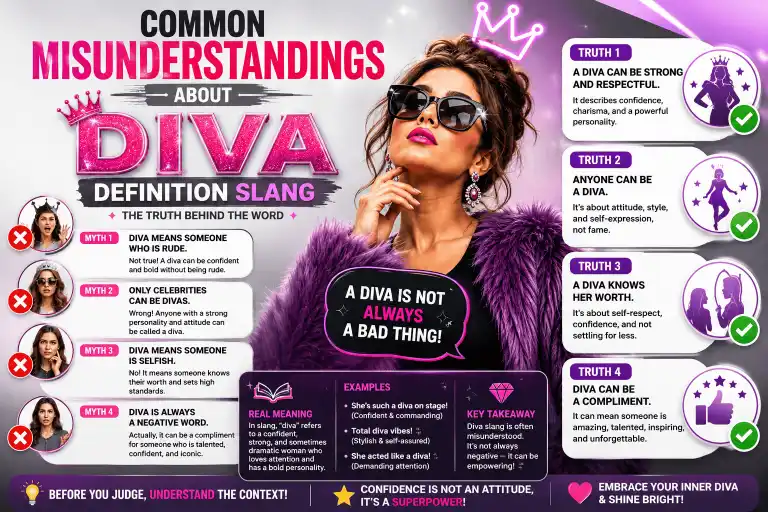
Although diva is a popular slang term, it is often misunderstood. Here are some common misconceptions about its meaning and usage.
Thinking Diva Is Always an Insult
Many people believe that calling someone a diva is always rude. In reality, it can be a genuine compliment.
For example:
“She’s a fashion diva.”
This usually praises someone’s confidence, style, or glamorous personality.
However:
“He’s acting like a diva.”
This often criticizes someone for being demanding or dramatic.
The tone depends on the situation and how the speaker intends the word.
Assuming Diva Only Describes Women
Historically, diva referred to famous female opera singers, but modern slang is much broader.
Today, people sometimes use diva for men as well, especially when describing someone who is:
- Dramatic
- Demanding
- Fashionable
- Attention seeking
- Extremely confident
The context matters more than the person’s gender.
Confusing Diva with Drama Queen
Although the two terms are related, they are not identical.
A drama queen almost always describes someone who exaggerates problems or overreacts.
A diva, on the other hand, may simply be:
- Confident
- Stylish
- Talented
- Glamorous
Only in some situations does diva imply dramatic or demanding behavior.
Believing Diva Always Has a Negative Meaning
Modern social media has made diva much more positive.
Many creators proudly use phrases like:
- “Diva energy”
- “Diva era”
- “Serving diva vibes”
These expressions celebrate confidence and self expression rather than criticizing someone’s attitude.
Key Takeaways
- Diva is not an acronym and has no full form.
- The word originally comes from Italian and means “goddess.”
- In modern slang, diva can describe someone who is confident, stylish, glamorous, or highly talented.
- It can also describe someone who behaves dramatically or expects special treatment.
- The meaning depends entirely on the context and tone.
- Diva is commonly used on TikTok, Instagram, Snapchat, Reddit, Discord, and in text messages.
- The slang is usually safe to use, but avoid it in formal or professional situations where it could be misunderstood.
Frequently Asked Questions
Q1. What is the diva definition in slang?
In slang, diva refers to someone who is confident, glamorous, talented, or has a strong personality. It can also describe a person who behaves in a demanding or dramatic way.
Q2. Is calling someone a diva a compliment?
It can be. Calling someone a diva is often a compliment when praising their confidence, fashion sense, talent, or stage presence. However, it may sound negative if it suggests they are difficult or demanding.
Q3. Does diva have a full form?
No. Diva is not an abbreviation or acronym, so it does not have a full form. The word comes from Italian and originally meant “goddess.”
Q4. Is diva slang rude?
Not usually. The word is generally neutral, but its tone depends on the context. Friends may use it jokingly, while in other situations it can sound like criticism.
Q5. Why do people say “diva energy”?
Diva energy refers to someone who appears confident, stylish, glamorous, and comfortable expressing themselves. It is especially popular on TikTok and Instagram.
Q6. Can men be called divas?
Yes. Although the word originally referred to women, modern slang can describe men who are dramatic, fashionable, demanding, or have bold personalities.
Q7. Is diva popular on social media?
Yes. Diva is widely used on TikTok, Instagram, Snapchat, Reddit, and X. It often appears in captions, hashtags, comments, and memes celebrating confidence or glamorous lifestyles.
Q8. What’s the difference between a diva and a drama queen?
A diva may simply be confident or glamorous, while a drama queen almost always describes someone who exaggerates situations or overreacts. Although the meanings sometimes overlap, they are not the same.
Q9. Should I use diva at work?
It’s best to avoid using diva in professional settings unless you know the person well and are certain they’ll take it as a joke. In workplaces, the word can easily be misunderstood as criticism.
Q10. Is diva slang positive or negative?
It can be either. Diva has both positive and negative meanings. It is positive when referring to confidence, talent, or style, and negative when referring to demanding or dramatic behavior.
Conclusion
Understanding the diva definition slang helps you recognize why this word has remained popular across everyday conversations and social media. Originally used for celebrated opera singers, diva has evolved into a modern slang term that can describe someone who is confident, glamorous, fashionable, talented, or full of personality. At the same time, it can also refer to someone who is dramatic, demanding, or expects special treatment, making context especially important.
if you see diva in a TikTok caption, an Instagram comment, a Reddit discussion, or a text message, the speaker’s tone usually reveals if it’s meant as praise or playful criticism. By understanding both meanings and using the term thoughtfully, you can communicate more naturally while avoiding misunderstandings in casual, social, and professional conversations.

Hey, I’m Jordan. I grew up in a bilingual household in LA, so Spanish and Mexican American slang has always been part of how I talk. I’ve been writing online content for five years, explaining terms the way I’d explain them to a friend meaning, tone, and when it’s actually okay to use.