Jeffing is a run walk run interval technique (named after Olympic runner Jeff Galloway) that’s become a popular fitness slang term, especially on TikTok’s running community.
Jeffing slang is an informal expression that people sometimes use as a milder substitute for a stronger swear word, especially in phrases like “What the jeff?” or “Are you jeffing kidding me?” Instead of using offensive language, speakers replace the original swear word with jeffing to sound less rude while still showing surprise, frustration, or disbelief.
Many people search for jeffing slang after seeing it in text messages, memes, online forums, or social media. Because it isn’t as common as other slang terms, its meaning can be confusing. This guide explains what jeffing means, where it is commonly used, if it is offensive, and how to use it correctly in different situations.
Quick Answer
In slang, jeffing is a euphemism a softer replacement for a stronger swear word. It is commonly used to express surprise, annoyance, frustration, or disbelief without using explicit profanity.
What Does Jeffing Slang Mean?
In modern slang, jeffing is an informal substitute for a stronger curse word. People use it when they want to express emotion without sounding overly offensive.
It is often used in casual conversations to soften strong language.
For example:
“What the jeff is going on?”
Here, jeff replaces a stronger swear word while keeping the emotional tone.
Another example:
“Are you jeffing serious?”
The speaker is expressing disbelief but avoiding explicit profanity.
Meaning 1: A Softer Substitute for Swearing
This is the most common meaning of jeffing.
People use it when they want to:
- Show surprise
- Express frustration
- React to unexpected news
- Avoid stronger profanity
Example:
“Why is this game jeffing broken again?”
The speaker is frustrated but uses a milder expression.
Meaning 2: A Humorous Way to Censor Profanity
Sometimes people intentionally replace swear words with jeff or jeffing to make a conversation sound funny rather than offensive.
For example:
“That was jeffing ridiculous.”
The sentence communicates annoyance while keeping the language relatively clean.
This usage is especially common in memes, humorous online posts, and casual conversations.
Full Form or Complete Meaning
Jeffing is not an acronym, so it has no full form.
Instead, it is considered a euphemistic slang expression, meaning it replaces a stronger swear word with a less offensive alternative.
Unlike abbreviations such as LOL or BRB, jeffing is simply a modified word used to reduce the impact of profanity.
Today, people commonly use it to express:
- Surprise
- Anger
- Annoyance
- Frustration
- Disbelief
without using explicit language.
Where Is Jeffing Slang Commonly Used?
Although jeffing isn’t among the most widely used internet slang terms, it appears in several informal settings.
1. Text Messages
Friends sometimes use jeffing while texting to express frustration without using stronger swear words.
Example:
“What the jeff happened?”
The message sounds emotional without containing explicit profanity.
2. Reddit
On Reddit, jeffing occasionally appears in humorous discussions, memes, and casual conversations.
People often use it to:
- Tone down profanity
- Make jokes
- Keep discussions lighthearted
3. Discord
Gaming communities and Discord servers sometimes use jeffing while chatting.
Example:
“This boss is jeffing impossible.”
Here, the player is expressing frustration during gameplay.
4. Social Media
Some users include jeffing in comments or memes because it sounds less harsh than traditional swear words.
Examples include:
- “That ending was jeffing wild.”
- “What the jeff did I just watch?”
These expressions are usually intended to be humorous.
5. Everyday Conversations
Although less common in spoken English, some people say jeffing when they want to avoid stronger profanity around children, family members, or in casual public settings.
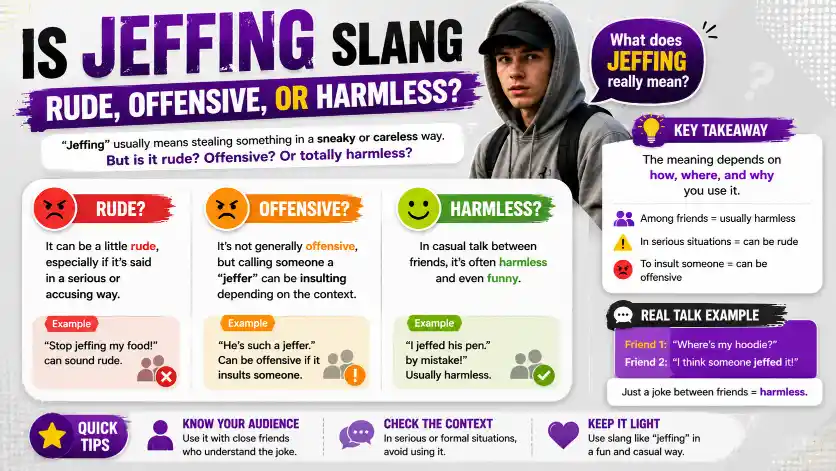
Is Jeffing Slang Rude, Offensive, or Harmless?
Jeffing is generally considered mild rather than offensive.
Because it replaces a stronger swear word, many people view it as a cleaner alternative.
| Context | Tone |
| Friendly conversations | Neutral |
| Text messages | Mild |
| Memes | Humorous |
| Gaming | Casual |
| Family conversations | Usually acceptable |
| Professional workplace | Better avoided |
Although jeffing is much less offensive than the swear word it replaces, it still imitates profanity. For that reason, it may not be appropriate in formal writing, business communication, or academic settings.
If you’re unsure if your audience will understand it, choosing a more neutral expression is often the safer option.
Real Life Examples of Jeffing Slang
Here are realistic examples showing how jeffing is used in different situations.
1. Friendly Conversation
Alex: “I forgot my wallet at home.”
Ryan: “What the jeff? We just left!”
Here, jeff expresses surprise in a humorous, lighthearted way.
2. Casual Conversation
“This weather keeps changing. It’s so jeffing confusing.”
The speaker is frustrated without using explicit profanity.
3. Social Media
“That plot twist was jeffing unpredictable! “
In social media posts, jeffing often adds emotion while keeping the language cleaner than a traditional swear word.
4. Gaming
“This level is jeffing impossible!”
Gamers sometimes use jeffing to express frustration after repeated failures.
5. Family Conversation
Dad: “Who left the lights on all night?”
Son: “Oh jeff… that was me.”
This example shows a playful replacement for a stronger exclamation.
Origin and History
The exact origin of jeffing is uncertain, and there is no single documented source that confirms when it first appeared.
What is generally understood is that jeffing developed as a euphemistic replacement for a stronger swear word. Similar substitutions have existed in English for many years, allowing speakers to express strong emotions without using explicit profanity.
Expressions like:
- Jeez
- Gosh
- Darn
- Heck
- Freaking
follow the same pattern by softening stronger language.
The slang jeffing became more noticeable in online conversations, memes, gaming communities, and casual chats where people wanted to sound expressive without being overly offensive.
Because it is relatively uncommon, its popularity varies by region and online community.
Similar Slang or Related Terms
Several slang expressions serve the same purpose as jeffing by replacing stronger swear words.
| Slang | Meaning | Tone |
| Freaking | Mild substitute for profanity | Neutral |
| Fricking | Softer version of a swear word | Neutral |
| Heck | Substitute for stronger language | Friendly |
| Darn | Mild expression of annoyance | Friendly |
| Gosh | Softer form of surprise | Polite |
| Jeez | Mild expression of shock | Casual |
| What the heck | Surprise or disbelief | Neutral |
| Good grief | Frustration or disappointment | Friendly |
Although these expressions are similar, jeffing is less common and may not be recognized by everyone.
Why Do People Use Jeffing Slang?
People use jeffing because it allows them to express emotions without sounding excessively rude.
Common reasons include:
- Avoiding explicit profanity.
- Making conversations more humorous.
- Expressing frustration politely.
- Keeping messages family friendly.
- Following internet humor.
- Softening emotional reactions.
For example, instead of saying:
“What the!”
Someone may say:
“What the jeff!”
The emotional meaning remains similar, but the language becomes much milder.
When Should You Avoid Using It?
Although jeffing is much milder than the swear word it replaces, it isn’t suitable everywhere.
Avoid using it:
- In professional emails.
- During job interviews.
- In academic assignments.
- In official reports.
- When speaking with people who may misunderstand the expression.
- In formal presentations.
A professional alternative would be:
Instead of:
“This is jeffing ridiculous.”
Say:
“This situation is very frustrating.”
This communicates the same feeling more professionally.
Polite Alternatives
If you’d rather avoid slang, these expressions work well.
| Jeffing Slang | Polite Alternative |
| What the jeff? | What happened? |
| Jeffing | Very |
| Jeffing ridiculous | Extremely unreasonable |
| Jeffing annoying | Very annoying |
| Jeffing impossible | Extremely difficult |
| Oh jeff! | Oh no! |
| Jeffing serious? | Are you serious? |
| Jeffing unbelievable | Completely unexpected |
| Jeffing unbelievable | Hard to believe |
| Jeffing frustrating | Very frustrating |
These alternatives are appropriate for schools, workplaces, and formal communication.
Platform Usage Comparison Table
| Platform | Common Usage | Popularity |
| Text Messages | Mild frustration or surprise | Medium |
| Memes and humorous comments | Medium | |
| Discord | Gaming conversations | Medium |
| TikTok | Occasional humorous captions | Low |
| Funny comments or reels | Low | |
| Gaming Chats | Expressing frustration | Medium |
| Professional Chat | Generally avoided | Very Low |
Unlike popular slang such as bet or no cap, jeffing is a niche expression and may not be familiar to everyone.
Is It Safe for Social Media?
Yes. Jeffing is generally considered safe for social media because it avoids explicit profanity.
It can be used in:
- TikTok captions
- Instagram comments
- Reddit discussions
- Discord chats
- Facebook posts
- Text messages
However, because it imitates a swear word, some readers may still view it as informal. If you’re creating professional or educational content, using standard language is usually the better choice.
Common Misunderstandings
Because jeffing is not as widely used as many internet slang terms, people often misunderstand its meaning. Here are some of the most common misconceptions.
1. Thinking Jeffing Is an Acronym
One common mistake is believing jeffing stands for a phrase or abbreviation.
It does not.
Unlike LOL, BRB, or IDK, jeffing is not an acronym and has no full form. It is simply a slang substitute for a stronger swear word.
2. Assuming Jeffing Refers to Someone Named Jeff
Some people think jeffing is related to a person named Jeff.
In most slang contexts, this isn’t true.
The word is usually used as a humorous replacement for profanity rather than referring to an actual person.
For example:
“What the jeff is happening?”
Here, Jeff is not a person’s name it simply replaces a stronger expression.
3. Believing Jeffing Is Always Offensive
Although jeffing is based on a swear word, it is generally considered much milder.
Most people use it to:
- Express surprise
- Show frustration
- Add humor
- Avoid explicit language
Even so, it may still sound too informal in professional or academic settings.
4. Thinking Everyone Will Understand It
Unlike popular slang such as LOL, OMG, or No Cap, jeffing is relatively uncommon.
Some people may immediately recognize it, while others may have never seen or heard the expression before.
If you’re communicating with a broad audience, using more familiar language can help avoid confusion.
Key Takeaways
- Jeffing is not an acronym and has no full form.
- It is a euphemistic slang term used as a milder replacement for a stronger swear word.
- People use it to express surprise, frustration, annoyance, or disbelief without using explicit profanity.
- Jeffing is generally considered mild and is less offensive than the swear word it replaces.
- It is most commonly seen in text messages, memes, Reddit discussions, Discord chats, and casual online conversations.
- The exact origin of jeffing is uncertain, but it follows a long tradition of replacing swear words with softer alternatives.
- Although it’s usually harmless, it’s best to avoid using it in formal, academic, or professional communication.
Frequently Asked Questions
Q1. What does jeffing mean in slang?
Jeffing is a slang expression used as a softer substitute for a stronger swear word. It helps express surprise, frustration, or disbelief without using explicit profanity.
Q2. Is jeffing a bad word?
Not usually. Jeffing itself is generally considered a mild expression. However, because it replaces a swear word, some people may still view it as informal.
Q3. Does jeffing have a full form?
No. Jeffing is not an abbreviation or acronym, so it does not have a full form.
Q4. Why do people say “What the jeff”?
People say “What the jeff?” as a humorous alternative to a stronger exclamation. It expresses surprise or confusion while avoiding explicit language.
Q5. Is jeffing offensive?
In most situations, jeffing is not considered offensive. It is much milder than the profanity it replaces, though it may still be inappropriate in formal settings.
Q6. Where is jeffing commonly used?
Jeffing is mainly used in text messages, online forums, Reddit, Discord, gaming chats, memes, and casual conversations.
Q7. Can I use jeffing at work?
It’s better to avoid jeffing in workplaces, business emails, or professional meetings. Clear, neutral language is usually more appropriate.
Q8. Is jeffing popular on social media?
It appears occasionally on social media, especially in memes and humorous posts, but it is far less common than slang terms like LOL, OMG, or No Cap.
Q9. Is jeffing the same as “freaking”?
They are very similar. Both are mild substitutes for stronger profanity, although freaking is much more common and widely recognized.
Q10. Should parents be concerned if children use jeffing?
Generally, jeffing is a mild slang term rather than explicit profanity. However, parents may still want to explain that it’s informal language and encourage children to use more appropriate expressions in school or formal situations.
Conclusion
Understanding jeffing slang is easier once you know that it isn’t an acronym or a secret internet code. Instead, it is a mild euphemistic expression that replaces a stronger swear word, allowing people to show surprise, frustration, or disbelief without using explicit profanity. While it isn’t one of the most common slang terms, it appears in casual conversations, memes, gaming communities, text messages, and online discussions where a lighter tone is preferred.
Because jeffing is relatively uncommon, not everyone will recognize it immediately. Using it with friends who understand the expression is usually fine, but in professional, academic, or formal settings, it’s better to choose clear and neutral language. By understanding its meaning, tone, and context, you can decide when this slang fits naturally and when a more formal expression is the better choice.
You May Also Like:
- What Does OD Stand for Slang? Meaning, Examples, and Usage
- Slang for Stealing: Common Words, Meanings and Examples
- HTN Slang Meaning: What Does HTN Mean in Text?
- CD Gay Slang: Definition, Usage & Examples

Hi, I’m Sarah. I studied Communications at the University of Texas and have spent the last six years writing about internet culture and Gen Z slang across TikTok, Twitter, and everyday conversations. I focus on real usage, not just dictionary definitions.