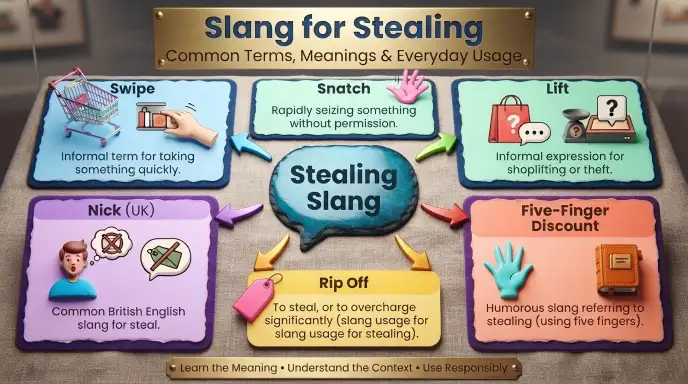
Slang for stealing refers to informal words or phrases people use instead of the standard word “steal.” Common examples include swipe, snatch, lift, nick, and rip off. These terms vary by region and context, so their meaning and tone can differ depending on how they are used.
Slang for stealing includes informal words and phrases that people use instead of the standard verb “steal.” These expressions appear in everyday conversations, movies, TV shows, music, social media, and online discussions.
Some slang terms are harmless in the sense that they simply describe theft informally, while others can have different meanings depending on the context and region.
Many people search for slang for stealing to understand unfamiliar words they have heard in conversations, read online, or seen in entertainment. In this guide, you’ll learn the meanings of the most common slang terms for stealing, how and where they are used, whether they are appropriate in different situations, and real-life examples that make each expression easy to understand.
Whether you’re improving your English, writing content, or simply curious about modern slang, this article will help you use these terms correctly and recognize them when you encounter them.
Quick Answer: Slang For Stealing
Slang for stealing includes informal words such as swipe, snatch, lift, nick, rip off, pinch, and boost. The exact meaning depends on the context, region, and type of theft being described.
What Does Slang for Stealing Mean in Text?
Slang for stealing refers to informal words or phrases people use instead of the standard verb steal.
These expressions often appear in:
- Casual conversations
- Movies and television
- Crime dramas
- Rap lyrics
- Social media
- Online forums
- Fiction books
Some slang terms describe small thefts, while others may refer to shoplifting, robbery, or taking something secretly.
Here are some of the most common examples:
- Swipe : to steal something quickly.
- Nick : British slang for stealing.
- Pinch : another British term for stealing.
- Lift : often used for shoplifting.
- Boost : slang for stealing merchandise, especially from stores.
- Snatch : to grab something suddenly.
- Rip off : to steal or cheat someone.
- Cop : in some informal contexts, to take or obtain something, though its meaning varies.
Not every slang term has exactly the same meaning, so context matters.
Slang for Stealing Full Form / Definition
Unlike internet abbreviations such as LOL or BRB, slang for stealing is not an acronym and has no full form.
Instead, it refers to the collection of informal words people use to describe theft.
General definition
These slang words usually describe:
- Taking something without permission.
- Secretly removing property.
- Shoplifting.
- Grabbing an item quickly.
- Illegally obtaining something.
Different slang words may suggest different types of theft.
For example:
“Someone swiped my phone.”
This usually means the phone was stolen quickly.
Another example:
“He got caught trying to lift a jacket.”
Here, lift refers to shoplifting.
Is Slang for Stealing Rude, Offensive, or Neutral?
Most slang terms for stealing are informal rather than offensive.
However, because they describe illegal activity, they often carry a negative tone.
| Context | Tone |
| Talking about crime in news | Neutral |
| Discussing movies or books | Neutral |
| Joking with close friends | Informal |
| Encouraging theft | Inappropriate |
For example:
“The thief swiped several wallets.”
This is simply describing an event.
However, using these words to encourage illegal behavior would be inappropriate.
Many people also use these expressions humorously, such as:
“My little brother keeps swiping my snacks.”
In this example, no actual crime is implied.
Where Is Slang for Stealing Commonly Used?
These expressions appear in many places, although the exact words vary by country and community.
1. Movies and TV Shows
Crime dramas, detective series, and action films often use slang instead of formal language.
Examples include:
- “He swiped the keys.”
- “They boosted the car.”
- “Someone nicked my wallet.”
Using slang makes dialogue sound more natural.
2. Reddit
On Reddit, these terms appear in discussions about:
- Crime news
- Movies
- True crime
- Language learning
- British vs. American English
Most discussions use these words descriptively rather than encouraging theft.
3. Snapchat and Text Messages
Friends sometimes use theft related slang jokingly.
Examples:
“You totally swiped my hoodie.”
“Someone pinched my fries.”
These usually describe harmless situations where friends borrow or take something playfully.
4. Gaming Communities
Gamers sometimes use stealing slang in games where stealing is part of the gameplay.
Examples include:
- “I swiped all the loot.”
- “He boosted the treasure.”
- “Someone snatched the rewards.”
These uses refer to in game actions rather than real world theft.
Why Context Matters
Many slang terms have more than one meaning.
For example:
Swipe can mean:
- Steal something.
- Move your finger across a phone screen.
- Use a bank card.
Similarly:
Boost can mean:
- Steal merchandise.
- Increase performance.
- Improve something.
- Promote a social media post.
Without context, it’s easy to misunderstand what someone means.
Ask yourself:
- Is the conversation about crime?
- Is it about smartphones?
- Is it about video games?
- Is someone joking?
The surrounding conversation almost always reveals the intended meaning.
Origin and Background of Slang for Stealing
People have created informal words for stealing for hundreds of years. As languages evolve, communities often develop their own expressions to describe common actions, including crimes. Some slang terms became popular through everyday speech, while others spread through movies, music, television, and the internet.
For example:
- Nick and pinch have been used in British English for many years to mean “steal.”
- Swipe became common in American English to describe taking something quickly without permission.
- Boost originally referred to shoplifting or stealing goods from stores and later appeared in crime stories and films.
- Rip off developed as a way to describe cheating someone or overcharging them, although it can also mean stealing.
Today, many of these expressions are widely recognized even by people who do not use them in everyday conversation.
Comparison with Similar Slang
Many slang words describe stealing, but each has its own meaning and usage.
| Slang | Meaning | Common Usage |
| Swipe | Steal something quickly | Casual conversation |
| Nick | Steal | British English |
| Pinch | Steal | British English |
| Lift | Shoplift | Retail theft |
| Boost | Steal merchandise | Street slang, crime discussions |
| Snatch | Grab something suddenly | Everyday speech |
| Rip off | Cheat or steal | Informal conversations |
| Secretly take and keep | Casual speech |
Although these words all relate to theft, they are not always interchangeable. Choosing the correct word depends on the situation.
Why People Use Slang for Stealing
People often use slang instead of the formal word steal because it sounds more natural in casual conversation or storytelling.
Common reasons include:
- Making conversations sound informal.
- Describing movie or game scenes.
- Quoting song lyrics.
- Adding humor in harmless situations.
- Reflecting regional language differences.
- Writing realistic dialogue in books or scripts.
For example, someone may say:
“He swiped my pen.”
instead of:
“He stole my pen.”
The first version sounds more conversational.
Impact of Using Slang in Communication
Using slang can make speech sound more relaxed, but it can also create misunderstandings.
Positive effects
- Makes conversations sound natural.
- Helps people understand movies, books, and music.
- Reflects local culture and regional language.
- Makes storytelling more engaging.
Possible drawbacks
- Some people may not know the slang.
- Meanings vary by country.
- Certain words may sound inappropriate in formal settings.
- Using crime related slang carelessly may give the wrong impression.
When discussing theft, choose your words carefully based on your audience.
When to Avoid Using Slang for Stealing
Although these expressions are common, they are not suitable for every situation.
Avoid using them when:
- Writing academic assignments.
- Preparing legal documents.
- Reporting crimes officially.
- Writing business emails.
- Speaking in professional settings.
Instead of writing:
“Someone swiped company equipment.”
A formal report should say:
“Someone stole company equipment.”
Using standard language improves clarity and professionalism.
Polite Alternatives
If you prefer formal or neutral language, these alternatives work well.
| Slang | Formal Alternative |
| Swipe | Steal |
| Nick | Take without permission |
| Pinch | Steal |
| Lift | Shoplift |
| Boost | Steal merchandise |
| Snatch | Grab suddenly |
| Rip off | Cheat or overcharge |
These alternatives are more appropriate for schools, workplaces, and official writing.
Is Slang for Stealing Safe for Social Media?
Generally, yes when used for educational, fictional, or descriptive purposes.
Examples include:
- Discussing movie scenes.
- Explaining English vocabulary.
- Talking about news stories.
- Teaching slang meanings.
However, avoid using these terms to encourage, glorify, or joke about real criminal behavior, as this can be misunderstood or violate community guidelines on some platforms.
Adding context makes your meaning clear.
Real Life Examples of Usage
Here are examples showing how different slang terms for stealing are used in everyday English.
1. Friendly Tone
“My sister keeps swiping my chocolate.”
“Someone pinched my favorite hoodie again.”
These examples are playful and usually refer to family or friends rather than actual crimes.
2. Casual Conversation
“I think someone nicked my bike yesterday.”
“He accidentally pocketed the pen after the meeting.”
These are informal ways of describing theft or taking something without permission.
3. Argumentative Context
“Don’t rip people off just because they’re new.”
“He tried to boost merchandise and got caught.”
These examples involve dishonest or illegal behavior.
4. Gaming Context
“The enemy team swiped all the treasure.”
“Someone snatched the rare loot before I arrived.”
In gaming, these phrases often describe in game actions rather than real world theft.
5. Social Media Context
“Someone copied my design and totally ripped me off.”
“That account swiped my content without giving credit.”
In these examples, the words describe copying or taking someone else’s work rather than physical theft.
Comparison Table of Common Slang for Stealing
| Slang Term | Meaning | Region/Common Usage |
| Swipe | Steal quickly | American English |
| Nick | Steal | British English |
| Pinch | Steal | British English |
| Lift | Shoplift | UK & US |
| Boost | Steal goods, especially from stores | Street slang |
| Snatch | Grab suddenly | General English |
| Rip off | Cheat or steal | International English |
| Secretly keep something | General English |
This table shows that while all these words relate to stealing, each has its own tone and preferred context.
Common Mistakes People Make When Using Slang for Stealing
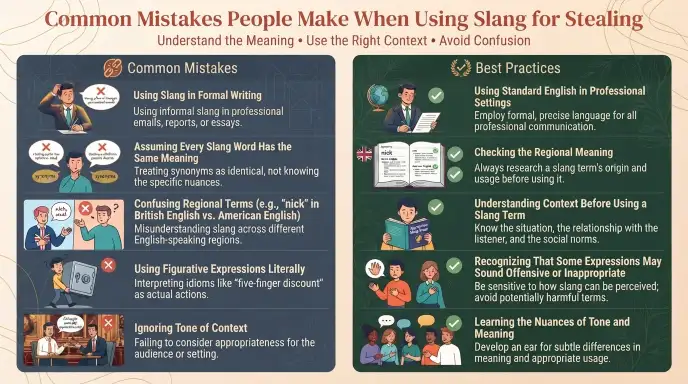
Understanding these expressions is useful, but people sometimes use them incorrectly.
Using Every Word Interchangeably
Although many slang terms relate to stealing, they do not always mean the same thing.
For example:
- Lift often refers to shoplifting.
- Swipe usually suggests taking something quickly.
- Rip off can also mean cheating someone, not just stealing.
- Pocket often means secretly keeping something you should return.
Choosing the right word makes your meaning clearer.
Forgetting Regional Differences
Some expressions are much more common in certain countries.
For example:
- Nick and pinch are widely used in the UK.
- Swipe is more common in American English.
- Boost is frequently heard in crime related discussions and some street slang.
Knowing your audience helps you choose the most natural expression.
Using Slang in Formal Writing
Slang should usually be avoided in professional communication.
Instead of writing:
“The suspect boosted electronics.”
A formal report would say:
“The suspect stole electronic devices.”
Standard English is clearer in legal, academic, and workplace writing.
Key Takeaways About Slang for Stealing
Here are the main points to remember:
- Slang for stealing includes informal words like swipe, nick, pinch, lift, boost, snatch, rip off, and pocket.
- These words are commonly used in movies, TV shows, books, social media, and everyday conversations.
- Some slang terms are regional, especially in British and American English.
- Many expressions have more than one meaning, so context is important.
- Most of these words are informal rather than offensive.
- They should be understood for language learning and communication, not to promote illegal behavior.
- In formal situations, use standard words such as steal, take without permission, or shoplift instead.
Frequently Asked Questions
1. Is dip slang for steal?
Yes, “dip” can be slang for “steal,” but it depends on the context. In some urban slang, “to dip with something” means to take or steal it and leave quickly. More commonly, however, “dip” means to leave or exit a place fast. Always use context to understand the intended meaning.
2. What is a fancy word for steal?
Here are some formal or sophisticated words that mean “steal”:
- Pilfer : to steal small items.
- Purloin : a formal word meaning to steal.
- Filch : to steal secretly.
- Embezzle : to steal money you were trusted to manage.
- Misappropriate : to take something for the wrong use.
- Appropriate : sometimes used formally to mean taking something without permission.
3. Urban slang for stealing
Common urban slang terms for stealing include:
- Boost : to shoplift or steal.
- Jack : to rob or steal from someone.
- Swipe : to secretly take something.
- Snatch : to grab and steal quickly.
- Lift : to steal, especially from a store.
- Dip : in some contexts, to steal and leave.
- Flock : modern slang that can mean to steal, especially in some online and regional communities.
4. Gen Z slang for stealing
Gen Z uses a few slang terms for stealing, especially on social media and in casual conversations:
- Flocking : stealing items, often from stores or cars.
- Boosting : shoplifting or taking something without paying.
- Swiping : secretly taking something.
- Snagging : grabbing something quickly, sometimes implying theft.
- Yoink : a humorous slang term for quickly taking or “stealing” something, often used jokingly online.
Q5. What is another slang word for stealing?
There are many slang words for stealing, including swipe, nick, pinch, lift, boost, snatch, rip off, and pocket. The best choice depends on the type of theft and the region where the word is used.
Q6. What does “swipe” mean in slang?
In slang, swipe usually means to steal something quickly or secretly.
Example:
“Someone swiped my wallet while I was shopping.”
However, swipe can also mean moving your finger across a phone screen or using a payment card, so context is important.
Q7. Is “nick” British slang for stealing?
Yes. Nick is one of the most common British slang words for steal.
Example:
“Someone nicked my bicycle.”
In American English, people are more likely to say stole or swiped.
Q8. Is slang for stealing offensive?
Most slang words for stealing are not offensive, but they describe illegal actions. They are generally acceptable when discussing movies, books, news stories, or language learning.
They should not be used to encourage or glorify criminal behavior.
Q9. What does “boost” mean in slang?
In theft related slang, boost often means stealing merchandise, especially from a store.
In other contexts, boost has completely different meanings, such as:
- Improving performance
- Increasing something
- Promoting a social media post
- Giving someone confidence
Always use context to determine the intended meaning.
Q10. Why are there so many slang words for stealing?
Like many common actions, stealing has developed different slang terms over time through regional dialects, popular culture, movies, music, and everyday speech.
Some words are common in British English, while others are more popular in American English.
Conclusion
Understanding slang for stealing can make it easier to follow conversations, movies, books, music, and online discussions. Words like swipe, nick, pinch, lift, boost, and rip off are commonly used as informal alternatives to steal, but each has its own meaning, tone, and regional usage.
The most important thing to remember is that context determines the meaning. Some words describe shoplifting, others refer to grabbing something quickly, and some can even mean cheating rather than physical theft. Paying attention to the surrounding conversation will help you interpret these expressions accurately.
Whether you’re learning English, exploring slang, or trying to understand dialogue in films or social media, knowing these common expressions will improve your vocabulary while helping you recognize when informal language is appropriate. In professional or formal situations, it’s usually better to use standard English instead of slang to ensure your message is clear and respectful.
Discover More:

Hi, I’m Sarah. I studied Communications at the University of Texas and have spent the last six years writing about internet culture and Gen Z slang across TikTok, Twitter, and everyday conversations. I focus on real usage, not just dictionary definitions.