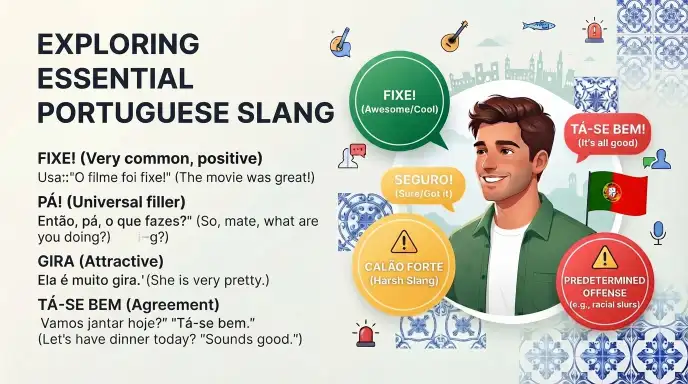
Portugese slang refers to informal words and expressions that Portuguese speakers use in everyday conversations.
These words often sound more natural than formal Portuguese and may vary by country, region, age group, or social setting. While many people search for “Portugese slang,” the standard English spelling of the language is Portuguese.
People often look up Portugese slang before traveling, chatting with native speakers, watching Portuguese language movies, or understanding social media posts. Learning common slang can help you sound more natural and better understand casual conversations.
In this guide, you’ll discover what Portugese slang means, where it is used, whether it is appropriate in different situations, and some of the most common slang words with easy to understand examples.
Quick Answer: Portugese Slang
Portugese slang is a collection of informal words and phrases used by Portuguese speakers in casual conversations. These expressions are common among friends, family members, classmates, and on social media.
What Does Portugese Slang Mean?
Portugese slang means everyday informal language that people use instead of formal Portuguese. These expressions make conversations sound more relaxed, friendly, and natural.
Unlike words taught in most language textbooks, slang often reflects local culture, humor, and modern trends. Because of this, the same slang word may have different meanings depending on the country or even the city where it is is spoken.
For example, a slang word that is common in Brazil may not be widely used in Portugal, and vice versa. Understanding the context is just as important as knowing the word itself.
Key Characteristics of Portugese Slang
- Used mainly in casual conversations.
- Often appears on social media and messaging apps.
- Can differ between Portugal and Brazil.
- Changes over time as new trends appear.
- Usually not suitable for formal writing or business communication.
Is “Portugese” the Correct Spelling?
This is a common question.
The correct English spelling of the language is Portuguese.
However, many people search online using Portugese slang, so you may see both spellings on the internet. They refer to the same language, but Portuguese is the correct form in dictionaries, schools, and official writing.
| Search Term | Correct? | Notes |
| Portugese Slang | ❌ Common misspelling | Frequently searched on Google |
| Portuguese Slang | ✅ Correct | Standard English spelling |
What Counts as Portuguese Slang?
Portuguese slang includes informal words, shortened expressions, local sayings, and modern phrases that people use in everyday speech instead of formal language.
Some slang words are:
- Friendly greetings
- Casual ways to say “okay”
- Expressions of surprise
- Words for friends
- Compliments
- Mild insults
- Internet and texting slang
- Regional phrases
These expressions often make conversations feel more natural but may confuse learners if they only know formal Portuguese.
Read related article:
Why Do People Use Portugese Slang?
People use slang because it helps conversations feel more relaxed and personal. It can also show that someone belongs to a particular community, age group, or region.
Common reasons people use Portuguese slang include:
- Talking with friends and family.
- Sending text messages.
- Posting on social media.
- Watching or creating online videos.
- Playing online games.
- Joining conversations on community forums.
- Expressing emotions in a more natural way.
In most casual situations, slang helps conversations sound less formal and more authentic.
Where Is Portugese Slang Commonly Used?
Portuguese slang appears in many everyday situations, including:
| Situation | Is Slang Common? |
| Text messages | ✅ Very common |
| Social media | ✅ Very common |
| Friends chatting | ✅ Yes |
| Family conversations | ✅ Often |
| Online gaming | ✅ Yes |
| Workplace meetings | ⚠️ Usually not |
| School assignments | ❌ No |
| Academic writing | ❌ No |
| Business emails | ❌ Avoid |
In professional or academic settings, standard Portuguese is usually the better choice. Slang is most appropriate when speaking casually with people who understand the expressions.
Different Types of Portuguese Slang
Portuguese slang is not the same everywhere. Its meaning often depends on the country, region, and the people using it.
The main types include:
1: Brazilian Portuguese Slang
Brazil has one of the richest collections of Portuguese slang. Many expressions become popular through music, television, and social media.
2: European Portuguese Slang
People in Portugal use many slang words that are different from those heard in Brazil. Even when the language is the same, vocabulary and pronunciation can vary.
3: Internet Slang
Some Portuguese slang is mainly used online in text messages, memes, gaming communities, and social media posts.
4: Regional Slang
Cities and regions often develop their own unique expressions. A slang word that is common in one area may be unfamiliar somewhere else.
Common Portuguese Slang Words
The meaning of Portuguese slang often depends on where it is used. A word that sounds friendly in Brazil may not be common in Portugal, and vice versa. The table below introduces popular slang terms with simple meanings and notes about where they are most often heard.
| Slang Word | Meaning | Commonly Used In | Tone |
| Cara | Dude, guy | Brazil | Friendly |
| Mano | Bro, buddy | Brazil | Friendly |
| Mina | Girl | Brazil | Casual |
| Grana | Money | Brazil | Casual |
| Bacana | Cool, nice | Brazil | Positive |
| Legal | Nice, great | Brazil | Positive |
| Beleza | Okay, all good | Brazil | Friendly |
| Valeu | Thanks | Brazil | Friendly |
| Poxa | Oh no!, Wow! | Brazil | Mild |
| Caramba | Wow! | Brazil & Portugal | Mild |
| Fixe | Cool, awesome | Portugal | Friendly |
| Giro | Nice, attractive | Portugal | Positive |
| Malta | Group of friends | Portugal | Casual |
| Bué | Very, a lot | Portugal | Informal |
| Tchau | Bye | Brazil & Portugal | Neutral |
Tip: These words are common in everyday speech, but some are much more popular in one country than another. Always consider your audience.
Brazilian Portuguese vs European Portuguese Slang
Although both countries speak Portuguese, their slang is often quite different. Learning the regional differences helps you understand conversations more naturally.
| Situation | Brazil | Portugal |
| Saying “Cool” | Bacana, Legal | Fixe |
| Saying “Friend” | Mano | Malta (group), Amigo |
| Saying “A lot” | Muito | Bué (informal) |
| Saying “Thanks” | Valeu | Obrigado (more common), Valeu less common |
These differences are part of local culture. Neither version is “better” they simply reflect different ways people speak.
How Is Portugese Slang Used in Everyday Conversations?
Portuguese slang appears most often in relaxed, informal situations. Friends, classmates, teammates, and family members use it to make conversations feel more natural.
You may hear slang when people are:
- Chatting with friends.
- Sending text messages.
- Commenting on social media.
- Watching live streams.
- Playing online games.
- Creating videos.
- Speaking casually after school or work.
Formal situations usually require standard Portuguese instead of slang.
Real Life Examples
Here are a few realistic examples of how Portuguese slang sounds in everyday conversations.
1. Friends Meeting
Lucas: Cara, vamos sair hoje?
Mateus: Claro!
Meaning
Lucas: Dude, shall we go out today?
Mateus: Sure!
2. Text Message
Ana: Valeu pela ajuda!
Julia: De nada!
Meaning
Ana: Thanks for the help!
Julia: You’re welcome!
3. Talking About Money
Pedro: Não tenho grana hoje.
Meaning
“I don’t have any money today.”
4. Talking About Something Cool
Maria: Esse filme é muito bacana.
Meaning
“That movie is really cool.”
5. Friends in Portugal
Tiago: Esse restaurante é fixe!
Meaning
“That restaurant is awesome!”
Is Portugese Slang Used on Social Media?
Yes. Portuguese slang is very common on social media because it makes conversations feel short, friendly, and natural.
You may see it on:
- Instagram comments
- TikTok videos
- WhatsApp chats
- Facebook posts
- X (formerly Twitter)
- Reddit communities
- Discord servers
- YouTube comments
Many creators also mix internet abbreviations with traditional Portuguese slang.
Is Portugese Slang Rude, Offensive, or Harmless?
Most Portuguese slang is harmless when used in the right situation. However, some expressions can sound rude, insulting, or overly casual if used with strangers or in professional settings.
Generally Safe to Use
- Valeu
- Cara
- Bacana
- Legal
- Fixe
- Giro
Use with Caution
Some slang words may:
- Sound disrespectful to older people.
- Have different meanings in another country.
- Be acceptable among close friends but not at work.
- Include mild insults depending on tone.
When you are unsure, choose standard Portuguese instead of slang.
Can You Use Portugese Slang at Work or School?
Usually, no.
Professional environments such as workplaces, schools, universities, government offices, and formal emails generally expect standard Portuguese.
Here’s a quick guide:
| Situation | Should You Use Slang? |
| Talking with close friends | ✅ Yes |
| Family conversations | ✅ Yes |
| Casual text messages | ✅ Yes |
| Gaming chats | ✅ Yes |
| Social media comments | ✅ Usually |
| Classroom presentations | ❌ Avoid |
| Job interviews | ❌ Avoid |
| Business emails | ❌ Avoid |
| Official documents | ❌ Never |
Using formal language shows respect in professional settings.
Why Do Native Speakers Use Portugese Slang?
Native speakers use slang because it helps conversations feel warmer and more personal.
Common reasons include:
- Building friendships.
- Showing humor.
- Expressing emotions naturally.
- Speaking more quickly.
- Feeling part of a local community.
- Following modern language trends.
Slang also changes over time. New expressions become popular through music, television, online videos, and social media, while older slang may gradually disappear.
Common Mistakes Learners Make
If you’re learning Portuguese, avoid these common mistakes:
- Assuming every slang word has the same meaning in Brazil and Portugal.
- Using slang in formal writing.
- Copying slang without understanding the context.
- Believing internet slang is appropriate everywhere.
- Overusing slang in every conversation.
The best approach is to learn standard Portuguese first and then add slang naturally as you become more familiar with everyday speech.
Origin and History of Portuguese Slang
Portuguese slang has developed over many generations through everyday conversation, local traditions, and cultural influences. Unlike formal Portuguese, slang changes quickly as people create new words or give old words new meanings.
Today, slang continues to evolve through:
- Music and popular culture
- Television and movies
- Social media
- Online gaming
- Messaging apps
- Local communities
Because Portuguese is spoken in several countries, slang has grown differently in each place. For example, Brazilian Portuguese and European Portuguese share the same language but often use different slang expressions.
Note: Most slang words do not have one exact “creation date.” Many developed naturally in local communities before becoming widely known.
Why Does Portuguese Slang Vary by Country?
Portuguese is an official language in several countries, including Brazil, Portugal, Angola, Mozambique, and Cape Verde. While these countries share the same language, their informal vocabulary has evolved in different ways.
Several factors influence regional slang:
- Local culture
- History
- Pronunciation
- Popular music
- Television
- Youth culture
- Internet trends
Because of these differences, a slang word that sounds perfectly natural in Brazil may be uncommon or even misunderstood in Portugal.
Similar Slang and Related Terms
If you’re learning Portuguese, you may also come across these related expressions:
| Term | Meaning |
| Gíria | The Portuguese word for “slang.” |
| Expressão informal | Informal expression. |
| Gíria regional | Regional slang used in a specific area. |
| Internet slang | Informal words commonly used online. |
| Texting slang | Shortened words used in messages and chats. |
Learning these terms can make it easier to understand Portuguese dictionaries, language learning resources, and social media discussions.
When Should You Avoid Using Portugese Slang?
Although slang is useful in casual conversations, it is not appropriate in every situation.
Avoid using Portuguese slang when you are:
- Writing academic assignments.
- Sending business emails.
- Speaking during job interviews.
- Communicating with government offices.
- Giving formal presentations.
- Talking to someone who may not understand informal language.
If you are unsure whether slang is appropriate, choose standard Portuguese. It is more widely understood and works well in both professional and educational settings.
Common Misunderstandings About Portugese Slang
Many learners have incorrect ideas about Portuguese slang. Here are a few common myths:
| Myth | Reality |
| All Portuguese slang is the same. | Slang varies by country and region. |
| Slang is always rude. | Most slang is simply informal and friendly. |
| You should use slang everywhere. | Slang is best for casual conversations. |
| Every young person uses the same slang. | Popular slang changes over time and varies between communities. |
| Learning slang is more important than formal Portuguese. | Standard Portuguese should come first, then slang. |
Understanding these differences will help you communicate more naturally and avoid awkward situations.
Frequently Asked Questions
Q1. What is Portugese slang?
Portugese slang refers to informal words and expressions used in everyday Portuguese conversations. The correct English spelling is Portuguese slang, but many people search for the misspelled version.
Q2. Is “Portugese” the correct spelling?
No. The correct spelling is Portuguese. However, “Portugese” is a common spelling mistake that appears frequently in online searches.
Q3. Is Portuguese slang different in Brazil and Portugal?
Yes. Brazil and Portugal share the same language, but many slang words are different. Some expressions are only common in one country, while others are understood in both.
Q4. Is Portuguese slang rude?
Not usually. Most Portuguese slang is friendly and informal. However, some expressions may be considered rude depending on the context, tone of voice, or relationship between the speakers.
Q5. Can I use Portuguese slang with teachers or at work?
It is generally better to avoid slang in professional or educational settings. Standard Portuguese is the safer choice for schools, workplaces, and formal communication.
Q6. Where can I hear Portuguese slang?
You can hear Portuguese slang in:
- Everyday conversations
- Movies and TV shows
- Music
- YouTube videos
- TikTok
- WhatsApp chats
- Online games
- Podcasts
Listening to native speakers is one of the best ways to learn how slang is used naturally.
Q7. Is Portuguese slang always changing?
Yes. Like slang in most languages, Portuguese slang evolves over time. New expressions become popular through music, social media, and internet culture, while older terms may become less common.
Q8. How to Flirt in Portuguese?
Flirting in Portuguese is often warm, playful, and respectful. You can start with simple phrases like “Você é muito bonito(a)” (You are very handsome/beautiful), “Posso te conhecer melhor?” (Can I get to know you better?), or “Seu sorriso é lindo.” (Your smile is beautiful). Always pay attention to the other person’s comfort and keep the conversation friendly and genuine. A sincere compliment and a smile usually work better than overly bold pickup lines.
Q9. How Do Brazilians Say “Wow”?
Brazilians use several expressions to say “wow,” depending on the situation. Common choices include “Uau!” (Wow!), “Nossa!” (Wow! or Oh my!), “Caramba!” (Gosh! or Wow!), and “Nossa senhora!” (Oh my goodness!). Among these, “Nossa!” is one of the most popular and is used in everyday conversations to express surprise, excitement, or amazement.
Q10. What Are Some Portuguese Slang Words?
Some common Portuguese slang words include “cara” (dude/guy), “legal” (cool), “grana” (money), “balada” (party or nightclub), “valeu” (thanks or cheers), “mó” (very/really, in Brazilian slang), and “ficar” (to casually date or hook up). These slang terms are widely used in everyday conversations, especially in Brazil, though some meanings and usage can vary by region.
Conclusion
Portugese slang includes the informal words and expressions that make everyday Portuguese conversations feel natural and relaxed. Although the correct spelling is Portuguese slang, many people search using the misspelled version, which refers to the same topic.
The most important thing to remember is that slang depends on context, region, and audience. A phrase that sounds normal in Brazil may not be common in Portugal, and vice versa. Learning these differences will help you understand movies, social media, text messages, and conversations with native speakers more confidently.
If you’re just starting to learn Portuguese, begin with standard Portuguese first, then gradually add slang as you become familiar with real life conversations. This approach will help you communicate naturally while avoiding common mistakes.
Read related article:

Hi, I’m Sarah. I studied Communications at the University of Texas and have spent the last six years writing about internet culture and Gen Z slang across TikTok, Twitter, and everyday conversations. I focus on real usage, not just dictionary definitions.