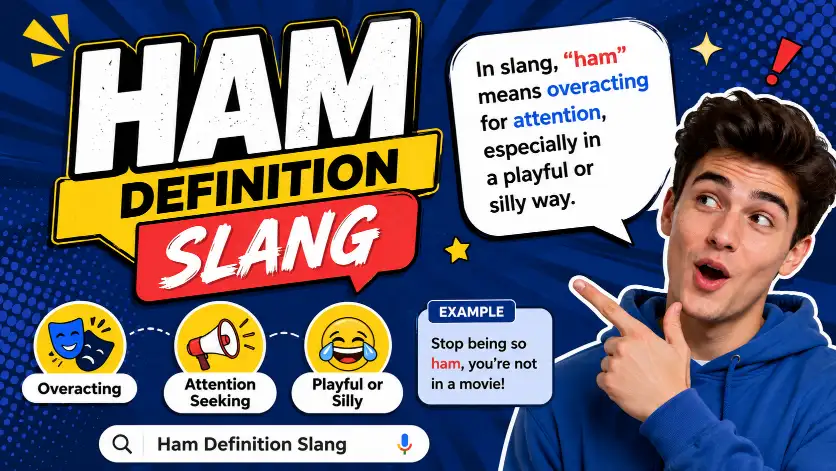
Ham is a slang term for someone who loves being the center of attention, often by acting dramatically, joking around, or entertaining others. It is usually playful and not considered offensive.
Ham definition slang is a phrase many people search after seeing someone called a “ham” in a text message, social media post, or casual conversation. At first, it can be confusing because the word “ham” is also the name of a type of meat. However, in slang, it usually has a completely different meaning.
You might hear someone say, “He’s such a ham,” after a funny performance or see the term used online to describe someone who loves attention. Understanding the context is important because the slang meaning depends on how the word is used.
What Does Ham Mean in Text?
In modern texting and casual conversations, ham usually refers to a person who enjoys entertaining others or acting in an exaggerated way to get laughs or attention.
Instead of describing food, the slang describes someone’s personality.
For example:
- “Jake is such a ham whenever there’s a camera around.”
- “My little brother is a total ham at family parties.”
In both examples, “ham” describes someone who enjoys performing and making people smile.
Ham Full Form / Definition of the Slang
Many people search for hamfull form, but unlike abbreviations such as LOL or BRB, ham is not an acronym.
Instead, it is simply an English word that developed a slang meaning over time.
Ham Definition Slang
A ham is:
- Someone who acts dramatically.
- A person who enjoys entertaining others.
- Someone who likes attention or being in the spotlight.
- A playful performer who exaggerates actions for fun.
The slang is commonly used in conversations about actors, comedians, children, friends, or anyone with a lively personality.
Is Ham Rude, Offensive, or Neutral?
In most situations, ham is considered neutral to positive.
People often use it affectionately rather than as an insult.
| Tone | Meaning |
| Friendly | Someone funny and entertaining |
| Playful | Loves attention in a harmless way |
| Mildly Negative | Someone being overly dramatic |
| Offensive | Rarely, depending on tone |
For example:
Friendly:
“You’re such a ham—you always make everyone laugh.”
Negative:
“Stop being such a ham and let someone else speak.”
The tone of voice usually determines whether it sounds like praise or gentle criticism.
Where Is Ham Commonly Used?
The slang appears in many everyday situations.
1. Family Conversations
Parents often call energetic children “little hams” because they enjoy performing.
Example:
“Emma becomes a little ham whenever guests visit.”
2. Social Media
People may describe creators who enjoy making funny videos as hams.
Platforms include:
- TikTok
- YouTube
3. Text Messages
Friends sometimes joke with each other.
Example:
“You’re such a ham in every group photo.”
4. Theater and Acting
The term has long been connected with acting.
Someone who overacts for dramatic effect may be called a ham.
5. School and College
Students who enjoy class presentations or making classmates laugh are sometimes described as hams.
RealLife Examples of Ham in Different Situations
1. Friendly Example
“You’re such a ham whenever we start recording videos.”
Meaning: You love entertaining people.
2. Casual Conversation
“My cousin is a real ham at family dinners.”
Meaning: He enjoys making everyone laugh.
3. Argumentative Tone
“Quit being a ham and take this seriously.”
Meaning: Stop acting dramatically.
4. Gaming Chat
“Our teammate is a total ham on voice chat.”
Meaning: They keep joking around and entertaining everyone.
5. Social Media Example
“The comments say he’s a ham because he always steals the spotlight.”
Meaning: People think he enjoys attention.
6. Workplace Example
“Everyone laughed because Mark was being a ham during the meeting.”
Meaning: Mark was acting playfully and dramatically.
Origin and Background of the Slang
The slang meaning of ham has existed for well over a century.
It became popular in the theater world, where actors who exaggerated their performances were sometimes called ham actors. Over time, the expression became shorter, and people simply started calling someone a ham.
Today, the meaning has expanded beyond acting.
Now it can describe anyone who:
- Likes entertaining people
- Enjoys making jokes
- Loves attention
- Acts dramatically for fun
Although the exact historical origin is debated, the connection with theatrical performance is widely accepted.
Why Do People Use This Slang?
People use ham because it quickly describes a recognizable personality.
Someone who is a ham often:
- Makes others laugh.
- Loves performing.
- Enjoys attention.
- Is expressive and energetic.
- Brings excitement to conversations.
Calling someone a ham is usually much shorter than explaining all those personality traits.
Comparison With Similar Slang
| Slang | Meaning | Positive or Negative |
| Ham | Loves attention and entertaining people | Usually positive |
| Show off | Displays abilities to impress others | Often negative |
| Drama queen | Overreacts emotionally | Usually negative |
| Clown | Acts silly for laughs | Neutral or positive |
| Goofball | Silly and playful person | Positive |
| Attention seeker | Wants constant attention | Usually negative |
While these terms overlap, ham often sounds more affectionate than critical.
When Should You Avoid Using Ham?
Although it is generally harmless, there are situations where another word may be more appropriate.
Avoid using it when:
- Giving professional feedback.
- Writing formal emails.
- Speaking with someone who may misunderstand the slang.
- Discussing serious situations.
For example:
Instead of saying:
“The presenter was a ham.”
You could say:
“The presenter was energetic and engaging.“
Polite Alternatives
If you want a more formal or neutral expression, try these alternatives.
- Entertainer
- Funny person
- Expressive
- Outgoing
- Playful
- Charismatic
- Energetic
- Lively
- Performer
- Animated
These work better in professional or academic settings.
Impact of Using Slang in Communication
Slang helps conversations feel natural and relaxed.
Using words like ham can:
1. Build Friendliness
It creates a casual and warm tone among friends.
2. Add Humor
The word often makes conversations more playful.
3. Show Personality
It describes someone’s behavior in just one word.
4. Cause Confusion
Not everyone knows the slang meaning, especially people learning English.
Because of this, always consider your audience.
Is Ham Safe for Social Media?
Yes.
In nearly all situations, ham is considered safe for:
- TikTok
- Snapchat
- Discord
- YouTube comments
- Text messages
It does not contain profanity or offensive language.
However, context still matters.
Calling someone a ham in a joking way is usually acceptable.
Calling someone a ham during an argument could sound sarcastic.
Ham Meaning Slang vs Literal Meaning
| Literal Meaning | Slang Meaning |
| A type of pork meat | Someone who loves entertaining people |
| Food | Personality trait |
| Used in cooking | Used in conversation |
This difference is why context is so important.
What Does Ham Stand For?
Many users search:
- What does ham stand for?
- Ham full form
- Ham meaning slang
The answer is simple:
Ham does not stand for anything.
It is not an abbreviation or internet acronym.
It is simply an English word that developed a second meaning through everyday speech.
FAQs
1. What Does It Mean If You Call Someone a Ham?
Calling someone a ham means they love being the center of attention. A ham often acts in an exaggerated, funny, or dramatic way to entertain other people.
2. What Is Ham in British Slang?
In British English, ham is not a common slang term, but it can still describe someone who is overly dramatic or enjoys performing for others. The meaning is similar to American English.
3. Why Do People Say “He’s Such a Ham”?
People say “He’s such a ham” when someone is always joking, acting dramatically, or trying to make others laugh. It is usually meant as a playful compliment rather than an insult.
4. What Is the Other Meaning of Ham?
Besides the slang meaning, ham is the meat from the upper part of a pig’s leg. It can also refer to an amateur radio operator in the term ham radio.
5. Ham Definition Slang in English
In English slang, ham refers to a person who enjoys showing off, acting theatrically, or entertaining others. It is often used for someone with a fun and outgoing personality.
6. You’re Such a Ham Meaning
The phrase “You’re such a ham” means someone is acting silly, playful, or dramatic to get attention or make people smile. It is generally a friendly and humorous expression.
7. Calling a Baby a Ham Meaning
Calling a baby a ham means the baby enjoys smiling, making funny faces, or performing for attention. Parents often use this phrase affectionately when a baby loves the camera or makes people laugh.
8. I’m a Ham Meaning
If someone says “I’m a ham,” they mean they enjoy performing, making jokes, or being the center of attention. It is a lighthearted way to describe an outgoing personality.
9. HAM Meaning in Medical Terms
In medical terminology, HAM can have different meanings depending on the context. One common meaning is Hypertrophic Cardiomyopathy–Associated Mutation, while other medical fields may use HAM as an abbreviation for different conditions or procedures. The meaning should always be understood from the specific medical context.
10. Going Ham Meaning Slang
Going ham means doing something with maximum energy, effort, or intensity. It often describes someone giving their all without holding back.
Example:
“The team went ham in the final match.”
“She went ham during the workout.”
Conclusion
The ham definition slang is much more than its literal meaning. In everyday English, a ham is someone who enjoys entertaining others, acting dramatically, or being the center of attention. Most of the time, the term is friendly, humorous, and complimentary rather than offensive.
Knowing the context is the key to understanding and using this slang correctly. Whether you see it in texting, social media, theater, gaming, or casual conversations, the meaning usually points to an outgoing, playful personality. Since ham is not an acronym or abbreviation, there is no full form to memorize—just remember that it describes behavior, not food, when used as slang.
You may like!

Hey, I’m Jordan. I grew up in a bilingual household in LA, so Spanish and Mexican American slang has always been part of how I talk. I’ve been writing online content for five years, explaining terms the way I’d explain them to a friend meaning, tone, and when it’s actually okay to use.