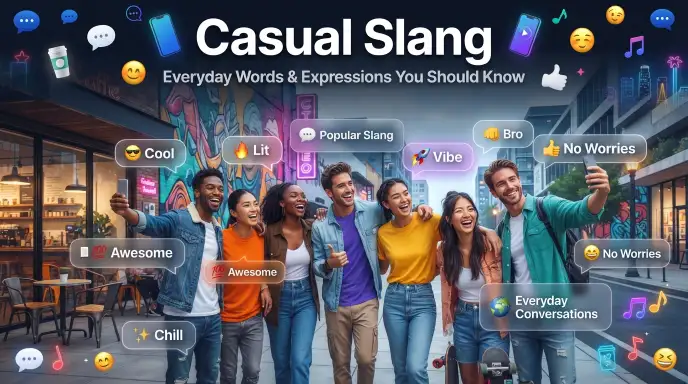
Casual slang refers to informal words and expressions people use in everyday conversations instead of formal language.
You’ll often hear it among friends, family members, classmates, coworkers, and on social media platforms like TikTok, Instagram, Snapchat, and Discord. These words help conversations feel more relaxed, natural, and expressive.
Many people search for casual slang to understand modern English, communicate more naturally, or keep up with internet culture. In this guide, you’ll learn what it means, why people use it, where it’s commonly used, popular examples, and when it’s appropriate to avoid slang.
If you’re an English learner or simply curious about everyday expressions, this article will help you understand and use with confidence.
Quick Answer
Casual slang is informal language used in relaxed, everyday conversations. It includes words and phrases that are common among friends, family, classmates, and online communities but are usually not suitable for formal writing or professional communication.
What Is Casual Slang?
Casual slang is non formal vocabulary that makes conversations sound friendly and natural. Unlike standard English, slang often changes over time and may become popular because of social media, music, movies, gaming, or local culture.
People use it to:
- Sound more relaxed
- Express emotions quickly
- Connect with others
- Keep conversations informal
- Follow current language trends
Most it is easy to understand once you know the context.
What Does Casual Slang Mean?
It includes words or phrases that replace more formal expressions in everyday speech.
For example:
| Casual Slang | Standard English |
| Cool | Very good |
| Bro | Friend or brother |
| Chill | Relax |
| Awesome | Excellent |
| No worries | It’s okay |
| Hang out | Spend time together |
| What’s up? | How are you? |
| Yep | Yes |
These words make conversations sound more natural and conversational.
Common Words
1. Cool
Meaning: Good, enjoyable, or impressive.
Example:
“That’s a really cool idea.”
2. Bro
Meaning: A close friend or someone you’re speaking to casually.
Example:
“Thanks, bro!”
3. Chill
Meaning: Relax or stay calm.
Example:
“Let’s just chill after school.”
4. Awesome
Meaning: Excellent or amazing.
Example:
“Your presentation was awesome.”
5. No Worries
Meaning: It’s okay or don’t worry about it.
Example:
“No worries. I can help you.”
6. Hang Out
Meaning: Spend time together socially.
Example:
“Do you want to hang out this weekend?”
7. What’s Up?
Meaning: A casual way to ask how someone is doing or what’s happening.
Example:
“Hey! What’s up?”
8. Yep
Meaning: An informal way of saying “yes.”
Example:
“Yep, I’ll be there.”
Why Do People Use this Slang?
People use this slang because it makes conversations feel:
- Friendly
- Relaxed
- Natural
- Expressive
- Quick and easy
Slang also helps people connect with others, especially within the same age group, community, or online culture. Many expressions become popular through social media, music, movies, and everyday conversations.
Is it Rude, Offensive, or Harmless?
Most casual slang is harmless. It is designed to make conversations feel friendly and relaxed. However, some slang words can become rude or offensive depending on their meaning, the speaker’s tone, and the situation.
| Context | Tone | Appropriate? |
| Talking with friends | Casual | ✅ Yes |
| Family conversations | Friendly | ✅ Yes |
| Text messages | Informal | ✅ Yes |
| Social media | Very common | ✅ Yes |
| Workplace meetings | Too informal | ❌ Usually No |
| School essays | Not appropriate | ❌ No |
| Business emails | Too casual | ❌ No |
If you’re speaking in a professional or academic setting, it’s usually better to use standard English instead of slang.
Where Is Commonly Used?
1. Everyday Conversations
Friends and family often use during daily conversations.
Example
Emma: Want to hang out later?
Jake: Sounds cool!
2. Text Messages
Slang makes texting faster and more natural.
Example
“I’ll be there soon. No worries!”
3. TikTok
Creators frequently use in videos, captions, and comments to connect with viewers.
4. Instagram
Instagram users include slang in captions, stories, and direct messages.
Example
“That outfit is awesome!”
5. Discord
Gamers and online communities regularly use while chatting.
6. WhatsApp
Friends often use slang in group chats and private conversations.
Example
“Yep! See you at 6.”
Real Life Examples
Example 1: Friends Talking
Alex: That movie was awesome!
Ben: Yeah, it was really cool.
Example 2: Planning the Weekend
Emma: Want to hang out tomorrow?
Sophia: Sure! That sounds fun.
Example 3: Family Conversation
Mom: Thanks for helping me.
Jake: No worries!
Example 4: Social Media
Caption:
“This concert was amazing! Such a cool night.”
Example 5: Gaming Chat
Player 1: Nice game!
Player 2: GG, bro!
Origin and Evolution of Casual Slang
Casual slang has existed for centuries, but today’s expressions spread much faster because of the internet.
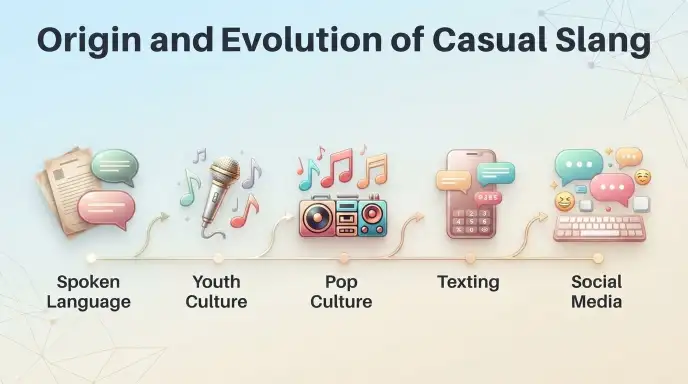
Modern slang often becomes popular through:
- Social media platforms
- Movies and television
- Music and pop culture
- Online gaming
- Schools and universities
- Local communities
Some slang words remain popular for years, while others disappear quickly as language trends change.
Similar Informal Expressions
| Casual Slang | Meaning |
| Cool | Great or impressive |
| Awesome | Excellent |
| Chill | Relax |
| Bro | Friend |
| Dude | Friend or person |
| Yep | Yes |
| Nope | No |
| Hang out | Spend time together |
| No worries | It’s okay |
| What’s up? | How are you? |
Casual Slang vs. Formal English
| Casual Slang | Formal English |
| Yep | Yes |
| Nope | No |
| Bro | Friend |
| Cool | Good or impressive |
| Chill | Relax |
| What’s up? | How are you? |
| Hang out | Spend time together |
| No worries | You’re welcome / It’s okay |
Using the formal version is usually better in workplaces, classrooms, official documents, and business communication.
Who Commonly Uses?
It is widely used by:
- Teenagers
- College students
- Friends
- Families
- Social media users
- Gamers
- Content creators
- Coworkers in informal workplaces
Today, it is part of everyday communication and appears in conversations both online and offline. While many expressions are understood by people of all ages, new slang often becomes popular among younger generations before spreading more widely.
When Should You Avoid?
Although casual slang makes conversations feel friendly and natural, it isn’t suitable for every situation.
Avoid using when:
- Writing business emails
- Attending job interviews
- Giving formal presentations
- Writing school, college, or university assignments
- Preparing legal or official documents
- Speaking with someone who may not understand slang
- Communicating in professional customer service settings
In these situations, standard English helps you sound more clear, respectful, and professional.
Common Misunderstandings About Casual Slang

People think casual slang is bad English.
No. Casual slang is a normal part of everyday language. It simply follows different rules than formal English and is used in informal settings.
Everyone understands the same slang.
Not always. Slang can vary by country, region, age group, and online community. A phrase that’s popular in one place may be unfamiliar somewhere else.
Should be used everywhere.
No. Slang is best for relaxed conversations. In professional, academic, or official situations, standard English is usually more appropriate.
Slang never changes.
That’s incorrect. Slang evolves constantly. New expressions appear through social media, music, gaming, and pop culture, while older slang may become outdated over time.
Frequently Asked Questions
1. What is casual slang?
Casual slang is informal language used in everyday conversations. It includes words and phrases that make speech sound relaxed, friendly, and natural.
2. Is casual slang proper English?
Casual slang is part of everyday English, but it is not considered formal English. It is best suited for conversations with friends, family, and online communities.
3. Where is casual slang commonly used?
It is used in:
- Text messages
- Social media
- TikTok
- Snapchat
- Discord
- Gaming chats
- Everyday conversations
4. Is casual slang appropriate at work?
Usually not. While some relaxed workplaces may allow informal language, standard English is the safer choice for meetings, emails, and professional communication.
5. Why do people use casual slang?
People use casual slang to communicate more naturally, express emotions, save time, and connect with friends or online communities.
6. How is casual slang different from formal English?
Casual slang uses informal words and expressions, while formal English follows standard grammar and vocabulary used in professional, academic, and official settings.
7. Does casual slang change over time?
Yes. New slang appears regularly through social media, music, movies, gaming, and youth culture, while older expressions may become less common.
8. Can English learners use casual slang?
Yes. Learning casual slang can help English learners understand movies, social media, and everyday conversations. However, it’s important to know when formal English is more appropriate.
9. Is casual slang the same in every English speaking country?
No. Slang differs between countries such as the United States, United Kingdom, Canada, Australia, and other English speaking regions. Local culture often influences the words people use.
10. How can I learn casual slang naturally?
You can learn casual slang by listening to native speakers, watching movies and TV shows, following social media creators, reading online conversations, and practicing with friends. Always pay attention to the context so you know when a slang term is appropriate.
Conclusion
Understanding casual slang makes it easier to follow everyday conversations and communicate naturally in English. These informal words and expressions are widely used by friends, families, classmates, and online communities to create a relaxed and friendly tone.
While it is useful in social settings, it’s important to know when to switch to standard English for professional, academic, or formal situations.
By learning the meaning, context, and proper usage of common slang terms, you’ll be able to communicate with greater confidence and avoid common misunderstandings.
Related Slang Guides You May Also Like
- Renaissance Slang: History, Meanings, and Everyday Expressions
- Rib Meaning Slang: Everything You Need to Know
- Yes Slang Explained: Modern Texting Words That Mean “Yes”

Hi, I’m Sarah. I studied Communications at the University of Texas and have spent the last six years writing about internet culture and Gen Z slang across TikTok, Twitter, and everyday conversations. I focus on real usage, not just dictionary definitions.