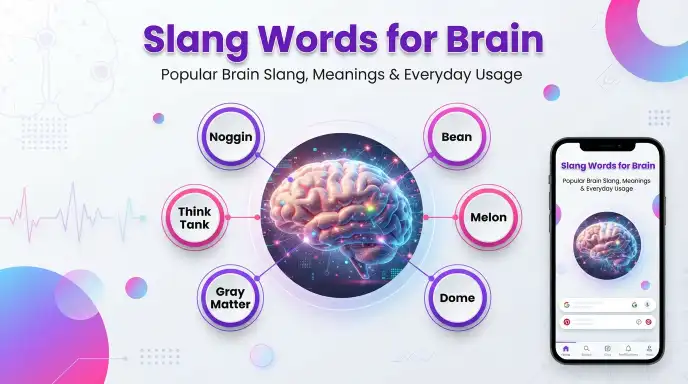
Slang words for brain are informal terms people use to refer to the brain, mind, intelligence, or thinking ability.
You may hear these words in everyday conversations, movies, TV shows, comedy, social media, or online discussions.Some slang terms are humorous, while others describe someone as smart, forgetful, or quick thinking.
People often search for slang words for brain because they want to understand expressions used in casual English, improve their vocabulary, or recognize slang in books, songs, and conversations.
Knowing these terms can help you communicate more naturally and understand informal speech without confusion. However, since some slang words can be playful or insulting depending on the context, it’s important to know when each one is appropriate.
Quick Answer:
Slang words for brain are informal words or nicknames used to describe a person’s brain, mind, or intelligence. Popular examples include noggin, bean, melon, dome, gray matter, and think tank, with each having its own tone and usage.
What Do Slang Words for Brain Mean in Text?
In text messages and casual conversations, slang words for brain usually refer to someone’s head, mind, or ability to think rather than the physical organ itself.
For example:
- “Use your noggin!” means Think carefully.
- “My brain is fried.” means I’m mentally tired.
- “He’s got a good head on his shoulders.” means He’s intelligent and makes good decisions.
The exact meaning depends on the phrase and the situation.
Full Form or Definition of Slang Words for Brain
There is no single full form for slang words for brain because they are ordinary slang expressions, not abbreviations.
Instead, they are informal alternatives people use for:
- Brain
- Mind
- Head
- Intelligence
- Thinking ability
Some expressions focus on the physical head, while others describe mental ability or common sense.
Common Slang Words for Brain
1. Noggin
Meaning: A humorous word for someone’s head or brain.
Tone: Friendly and playful.
Example:
“Use your noggin before making that decision.”
Bean
Meaning: A casual nickname for the head or brain.
Tone: Informal.
Example:
“He bumped his bean on the door.”
2. Melon
Meaning: A humorous way to refer to someone’s head.
Tone: Funny and lighthearted.
Example:
“Don’t forget your helmet you need to protect your melon.”
3. Dome
Meaning: Slang for the head.
Although dome technically refers to the head, it’s often used when talking about thinking or protecting the brain.
Example:
“He scratched his dome while trying to solve the puzzle.”
4. Gray Matter
Meaning: Intelligence or brainpower.
This phrase refers to the part of the brain involved in thinking and problem solving.
Example:
“That quiz really made me use my gray matter.”
5. Think Tank
Meaning: A person’s thinking ability or a group known for generating ideas.
In casual speech, people sometimes jokingly call someone’s brain a think tank.
Example:
“My think tank needs a coffee break.”
6. Head
Meaning: The most common informal word referring to the brain or mind.
Example:
“I’ve got too much going on in my head today.”
7. Mind
Meaning: Thoughts, intelligence, or mental ability.
Although mind is standard English rather than slang, it is often used informally in many expressions.
Example:
“She has a brilliant mind.”
Is It Rude, Offensive, or Neutral?
Most slang words for brain are neutral or humorous.
| Slang Term | Tone | Appropriate? |
| Noggin | Playful | ✅ Yes |
| Bean | Casual | ✅ Yes |
| Melon | Humorous | ✅ Yes |
| Dome | Informal | ✅ Yes |
| Gray Matter | Neutral | ✅ Yes |
| Think Tank | Friendly | ✅ Yes |
These expressions are generally safe for casual conversations but are less suitable for formal writing or professional communication.
Where Are Slang Words for Brain Commonly Used?
These expressions are most common in relaxed conversations and entertainment.
You’ll often hear them in:
- Everyday conversations
- Comedy shows
- Movies
- Television series
- Podcasts
- Sports commentary
- Social media posts
- Reddit discussions
- Casual text messages
Unlike internet abbreviations such as LOL or BRB, these slang terms are usually spoken rather than typed, although they do appear online from time to time.
Real Life Examples of Usage
Friendly Conversation
Emma: Think before you answer.
Jake: Don’t worry I’m using my noggin!
Family Conversation
Mom: Wear your bike helmet.
Son: I know. I’ve got to protect my melon.
Casual Conversation
Sarah: My brain feels exhausted after studying all day.
David: Mine too. I need a break.
Office Conversation
Manager: Let’s put our gray matter together and solve this problem.
Team: Sounds good!
Origin and Background of Slang Words for Brain
Many slang words for brain have been part of English for decades or even centuries. Most began as humorous ways to refer to a person’s head, then gradually came to represent the mind or thinking ability.
For example:
- Noggin has been used in informal English since the 19th century as a playful word for the head.
- Bean became popular because the shape of a head can be humorously compared to a bean.
- Melon is another lighthearted nickname based on the round shape of the head.
- Gray matter comes from anatomy, referring to the parts of the brain involved in thinking, but it is often used figuratively to mean intelligence.
Unlike many modern slang terms, these expressions did not originate on social media. They became common through everyday speech, comedy, books, movies, and television.
Comparison with Similar Slang Terms
Although these words all relate to the brain or head, they aren’t always interchangeable.
| Slang Term | Meaning | Tone | Common Usage |
| Noggin | Head or brain | Playful | Everyday conversations |
| Bean | Head | Humorous | Casual speech |
| Melon | Head | Funny | Friends and family |
| Dome | Head | Informal | Sports and casual talk |
| Gray Matter | Intelligence | Neutral | Discussions about thinking |
| Think Tank | Brain or ideas | Humorous | Casual conversations |
| Head | Mind or brain | Neutral | Very common |
Choose the expression based on the situation and the tone you want to create.
Why Do People Use Slang Words for Brain?
People use these expressions because they make conversations more interesting and less formal.
Common reasons include:
- Adding humor
- Making conversations sound natural
- Avoiding repetitive language
- Showing creativity
- Expressing thoughts in a memorable way
- Matching a casual speaking style
Many comedians, writers, and content creators also use these expressions to make dialogue feel more realistic.
Impact of Using Slang in Communication
Slang can make conversations feel friendly and engaging, but it should be used thoughtfully.
Positive Effects
- Makes speech more natural
- Creates a relaxed atmosphere
- Builds connections with friends
- Adds personality to conversations
- Makes storytelling more entertaining
Possible Drawbacks
- Some people may not understand regional slang.
- Slang can sound unprofessional in formal situations.
- Older or younger audiences may interpret expressions differently.
- Excessive slang can confuse people learning English.
Understanding your audience helps you decide if slang is appropriate.
Is It Safe for Social Media?
Yes. Most slang words for brain are completely safe to use on social media because they are generally humorous and non offensive.
They are commonly seen on:
- X (formerly Twitter)
- TikTok
- Discord
- Snapchat
- YouTube comments
For example:
“Use your noggin before posting that!”
or
“My gray matter stopped working after that math exam.”
These expressions are widely understood by native English speakers and don’t usually violate community guidelines. However, avoid using them to mock or insult others, as the tone can change depending on the context.
More Real Life Examples
Casual Conversation
Chris: I can’t remember where I left my keys.
Alex: Come on, use your bean!
Friendly Joke
Liam: I forgot my homework again.
Noah: Give that noggin a wake up call!
Gaming Chat
Player 1: We need a new strategy.
Player 2: Let’s use our gray matter instead of rushing.
Social Media Post
“My brain officially stopped working after five hours of studying. “
Team Discussion
Manager: Let’s get everyone together and use our collective brainpower to solve this issue.
Slang Words for Brain vs. Formal Terms
| Informal Slang | Formal Word |
| Noggin | Head |
| Bean | Head |
| Melon | Head |
| Dome | Head |
| Gray Matter | Brain / Intelligence |
| Think Tank | Mind / Intelligence |
| Brainpower | Mental ability |
The formal terms are better suited for academic writing, business communication, and professional settings, while the slang versions fit casual conversations.
When Should You Avoid Using Slang Words for Brain?
Although most slang words for brain are harmless, they are not appropriate in every situation.
Avoid using them when:
- Writing business emails or official documents
- Giving academic presentations
- Speaking in job interviews
- Writing school or university assignments
- Talking to someone who may not understand informal English
- The slang could be misunderstood as mocking or disrespectful
In professional or formal settings, it’s better to use words like brain, mind, intelligence, or thinking ability.
Polite Alternatives
If you want to sound more formal or respectful, consider these alternatives instead of slang.
| Slang | Polite Alternative |
| Noggin | Head |
| Bean | Head |
| Melon | Head |
| Dome | Head |
| Gray Matter | Brain or Intelligence |
| Think Tank | Mind or Brain |
| Brainpower | Mental Ability |
These alternatives work well in workplaces, classrooms, and professional writing.
Why People Use Slang Words for Brain
People use these expressions because they make conversations more engaging and expressive.
Some common reasons include:
- Adding humor to conversations
- Making speech feel relaxed
- Showing creativity
- Avoiding repetitive language
- Making stories more entertaining
- Building stronger social connections
Many of these expressions have remained popular because they are easy to understand and memorable.
Common Misunderstandings About Slang Words for Brain

All slang words for brain mean intelligence.
No. Some refer to the physical head, while others describe thinking ability or mental skill.
These words are offensive.
Generally, no. Terms like noggin, bean, and melon are usually playful rather than insulting.
They’re only used online.
No. Most of these expressions became popular long before social media and are still commonly heard in everyday conversations.
Everyone uses the same brain slang.
Not necessarily. Some expressions are more common in certain English speaking countries or regions than others.
Frequently Asked Questions
1. What are slang words for brain?
Slang words for brain are informal expressions people use instead of saying brain, mind, or head. Examples include noggin, bean, melon, dome, and gray matter.
2. What is the most common slang word for brain?
Noggin is one of the most common and widely recognized slang words for the brain or head in English.
3. Is “noggin” an insult?
No. Noggin is usually a friendly and humorous word. It is rarely considered offensive when used respectfully.
4. What does “gray matter” mean in slang?
In casual language, gray matter refers to a person’s intelligence, thinking ability, or brainpower rather than the physical brain itself.
5. Are slang words for brain safe to use on social media?
Yes. Most are harmless and commonly used in jokes, memes, captions, and casual conversations on platforms like Reddit, Instagram, TikTok, and Discord.
6. Can I use these slang terms at work?
You can use them in relaxed conversations with coworkers, but standard terms like brain or mind are more appropriate in meetings, presentations, and professional writing.
Conclusion
Understanding slang words for brain helps you recognize informal English in everyday conversations, movies, books, and social media. Popular terms like noggin, bean, melon, dome, and gray matter add humor and personality to casual speech while referring to the head, mind, or thinking ability.
The key is to use these expressions in the right context. They’re perfect for friendly conversations but are generally less suitable for formal communication. By learning both their meanings and appropriate usage, you’ll better understand natural English and communicate with greater confidence.
Related Articles:
- Diva Definition Slang: Meaning, Uses & Examples
- Spanish Slang for Girlfriend: Popular Nicknames and Meanings
- Yes Slang Explained: Modern Texting Words That Mean “Yes”

Hi, I’m Sarah. I studied Communications at the University of Texas and have spent the last six years writing about internet culture and Gen Z slang across TikTok, Twitter, and everyday conversations. I focus on real usage, not just dictionary definitions.