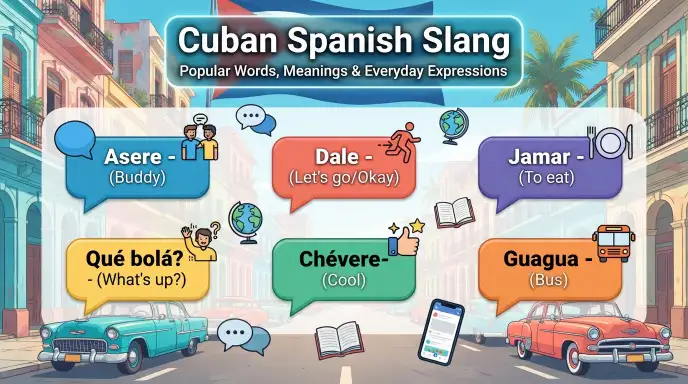
Cuban Spanish slang refers to the informal words, phrases, and expressions that people in Cuba use in everyday conversations. These terms often differ from standard Spanish and can confuse visitors or Spanish learners.
Understanding Cuban Spanish slang helps you communicate more naturally, understand local conversations, and appreciate Cuban culture.
Many people search for Cuban Spanish slang before traveling to Cuba, watching Cuban movies, listening to Cuban music, or talking with Cuban friends.
This guide explains the most common expressions, where they are used, if they are polite or rude, and how to use them correctly in real life situations.
By the end, you’ll understand the meanings behind popular Cuban slang words and avoid common mistakes.
Quick Answer: Cuban Spanish Slang
Cuban Spanish slang is the collection of informal words and expressions commonly used by people in Cuba. It reflects the country’s history, culture, humor, and everyday life. While many slang words are friendly and widely accepted among Cubans, some are informal or offensive depending on the situation, so context always matters.
What Does Cuban Spanish Slang Mean?
Cuban Spanish slang means the everyday informal language spoken by many Cubans outside formal settings. These expressions often replace standard Spanish words and may sound unfamiliar to speakers from Spain, Mexico, or other Spanish speaking countries.
Unlike textbook Spanish, Cuban slang changes with age groups, regions, and social situations. Friends may use words that would sound strange or even rude in a classroom or workplace.
People commonly use Cuban slang in:
- Casual conversations
- Family gatherings
- Neighborhoods
- Music and songs
- Comedy
- Social media
- Text messages
- Local markets
- Sports events
Learning these expressions helps you understand not just the words but also the personality and humor behind Cuban communication.
Does Cuban Spanish Slang Have a Full Form?
No.
Unlike internet abbreviations such as LOL or BRB, Cuban Spanish slang is not an acronym or abbreviation. It simply refers to the informal vocabulary and expressions that developed naturally within Cuban Spanish over many generations.
These words often come from:
- Everyday speech
- African linguistic influences
- Spanish colonial history
- Caribbean culture
- Youth language
- Music and popular entertainment
Some expressions are centuries old, while others became popular more recently through music, television, and social media.
Why Is Cuban Spanish Slang Different?
Cuban Spanish developed its own identity because of Cuba’s unique history and cultural influences. Although it shares the same grammar as standard Spanish, everyday speech has evolved in ways that make it sound distinct.
Several factors shaped Cuban slang:
- Caribbean Spanish pronunciation
- African cultural influence
- Spanish colonial heritage
- Immigration from the Canary Islands
- Local traditions and humor
- Modern music genres like salsa, son, timba, and reggaeton
This mix created expressions that are deeply connected to Cuban life and may not be understood in other Spanish speaking countries.
Common Features of Cuban Spanish Slang
Most Cuban slang shares a few recognizable characteristics.
| Feature | Explanation |
| Informal | Mostly used among friends and family |
| Expressive | Often humorous or emotional |
| Fast changing | New slang appears with younger generations |
| Context dependent | Meaning can change depending on tone and situation |
| Regional | Some expressions are more common in certain parts of Cuba |
| Cultural | Many phrases reflect Cuban traditions and daily life |
Because of these features, translating Cuban slang word for word into English often misses the real meaning.
How Context Changes Cuban Slang
context is one of the most important parts of understanding Cuban slang. The same expression may sound friendly among close friends but unusual or too informal in a professional setting.
When you come across an unfamiliar Cuban expression, look at the entire sentence instead of translating the word by itself. Consider who is speaking, who they are talking to, and if the conversation is serious, humorous, or casual.
If you are learning Cuban Spanish, it is usually better to understand an expression first and use it later. Listening to native speakers can help you learn the natural tone and situation for each term.
Cuban Slang in Everyday Conversations
Cuban Spanish slang is often most natural in relaxed conversations between friends, relatives, and people who already know each other. Expressions such as casual greetings and familiar forms of address can make a conversation sound warmer and more informal.
The meaning of a slang expression is not always enough to understand how it should be used. Tone, relationship, age, and situation can all affect how natural a word sounds. A phrase that works well between close friends may not be appropriate in a formal conversation.
Most Common Cuban Spanish Slang Words
Below are some of the best known Cuban slang expressions. Meanings can vary slightly depending on context, so examples help show how they are used.
1: Asere
Meaning: Friend, buddy, pal, or mate.
“Asere” is probably one of the most recognizable Cuban slang words. It is a warm and friendly way to greet someone you know well.
Examples
“¡Asere! Long time no see!”
“Hey asere, are you coming tonight?”
Tone: Friendly and casual
Use with teachers or bosses? No. It is too informal for professional situations.
2: Acere
Meaning: Another spelling of Asere with the same meaning.
Different speakers spell it differently, but both refer to a close friend.
Examples
“Acere, let’s grab lunch.”
“What’s up, acere?”
3: Guagua
Meaning: Bus.
Although several Spanish speaking countries use “guagua,” it is especially common in Cuba.
Instead of saying the standard Spanish word autobús, Cubans often simply say guagua.
Examples
“The guagua is late again.”
“We took the guagua downtown.”
Tone: Neutral and commonly accepted.
4: Yuma
Meaning: A foreigner, especially someone from the United States.
Depending on the conversation, Yuma may simply describe a visitor without being insulting. The tone depends on how it is said.
Examples
“Many yumas visit Havana every year.”
“My neighbor is a yuma from Florida.”
Tone: Usually neutral, but context matters.
5: Jinetero / Jinetera
Meaning: A person who approaches tourists to earn money, offer services, or seek opportunities.
This term has different meanings depending on the situation. In some contexts, it refers broadly to someone informally seeking income from tourists. In others, it can carry more specific or negative meanings. Because of this, it should be used carefully and only when you understand the context.
Examples
“The guide explained the local meaning of jinetero.”
“Travel books often discuss the word in Cuban culture.”
Tone: Can be sensitive or negative depending on context.
Avoid using it casually unless you understand the situation well.
6: Qué bolá?
Meaning: What’s up? How’s it going?
This is one of the most common greetings in Cuba.
It is similar to saying:
What’s up?
How are things?
What’s going on?
Examples
“¡Qué bolá, asere!”
“Qué bolá? Haven’t seen you in weeks.”
Tone: Very casual and friendly.
7: Dale
Meaning: Okay, let’s go, sounds good, or go ahead.
The exact meaning depends on the conversation.
Examples
“Meet at six?”
“Dale!”
Or:
“You can start now.”
“Dale.”
It is one of the most frequently used everyday expressions in Cuban conversations.
More Popular Cuban Spanish Slang Words
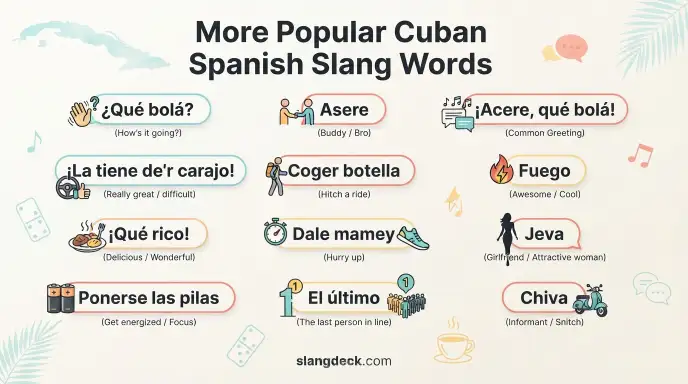
The following expressions are widely heard in Cuba. Some are friendly, while others should only be used in informal conversations. Always pay attention to the speaker’s tone and the situation.
1. Pipo
Meaning: A mild expression of surprise, frustration, or excitement.
Many Cubans use pipo as a softer alternative to stronger swear words.
Examples
- “Pipo, I forgot my keys!”
- “Pipo, that game was amazing!”
Tone: Informal but generally harmless.
2. Socio
Meaning: Friend, buddy, or close companion.
Although socio literally means “partner,” in Cuban slang it often means a good friend.
Examples
- “He’s my socio from school.”
- “Thanks for helping me, socio.”
Tone: Friendly and casual.
3. Chévere
Meaning: Cool, great, nice, or awesome.
This word is understood across much of Latin America, including Cuba.
Examples
- “That restaurant is chévere.”
- “Your new bike looks chévere.”
Tone: Positive and informal.
4. Pincha
Meaning: Work or job.
Instead of using the standard Spanish word trabajo, many Cubans casually say pincha or la pincha.
Examples
- “I have to go to pincha early tomorrow.”
- “She just finished work.”
Tone: Informal.
5. Pinchar
Meaning: To work.
This verb is commonly used in everyday conversations.
Examples
- “I pincho every weekend.”
- “He’s pinching late today.”
Tone: Casual.
6. Monina
Meaning: Money.
This slang term is commonly heard among friends.
Examples
- “Do you have enough monina?”
- “I’m saving my monina for vacation.”
Tone: Informal.
7. Barbaro
Meaning: Amazing, incredible, or excellent.
Cubans often say ¡Bárbaro! when something impresses them.
Examples
- “You passed the exam? Bárbaro!”
- “That concert was bárbaro.”
Tone: Positive.
8. Fula
Meaning: US dollar or foreign currency.
Depending on the conversation, fula may also refer to money in general.
Examples
- “Do you have any fula?”
- “Tourists often pay in foreign currency.”
Tone: Neutral.
9. Embullo
Meaning: Excitement, motivation, or enthusiasm.
Someone with embullo feels energized about doing something.
Examples
- “She has a lot of embullo for the trip.”
- “Everyone was full of embullo before the concert.”
Tone: Positive.
10. Guajiro
Meaning: A person from the countryside or rural area.
Usually this is descriptive rather than insulting, though tone matters.
Examples
- “My grandparents are guajiros.”
- “He grew up in the countryside.”
11. Mango
Meaning: An attractive person.
Like English expressions such as “good looking,” this word is informal.
Examples
- “Everyone says he’s a mango.”
- “She thinks that actor is a mango.”
Tone: Casual.
12. Jamar
Meaning: To eat.
This is one of the best known informal verbs in Cuban Spanish.
Examples
- “Let’s go jamar.”
- “We’re going to jamar after work.”
Tone: Friendly and very common.
13. Jama
Meaning: Food.
Examples
- “The jama smells delicious.”
- “Let’s buy some jama.”
14. Resolver
Meaning: To figure something out or find a practical solution.
Although resolver is standard Spanish, in Cuba it often has a broader meaning. It can describe solving everyday problems in creative ways.
Examples
- “Don’t worry, we’ll resolver it.”
- “He always knows how to resolver.”
Where Is Cuban Spanish Slang Commonly Used?
Most Cuban slang appears in everyday conversations rather than formal writing. You are likely to hear these expressions in relaxed social settings.
| Place or Situation | How Common Is Slang? |
| Conversations with friends | Very common |
| Family gatherings | Very common |
| Local neighborhoods | Very common |
| Cafés and restaurants | Common |
| Markets and shops | Common |
| Music lyrics | Very common |
| TV comedy | Common |
| Social media | Common |
| Text messages | Common |
| Business meetings | Rare |
Is Cuban Spanish Slang Rude, Offensive, or Harmless?
Most Cuban Spanish slang is harmless, but not every expression is appropriate in every setting.
Here’s a simple guide:
| Type | Examples | Appropriate? |
| Friendly greetings | Asere, Qué bolá | ✔ Yes |
| Everyday vocabulary | Guagua, Jamar | ✔ Yes |
| Compliments | Chévere, Bárbaro | ✔ Yes |
| Tourist related terms | Yuma | Usually, but depends on tone |
| Sensitive words | Jinetero/Jinetera | Use carefully because meanings vary |
Some slang becomes rude only because of:
- Voice tone
- Facial expression
- Relationship between speakers
- Situation
The same word can sound friendly among close friends but disrespectful in a professional environment.
Can You Use Cuban Spanish Slang at Work or School?
Usually no, unless you know the people well and the environment is very informal.
Use standard Spanish when speaking with:
- Teachers
- Professors
- Employers
- Customers
- Government offices
- Job interviewers
- Older people you have just met
Slang is best saved for relaxed conversations with friends and family.
Why Do People Use Cuban Spanish Slang?
People use slang because it makes conversations feel more natural and personal.
Some common reasons include:
- To sound friendly
- To show local identity
- To express emotions
- To speak more casually
- To create humor
- To fit into social groups
- To shorten everyday conversations
Using the right slang at the right time can help conversations feel warmer and more authentic.
Cuban Spanish Slang in Music and Social Media
Many visitors first hear Cuban slang through entertainment.
You’ll often find these expressions in:
- Salsa songs
- Timba music
- Reggaeton
- Street interviews
- Comedy shows
- YouTube videos
- TikTok clips
- Instagram Reels
- Facebook posts
- WhatsApp chats
Artists often use slang to sound natural and represent everyday Cuban life. Because slang changes over time, newer songs may introduce fresh expressions while older favorites preserve traditional ones.
Common Mistakes Learners Make
If you’re learning Spanish, avoid these common errors when using Cuban slang:
- Assuming every Spanish speaking country uses the same slang. A word common in Cuba may be unfamiliar elsewhere.
- Using slang in formal situations. Friendly expressions can sound disrespectful in business or academic settings.
- Translating slang word for word. Many expressions have meanings that go beyond their literal translation.
- Ignoring tone and context. The same word can sound friendly, humorous, or rude depending on how it’s said.
Understanding the situation is just as important as knowing the vocabulary.
Real Life Examples of Cuban Spanish Slang
The best way to understand Cuban Spanish slang is to see how people naturally use it. These examples reflect everyday conversations rather than textbook Spanish.
Example 1: Meeting a Friend
Carlos: ¡Qué bolá, asere!
Miguel: Todo bien. ¿Y tú?
Carlos: Dale, let’s grab some jama.
Meaning in English
- Carlos: “What’s up, buddy!”
- Miguel: “Everything’s good. And you?”
- Carlos: “Great, let’s get something to eat.”
Example 2: Talking About Work
Ana: Are you working tomorrow?
Luis: Yes, I have to pinchar early.
Ana: Good luck!
Here, pinchar simply means to work.
Example 3: Complimenting Someone
Maria: What do you think of the new restaurant?
Elena: It’s chévere! The food is bárbaro.
This means the restaurant is cool, and the food is excellent.
Example 4: Talking About Money
Friend 1: Do you have enough monina?
Friend 2: Not yet. I’m still saving.
Here, monina means money.
Example 5: Greeting a Visitor
Local: Are you a yuma?
Tourist: Yes, I’m visiting from Canada.
In this context, yuma simply refers to a foreign visitor. The tone is neutral and not meant as an insult.
Origin and History of Cuban Spanish Slang
Cuban Spanish slang developed over hundreds of years through the island’s unique cultural history. Rather than coming from one source, it grew from a blend of influences that shaped everyday speech.
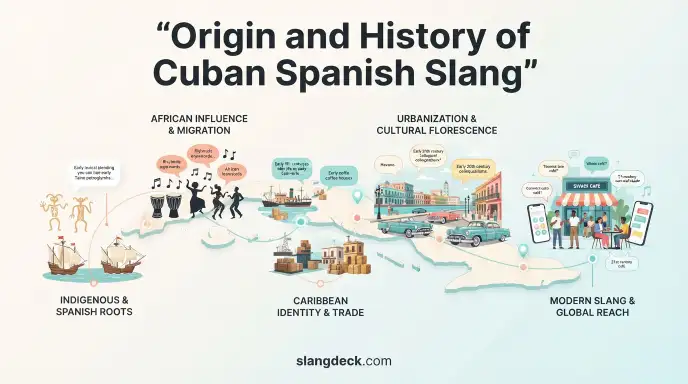
Some of the strongest influences include:
- Spanish settlers, especially from the Canary Islands, whose speech patterns influenced Cuban pronunciation and vocabulary.
- African languages and cultures, brought by enslaved people, which contributed words, rhythms, and expressions still heard today.
- Caribbean culture, where neighboring islands shared linguistic features through trade and migration.
- Local traditions, music, sports, and community life, which helped create new slang over time.
Today, Cuban slang continues to evolve. Younger generations introduce new expressions through music, social media, and popular culture, while many traditional phrases remain part of everyday conversation.
Note: The exact origin of some slang terms is debated by linguists. When there is no clear historical record, it’s best to treat the origin as uncertain rather than presenting assumptions as facts.
Similar Slang in Other Spanish Speaking Countries
Some Cuban slang resembles expressions used elsewhere, but the meanings are not always identical.
| Cuban Slang | Similar Expression | Common Region | Same Meaning? |
| Asere | Pana | Venezuela | Similar |
| Asere | Wey/Güey | Mexico | Similar |
| Chévere | Chévere | Many Latin American countries | Yes |
| Guagua | Bus | Cuba, Canary Islands, parts of Latin America | Mostly |
| Jamar | Comer | Standard Spanish | Yes |
| Dale | Dale | Argentina, Uruguay, Cuba | Very similar |
Even when two countries use the same word, pronunciation and tone may differ.
When Should You Avoid Using Cuban Spanish Slang?
Although slang helps conversations feel natural, there are situations where standard Spanish is a better choice.
Avoid using Cuban slang when speaking with:
- Teachers
- Professors
- Employers
- Job interviewers
- Government officials
- Customers
- Healthcare professionals
- People you have just met in formal settings
Also avoid using slang if:
- You are unsure of its meaning.
- The word may have a sensitive or negative meaning.
- You’re speaking with people from another Spanish speaking country who may not recognize the expression.
When in doubt, standard Spanish is the safest option.
Why Do People Like Cuban Spanish Slang?
Many learners enjoy Cuban slang because it brings conversations to life.
People use it to:
- Sound more natural.
- Build friendships.
- Show cultural identity.
- Express humor.
- Speak more casually.
- Feel connected to local traditions.
For visitors and language learners, understanding slang also makes movies, music, and everyday conversations easier to follow.
Common Misunderstandings About Cuban Spanish Slang

“All Spanish speakers understand Cuban slang.”
No. Many expressions are unique to Cuba, and speakers from Spain, Mexico, Colombia, or Argentina may use different slang.
“Every Cuban uses the same slang.”
Not necessarily. Age, region, and personal preference all influence vocabulary. Younger speakers may use newer expressions, while older generations often prefer traditional ones.
“Slang is always rude.”
False. Most Cuban slang is simply informal. Many expressions are friendly and widely accepted among family and friends.
“I should use slang to sound fluent.”
Not always. Using too much slang, or using it incorrectly, can sound unnatural. It’s better to learn the meaning first and use it only when the situation feels appropriate.
Frequently Asked Questions
Q1. What is Cuban Spanish slang?
Cuban Spanish slang is the informal language used in everyday conversations in Cuba. It includes unique words and expressions that may not appear in standard Spanish textbooks.
Q2. Is Cuban Spanish different from regular Spanish?
Yes. The grammar is largely the same, but pronunciation, vocabulary, and slang differ from standard Spanish and from other regional varieties.
Q3. What does “Asere” mean in Cuban slang?
Asere means friend, buddy, or pal. It is one of the most common and recognizable greetings in Cuba.
Q4. What does “Qué bolá” mean?
It means “What’s up?”, “How’s it going?”, or “What’s happening?” It is a casual greeting used among friends.
Q5. Is Cuban Spanish slang rude?
Most Cuban slang is not rude. However, some words may become offensive depending on tone, context, or the relationship between the speakers.
Q6. Can tourists use Cuban slang?
Yes, but use it carefully. Friendly expressions like asere, qué bolá, and chévere are generally safe in casual conversations. Avoid sensitive terms unless you fully understand their meaning.
Q7. Is Cuban slang used on social media?
Yes. Cubans often use slang in text messages, comments, memes, and posts on platforms like Instagram, TikTok, Facebook, and WhatsApp. Informal language is especially common when communicating with friends and family.
Q8. How can I learn Cuban Spanish slang faster?
Listening to Cuban music, watching Cuban films, following Cuban creators online, and practicing with native speakers are excellent ways to become familiar with common expressions and their natural usage.
9. What slang is used in Cuba?
Cuban Spanish includes many unique slang words used in everyday conversations. Some common examples are asere (friend or buddy), qué bolá (what’s up?), yuma (foreigner, especially an American), guagua (bus), and pincha (work). These expressions are widely used by Cubans in casual speech.
10. How do Cubans say “let’s go”?
Cubans often say “¡Vamos!” to mean “Let’s go!” In informal conversations, you may also hear “¡Dale!”, which means “Come on,” “Go ahead,” or “Let’s do it.” Both expressions are very common in Cuba and other Spanish-speaking countries.
Conclusion
Cuban Spanish slang is an important part of everyday communication in Cuba. It adds personality, humor, and cultural identity to conversations, helping speakers express themselves in ways that standard Spanish often cannot.
If you’re planning a trip, learning Spanish, or simply curious about Cuban culture, understanding common expressions like asere, qué bolá, jamar, and chévere will make conversations easier to follow and more enjoyable.
Remember that context matters, while most slang is friendly and harmless, some expressions carry different meanings depending on tone or situation.
The best approach is to learn each term gradually, pay attention to how native speakers use it, and choose standard Spanish whenever you’re in a formal setting or unsure of the context.
Explore More:

Hi, I’m Sarah. I studied Communications at the University of Texas and have spent the last six years writing about internet culture and Gen Z slang across TikTok, Twitter, and everyday conversations. I focus on real usage, not just dictionary definitions.