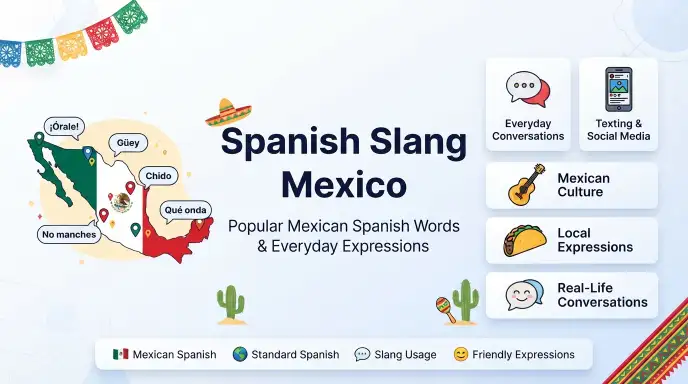
Spanish slang Mexico refers to the informal words, phrases, and expressions that people in Mexico use in everyday conversations. These slang terms often sound different from standard Spanish and help speakers express humor, emotions, friendship, surprise, or local culture.
Many people search for spanish slang mexico because they hear these expressions in movies, music, social media, travel videos, or while talking with native Mexican Spanish speakers. Learning them makes conversations easier and helps you understand real life Mexican Spanish beyond what textbooks teach.
In this guide, you’ll learn what spanish slang mexico means, where it is commonly used, whether it is polite or offensive, popular examples, and when you should avoid using certain expressions. Whether you’re a student, traveler, content creator, or simply curious, this guide will help you understand Mexican slang in a simple and practical way.
Quick Answer: Spanish Slang Mexico
Spanish slang Mexico is the collection of informal words and phrases commonly used by people in Mexico. These expressions add personality and emotion to conversations. Some are friendly and humorous, while others can be rude depending on the situation, tone, and the people involved.
What Does Spanish Slang Mexico Mean?
Spanish slang Mexico means the everyday informal vocabulary used by Mexican Spanish speakers instead of formal dictionary Spanish.
Unlike standard Spanish, slang changes from region to region and even between generations. Teenagers may use different expressions than older adults, and people in northern Mexico may prefer words that are uncommon in southern Mexico.
Mexican slang helps speakers:
- Sound more natural.
- Show friendship.
- Express emotions.
- Add humor to conversations.
- Feel connected to local culture.
Many of these expressions appear in daily conversations, television shows, podcasts, memes, online videos, and social media platforms.
Standard Spanish vs. Mexican Slang
| Standard Spanish | Mexican Slang | Meaning |
| Amigo | Güey (Wey) | Friend, buddy (informal) |
| Dinero | Lana | Money |
| Excelente | Chido | Cool, awesome |
| Fiesta | Peda | Drinking party |
| Casa | Cantón | Home |
Remember that slang should not replace standard Spanish in every situation. Formal Spanish is still the best choice for schools, business meetings, official documents, and professional communication.
Does Spanish Slang Mexico Have a Full Form?
No.
Spanish slang Mexico is not an abbreviation, acronym, or short form.
Instead, it refers to the informal vocabulary and expressions used by Spanish speakers in Mexico. Each slang word has its own meaning, history, and cultural background.
For example:
- Güey means “friend,” “mate,” or sometimes “idiot,” depending on tone.
- Chido means “cool” or “great.”
- Órale can express surprise, encouragement, agreement, or excitement.
Each expression should be understood within its own context.
Different Meanings of Spanish Slang Mexico
There is no single slang word called Spanish Slang Mexico. Instead, the phrase describes hundreds of informal expressions used across Mexico.
These slang words generally fall into several categories.
Friendly Slang
These words are commonly used among friends and family.
Examples include:
- Güey
- Chido
- Neta
- Órale
They usually create a relaxed and friendly tone.
Humorous Slang
Some expressions are mainly used to make conversations funnier or more expressive.
Examples include:
- No manches
- Qué padre
- Está cañón
These phrases are common in casual conversations and online content.
Regional Slang
Not every slang word is understood everywhere in Mexico.
Some expressions are popular only in certain cities or regions. Others may sound old fashioned or uncommon outside their local area.
Because of this, context matters when learning Mexican slang.
Strong or Offensive Slang
Some Mexican slang includes swear words or insults.
These expressions are generally used:
- During arguments.
- Between very close friends who understand each other’s humor.
- In comedy or entertainment.
If you are learning Spanish, it is best to avoid using offensive slang until you fully understand its meaning and the social context. A word that sounds playful among friends may offend strangers or coworkers.
Where Is Spanish Slang Mexico Commonly Used?
Mexican slang is part of everyday communication and appears in many different settings.
Everyday Conversations
Friends often use slang naturally when chatting at school, work, cafés, or family gatherings.
Example:
“¡Qué chido estuvo el concierto!”
Meaning:
“The concert was really cool!”
Social Media
Platforms like TikTok, Instagram, Facebook, and X are full of Mexican slang.
Creators often use informal language to sound relatable and entertaining.
Common online expressions include:
- No manches
- Neta
- Güey
- Chido
- Órale
Messaging Apps
People frequently use slang while chatting on:
- Messenger
- Discord
- Snapchat
Short informal expressions make conversations feel more natural.
Movies and TV Shows
Mexican films, television series, YouTube videos, and podcasts often include local slang.
Learning these expressions can make it much easier to understand authentic conversations.
Music
Many Mexican songs, especially regional music, pop, and rap, include slang words that reflect local culture and everyday speech.
Is Spanish Slang Mexico Rude, Offensive, or Harmless?
Most Spanish slang Mexico expressions are harmless when used in the right setting.
However, not every slang word has the same tone.
| Type | Safe? | Example |
| Friendly slang | ✅ Yes | Chido, Neta |
| Casual slang | ✅ Usually | Güey (among friends) |
| Strong slang | ⚠ Depends | No manches (mild depending on context) |
| Offensive slang | ❌ Sometimes | Certain insults and profanity |
Tone, relationship, and situation matter more than the word itself.
For example, güey is often used affectionately between close friends, similar to “buddy” or “dude.” However, saying it to a teacher, employer, or someone you do not know well may sound disrespectful.
Likewise, some slang expressions that are acceptable among friends may not be appropriate in workplaces, schools, or formal events.
General advice: If you are new to Mexican Spanish, start with friendly and widely accepted slang. As your understanding grows, you’ll better recognize which expressions are playful, regional, or best avoided in formal situations.
Common Mexican Spanish Slang Words
The table below introduces some of the most common Mexican slang expressions. Their meanings can change slightly depending on the speaker, region, and situation.
| Slang | Meaning | Tone | Example |
| Güey (Wey) | Friend, dude, buddy | Casual | “¿Qué onda, güey?” |
| Chido | Cool, awesome | Friendly | “Tu carro está chido.” |
| Órale | Wow, okay, come on, let’s go | Casual | “¡Órale! Vámonos.” |
| Neta | Really? / The truth | Friendly | “¿Neta? No lo sabía.” |
| No manches | No way! / You’re kidding! | Informal | “¡No manches! Ganaste.” |
| Qué padre | That’s great | Friendly | “¡Qué padre está ese lugar!” |
| Lana | Money | Casual | “No tengo lana hoy.” |
| Chamba | Job or work | Casual | “Busco una nueva chamba.” |
| Cantón | Home | Casual | “Nos vemos en mi cantón.” |
| Fresa | Someone who acts rich or spoiled | Informal | “Dicen que es muy fresa.” |
| Carnal | Brother, close friend | Friendly | “Gracias, carnal.” |
| Aguas | Be careful | Friendly | “¡Aguas! El piso está mojado.” |
Tip: Even common slang may not be used everywhere in Mexico. Local vocabulary often changes from one state or city to another.
Real Life Examples of Spanish Slang Mexico
The best way to understand Mexican slang is to see how people naturally use it.
1. Friends Talking
Carlos: ¿Qué onda, güey?
Luis: Todo bien. ¿Vamos por unos tacos?
Meaning:
“Hey buddy, what’s up?”
“Everything’s good. Want to get some tacos?”
2. Text Message
Friend 1: ¡No manches! Ya salió el nuevo videojuego.
Friend 2: ¡Órale! Lo voy a comprar.
Meaning:
“No way! The new video game is out.”
“Awesome! I’m going to buy it.”
3. Family Conversation
Mom: Aguas con la escalera.
Son: Gracias.
Meaning:
“Be careful with the stairs.”
4. Social Media Caption
“Qué padre estuvo el concierto. La pasé increíble.”
Meaning:
“The concert was awesome. I had an amazing time.”
5. Workplace Conversation
Instead of saying:
“¿Qué onda, güey?”
A professional greeting would be:
“Buenos días.”
This shows how slang is usually reserved for casual conversations rather than professional settings.
Origin and History of Spanish Slang Mexico
Mexican slang did not appear overnight. It developed over many centuries as different cultures, regions, and communities influenced the Spanish language in Mexico.
When Spanish arrived in Mexico during the 16th century, it mixed with many Indigenous languages such as Nahuatl, Maya, and Zapotec. Over time, these influences became part of everyday speech.
Later, migration, popular music, television, movies, sports, and the internet introduced new expressions that spread across the country.
Today, social media platforms such as TikTok, Instagram, YouTube, and WhatsApp help new slang travel much faster than before.
Why meanings change
Slang changes because language reflects everyday life.
New words appear when people:
- Create internet memes.
- Follow trends.
- Listen to popular music.
- Watch TV shows.
- Join online communities.
- Talk with friends.
Some slang words stay popular for decades, while others disappear after only a few years.
Why Do People Use Mexican Slang?
People use slang because it makes conversations feel more natural and expressive.
Some common reasons include:
- Showing friendship.
- Creating a relaxed atmosphere.
- Expressing emotions quickly.
- Adding humor.
- Feeling connected to local culture.
- Speaking like native speakers.
Using the right slang at the right time can make conversations sound warm and authentic.
However, using too much slang or using it incorrectly may confuse listeners or sound unnatural.
Similar Slang and Regional Differences
Not every Spanish speaking country uses the same slang.
A word that sounds normal in Mexico may be uncommon or even misunderstood elsewhere.
| Country | Common Word for “Cool” |
| Mexico | Chido |
| Spain | Guay |
| Argentina | Copado |
| Colombia | Bacano |
| Chile | Bacán |
Likewise, the word güey is strongly associated with Mexican Spanish. Many other Spanish speaking countries rarely use it in everyday conversation.
This is why it’s helpful to learn slang based on the country you’re visiting or communicating with.
When Should You Avoid Using Spanish Slang Mexico?
Slang is useful, but it is not appropriate in every situation.
Avoid Mexican slang in these situations:
1. Formal Business Meetings
Professional communication usually requires standard Spanish.
Instead of casual slang, use polite language.
2. School Assignments
Teachers generally expect formal grammar and vocabulary unless the lesson specifically discusses slang.
3. Official Documents
Never use slang in:
- Job applications
- Government forms
- Business emails
- Academic papers
4. Talking to People You Don’t Know Well
Some expressions, especially güey, may sound rude if used with strangers or older adults.
It’s better to begin with polite Spanish until you understand the person’s communication style.
5. When You’re Unsure of the Meaning
Some slang changes meaning depending on:
- Tone of voice
- Facial expressions
- Relationship
- Region
If you’re unsure, it’s safer to avoid using the expression until you’ve heard native speakers use it naturally.
Quick Guide: When to Use Mexican Slang
| Situation | Use Slang? |
| Friends | ✅ Yes |
| Family | ✅ Usually |
| Social media | ✅ Yes |
| Text messages | ✅ Yes |
| Gaming chats | ✅ Yes |
| Workplace | ⚠ Use carefully |
| School presentation | ❌ Usually no |
| Business email | ❌ No |
| Job interview | ❌ No |
| Official documents | ❌ Never |
Polite Alternatives to Mexican Slang
If you’re speaking with teachers, coworkers, clients, or someone you’ve just met, it’s usually better to use standard Spanish instead of slang. This helps you sound respectful and avoids misunderstandings.
| Instead of Slang | Use This | Meaning |
| Güey | Amigo / Señor / Señora | Friend, Sir, Ma’am |
| Chido | Excelente / Muy bueno | Excellent, Very good |
| No manches | No puedo creerlo | I can’t believe it |
| Lana | Dinero | Money |
| Chamba | Trabajo | Work or Job |
| Cantón | Casa | Home |
Tip: Once you know the person well, you can naturally use more informal expressions if they are comfortable with them.
Common Misunderstandings About Spanish Slang Mexico
Many learners assume Mexican slang works the same way as standard Spanish. It doesn’t. Here are a few common misunderstandings.
1. Every Spanish speaking country uses the same slang.
False.
Each country has its own informal vocabulary. A word that is common in Mexico may be rare or have a different meaning in Spain, Argentina, Chile, or Colombia.
2. Slang is always rude.
False.
Most Mexican slang is friendly and harmless. However, some expressions become offensive depending on the tone, situation, or relationship between speakers.
3. Learning slang is more important than learning standard Spanish.
False.
Standard Spanish should come first. Slang is best learned after you understand basic grammar and everyday vocabulary.
4. Slang never changes.
False.
Like internet trends, slang evolves over time. New words appear through music, movies, gaming, and social media, while older expressions may become less common.
5. You should use slang with everyone.
False.
Always consider your audience. What sounds friendly with close friends may be inappropriate in a workplace, classroom, or formal setting.
Frequently Asked Questions
Q1. What does Spanish slang Mexico mean?
Spanish slang Mexico refers to the informal words and expressions commonly used by people in Mexico during everyday conversations. These phrases are different from formal Spanish and often reflect local culture.
Q2.Is Mexican slang different from Spanish spoken in Spain?
Yes. While both use the Spanish language, many slang words are unique to each country. A common Mexican expression may not be used or may mean something different in Spain.
Q3.Is Mexican slang difficult to learn?
Not usually. If you already know basic Spanish, learning common slang becomes much easier because you’ll understand the context in which people use it.
Q4.Is Mexican slang safe to use?
Most expressions are safe when used appropriately. Friendly slang such as chido or qué padre is generally harmless, while stronger expressions should be used carefully or avoided if you’re unsure.
Q5.Can I use Mexican slang at work?
It’s better to use standard Spanish in professional settings. Casual slang is more suitable for conversations with friends or people you know well.
Q6.Why do people use Mexican slang?
People use slang to sound natural, express emotions, build friendships, add humor, and connect with local culture. It makes conversations feel more relaxed and personal.
Q7.Where can I hear Mexican slang?
You can hear it in:
- Everyday conversations
- Movies and TV shows
- Podcasts
- Music
- YouTube videos
- TikTok
- WhatsApp chats
- Online gaming communities
Q8.Does every region of Mexico use the same slang?
No. Mexico has many regional expressions. While some slang words are understood nationwide, others are mostly used in specific cities or states.
Q9.Should beginners learn slang first?
No. Learn standard Spanish first, then gradually add common slang words. This approach helps you communicate clearly and understand when informal language is appropriate.
Q10.How can I learn Mexican slang naturally?
The best way is to listen to native speakers, watch Mexican movies and TV shows, follow Mexican content creators, and practice conversations with fluent speakers. Always pay attention to context and tone.
Conclusion
Spanish slang Mexico is an important part of everyday communication in Mexico. These informal words and phrases help people express humor, emotions, excitement, surprise, and friendship in a natural way.
While many slang expressions are friendly and widely used, context always matters. The same word can sound welcoming among close friends but feel disrespectful in a formal setting. Understanding when and when not to use slang is just as important as knowing its meaning.
If you’re learning Spanish, don’t try to memorize every slang term at once. Start with a few common expressions, observe how native speakers use them, and focus on the situation, tone, and relationship between speakers. Over time, you’ll become more confident and better understand authentic Mexican conversations.
Discover more:

Hi, I’m Sarah. I studied Communications at the University of Texas and have spent the last six years writing about internet culture and Gen Z slang across TikTok, Twitter, and everyday conversations. I focus on real usage, not just dictionary definitions.