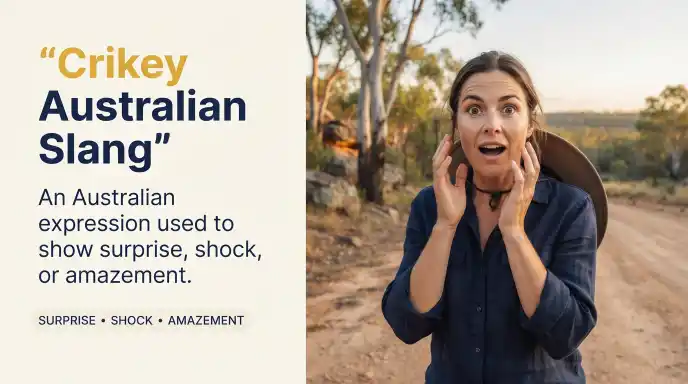
Crikey Australian slang is an informal Australian expression used to show surprise, shock, excitement, or amazement. It is similar to saying “wow,” “goodness,” or “oh my!”
You may hear crikey when someone sees something unexpected or impressive. For example, someone might say, “Crikey, that’s a huge fish!” after seeing a very large fish.
The word is strongly linked to Australian English. It is also known by many English speakers outside Australia. It is usually harmless and often sounds friendly or humorous.
In this guide, you’ll learn what crikey means, where it came from, how Australians use it, and how it sounds in everyday conversations.
Quick Answer: What Does Crikey Mean in Australian Slang?
Crikey is an Australian exclamation used to show surprise, shock, excitement, or amazement. It is similar to “wow,” “goodness,” or “oh my!” It is generally mild and non-offensive.
What Does Crikey Mean in Australian Slang?
In Australian English, crikey is mainly an exclamation. It does not describe a person or object by itself.
Its meaning depends on the situation and the speaker’s tone. Someone may say it after seeing something surprising, impressive, strange, or unexpected.
For example:
“Crikey, that was close!”
Here, the speaker is showing surprise or relief.
Another example is:
“Crikey, look at the size of that!”
In this case, crikey shows amazement.
The word is short and expressive. That makes it useful in casual conversations.
What Does Crikey Mean in Text?
In texting, crikey has the same basic meaning. People use it as a quick reaction to something surprising or hard to believe.
For example:
Friend: I just saw a spider bigger than my hand.
You: Crikey!
The word adds emotion without needing a long reply.
You may also see crikey in social media comments, captions, and casual online chats. The meaning is usually clear from the surrounding message.
Is Crikey Rude or Offensive?
No, crikey is generally not rude or offensive. It is a mild expression used to show surprise or amazement.
Unlike strong swear words, crikey is usually safe in everyday conversations. It can also be used around children or in family-friendly settings.
Still, tone matters. Someone may say crikey as a joke, with concern, or with strong surprise. The situation helps show the exact feeling.
Where Is Crikey Commonly Used?
Crikey is closely linked with Australian English. It is mainly used in informal speech and writing.
You may encounter it in:
- Everyday conversations
- Australian TV and media
- Movies and comedy
- Social media
- Text messages
- Online comments
- Informal writing
- Humorous conversations
The word is also recognized outside Australia. Australian TV, entertainment, and popular culture have helped make it familiar to many English speakers.
How Do Australians Use Crikey?
Australians can use crikey in different situations. The common idea is that something has caught the speaker’s attention.
It may express:
- Surprise
- Shock
- Amazement
- Excitement
- Concern
- Relief
- Disbelief
For example, “Crikey, that’s expensive!” shows surprise about a price.
“Crikey, you scared me!” shows that something caused a sudden reaction.
The word is flexible. The sentence and tone help show the exact feeling.
Crikey vs. Wow
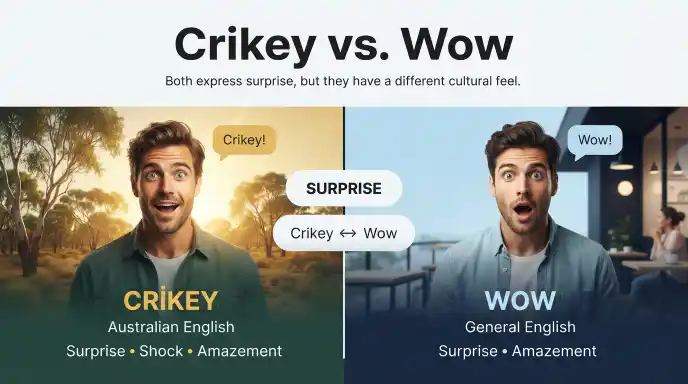
Crikey and wow can both express surprise. However, they have different styles.
Wow is common across many types of English. Crikey has a stronger connection with Australian and British English.
For example:
“Wow, that car is fast!”
Or:
“Crikey, that car is fast!”
Both sentences show surprise. The second one has a more distinct Australian or traditional English feel.
Crikey vs. Blimey
Blimey is another mild expression used to show surprise. It is more strongly linked with British English.
Crikey has a similar function. However, it is widely recognized as an Australian expression.
| Expression | Main Association | Basic Meaning |
| Crikey | Australia | Wow, goodness, amazing |
| Blimey | Britain | Wow, goodness |
| Wow | General English | Surprise or amazement |
| Gosh | General English | Mild surprise |
| Whoa | General English | Strong surprise or reaction |
These expressions can have similar meanings. Their cultural associations are different.
Real-Life Examples of Crikey
Crikey is usually used as a quick reaction. The exact feeling depends on what happens in the conversation.
Friendly Conversation
Sam: Did you see how big that fish was?
Ben: Crikey, it was massive!
Here, crikey shows amazement. The speaker is impressed by the size of the fish.
Showing Surprise
Amy: I finished the whole project in one night.
Jack: Crikey, you must be exhausted!
The word shows surprise at what the other person has done.
Showing Shock
Tom: The storm damaged half the roof.
Mike: Crikey, that’s terrible.
Here, crikey shows shock and concern rather than excitement.
Showing Excitement
Friend: We got tickets for the final!
Reply: Crikey! That’s brilliant!
The expression adds excitement to the reaction.
Text Message
Friend: Guess what? I won the competition!
Reply: Crikey! Congrats!
In texting, crikey works as a short and expressive reaction.
Origin and History of Crikey Australian Slang
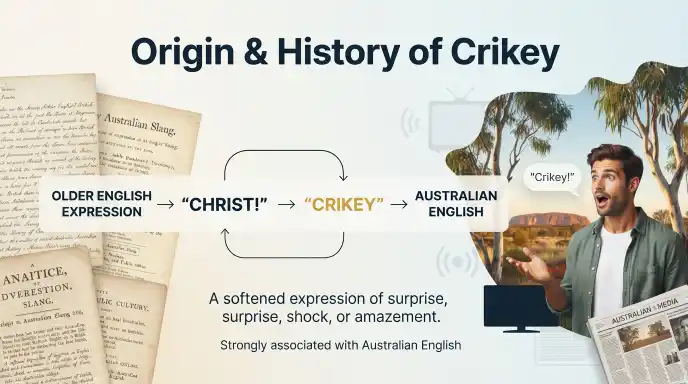
The exact history of crikey is linked to older English expressions used to show surprise. It is generally understood as a softened form of “Christ!”, used as an exclamation.
The word became strongly associated with Australian English over time. In Australia, it has been used as a mild way to express surprise, shock, or amazement.
Today, crikey is widely recognized as an Australian expression. However, it is not limited to Australia. English speakers in other countries may also understand or use it.
Australian media and public figures have also helped spread the expression. As a result, many people recognize crikey even if they have never lived in Australia.
Is Crikey Still Common in Australia?
Crikey is still understood in Australia, but it may sound more traditional or playful than modern everyday slang.
You may hear it in humorous speech, media, or situations where someone wants to add an Australian flavor to their reaction.
It is not usually considered strong or offensive. Younger speakers may prefer simpler reactions such as “wow,” “no way,” or “seriously?”
So, crikey is best viewed as a well-known Australian expression rather than one of the newest internet slang terms.
Crikey on Social Media
Crikey can appear on social media when someone wants to react to something surprising or impressive.
It may be used in comments, captions, memes, or casual posts. The word can also make a message sound humorous or distinctly Australian.
For example:
“Crikey, that sunset is incredible!”
Or:
“Crikey, what a game!”
The expression is usually easy to understand because the surrounding content shows what caused the reaction.
When Should You Avoid Using Crikey?
There is no major safety concern with crikey. Still, the situation matters.
It may sound unusual in very formal writing because it is an informal exclamation. In a formal report, academic paper, or business document, a clearer phrase such as “surprisingly” or “remarkably” would usually work better.
You may also want to avoid forcing the word into a conversation just to sound Australian. If it does not match your natural speaking style, it may sound forced or outdated.
Why Do People Use Crikey?
People use crikey because it gives a quick emotional reaction without using strong language.
It can make a sentence sound:
- Surprised
- Excited
- Humorous
- Dramatic
- Informal
- Australian
The word is useful when someone wants to show a strong reaction while keeping the language mild.
Is Crikey Safe for Social Media?
Yes, crikey is generally safe for social media. It is a mild expression and does not normally contain profanity or offensive language.
You can use it in casual posts, comments, captions, and messages.
For example:
“Crikey, that was an amazing match!”
There is usually no problem with this type of use. As always, the exact feeling can change slightly with tone and context.
Common Misunderstandings About Crikey
One common misunderstanding is that crikey means “cool.” It does not directly mean cool. Instead, it shows a reaction such as surprise or amazement.
Another misunderstanding is that crikey is always a modern Australian slang word. It is better described as a long-standing informal exclamation that has become strongly associated with Australian English.
It is also not normally an insult. If someone says “Crikey!”, they are usually reacting to something rather than attacking another person.
Polite Alternatives to Crikey
Because crikey is already mild, you do not usually need to replace it.
Depending on the situation, you could use:
- Wow!
- Oh wow!
- Goodness!
- Whoa!
- No way!
- That’s surprising!
- That’s amazing!
For formal situations, phrases such as “That is surprising” or “That is remarkable” are more suitable.
Key Takeaways About Crikey Australian Slang
- Crikey is an exclamation strongly linked with Australian English.
- It shows surprise, shock, excitement, or amazement.
- It is generally mild and not offensive.
- It can appear in speech, texting, social media, and informal writing.
- It does not directly mean “cool.”
- It may sound traditional, humorous, or playful today.
- Formal writing usually needs a more neutral expression.
Frequently Asked Questions About Crikey
1. What does crikey mean in Australian slang?
Crikey is an informal exclamation used to show surprise, shock, excitement, or amazement. It is similar to saying “wow,” “goodness,” or “oh my!”
2. Is crikey an Australian slang word?
Yes. Crikey is strongly associated with Australian English, although the expression is also known and understood in other English-speaking countries.
3. Is crikey a bad word?
No. Crikey is generally considered mild and non-offensive. It can be used as a family-friendly reaction to something surprising or impressive.
4. What does crikey mean in texting?
In texting, crikey works as a quick reaction to unexpected news or events. For example, “Crikey, that’s expensive!” shows surprise about the price.
5. Does crikey mean cool?
Not exactly. Crikey expresses a reaction, while cool describes something that is good, impressive, or fashionable. Someone might say crikey because something is cool, but the two words do not have the same meaning.
6. Is crikey still used today?
Yes, people still recognize and use crikey, especially in Australian English. However, it can sound playful, traditional, or slightly old-fashioned compared with newer reactions such as “wow,” “no way,” or “seriously?”
Crikey Australian Slang vs. Similar Expressions
Understanding similar expressions can help you choose the right word for the situation.
| Expression | Meaning | Style |
| Crikey | Surprise or amazement | Australian, informal |
| Wow | Surprise or admiration | General, informal |
| Whoa | Strong surprise | Casual |
| Gosh | Mild surprise | Polite, general |
| Blimey | Surprise or shock | British, informal |
| No way | Disbelief or surprise | Casual |
These expressions can have similar meanings. However, they do not have the same cultural feel. Crikey has a clear connection with Australian English.
How to Use Crikey Naturally
The easiest way to use crikey is to put it at the beginning of a sentence. You can also use it alone as a reaction.
For example:
“Crikey, that’s a long queue!”
You can also use it by itself:
“Crikey!”
This works when the situation already makes the reason for your reaction clear.
The word does not need to appear in every sentence. It works best when something genuinely surprises you.
Final Thoughts on Crikey Australian Slang
Crikey Australian slang is a mild expression used to show surprise, shock, excitement, or amazement. It is strongly linked with Australian English and is usually friendly rather than offensive.
The word is still understood today, although it can sometimes sound playful or traditional. If you see “crikey” in a text, comment, video, or conversation, read it as an emotional reaction rather than a description.
For most casual situations, it is a harmless expression. Just remember that crikey does not mean “cool” by itself. It shows how strongly someone reacts to what they have seen, heard, or experienced.
Discover More Related Articles:
- What Is a Name for El Salvador’s Slang Language?
- Relax in Spanish Slang: Casual Words, Meanings & Examples
- Yinzer Slang: Meaning, Definition, Origin and Everyday Usage

Hey, I’m Jordan. I grew up in a bilingual household in LA, so Spanish and Mexican American slang has always been part of how I talk. I’ve been writing online content for five years, explaining terms the way I’d explain them to a friend meaning, tone, and when it’s actually okay to use.