
Toronto slang is a group of informal words and expressions associated with Toronto, especially the city’s multicultural youth speech.
Words such as mans, ting, yute, mandem, ahlie, wallahi, and wasteman can appear in conversations, music, social media, and everyday speech. Their meaning depends on the word and the context.
Toronto slang is closely connected to Multicultural Toronto English, a variety of English that developed through contact between different communities in the Greater Toronto Area. Jamaican Patois, Somali, Arabic, and other linguistic influences have helped shape its vocabulary.
This guide explains common Toronto slang, what the words mean, where they come from, how people use them, and when you may want to avoid them.
Quick Answer: What Is Toronto Slang?
Toronto slang is informal vocabulary and expressions used in parts of Toronto, particularly among younger and multicultural communities. It includes words influenced by Jamaican Patois, Somali, Arabic, and other forms of English spoken in the city.
Some commonly documented examples include:
- Mans: I, me, you, we, or people, depending on context
- Ting: thing; in some Toronto usage, it can also refer to a woman
- Yute: youth or young person
- Mandem: a group of men or male friends
- Ahlie: an expression used for agreement or confirmation
- Wallahi: “I swear,” literally connected to “by God”
- Wasteman: a person viewed as worthless or foolish
- Nize it: shut up or stop talking
These meanings are documented in University of Toronto material on Toronto slang.
What Does Toronto Slang Mean?
Toronto slang does not refer to one single language or one fixed list of words. It describes a collection of informal expressions that have developed within Toronto’s multicultural communities.
Linguist Derek Denis has studied what is known as Multicultural Toronto English since 2015. His research looks at how speakers in Toronto combine local English with words and patterns connected to different cultural and linguistic communities.
This is why Toronto slang can sound different from standard Canadian English.
For example:
Mans has work in the morning.
Here, mans can refer to the speaker themselves, meaning something like “I have work in the morning.”
The meaning comes from how the word is being used in the sentence, not simply from its standard English definition.
Common Toronto Slang Words
Here are some of the better documented Toronto slang terms.
| Toronto Slang | Meaning | Common Context |
| Mans | I, me, you, we, or people | Conversation |
| Ting | Thing; sometimes a woman | Casual speech |
| Yute | Youth or young person | Casual conversation |
| Mandem | Group of male friends | Friendship |
| Ahlie | Agreement or confirmation | Conversation |
| Wallahi | I swear | Emphasis |
| Wasteman | A worthless or foolish person | Insults |
| Nize it | Shut up / stop talking | Conflict |
| Mixup | Drama, gossip, or conflict | Social situations |
| T Dot | Toronto | City reference |
These terms are not all interchangeable, and some can carry different tones depending on who is speaking and the situation.
What Does “Mans” Mean in Toronto Slang?
Mans is one of the most recognizable Toronto slang terms.
It can work in several ways, including I, me, you, we, or people, depending on the sentence.
For example:
Mans is tired.
The speaker may be referring to themselves.
In another context:
What are mans saying?
The phrase can refer to what someone, or a group of people, is saying.
The use of mans as a pronoun is particularly notable in research on Toronto English. The University of Toronto notes that researchers found this use unusual because pronouns normally remain relatively stable across varieties of English.
What Does “Ting” Mean in Toronto Slang?
Ting comes from a pronunciation and spelling associated with thing, but Toronto usage can give it a more specific meaning.
In Toronto slang, ting may refer to a woman, especially in casual speech.
For example:
That ting is here.
The word can sound casual and may be viewed as disrespectful depending on the person and context. A 2026 Toronto slang guide also notes that ting is commonly used to refer to women and can be slightly disrespectful.
So, it is better not to assume that every use of ting simply means “thing.”
What Does “Yute” Mean?
Yute is used to refer to a young person or youth.
It is associated with Jamaican Patois and appears in Toronto slang as part of the city’s Caribbean linguistic influence.
For example:
That yute is always outside.
Depending on the speaker and situation, it can simply identify a young person.
The spelling yute also reflects a pronunciation pattern that appears in some Toronto speech.
What Does “Mandem” Mean?
Mandem refers to a group of men or male friends.
For example:
The mandem are coming later.
In this sentence, mandem refers to a group of male friends.
The word is associated with Jamaican Patois and has become part of the vocabulary documented in Toronto’s multicultural speech.
It is also heard in other varieties of multicultural English, so it is not exclusive to Toronto.
What Does “Ahlie” Mean?
Ahlie is a Toronto slang expression used for agreement, confirmation, or checking that someone agrees.
It can work somewhat like:
- Right?
- Exactly.
- You know?
- Am I right?
For example:
That movie was shocking, ahlie?
The speaker is looking for agreement from the other person.
University of Toronto material identifies ahlie as a confirmational expression associated with Jamaican Patois influence in Toronto slang.
What Does “Wallahi” Mean?
Wallahi means roughly “I swear” or “I swear to God.”
The word comes through Somali from Arabic and is used in Toronto slang in contexts where someone wants to strongly emphasize that they are telling the truth.
For example:
Wallahi, mans didn’t take your phone.
Here, the speaker is strongly insisting that they did not take the phone.
Because the word has religious and cultural meaning, it should not be treated as a random replacement for “really.”
Where Did Toronto Slang Come From?

Toronto slang does not have one single origin.
Research on Toronto English shows that the city’s slang developed through contact among different communities.
Jamaican Patois is a major influence, while Somali and Arabic have also contributed words. Canadian English and locally developed expressions are part of the picture as well.
This reflects Toronto’s multicultural population.
For example, wallahi entered Toronto slang through Somali usage, while several other well known terms have connections to Jamaican Patois.
The University of Toronto describes this kind of speech as a multi ethnolect, meaning a variety of language shaped by contact between different ethnic and linguistic communities.
There is also evidence that some Toronto forms developed locally rather than simply being copied from another city.
The history of mans is a good example. Researchers have found similarities between Toronto’s use of mans and the use of man in London’s multicultural English, but the evidence does not establish a simple direct borrowing from London.
Is Toronto Slang the Same as Jamaican Slang?
No. Toronto slang and Jamaican slang are not the same thing.
There is a strong Jamaican influence on Toronto slang, but Toronto speakers have developed their own local meanings and expressions.
For example, researchers describe mans as a notable Toronto usage. Some words also developed meanings that fit Toronto’s own social and linguistic environment.
So it is more accurate to describe Toronto slang as multicultural Toronto speech with strong Caribbean influence, rather than simply calling it Jamaican slang.
Is Toronto Slang Used on Social Media?
Yes. Toronto slang can appear in TikTok captions, Instagram comments, DMs, YouTube videos, music, memes, and text conversations.
Social media also makes local expressions easier for people outside Toronto to see.
However, seeing a Toronto slang word online does not mean that every Toronto resident uses it. Usage varies by age, neighborhood, community, social group, and personal speaking style.
Some terms may also spread beyond Toronto through Canadian music and online culture.
Toronto Slang vs. Standard Canadian English
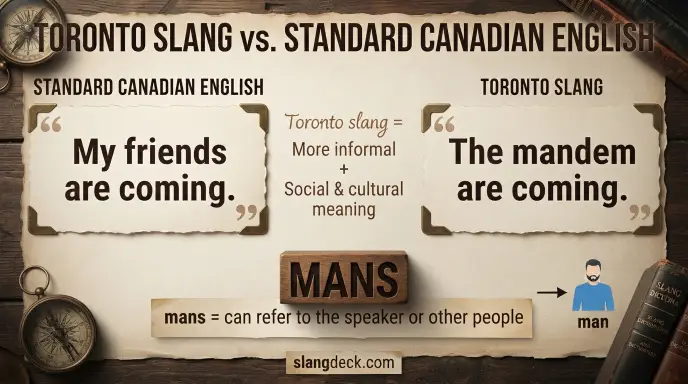
The biggest difference is often informality and vocabulary.
Standard Canadian English might use:
My friends are coming.
A speaker using Toronto slang might say:
The mandem are coming.
The second sentence carries additional social and cultural meaning.
Toronto slang can also change how familiar words are used. Mans, for example, can function differently from standard English man because it may act as a pronoun referring to the speaker or other people.
Is Toronto Slang Rude or Offensive?
Some Toronto slang is harmless and friendly, while other terms can sound insulting, disrespectful, or culturally inappropriate. Context matters.
Words such as ahlie can be used casually between friends.
Other expressions, including wasteman or nize it, can be confrontational.
Some terms also have cultural or religious backgrounds. Using a word without understanding its meaning can make the speaker sound unnatural or disrespectful.
A good rule is simple: listen to how people around you use a term before adding it to your own vocabulary.
Can You Use Toronto Slang at Work?
Most Toronto slang is better suited to casual conversations, close friends, social media, and informal messages.
For work emails, interviews, school assignments, customer service, and other formal situations, standard English is usually clearer.
For example, instead of:
“Nize it.”
a professional speaker could say:
“Please stop.”
Instead of using unfamiliar slang with a customer or manager, use straightforward language.
The issue is not that Toronto slang is “bad English.” It is a different style of communication, and the right choice depends on the setting.
Toronto Slang Examples in Real Conversations
1. Talking With Friends
A: “You coming tonight?”
B: “Yeah, mans will be there.”
Here, mans refers to the speaker.
2. Asking for Agreement
A: “That game was wild, ahlie?”
B: “For real.”
Here, ahlie asks the other person to agree.
3. Talking About Friends
A: “Who are you going with?”
B: “The mandem.”
Here, mandem refers to the speaker’s male friends.
4. Emphasizing a Statement
A: “Did you take my charger?”
B: “Wallahi, I didn’t.”
Here, wallahi adds strong emphasis to the speaker’s statement.
When Should You Avoid Toronto Slang?
You may want to avoid Toronto slang when:
- You are writing a formal email.
- You are speaking in a job interview.
- You are writing an academic assignment.
- You are talking to someone who may not understand the expression.
- You are using a culturally specific word without understanding it.
- A term sounds insulting or disrespectful in the situation.
You also do not need to use Toronto slang just because you live in Toronto. Slang is personal and varies between communities.
Common Misunderstandings About Toronto Slang
Is Toronto slang one fixed language?
No. It is a collection of expressions and linguistic features associated with parts of Toronto’s multicultural speech.
Does every Toronto resident use slang?
No. Usage varies across communities, ages, neighborhoods, and social groups.
Did one person invent Toronto slang?
No single inventor is documented. Researchers describe it as something that developed through contact among communities and through local innovation.
Is all Toronto slang from Jamaica?
No. Jamaican Patois is an important influence, but research also documents Somali and Arabic influences, along with Canadian English and locally developed forms.
Is Toronto slang only used online?
No. These expressions can be used in spoken conversation as well as online communication.
Key Takeaways
- Toronto slang refers to informal expressions associated with parts of Toronto’s multicultural speech.
- It is closely connected with Multicultural Toronto English.
- Jamaican Patois is a major influence.
- Somali and Arabic have also contributed words.
- Common documented examples include mans, ting, yute, mandem, ahlie, wallahi, and wasteman.
- Meanings can change with context.
- Not every Toronto resident uses the same slang.
- Some terms are casual, while others can sound rude or disrespectful.
- Formal situations usually call for standard English.
Frequently Asked Questions
Q1. What is the most common Toronto slang?
There is no single official “most common” Toronto slang word. Mans is one of the best known examples documented by University of Toronto researchers.
Q2. What does “mans” mean in Toronto?
Mans can mean I, me, you, we, or people, depending on the sentence and context. Its use as a pronoun is a notable feature of Toronto English.
Q3. What does “ting” mean in Toronto slang?
Ting can mean “thing,” but in Toronto slang it can also refer to a woman. The second use may sound disrespectful depending on the context.
Q4. What does “ahlie” mean?
Ahlie is used to seek agreement or confirmation. It can be similar to saying “right?” or “you know?”
Q5. What does “mandem” mean?
Mandem refers to a group of men or male friends. It is associated with Jamaican Patois influence in Toronto slang.
Q6. Is Toronto slang only used by young people?
Young speakers are especially associated with the variety studied as Multicultural Toronto English, but Toronto slang is not limited to one age group. Usage depends on community and social setting.
Conclusion
Toronto slang is more than a list of unusual words. It reflects the city’s multicultural history, local communities, and changing ways of speaking.
Terms such as mans, ting, yute, mandem, ahlie, and wallahi show how different linguistic influences can become part of a local style of English. Jamaican Patois has played a major role, while Somali, Arabic, Canadian English, and locally developed forms have also shaped the vocabulary.
If you see Toronto slang on TikTok, Instagram, in a text, or in a conversation, focus on the context and the speaker’s community. That will usually tell you more than the word alone.
Discover More

Hey, I’m Jordan. I grew up in a bilingual household in LA, so Spanish and Mexican American slang has always been part of how I talk. I’ve been writing online content for five years, explaining terms the way I’d explain them to a friend meaning, tone, and when it’s actually okay to use.