
Cool slang in Spanish refers to informal words people use to say something is great, awesome, stylish, or impressive. The exact word changes by country and region.
If you search for cool slang in Spanish, you may notice that Spanish speakers do not use one single word everywhere. A word that sounds natural in Mexico may sound unusual in Spain or another Spanish-speaking country.
Common examples include chido in Mexico, guay in Spain, and chévere in several Latin American countries. These words can describe a person, place, outfit, idea, event, or experience.
This guide explains the most useful Spanish slang words for “cool.” It also shows where they are used, what they mean, and how they sound in real conversations.
Quick Answer: What Is “Cool” in Spanish Slang?
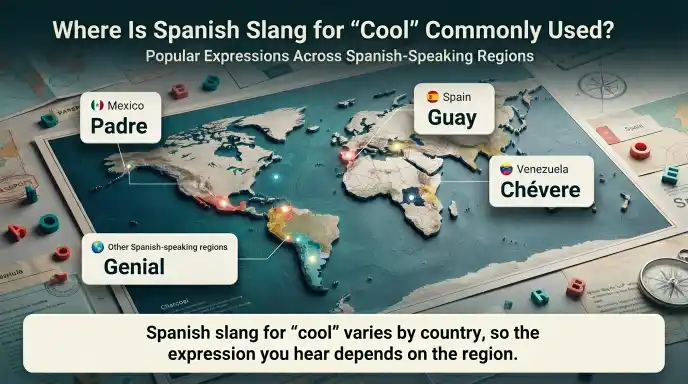
There is no single Spanish slang word for “cool.” Chido is common in Mexico, guay is widely associated with Spain, while chévere is used in several Latin American countries.
The best choice depends on the Spanish-speaking country and the situation.
What Does “Cool” Mean in Spanish Slang?
In Spanish slang, words for “cool” usually describe something that is great, impressive, fun, stylish, or enjoyable.
The meaning can change slightly depending on the country. Some words focus on something being fun, while others can mean stylish or impressive.
For example, a Mexican speaker might say “Está chido” to mean “It’s cool.” A person from Spain might use “Está guay” for a similar idea.
These expressions are informal. They are most natural in conversations with friends, family, classmates, or people you know well.
Popular Cool Slang Words in Spanish
Here are some common ways to say “cool” in Spanish slang:
| Slang Word | Common Region | Meaning |
| Chido | Mexico | Cool, awesome, great |
| Guay | Spain | Cool, great, nice |
| Chévere | Latin America | Cool, great, excellent |
| Bacán | Several Latin American countries | Cool, awesome |
| Padre | Mexico | Cool, great |
| Copado | Argentina, Uruguay | Cool, great, fun |
| Padrísimo | Mexico | Very cool, awesome |
| Genial | Many Spanish-speaking regions | Great, cool, excellent |
| Brutal | Some Latin American regions | Amazing, awesome |
| De lujo | Several regions | Excellent, top-quality |
Not every word is equally common in every country. Regional context matters when choosing one.
Chido: Cool Slang in Mexican Spanish
Chido is one of the best-known Mexican slang words for “cool.” It can describe something fun, impressive, attractive, or simply enjoyable.
You may hear chido when someone talks about music, clothes, plans, places, movies, or experiences.
For example:
Tu camisa está muy chida.
Your shirt is really cool.
You can also use it to react to good news:
¡Qué chido!
That’s so cool!
The feminine form chida is often used when the noun is feminine. The form can change based on the thing being described.
Guay: Cool Slang in Spain
Guay is a very common informal word in Spain for something that is cool, nice, or great.
It can be used for experiences, objects, plans, places, and ideas.
For example:
La película estuvo muy guay.
The movie was really cool.
You might also hear:
¡Qué guay!
How cool!
Guay is strongly associated with Spanish Spanish. It may sound less natural if you are trying to imitate the slang of another Spanish-speaking country.
Chévere: Cool in Latin American Spanish
Chévere is another popular word for “cool” or “great.” It is used in different parts of Latin America, although its popularity can vary by country.
The word can describe a person, event, place, idea, or experience.
For example:
Tu nuevo teléfono está chévere.
Your new phone is cool.
You may also hear:
¡Qué chévere!
That’s great!
Because regional usage differs, it is useful to check which country the speaker is from before using local slang.
Padre: Another Mexican Way to Say Cool
In Mexico, padre can mean “cool” or “great” in informal speech.
The literal meaning of padre is “father,” but the slang meaning is different. Context makes the intended meaning clear.
For example:
Ese lugar está muy padre.
That place is really cool.
You might also hear:
¡Qué padre!
That’s cool!
This is a good example of why slang can be confusing for Spanish learners. A familiar Spanish word may have a different meaning in casual speech.
Bacán: Cool and Awesome
Bacán is an informal word used in several Spanish-speaking countries. It can mean cool, great, awesome, or enjoyable.
Its use varies by region, so it should not be treated as universal Spanish slang.
For example:
Ese concierto estuvo bacán.
That concert was awesome.
A speaker may also use bacán to describe a person who is pleasant, impressive, or fun to be around.
Padrísimo: Very Cool
Padrísimo is a stronger form of padre used in Mexican Spanish.
It can mean very cool, awesome, or really great.
For example:
Tu viaje se ve padrísimo.
Your trip looks really cool.
It is more expressive than simply saying padre. The word works well when someone is excited about something.
Is Spanish Slang for “Cool” the Same Everywhere?
No. Spanish slang changes from country to country.
A word that sounds completely natural in Mexico may not be the usual choice in Spain. The same thing happens across Latin America.
For example:
| Country or Region | Common Expression | English Meaning |
| Mexico | Chido | Cool |
| Mexico | Padre | Cool |
| Spain | Guay | Cool |
| Argentina | Copado | Cool |
| Several Latin American regions | Chévere | Cool |
| Several Latin American regions | Bacán | Cool |
This regional difference is important for language learners. Instead of memorizing one word as “the Spanish word for cool,” learn the expression used in the country you want to communicate with.
How Do You Say “That’s Cool” in Spanish Slang?
The natural translation depends on the region.
In Mexico, you can say:
¡Qué chido!
In Spain, you can say:
¡Qué guay!
In places where chévere is common, you may hear:
¡Qué chévere!
All three can communicate a similar reaction, but they have different regional flavors.
Is “Cool” Spanish Slang Rude or Offensive?
Most Spanish slang words for “cool” are friendly and harmless in casual conversation. Words like chido, guay, and chévere are not normally offensive.
The main issue is regional use. A word may sound natural in one country but unusual in another.
For example, chido is strongly linked with Mexican Spanish, while guay is common in Spain. Using either word is not rude, but it may reveal that you learned your Spanish from a different region.
Where Is Spanish Slang for “Cool” Commonly Used?
These expressions are mainly used in informal speech. You can hear them when people talk with friends, family members, classmates, or other people they know.
They can also appear in online communication, including:
- Text messages
- Instagram captions
- TikTok comments
- YouTube comments
- Reddit discussions
- Casual Discord chats
- Social media posts
- Online gaming chats
The exact slang still depends on the speaker’s country. A Mexican user may choose chido, while someone from Spain may prefer guay.
Cool Slang in Spanish for Texting
Spanish speakers often use slang when texting friends. Short reactions are especially common because they make messages feel relaxed and natural.
For example, a Mexican speaker might text:
¡Qué chido!
This can mean:
That’s cool!
A Spanish speaker might write:
¡Qué guay!
Both messages express a positive reaction. The difference comes from regional vocabulary.
You do not need to use slang in every message. Standard Spanish is often better when you are speaking with someone for the first time.
Cool Slang in Spanish on Social Media
Spanish slang for “cool” can appear often in casual social media conversations. People may use it when reacting to photos, videos, outfits, trips, music, or events.
For example:
Ese outfit está chido.
This means:
That outfit is cool.
A Spanish user might instead write:
Ese outfit está guay.
The meaning is similar, but the regional style is different.
Real-Life Examples of Cool Spanish Slang
Here are some natural examples showing how these words can work in different situations.
Friendly Conversation
Sofia: ¿Te gusta mi nueva chaqueta?
Ana: Sí, está muy chida.
Meaning:
“Do you like my new jacket?”
“Yes, it’s really cool.”
This example uses chida, the feminine form commonly used in Mexican Spanish.
Talking About a Movie
Luis: ¿Viste la nueva película?
Marco: Sí, estuvo muy chida.
Meaning:
“Did you see the new movie?”
“Yes, it was really cool.”
The speaker is describing the movie as enjoyable or impressive.
Talking About a Place
Ana: ¿Cómo estuvo el restaurante?
Carlos: Estuvo muy padre.
Meaning:
“How was the restaurant?”
“It was really cool.”
Here, padre has its informal Mexican meaning rather than its literal meaning of “father.”
Reacting to Good News
Friend: Me voy a España este verano.
Reply: ¡Qué guay!
Meaning:
“I’m going to Spain this summer.”
“How cool!”
This use of guay sounds natural in Spain.
Talking About an Event
Marta: ¿Cómo estuvo el concierto?
Luis: Estuvo chévere.
Meaning:
“How was the concert?”
“It was cool.”
Here, chévere expresses a positive reaction to the event.
Cool Slang vs. Standard Spanish
Slang is not the only way to express the idea of “cool” in Spanish. Standard or widely understood words can also work.
| Expression | Style | Meaning |
| Chido | Mexican slang | Cool, awesome |
| Guay | Spain slang | Cool, great |
| Chévere | Regional slang | Cool, great |
| Padre | Mexican slang | Cool, great |
| Genial | Casual/common | Great, excellent |
| Excelente | Neutral/formal | Excellent |
| Fantástico | Neutral | Fantastic, great |
If you are unsure about regional slang, genial is often an easier choice because it is widely understood.
When Should You Avoid Spanish Slang for “Cool”?
Most of these expressions are harmless, but slang is still informal. It may not fit every situation.
Avoid relying on slang when writing:
- Formal business emails
- Academic assignments
- Official documents
- Job applications
- Professional reports
- Formal presentations
- Communication with officials
In these situations, words such as excelente, fantástico, or muy bueno may sound more appropriate.
You should also be careful when speaking with someone from another Spanish-speaking country. If you are not sure about a regional word, use a more widely understood expression.
Why Do Spanish Speakers Use Slang for “Cool”?
People use these expressions because slang makes casual communication feel more natural. It can also show where a speaker is from.
Regional slang can add personality to a conversation. It can make a message sound friendly, relaxed, or more connected to local culture.
For language learners, these words are useful because native speakers may use them even when standard Spanish would use a different expression.
Key Takeaways
- There is no single Spanish slang word for “cool.”
- Chido is strongly associated with Mexican Spanish.
- Guay is common in Spain.
- Chévere is used in several Latin American regions.
- Padre can mean “cool” in Mexican Spanish.
- Bacán and copado are also used regionally.
- These words are mainly suitable for casual communication.
- Regional context matters when choosing Spanish slang.
- Genial is a useful option when you want a widely understood word.
Common Misunderstandings About Cool Spanish Slang
One common misunderstanding is that Spanish has one universal slang word for “cool.” It does not.
Another mistake is assuming that a word is equally common in every Spanish-speaking country. Spanish has many regional varieties, so slang changes across communities.
It is also easy to confuse a literal meaning with a slang meaning. For example, padre normally means “father,” but in Mexican casual speech it can mean “cool” or “great.”
Is Cool Spanish Slang Safe for Social Media?
Yes. Common expressions such as chido, guay, chévere, and padre are generally safe in casual social media posts and conversations.
They can be used in captions, comments, messages, and casual replies when the regional context is clear.
The main thing to remember is that slang is informal. For professional or official communication, a neutral Spanish word is usually a better choice.
FAQs About Cool Slang in Spanish
1. What is the most common Spanish slang word for cool?
There is no single word that is most common everywhere. Chido is strongly associated with Mexico, while guay is common in Spain.
2. What does chido mean in Spanish slang?
Chido is Mexican slang meaning “cool,” “great,” or “awesome.” It is commonly used in informal conversations.
3. What does guay mean in Spanish slang?
Guay is informal Spanish from Spain and means “cool,” “great,” or “nice.” It is especially common in casual speech.
4. Does chévere mean cool?
Yes. Chévere can mean “cool,” “great,” or “excellent” in several Spanish-speaking regions. Its exact popularity varies by country.
5. Can I use Spanish slang with native speakers?
Yes, if you understand the regional context. Start with words commonly used in the country whose Spanish you are learning.
6. Is Spanish slang appropriate at work?
Some mild slang may appear in relaxed workplaces, but it is safer to use standard Spanish in formal emails, reports, meetings, and professional documents.
Conclusion
Cool slang in Spanish changes from country to country, so there is no single expression that works everywhere. Words such as chido, guay, chévere, padre, bacán, and copado can all express the idea of something being cool or great in different regions.
The best word depends on who you are speaking with and where they are from. If you are learning Mexican Spanish, chido and padre are useful choices. For Spain, guay is a natural option.
The key is to learn slang with its regional context. That helps you sound more natural without using a word that feels out of place.
Explore More:

Hi, I’m Sarah. I studied Communications at the University of Texas and have spent the last six years writing about internet culture and Gen Z slang across TikTok, Twitter, and everyday conversations. I focus on real usage, not just dictionary definitions.