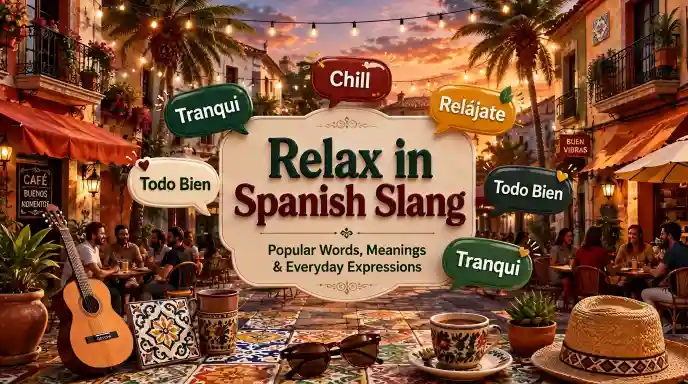
Relax in Spanish slang is commonly expressed with casual phrases like tranqui, relájate, calma, no pasa nada, and tómalo con calma. The best expression depends on the country, the situation, and how informal the conversation is.
These slang phrases are widely used among friends, family, and on social media to tell someone to calm down or take things easy.
Many people search for relax in Spanish slang after hearing these expressions in Spanish movies, TikTok videos, travel conversations, or text messages. While dictionaries usually translate “relax” as relajarse, native speakers often prefer shorter and more natural slang expressions.
In this guide, you’ll learn the most common ways to say “relax” in Spanish slang, where people use them, if they are polite, and when to avoid them.
Quick Answer: Relax in Spanish Slang
Relax in Spanish slang is usually expressed with phrases like tranqui (“relax” or “take it easy”), relájate (“relax”), calma (“calm down”), and no pasa nada (“it’s okay” or “don’t worry”). The right phrase depends on the country, your relationship with the other person, and the tone of the conversation.
What Does Relax in Spanish Slang Mean?
Unlike English, Spanish does not have one universal slang word that means “relax.” Instead, native speakers use several casual expressions depending on the situation.
Some phrases tell someone to stay calm.
Others reassure a person that everything is fine.
A few simply mean “don’t stress” or “take it easy.”
These expressions sound much more natural than using the formal dictionary translation in everyday conversations.
For example:
- Tranqui, todo saldrá bien. (Relax, everything will be fine.)
- No pasa nada. (Don’t worry. It’s okay.)
- Tómalo con calma. (Take it easy.)
Because Spanish is spoken in many countries, the most popular slang expression may change from one region to another.
Full Form or Complete Meaning
There is no official full form for relax in Spanish slang because it is not an abbreviation or acronym. Instead, it refers to several informal Spanish words and phrases that people use to tell someone to calm down, stop worrying, or take things easy.
Here are some of the most common expressions:
| Spanish Slang | English Meaning | Common Use |
| Tranqui | Relax / Take it easy | Friends and texting |
| Relájate | Relax | General casual conversations |
| Calma | Calm down | Everyday speech |
| No pasa nada | It’s okay / Don’t worry | Comforting someone |
| Tómalo con calma | Take it easy | Giving advice |
| Todo bien | Everything’s fine | Reassuring someone |
These expressions all relate to relaxing, but native speakers choose different ones depending on the country and situation.
Different Meanings of Relax in Spanish Slang
The phrase relax in Spanish slang does not always mean the same thing. Native speakers use different expressions for different situations.
1. Calm Down
This is the most common meaning.
People say tranqui, relájate, or calma when someone seems nervous, angry, or stressed.
Example:
A: I’m worried about tomorrow’s test.
B: Tranqui, you’ll do great.
2. Don’t Worry
Sometimes the goal is to reassure someone instead of telling them to stop being upset.
Expressions like no pasa nada let the other person know that everything is okay.
Example:
You accidentally spilled your drink.
Your friend says, No pasa nada.
3. Take It Easy
Spanish speakers also use casual phrases when advising someone not to rush or overwork themselves.
Tómalo con calma is a common choice in these situations.
Example:
You’ve been working all day.
Your coworker says, Tómalo con calma.
4. Chill Out
Among younger speakers, especially in casual conversations, tranqui can simply mean “chill” or “take it easy.”
It often appears in text messages and social media comments.
Example:
Friend: Why are you stressing so much?
Reply: Tranqui, I’ve got it.
Where Is Relax in Spanish Slang Commonly Used?
You can hear relax in Spanish slang in many everyday situations. The exact phrase depends on the platform, country, and conversation.
Text Messages
Friends often use short expressions like tranqui or no pasa nada because they are quick to type.
Example:
“Tranqui, I’ll be there in five minutes.”
TikTok
Spanish-speaking creators use these expressions in funny videos, lifestyle content, and reaction clips.
Example:
“Tranqui, it’s only a prank!”
People use casual Spanish slang in captions, comments, and direct messages.
Example:
“No pasa nada. Enjoy your day!”
Family members and friends often reassure each other using relaxed, everyday language.
Example:
“Calma. Everything will work out.”
Everyday Conversations
Native speakers naturally use these expressions while talking with friends, classmates, coworkers, and family members.
They help make conversations sound friendly and informal instead of overly formal.
Is Relax in Spanish Slang Rude, Offensive, or Harmless?
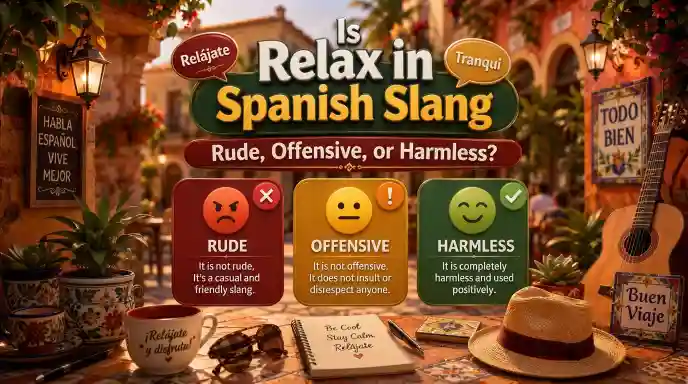
Relax in Spanish slang is generally harmless. Most expressions are friendly and meant to comfort someone.
However, your tone matters.
If you say “relájate” or “calma” politely, it usually sounds helpful.
If you say the same words during an argument, they may sound dismissive or annoying because the other person may feel that you are ignoring their feelings.
For that reason, think about:
- Your relationship with the other person.
- The situation.
- Your tone of voice.
- The country or region.
In friendly conversations, these expressions are perfectly normal. In heated discussions, they may not have the same positive effect.
Real-Life Examples of Relax in Spanish Slang
Here are some natural examples of how people use relax in Spanish slang in everyday conversations.
Example 1 : Friends
Lucas: I’m late again!
Sofia: Tranqui, they’ll wait for us.
Example 2 : Text Message
Emma: I think I sent the wrong file.
Mateo: No pasa nada. You can send the correct one.
Example 3 : Family Conversation
Mom: You look stressed today.
Son: I have too much homework.
Mom: Tómalo con calma. One step at a time.
Example 4 : Workplace
Employee: I made a small mistake.
Manager: Calma. We’ll fix it together.
Example 5 : Travel
Tourist: I think we’re on the wrong street.
Local: Tranqui, I’ll show you the right way.
Origin and History of Relax in Spanish Slang
The idea of saying “relax” in Spanish has existed for many years, but the slang expressions used today developed naturally in everyday conversation rather than from a single source.
Words like tranqui are shortened versions of tranquilo or tranquila, which mean “calm” or “relaxed.” Native speakers began shortening these words because they were quicker to say and type in casual conversations.
Other expressions, such as no pasa nada and tómalo con calma, have long been part of spoken Spanish. Over time, they became popular in text messages, social media, and online chats because they sound warm, friendly, and reassuring.
Today, these expressions are widely used across many Spanish-speaking countries, although the most common phrase can vary by region.
Similar Slang and Related Terms
| Spanish Expression | English Meaning | Common Situation |
| Tranqui | Relax / Chill | Friends, texting |
| Relájate | Relax | Everyday conversation |
| Calma | Calm down | Stressful situations |
| No pasa nada | Don’t worry | Reassuring someone |
| Tómalo con calma | Take it easy | Giving advice |
| Todo bien | Everything’s fine | Comforting others |
| Tranquilo / Tranquila | Stay calm | General conversation |
When Should You Avoid Using Relax in Spanish Slang?
Although these expressions are friendly, they are not suitable for every situation.
Avoid using relax in Spanish slang in these situations:
- Formal business meetings
- Professional emails
- Academic papers
- Legal documents
- Official presentations
- Job interviews
- Conversations where someone is very upset or emotional
- Speaking with someone who may think you are dismissing their feelings
In these situations, polite phrases such as please stay calm, don’t worry, or let’s discuss this carefully are usually better choices.
Why Do People Use Relax in Spanish Slang?
People use relax in Spanish slang because it sounds natural, friendly, and comforting.
The expressions are short and easy to remember. They also help conversations feel less formal.
Here are some common reasons people use them:
- To calm someone who feels stressed.
- To reassure a friend that everything is okay.
- To make conversations sound relaxed and natural.
- To respond quickly in text messages.
- To encourage someone not to panic.
- To create a warm and supportive tone.
Because these expressions are simple and positive, they remain popular in both spoken Spanish and online conversations.
Common Misunderstandings About Relax in Spanish Slang
Many learners misunderstand relax in Spanish slang because Spanish speakers use several different expressions instead of one universal slang word. Here are some common misconceptions.
Misunderstanding 1: There Is Only One Spanish Slang Word for “Relax”
Reality: No. Spanish has many informal expressions, such as tranqui, relájate, calma, no pasa nada, and tómalo con calma. The best choice depends on the country and the situation.
Misunderstanding 2: “Tranqui” Is Used Everywhere
Reality: Tranqui is popular in many Spanish-speaking regions, but it is not the only expression. Different countries often have their own preferred ways to tell someone to relax.
Misunderstanding 3: These Expressions Are Always Rude
Reality: Most Spanish slang for “relax” is friendly and supportive. However, saying relájate or calma during an argument may sound dismissive if your tone is harsh.
Misunderstanding 4: You Can Use Spanish Slang in Formal Situations
Reality: These expressions are informal. They are best for conversations with friends, family, classmates, or coworkers you know well. Formal settings usually require more polite language.
Key Takeaways
- Relax in Spanish slang is commonly expressed with phrases like tranqui, relájate, calma, no pasa nada, and tómalo con calma.
- There is no single Spanish slang word that means “relax” in every country.
- The most natural expression depends on the context, relationship, and region.
- These phrases are common in text messages, social media, WhatsApp, TikTok, Instagram, and everyday conversations.
- Most expressions are friendly and harmless, but your tone can change how they are received.
- Avoid using informal Spanish slang in professional emails, business meetings, academic writing, or other formal situations.
- Learning several expressions will help you sound more natural when speaking with native Spanish speakers.
Frequently Asked Questions
Q1. What is the most common way to say relax in Spanish slang?
Tranqui is one of the most common informal expressions. Other popular choices include relájate, calma, and no pasa nada.
Q2. Does “tranqui” mean the same as “relax”?
Yes. Tranqui is a casual way to say “relax,” “take it easy,” or “don’t worry.”
Q3. Is relax in Spanish slang rude?
No. It is usually friendly and supportive. However, your tone and the situation can make it sound less polite.
Q4. Can I use these expressions while traveling?
Yes. Many of these expressions are widely understood across Spanish-speaking countries, although local favorites may vary.
Q5. Is “relájate” formal or informal?
Relájate is generally informal. It is suitable for friends, family, and casual conversations.
Q6. What is the difference between “tranqui” and “no pasa nada”?
Tranqui tells someone to relax or stay calm. No pasa nada reassures someone by saying that everything is okay or that there is no problem.
Conclusion
Relax in Spanish slang includes several natural expressions that native speakers use every day. Instead of relying on one translation, people choose phrases like tranqui, relájate, calma, or no pasa nada based on the conversation and the country.
Understanding these expressions will help you sound more natural in Spanish and communicate with confidence. Remember to match the phrase to the situation, keep your tone friendly, and avoid informal slang in professional or formal settings.
Discover Related Slang Terms:

Hi, I’m Sarah. I studied Communications at the University of Texas and have spent the last six years writing about internet culture and Gen Z slang across TikTok, Twitter, and everyday conversations. I focus on real usage, not just dictionary definitions.