Crud slang is a term people often search because they see it in text messages, online chats, movies, games, or everyday conversations. While the word has been around for many years, its meaning depends on the situation.
Sometimes it is simply a mild way to express frustration. In other cases, it refers to something dirty, unpleasant, or of poor quality.
You may hear someone say “Oh, crud!” after making a mistake or read that a game is “crud” when someone dislikes it. Understanding the tone behind the word helps you avoid confusion and use it naturally in conversations.
Unlike many internet slang terms, crud is not an acronym and does not have a hidden meaning. It is simply an informal word that people use as a softer substitute for stronger swear words.
Quick Answer: Curd Slang
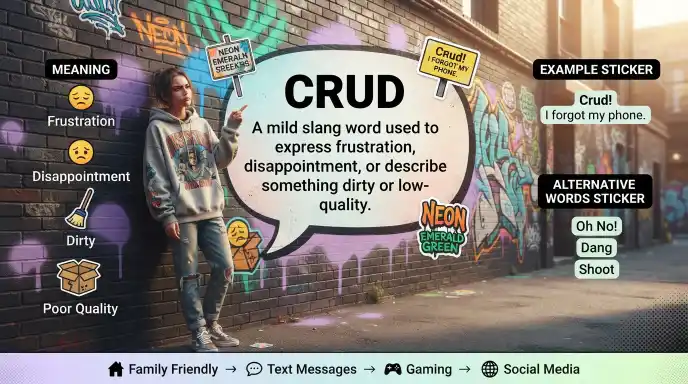
Crud is a mild slang word used to express disappointment, frustration, or annoyance. It can also describe something dirty, unpleasant, or low in quality, depending on the context.
What Does Crud Mean in Text?
In text messages and online conversations, crud usually expresses mild frustration or disappointment. It is often used instead of stronger curse words, making it a family-friendly choice.
For example, if someone forgets an important deadline, they might text:
“Crud! I completely forgot about the meeting.”
In this example, the speaker is annoyed with themselves rather than insulting anyone else.
Depending on the conversation, crud can also describe something that is dirty, messy, broken, or simply bad.
Common Meanings of Crud
| Meaning | Explanation | Example |
| Mild frustration | A soft replacement for a swear word | “Crud! I dropped my phone.” |
| Something dirty | Dirt, grime, or unwanted buildup | “There’s crud all over the keyboard.” |
| Poor quality | Something that performs badly or is disappointing | “This old laptop is complete crud.” |
Crud Full Form
Crud does not have a full form.
Unlike abbreviations such as LOL, BRB, or SMH, crud is a regular English slang word. It is not short for another phrase or sentence.
People sometimes search for:
- Crud full form
- What does crud stand for?
- Crud abbreviation
The answer is simple: Crud is not an acronym. It stands alone as an informal slang word.
Is Crud Rude, Offensive, or Neutral?
In most situations, crud is considered mild and generally acceptable.
Many people use it as a polite alternative to stronger profanity. Because of this, parents, teachers, and workplaces often consider it much more acceptable than common swear words.
Here is a quick overview.
| Situation | Appropriate? |
| Talking with friends | ✅ Yes |
| Family conversations | ✅ Yes |
| Text messaging | ✅ Yes |
| Social media | ✅ Yes |
| School discussions | ✅ Usually |
| Professional emails | ⚠️ Better to avoid |
| Formal business writing | ❌ No |
Although it is not highly offensive, formal communication usually sounds more professional without slang.
Where Is Crud Commonly Used?
The word crud appears in both spoken and written English. It is especially common in informal conversations.
You may see or hear it on:
- Text messages
- Casual conversations
- Social media comments
- Gaming chats
- Reddit discussions
- Discord servers
- Family conversations
- Movies and TV shows
- Everyday storytelling
It is less common on TikTok than newer slang, but many English speakers still recognize and understand it.
Who Uses “Crud” the Most?
The slang word crud is used by many different groups of people, especially those who prefer clean and family-friendly language.
Common users include:
- Parents talking with children
- Teachers in classrooms
- Students during casual conversations
- Adults who avoid profanity
- Writers creating family-friendly content
While younger generations may prefer newer slang expressions, many English speakers still recognize and understand crud.
Real Life Examples of Crud Slang
Here are several natural examples showing how people use crud in different situations.
1. Friendly
“Crud! I forgot your birthday. I’m really sorry.”
2. Casual
“Crud, it’s starting to rain.”
3. Frustrated
“Crud! My internet stopped working again.”
4. Gaming
“Crud, I got eliminated in the first round.”
5. Social Media
“Crud… I accidentally deleted all my photos.”
6. Talking About Something Dirty
“There’s so much crud under the sink that it needs cleaning.”
7. Talking About Poor Quality
“That cheap charger turned out to be complete crud.”
These examples show that the meaning changes based on the situation, but the overall tone stays informal and relatively mild.
Origin and Background of Crud Slang
The word crud has existed in English for well over a century. It originally referred to dirt, waste, or unpleasant material.
Over time, people began using it as a mild exclamation instead of stronger swear words. Rather than saying offensive language, many English speakers simply said:
“Crud!”
This made the word popular among families, schools, and television programs where stronger language was discouraged.
Today, the slang meaning remains largely the same. It expresses annoyance without sounding highly offensive, which explains why it has stayed in everyday English for many decades.
Crud vs Similar Slang Terms
Although crud expresses disappointment or describes something unpleasant, it is different from several similar slang words. Here’s how they compare.
| Slang | Meaning | Tone | Offensive Level |
| Crud | Mild frustration or something dirty/bad | Mild | Very Low |
| Crap | Something bad or an expression of annoyance | Informal | Low |
| Dang | A mild expression of surprise or frustration | Friendly | Very Low |
| Shoot | A polite substitute for a swear word | Mild | Very Low |
| Junk | Something useless or poor quality | Neutral | None |
| Garbage | Something very poor or worthless | Strong criticism | Low |
Crud is usually the safest option because it sounds less harsh than crap while still expressing disappointment.
When to Avoid Using Crud
Even though crud is a mild slang word, there are situations where it is better to choose more professional language.
Avoid using crud when:
- Writing business emails.
- Preparing academic papers.
- Speaking during formal presentations.
- Communicating with clients or senior management.
- Writing official reports or legal documents.
In these situations, words like unfortunate, poor quality, or unpleasant sound more professional.
Polite Alternatives to Crud
1. Oh No!
Pronunciation: (oh noh)
Meaning:
Oh no! is a polite expression used to show surprise, disappointment, or concern without using slang or offensive words.
Examples:
- “Oh no! I left my wallet at home.”
- “Oh no! The meeting has been canceled.”
2. I Forgot
Pronunciation: (eye fer-GOT)
Meaning:
I forgot is a simple and direct way to admit that you forgot something. It sounds more professional than saying, “Crud! I forgot.”
Examples:
- “I forgot to reply to your email.”
- “Sorry, I forgot about our appointment.”
3. That’s Disappointing
Pronunciation: (thats dis-uh-POINT-ing)
Meaning:
This phrase politely expresses that something did not meet your expectations or had an unfortunate outcome.
Examples:
- “That’s disappointing. I was hoping for better results.”
- “That’s disappointing, but we can try again tomorrow.”
4. This Isn’t Very Good
Pronunciation: (this IZ-uhnt VER-ee good)
Meaning:
Use this phrase when you want to politely say that something is below your expectations or needs improvement.
Examples:
- “This isn’t very good. It needs more work.”
- “This isn’t very good compared to the previous version.”
5. That’s Poor Quality
Pronunciation: (thats poor KWOL-i-tee)
Meaning:
This phrase describes a product, service, or piece of work that is made badly or does not perform well. It is a professional alternative to saying, “What a load of crud.”
Examples:
- “That’s poor quality. It broke after one use.”
- “The customer returned the item because it was poor quality.”
If you want to avoid slang altogether, here are some better alternatives.
| Instead of Crud | You Can Say |
| Crud! | Oh no! |
| Crud! I forgot. | I forgot. |
| That’s crud. | That’s disappointing. |
| This is crud. | This isn’t very good. |
| What a load of crud. | That’s poor quality. |
These alternatives work well in workplaces, classrooms, and professional writing.
Why Do People Use Crud Slang?
People continue using crud because it communicates emotion without sounding overly offensive.
Common reasons include:
- It replaces stronger swear words.
- It sounds friendly and harmless.
- Most English speakers understand it.
- It is suitable for mixed-age conversations.
- It expresses disappointment quickly.
- It avoids using offensive language.
Many people learned the word as children and still use it as adults because it feels natural and respectful.
Impact of Using Crud in Communication
Like many slang words, crud affects the tone of a conversation.
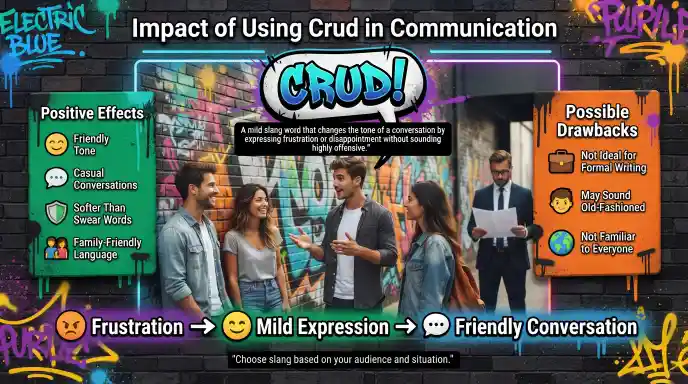
Positive Effects
- Sounds casual and approachable.
- Reduces the use of offensive language.
- Fits friendly conversations.
- Makes emotional reactions sound less aggressive.
Possible Drawbacks
- May sound old-fashioned to younger audiences.
- Can appear unprofessional in formal settings.
- Some international readers may not recognize the meaning.
Understanding your audience helps you decide whether crud is the right word to use.
Is Crud Slang Safe for Social Media?
Yes. In most cases, crud is considered safe for social media platforms.
You can usually use it on:
- X (Twitter)
- Discord
- Snapchat
- YouTube comments
Since it is a mild expression rather than explicit profanity, it rarely causes moderation issues. However, always keep the overall tone respectful, especially in public discussions.
Crud Slang in Pop Culture
The word crud has appeared in English-speaking pop culture for many years. Writers often use it in TV shows, movies, comic books, and children’s stories because it sounds natural without being offensive. It lets a character show surprise, frustration, or disappointment while keeping the dialogue family-friendly.
For example, a character might say, “Crud! I left my backpack at school.” This sounds emotional but remains polite enough for audiences of all ages. Although younger people now use newer slang words, crud still appears in family entertainment and nostalgic media.
Fun Facts About “Crud Slang”
Here are a few interesting facts about the slang word crud:
- Crud originally referred to dirt, waste, or something unpleasant before becoming a slang expression.
- It became popular as a softer alternative to stronger swear words.
- Parents and teachers often prefer crud because it is considered polite.
- The word has been used in English for decades and is still understood by most native speakers.
- Many people use it without thinking about its original meaning because it now mainly expresses emotion.
These facts show how a simple everyday word evolved into a common slang expression.
Why Do People Say “Crud” Instead of Swearing?
Many people choose crud because they want to express frustration without using offensive language. It helps speakers react naturally while keeping conversations respectful.
People often say crud in situations like these:
- Around children or family members
- In classrooms and schools
- At work or in public places
- During family-friendly conversations
- When they want to avoid stronger curse words
For example:
- Crud! I forgot my homework.
- Crud, we missed the last bus.
Using crud lets people express disappointment without sounding rude or inappropriate.
Common Misunderstandings About “Crud” Slang
Many people misunderstand the meaning and usage of crud. Here are the most common misconceptions.
1. People Think It Is a Swear Word
Although crud expresses frustration, it is generally considered a mild exclamation, not a profanity.
2. People Believe It Always Means Dirt
The original meaning of crud relates to dirt or something unpleasant. However, in slang, it usually expresses emotions like disappointment or annoyance instead.
3. People Confuse It With Strong Curse Words
Some assume crud has the same impact as stronger swear words, but it is much milder and suitable for most family-friendly conversations.
4. People Think It Is Outdated
While crud is less common among younger speakers today, many native English speakers still understand and occasionally use it in everyday conversations and media.
Understanding these differences helps you use crud correctly and avoid confusion in different situations.
Frequently Asked Questions
Q1. What does crud mean in slang?
Crud is a mild slang word that expresses frustration, disappointment, or describes something dirty or of poor quality.
Q2. What does crud stand for?
Crud does not stand for anything. It is not an acronym or abbreviation.
Q3. Is crud a bad word?
No. Crud is generally considered a mild and family-friendly expression compared to stronger swear words.
Q4. Can I use crud in text messages?
Yes. It is commonly used in casual texts, chats, and online conversations to express mild annoyance.
Q5. Is crud the same as crap?
Not exactly. Both have similar meanings, but crud is usually viewed as a softer and less offensive alternative.
Q6. Is crud still used today?
Yes. While it is less trendy than modern internet slang, many English speakers still use crud in everyday conversations.
Q7. What does it mean when someone has the crud?
It means someone has a mild illness, such as a cold, cough, or flu-like symptoms.
Q8. What is crud in UK slang?
In UK slang, crud refers to something dirty, unpleasant, or of poor quality. It can also describe a minor illness.
Q9. What is crud in Urban Dictionary?
On Urban Dictionary, crud usually means something disgusting, worthless, annoying, or a minor sickness, depending on the context.
Q10. Is crud a British word?
Yes. Crud has long been used in British English to describe dirt, filth, or something unpleasant, though it is also common in American English today.
Conclusion
Crud slang is a simple, mild expression that has remained part of everyday English for many years. People commonly use it to show disappointment, surprise, or frustration without using stronger profanity. It can also describe something dirty, messy, or of poor quality, depending on the context.
Because crud is generally polite and easy to understand, it works well in casual conversations, text messages, gaming chats, and social media. Just remember that formal writing and professional communication usually call for more neutral language.
Discove Related Slang

Hey, I’m Jordan. I grew up in a bilingual household in LA, so Spanish and Mexican American slang has always been part of how I talk. I’ve been writing online content for five years, explaining terms the way I’d explain them to a friend meaning, tone, and when it’s actually okay to use.