DM means “Direct Message” in text messages and on social media. It refers to a private message sent directly to another person instead of posting a public comment. People use DM when they want to talk privately on platforms like Instagram, TikTok, Snapchat, Facebook, and X.
For example, if someone says, “Send me a DM,” they are asking you to message them privately. You may also see phrases like “Check your DMs” or “I’ll DM you later.”
DM is one of the most common social media abbreviations. It makes online conversations quicker and helps people talk without sharing their messages publicly.
The meaning can change in other situations, but Direct Message is the main meaning in texting and social media conversations.
Read More: What Does DMs Mean in Text? Your Private Chats Decoded
What Does DM Stand For?
DM stands for Direct Message.
A direct message is a private conversation between people on a social media platform or messaging service. Unlike a public comment, a DM is generally visible only to the people involved in the conversation, subject to the platform’s privacy and messaging settings.
For example:
Alex: “Can you send me the details?”
Mia: “Sure, I’ll DM you.”
Meaning: Mia will send Alex a private message.
People often use DM as both a noun and a verb:
- As a noun: “I got your DM.” This means someone received your private message.
- As a verb: “DM me.” This means send me a private message.
What Does DM Mean on Instagram?
On Instagram, DM means Direct Message. It refers to private messages sent through Instagram’s messaging feature.
People use Instagram DMs to:
- Send private messages to friends.
- Share photos, videos, and Reels.
- Ask questions about posts or products.
- Discuss something they do not want to share publicly.
- Contact creators, brands, or other users.
For example:
Sam: “I sent you the pictures.”
Emma: “Okay, I’ll check my DMs.”
Here, Emma means she will look at her private Instagram messages.
What Does DM Mean on Snapchat?
On Snapchat, DM usually refers to a private message sent directly to another user.
People may use the abbreviation when talking about private conversations, even though Snapchat also uses terms such as Chats and Snaps for its messaging features.
Example:
Jake: “DM me your username.”
Lily: “Okay, I’ll send it.”
Jake is asking Lily to send the information privately.
What Does DM Mean on TikTok?
On TikTok, DM means Direct Message. It refers to private messages sent through TikTok’s messaging feature.
Users may send DMs to:
- Share TikTok videos.
- Talk with friends.
- Ask creators questions.
- Discuss a video privately.
- Share information without leaving a public comment.
For example:
Ryan: “I have something to tell you.”
Sophie: “DM me.”
Sophie wants Ryan to send the information in a private message.
What Does DM Mean on Facebook and X?
On Facebook, DM can refer to a private message sent through Messenger. People may use the term when asking someone to contact them privately.
On X, formerly Twitter, DM refers to a private message sent through the platform’s Direct Messages feature.
For example:
Person 1: “Can I ask you something?”
Person 2: “Sure, DM me.”
The second person is inviting them to send a private message.
How Is DM Used in Text Messages?
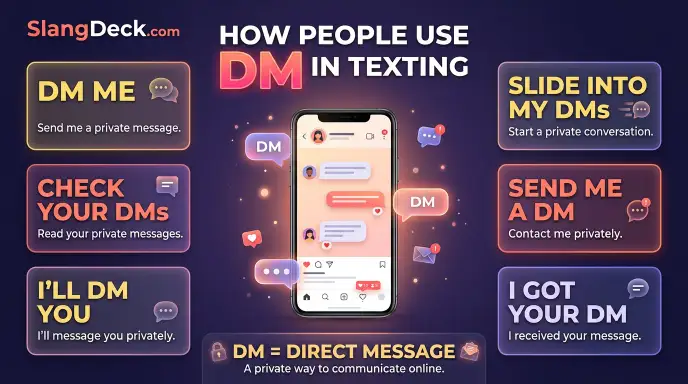
DM appears in everyday conversations in different ways. Here are some common expressions and what they mean.
1. DM Me
This means someone wants you to send them a private message.
Example: “If you’re interested, DM me.”
2. Check Your DMs
This means someone has sent you a private message and wants you to read it.
Example: “I sent you the address. Check your DMs.”
3. I’ll DM You
This means the person plans to send you a private message.
Example: “I’ll DM you the details later.”
4. Slide Into My DMs
This is an informal expression inviting someone to send a private message. It can sound playful or flirty, depending on the situation.
Example: “If you want to talk, slide into my DMs.”
5. Send Me a DM
This means the person wants you to contact them privately.
Example: “Send me a DM if you need help.”
6. I Got Your DM
This means the person has received your private message.
Example: “I got your DM. I’ll reply soon.”
10 Real Chat Examples of DM
These examples show how people use DM in everyday online conversations.
Example 1: Sharing Information
Alex: “I have the notes from class.”
Mia: “Can you DM them to me?”
Meaning: Mia wants Alex to send the notes privately.
Example 2: Asking a Question
Sam: “I need to ask you something.”
Leo: “Sure, DM me.”
Meaning: Leo is asking Sam to send the question in a private message.
Example 3: Checking Messages
Emma: “Did you send me the pictures?”
Noah: “Yes, check your DMs.”
Meaning: Noah has sent the pictures through private messages.
Example 4: Starting a Conversation
Jake: “I saw your comment on that post.”
Lily: “You can DM me if you want to talk.”
Meaning: Lily is inviting Jake to contact her privately.
Example 5: Sharing a Video
Ryan: “This video reminded me of you.”
Sophie: “DM it to me!”
Meaning: Sophie wants Ryan to send the video privately.
Example 6: Asking About a Product
Chris: “How much is this jacket?”
Anna: “DM me for the price.”
Meaning: Anna wants Chris to ask about the price through a private message.
Example 7: Following Up
Ben: “Did you see my message?”
Mia: “Yes, I got your DM.”
Meaning: Mia confirms that she received Ben’s private message.
Example 8: Making Plans
Tom: “Let’s discuss the party details.”
Ella: “I’ll DM you tonight.”
Meaning: Ella plans to send Tom a private message later.
Example 9: Flirty Conversation
Daniel: “You seem interesting.”
Grace: “Slide into my DMs then 😉”
Meaning: Grace is playfully inviting Daniel to send her a private message.
Example 10: Asking for Help
Mark: “I need help with this assignment.”
Olivia: “DM me the question.”
Meaning: Olivia wants Mark to send the assignment question privately.
How to Reply to DM in Text
Your response depends on what the other person says. Here are some simple replies you can use.
| Message you receive | Possible reply |
| “DM me” | “Sure, I’ll message you.” |
| “Check your DMs” | “Okay, I’ll check.” |
| “I’ll DM you later” | “Sounds good!” |
| “Send me a DM” | “Sure, I’ll send one.” |
| “I got your DM” | “Great, thanks for replying.” |
| “Slide into my DMs” | “Haha, maybe I will!” |
| “Did you see my DM?” | “Yes, I just read it.” |
If you do not want to continue a private conversation, you can politely say, “I’d rather talk here.”
Is DM Rude or Offensive?
No, DM is not rude or offensive. It is a neutral abbreviation for Direct Message.
People use it in friendly, professional, and casual online conversations. Businesses may also ask customers to DM them for product details, prices, or support.
However, the way someone uses a DM can matter. Unwanted messages, repeated contact, or inappropriate content can make a private conversation uncomfortable.
You can choose who you respond to and use the platform’s privacy controls if someone sends unwanted messages.
Is DM Used for Flirting?
Sometimes. People may use DMs to start a private conversation with someone they like.
For example:
Alex: “I like your pictures.”
Mia: “Thanks! You can DM me.”
This may be friendly or flirty, depending on their relationship and the rest of the conversation. The abbreviation itself does not automatically suggest romantic interest.
Who Uses DM?
DM is widely used by people who communicate through social media and online messaging platforms.
You may see it among:
- Friends and family members.
- Students and classmates.
- Social media creators and followers.
- Businesses and customers.
- People making plans or sharing information.
- People starting private conversations.
It is suitable for casual chats and many everyday professional interactions. In formal writing, spelling out “direct message” may be clearer.
Where Did DM Come From?
DM comes from the phrase “Direct Message.” It describes a message sent directly to another user rather than shared publicly.
The abbreviation became widely associated with social media platforms that introduced private messaging features. As online communication grew, people began using shorter expressions such as “DM me” and “check your DMs.”
Today, DM is commonly understood across many social media platforms. There is no single confirmed person credited with creating the abbreviation.
DM vs. PM vs. Inbox vs. Text
These terms are related, but they do not always mean exactly the same thing.
| Term | Full Form or Meaning | How It Is Used |
| DM | Direct Message | A private message on a social platform |
| PM | Private Message | A private message sent to another user |
| Inbox | Message inbox | The place where received messages appear |
| Text | Text Message | A written message, often sent through SMS or a messaging app |
| IM | Instant Message | A message sent through an instant messaging service |
DM and PM are often used in similar ways. However, DM is strongly associated with social media, while PM has also been used on forums and online communities.
Key Takeaways: What Does DM Mean in Text?
- DM stands for Direct Message.
- It means a private message sent directly to another person.
- It is widely used on Instagram, Snapchat, TikTok, Facebook, and X.
- “DM me” means “Send me a private message.”
- “Check your DMs” means “Look at your private messages.”
- DM is generally neutral and not offensive.
- It can be used for friendly, personal, or business conversations.
Common Misunderstandings About DM
Some people confuse DM with other messaging terms. Here are a few points to remember:
- DM does not mean a public comment: It refers to a private message.
- DM and PM are similar: Both can describe private communication.
- DM me is an invitation: It means someone wants you to contact them privately.
- A DM is not always romantic: It can be used for friendly, personal, or business conversations.
- DM can be a noun or a verb: You can receive a DM or DM someone.
The surrounding conversation helps you understand exactly how the abbreviation is being used.
Frequently Asked Questions About What Does DM Mean in Text?
What does DM mean in text messages?
DM means “Direct Message.” It refers to a private message sent directly to another person.
What does DM mean on Instagram?
On Instagram, DM means Direct Message. It refers to private messages sent through Instagram’s messaging feature.
What does DM me mean?
“DM me” means “Send me a direct message.” The person wants you to contact them privately.
What does slide into my DMs mean?
It is an informal expression inviting someone to send a private message. It can have a playful or flirty tone.
Is DM the same as PM?
They are very similar. DM stands for Direct Message, while PM stands for Private Message. Both refer to private online communication.
What does check your DMs mean?
It means someone has sent you a private message and wants you to open your message inbox to read it.
Can DM mean something else?
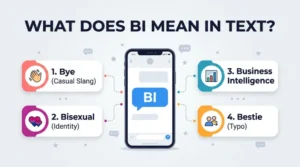
Yes. In other contexts, DM can have different meanings, such as Dungeon Master in tabletop role playing games or Direct Mail in marketing. However, Direct Message is the main meaning in social media and texting.
Is DM formal or informal?
DM is commonly used in casual online conversations. It is also understood in many workplaces and business settings, but writing “direct message” may be more suitable in formal documents.
Conclusion: What Does DM Mean in Text?
DM is a common abbreviation that stands for “Direct Message.” It is used when someone wants to send or receive a private message instead of communicating through a public comment.
If someone says “DM me,” they are asking you to contact them privately. You may see this expression on Instagram, Snapchat, TikTok, Facebook, and other online platforms.
Now that you know what DM means, you can easily understand phrases like “Check your DMs,” “I’ll DM you,” and “Slide into my DMs.”
See More Articles
- What Does WYF Mean in Text? Why Strangers Ask It?
- What Does SMT Mean in Text? Quick Guide to Its Full Form
- What Does SMTH Mean in Text? Real Meaning & Examples

Hi, I’m Sarah. I studied Communications at the University of Texas and have spent the last six years writing about internet culture and Gen Z slang across TikTok, Twitter, and everyday conversations. I focus on real usage, not just dictionary definitions.