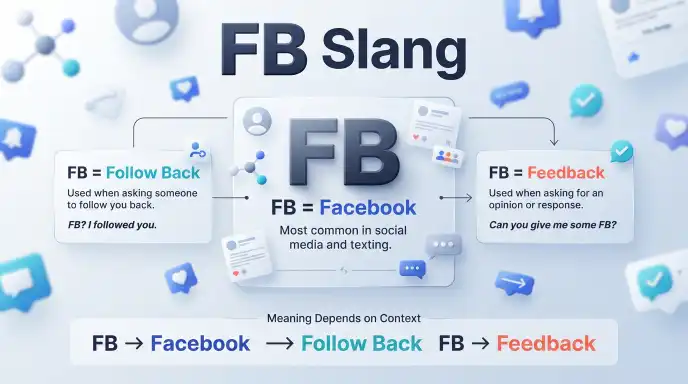
FB slang most commonly means “Facebook” in texting and online conversations, but it can also mean other things such as “Follow Back,” “Feedback,” or “Fine By Me,” depending on the context.
You may see “FB” in text messages, social media comments, group chats, and online communities. Since the same two letters can have different meanings, it is easy to misunderstand them without looking at the full conversation.
For example, someone may say “Message me on FB,” where FB clearly means Facebook. But if someone comments “FB?” on a social media post, they could be asking for a follow back.
That is why understanding the context is important when reading FB slang.
Quick Answer For FB Slang
In most social media and texting contexts, FB means “Facebook.” However, it can also mean “Follow Back,” “Feedback,” or other phrases depending on how it is used.
What Does FB Mean in Slang?
In slang and online communication, FB usually stands for Facebook.
People often shorten Facebook to “FB” because it is quick to type and easy to recognize. The abbreviation has been used widely in casual online communication for years.
For example:
“I saw your post on FB.”
Here, FB simply means Facebook.
You may also see it in messages such as:
“Send me the picture on FB.”
This means the person wants the picture sent through Facebook.
FB Meaning in Text
When someone uses FB in a text message, the intended meaning depends on what they are talking about.
If the conversation is about social media, profiles, posts, pages, or messages, FB most likely means Facebook.
For example:
“Are you on FB?”
This means:
“Are you on Facebook?”
Another example is:
“I will share it on FB later.”
Here, FB clearly refers to Facebook.
However, texting abbreviations can have more than one meaning. If the conversation does not involve Facebook, you should check the surrounding words before deciding what FB means.
FB Full Form in Slang
The most common full form of FB in casual online communication is Facebook.
Facebook is a social networking platform where people can share posts, photos, videos, messages, and other content.
Because the name is often mentioned in casual conversations, users commonly shorten it to FB.
Common Examples
“Add me on FB.”
Meaning: Add me on Facebook.
“I found her on FB.”
Meaning: I found her on Facebook.
“Check your FB messages.”
Meaning: Check your Facebook messages.
In these examples, there is no special slang meaning beyond the shortened form of Facebook.
Other Meanings of FB
Although Facebook is the most common meaning in social media conversations, FB can have other meanings.
The exact meaning depends on the platform, conversation, and sentence.
Some common interpretations include:
| FB | Meaning | Common Context |
| FB | Social media and texting | |
| FB | Follow Back | Social media |
| FB | Feedback | Work, school, online communication |
| FB | Fine By Me | Casual texting |
| FB | Football | Sports conversations |
| FB | Fullback | Sports and gaming |
Not every meaning is slang. Some are simply abbreviations used in specific fields.
For a slang website, it is useful to explain these meanings separately rather than treating every use of FB as internet slang.
FB Meaning on Social Media
On social media, FB most often refers to Facebook.
You may see it when people talk about Facebook profiles, posts, groups, pages, comments, or messages.
For example:
“I posted it on FB.”
This means the person posted something on Facebook.
FB Meaning “Follow Back”
On some social media platforms, FB can mean “Follow Back.”
This meaning is used when one person wants another person to follow their account in return.
For example:
“I followed you. FB?”
Here, FB means:
“Follow me back?”
This usage is especially dependent on context. If someone is talking about followers, following, or gaining social-media connections, “Follow Back” may make more sense than Facebook.
Facebook vs. Follow Back: How to Tell the Difference
These two meanings can be confusing because both are common in social-media conversations.
A simple way to distinguish them is to look at the words around FB.
If the conversation mentions posts, Facebook, Messenger, groups, pages, or profiles, FB probably means Facebook.
If it mentions followers, following, accounts, or returning a follow, FB may mean Follow Back.
| Example | Likely Meaning |
| “I posted this on FB.” | |
| “Message me on FB.” | |
| “Check my FB page.” | |
| “I followed you, FB?” | Follow Back |
| “New follower! FB?” | Follow Back |
| “Can you FB?” | Follow Back, depending on context |
This is a good example of why slang should be understood from context rather than from the abbreviation alone.
FB Meaning “Feedback”
In some conversations, FB can also mean “Feedback.”
This use is more common in work, school, creative projects, online communities, and professional communication than in casual slang.
For example:
“Can you give me some FB on this article?”
Here, FB means feedback.
Another example is:
“Thanks for the FB!”
This means:
“Thanks for the feedback!”
This meaning is different from Facebook because the surrounding topic usually involves an opinion, review, suggestion, or evaluation.
FB Meaning “Fine By Me”
In some casual texting contexts, FB can be used as a short form of “Fine By Me.”
“Fine by me” means that you agree with a suggestion or have no problem with it.
For example:
“We can meet at 6 instead.”
“FB.”
Here, FB may mean:
“Fine by me.”
This use is less obvious than Facebook, so it should always be interpreted from context.
If someone sends only “FB” without any additional information, you may need to ask what they mean.
Why Does FB Have So Many Meanings?
The main reason is that abbreviations save time.
Online conversations often use short forms because people want to type quickly, especially in texts, comments, gaming chats, and social media messages.
Two-letter abbreviations are particularly easy to reuse for different phrases.
That is why FB can represent Facebook in one conversation and Follow Back in another.
The same abbreviation may even have a completely different meaning in sports or professional communication.
Is FB Considered Slang?
FB is better described as an abbreviation than a traditional slang word.
When it means Facebook, it is simply a shortened form of the platform’s name.
When it means “Follow Back” or another casual phrase, it functions more like internet shorthand.
This distinction is useful because not every shortened word used online is technically slang.
Still, people often search for terms like “FB slang meaning” because they encounter the abbreviation in casual digital conversations and want to understand what it means.
Where Is FB Commonly Used?
FB can appear across many forms of digital communication.
Its meaning changes depending on the platform and the conversation.
You may see FB in:
- Text messages
- Facebook posts
- Instagram comments
- TikTok conversations
- Group chats
- Online forums
- Social-media bios
- Gaming communities
- Work chats
- School-related messages
The platform can provide an important clue.
For example, “FB” in a conversation about Facebook pages almost certainly refers to Facebook. In a conversation about gaining followers, it may mean “Follow Back.”
Examples of FB in Everyday Texting
Here are some simple examples showing how the meaning changes.
Facebook Example
“Are you active on FB?”
Meaning: Are you active on Facebook?
Facebook Message Example
“I sent you a message on FB.”
Meaning: I sent you a message on Facebook.
Follow Back Example
“Just followed you. FB?”
Meaning: Follow me back?
Feedback Example
“Can you give me some FB on my draft?”
Meaning: Can you give me some feedback on my draft?
Fine By Me Example
“Let’s meet after lunch.”
“FB.”
Meaning: Fine by me.
These examples show why the full conversation matters more than the abbreviation itself.
Is FB Rude or Offensive?
FB is not inherently rude, offensive, or inappropriate.
When it means Facebook, it is simply a shortened name for the platform.
When it means “Follow Back,” it is also generally harmless and casual.
The tone depends more on the sentence and situation than on the abbreviation itself.
For example:
“FB?”
is usually a simple request for clarification or a follow back.
However, abbreviations can sometimes sound abrupt because they provide very little emotional context.
In professional communication, it is usually better to write the full phrase when there is any chance of confusion.
When Should You Avoid Using FB?
You can use FB in casual conversations when the other person understands what you mean.
However, avoid relying on the abbreviation when writing something formal or when clarity is important.
It is better to write Facebook, feedback, or follow back in:
- Formal emails
- Academic assignments
- Business documents
- Official reports
- Professional applications
- Formal presentations
Clear language reduces the chance of misunderstanding.
How to Understand FB From Context
The easiest way to understand FB is to look at the words around it.
Ask yourself what the conversation is about.
If someone says:
“Check my FB post.”
FB means Facebook.
If someone says:
“I followed you. FB?”
FB probably means Follow Back.
If someone says:
“I need your FB on this design.”
FB probably means Feedback.
If someone says:
“6 PM works?”
“FB.”
FB may mean Fine By Me.
The same two letters can therefore communicate different ideas depending on the situation.
Why People Use FB Instead of the Full Phrase
People use FB because it is short, familiar, and quick to type.
This is especially useful in fast conversations where people already understand the context.
For example, writing “Facebook” takes longer than writing “FB,” but the difference is small. Over time, common abbreviations become part of everyday online communication.
The same idea applies to many other internet abbreviations such as LOL, IDK, BTW, and TBH.
FB fits into this broader culture of shortened digital communication.
FB Slang: The Main Takeaway
The most important thing to remember is that FB does not have only one meaning.
In most social-media contexts, it means Facebook. In follower-related conversations, it can mean Follow Back, while in work or creative discussions it may mean Feedback.
The phrase “Fine By Me” is another possible interpretation in casual texting.
Therefore, if you see “FB” and are unsure what it means, do not guess from the letters alone. Read the surrounding message and consider the platform or topic.
The context usually gives you the answer.
FB Meaning in Different Contexts
The meaning of FB can change when the topic changes.
A person talking about social media may mean Facebook, while someone discussing a project may mean feedback. In sports, FB can have a completely different meaning.
This is why context is the best clue when interpreting short internet abbreviations.
FB Meaning in Sports
In sports conversations, FB can refer to football or fullback, depending on the sport and region.
For example, someone discussing American football may use FB for fullback, a position on the offensive team.
In a sports discussion, a sentence such as:
“The FB made a great block.”
is likely referring to a fullback rather than Facebook.
This meaning is not internet slang, but it is useful to know because abbreviations often appear outside social media.
FB Meaning as Fullback
In American football, FB commonly stands for fullback.
A fullback is an offensive player who can block, run with the ball, and support other players depending on the team’s strategy.
For example:
“The FB cleared the way for the runner.”
Here, FB refers to the player’s position.
This meaning is mainly relevant in sports conversations, so it would be unusual to interpret it this way in a normal text about social media.
FB Meaning as Football
In some conversations, FB may also be used as a shortened form of football.
The exact usage can vary by country and sports community.
For example:
“Do you watch FB?”
could refer to football if the surrounding conversation is clearly about sports.
However, this is not usually the first meaning people expect when they see FB in a casual text. If the conversation is about social media, Facebook is much more likely.
FB Meaning in Work and School
In work, school, and creative conversations, FB can sometimes mean feedback.
This is useful when someone is reviewing a document, design, presentation, assignment, or project.
For example:
“I need your FB before I submit this.”
Here, FB means feedback.
Another example is:
“Thanks for the FB on my presentation.”
The person is thanking someone for their feedback.
In formal writing, however, it is better to write feedback in full. Not everyone will immediately understand FB.
FB Meaning in Casual Texting
Casual texting is where FB can become the most confusing.
People often leave out words and use abbreviations because both sides already understand the situation.
For example:
“You okay with 7?”
“FB.”
If the sender uses FB to mean “Fine By Me,” the reply means that 7 o’clock is acceptable.
But another person might read FB as Facebook.
This shows why abbreviations work best when both people share the same context.
FB Meaning on Instagram
On Instagram, FB can sometimes mean “Follow Back.”
This usually happens when someone is talking about followers or asking another user to return a follow.
For example:
“Followed you! FB?”
The person is asking the other user to follow them back.
However, FB can still mean Facebook when Instagram users are talking about Facebook accounts or cross-platform activity.
So Instagram does not automatically make FB mean “Follow Back.” The sentence still matters.
FB Meaning on TikTok
TikTok users may also use short forms such as FB when discussing followers, social connections, or other platforms.
If someone writes:
“FB?”
after mentioning a follow, they may be asking for a follow back.
But if someone says:
“I posted it on FB too,”
they are almost certainly referring to Facebook.
This difference is easy to understand once you look at the words around the abbreviation.
FB Meaning on Facebook
When you are already on Facebook, FB can still be used to refer to the platform itself.
For example:
“I saw your FB post.”
or:
“Send me your FB profile.”
In these examples, the abbreviation is simply a shorter way of saying Facebook.
People may use it because it is familiar and convenient in casual communication.
FB Meaning on Discord and Online Chats
In Discord, gaming chats, and online communities, FB does not have one universal meaning.
A gaming conversation might use FB for a sports-related term, while a social conversation may use it for Facebook or Follow Back.
The topic of the chat is therefore more important than the platform alone.
If someone says:
“Need FB on this build.”
they may mean feedback rather than Facebook.
If someone says:
“Add me on FB.”
the meaning is clearly Facebook.
Is FB a Positive or Negative Expression?
FB itself is generally neutral.
There is nothing inherently positive or negative about the abbreviation.
Its tone depends on the meaning and sentence.
For example:
“Add me on FB.”
sounds neutral.
“FB?”
meaning “Follow Back?” sounds casual.
“Thanks for the FB.”
meaning “Thanks for the feedback” sounds appreciative.
The abbreviation does not carry one fixed emotional tone.
Can FB Cause Misunderstandings?
Yes. FB can cause confusion because the same letters can represent unrelated phrases.
Someone may read FB as Facebook while the sender intended “Fine By Me.”
This is especially likely when the message is very short.
For example:
“FB”
has almost no context.
The reader may need to ask:
“Do you mean Facebook?”
or:
“FB as in follow back?”
Using the complete phrase can prevent this problem when clarity matters.
FB vs. Other Social Media Abbreviations
FB is one of many shortened terms used in online communication.
| Abbreviation | Common Meaning | Typical Use |
| FB | Social media | |
| FB | Follow Back | Social media |
| DM | Direct Message | Social media |
| PM | Private Message | Online communication |
| IG | Social media | |
| TT | TikTok | Social media |
| F4F | Follow for Follow | Social media |
| L4L | Like for Like | Social media |
| TBH | To Be Honest | Texting |
| BTW | By the Way | Texting |
Unlike some abbreviations with one dominant meaning, FB requires more attention to context.
FB vs. F4F: Are They the Same?
FB and F4F can sometimes appear in similar social-media situations, but they are not exactly the same.
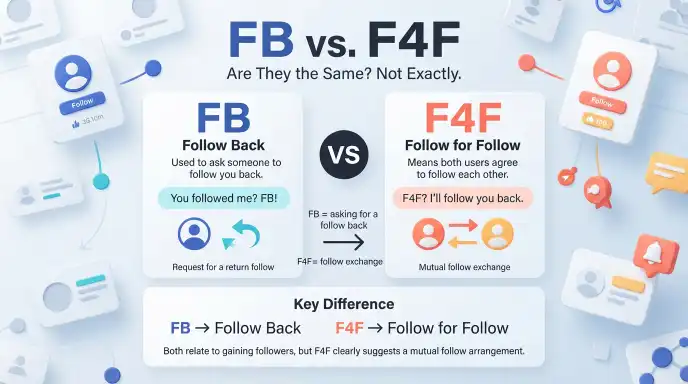
FB may mean “Follow Back,” which is a direct request for someone to return a follow.
F4F means “Follow for Follow.” It suggests an exchange where two users agree to follow each other.
For example:
“Followed you. FB?”
means “Follow me back?”
While:
“F4F?”
means “Will you follow me if I follow you?”
The ideas are related, but the expressions are different.
FB vs. NFB
NFB can have several meanings online, so it should not automatically be treated as the opposite of FB.
This is a good example of why internet abbreviations should not be interpreted by simply adding or removing letters.
The safest approach is always to check the conversation and platform before deciding what an abbreviation means.
When Should You Use FB?
Use FB when the conversation is casual and the meaning is already clear.
It works well when talking with friends or people who regularly use the same online abbreviations.
For example:
“I sent it on FB.”
is perfectly natural in a casual conversation where everyone knows Facebook is being discussed.
Similarly:
“Followed you, FB?”
can work on social media when the context is clearly about following.
When Should You Write the Full Word?
Write the full word when the audience may not understand the abbreviation.
This is especially important in professional or academic communication.
Instead of:
“Please send your FB.”
write:
“Please send your feedback.”
Instead of:
“I found it on FB.”
you can write:
“I found it on Facebook.”
Clear wording is better when the reader could reasonably interpret the abbreviation in more than one way.
Is FB Safe to Use on Social Media?
Yes. FB is generally safe and harmless to use on social media.
The abbreviation itself is not a profanity or offensive expression.
The only concern is possible confusion. If your audience does not know what FB means in your message, they may misunderstand you.
For public posts, comments, and professional social-media pages, writing the full phrase can sometimes be more effective.
For private chats, abbreviations are usually more acceptable.
Why Do People Use FB Instead of Facebook?
The main reason is convenience.
Typing FB is faster than typing Facebook, especially when the platform name appears several times in a conversation.
People also become familiar with common abbreviations through repeated online use.
Once both people understand the abbreviation, there is little need to spell out the full word every time.
This is one reason short forms remain common in digital communication.
Common Mistakes About FB Slang
One common mistake is assuming that FB always means Facebook.
Facebook is the most common interpretation in many social-media contexts, but it is not the only one.
Another mistake is assuming that FB always means “Follow Back” on Instagram or TikTok.
It may mean that when the conversation is about followers, but context is still necessary.
A third mistake is treating every use of FB as slang. Some meanings, such as football or fullback, are simply standard abbreviations.
How to Reply When Someone Says “FB?”
If someone sends you “FB?” and you are unsure what they mean, the best response is to ask.
You can say:
“FB as in Facebook?”
or:
“Do you mean follow back?”
This is better than guessing.
If the conversation is clearly about followers, “Follow Back” is likely. If the conversation is about social media platforms, Facebook may be intended.
Frequently Asked Questions About FB Slang
Q1. What does FB mean in slang?
FB most commonly means Facebook in casual online communication. Depending on context, it can also mean Follow Back, Feedback, Fine By Me, Football, or Fullback.
Q2. What does FB mean in texting?
In texting, FB can mean Facebook or Follow Back, among other meanings. The surrounding conversation determines the intended meaning.
Q3. What does FB mean on Instagram?
On Instagram, FB may mean Follow Back when someone is talking about followers. It can also refer to Facebook when the conversation involves that platform.
Q4. Is FB the same as F4F?
No. FB can mean Follow Back, while F4F means Follow for Follow. They are related social-media expressions but are not exactly the same.
Q5. Is FB a slang word?
FB is mainly an abbreviation or internet shorthand, rather than a traditional slang word. People may still search for it as slang because it is commonly used in casual online conversations.
Q6. Is FB rude?
No. FB is generally neutral and is not an offensive expression. Its tone depends on what it means in the particular conversation.
Conclusion
The meaning of FB slang depends on the context in which it appears.
The most common meaning is Facebook, especially when people are talking about posts, profiles, pages, or messages. In social-media conversations about followers, FB may mean Follow Back.
It can also mean Feedback, Fine By Me, Football, or Fullback in other situations.
The key is not to assume that every “FB” means the same thing. Look at the surrounding words, the platform, and the topic before deciding what the person means.
For casual conversations, using FB is usually fine. When clarity matters, writing the full phrase is the better choice.
You May Also Like!

Hi, I’m Sarah. I studied Communications at the University of Texas and have spent the last six years writing about internet culture and Gen Z slang across TikTok, Twitter, and everyday conversations. I focus on real usage, not just dictionary definitions.