BFN usually means “Bye for Now” in text messages and online chats. People use this abbreviation when they want to end a conversation temporarily without saying a final goodbye. It is common in casual messages, online conversations, and digital communication.
For example, someone might text, “I have to go now, BFN!” This means they are leaving for the moment but may talk to the other person again later.
You may see BFN in text messages, WhatsApp chats, Snapchat conversations, and online communities. It is a short and friendly way to say goodbye when you expect the conversation to continue another time.
However, abbreviations can have different meanings in different settings. In everyday texting, “Bye for Now” is a common interpretation of BFN, but the surrounding message helps you understand exactly what someone means.
Quick Answer: What Does BFN Mean in Text?
BFN means “Bye for Now.” It is a casual abbreviation used to end a conversation temporarily.
- Full form: Bye for Now
- Main meaning: A temporary goodbye
- Tone: Friendly, casual, and informal
- Common platforms: Text messages, WhatsApp, Snapchat, and online chats
- Example: “I need to finish my homework. BFN!”
In simple words, BFN means that someone is leaving the conversation for now and may talk to you again later.
What Does BFN Stand For?
BFN stands for “Bye for Now.” Each letter represents part of the phrase:
- B = Bye
- F = For
- N = Now
People use this abbreviation to save time when writing messages. Instead of typing the full phrase, they can simply write BFN.
For example:
Without the abbreviation:
“I have to go now. Bye for now!”
With the abbreviation:
“I have to go now. BFN!”
Both messages communicate the same idea. The person is ending the conversation temporarily rather than saying goodbye forever.
BFN is especially useful when someone needs to leave a chat but wants to sound friendly. It can also help keep a conversation short when someone is busy with school, work, or other activities.
Why Do People Use BFN?
People use BFN for several reasons.
1. To save time: Short abbreviations make messages quicker to type.
2. To end a conversation politely: BFN lets someone leave without abruptly stopping the conversation.
3. To show they may return: The phrase suggests that the goodbye is temporary.
4. To keep the tone friendly: It can sound warmer than a sudden or unexplained goodbye.
5. To communicate casually: It fits informal conversations with friends, family members, and online contacts.
For example, “Dinner is ready, BFN! Talk later 😊” tells the other person that the sender needs to leave but may return to the conversation later.
What Does BFN Mean in Text Messages?
In text messages, BFN usually means “Bye for Now.” It is used when someone wants to stop chatting for a while.
For example:
A: Are you staying online?
B: Not right now. I have to study.
A: Okay, talk to you later!
B: BFN 😊
Here, BFN is a friendly way to end the conversation. It does not suggest that the people will never talk again.
You might also see BFN when someone is going to sleep, leaving for school, starting work, or taking a break from their phone.
Examples include:
- “My class is starting. BFN!”
- “I need to go shopping. BFN 😊”
- “Talk to you tomorrow. BFN!”
- “I’m logging off now, BFN.”
- “Dinner time! BFN, everyone.”
The main idea stays the same: the person is saying goodbye for the moment.
What Does BFN Mean on Snapchat?
On Snapchat, BFN can mean “Bye for Now” when someone ends a conversation or leaves a chat.
Snapchat users often communicate through short messages, snaps, and informal expressions. BFN can fit this style when a person wants to say goodbye without writing a longer message.
For example:
A: Wanna keep snapping?
B: I have to go help my family.
A: Okay, snap you later!
B: BFN ❤️
In this conversation, BFN means the person is leaving temporarily and may return later.
Another example:
A: Are you going offline?
B: Yeah, I need some sleep. BFN 😴
Here, BFN is a simple goodbye before leaving Snapchat.
However, not every Snapchat user knows or uses this abbreviation. Many people prefer “bye,” “ttyl” (talk to you later), or “gn” (goodnight).
What Does BFN Mean on TikTok?
On TikTok, BFN may be used in direct messages, comments, or conversations when someone wants to say “Bye for Now.”
For example:
- “I’m going offline now, BFN!”
- “Gotta finish my assignment. BFN guys.”
- “I’ll watch the rest later, BFN 😂”
- “Thanks for chatting with me. BFN ❤️”
In these examples, the abbreviation communicates a temporary goodbye.
BFN is not necessarily a special TikTok slang term. Its meaning comes from the phrase “Bye for Now,” which can be used across different digital platforms.
If you encounter BFN in a TikTok comment, look at the surrounding discussion. In some situations, it may be part of a username, a community specific abbreviation, or another phrase rather than a goodbye.
What Does BFN Mean on Instagram?
On Instagram, BFN can be used in direct messages or group chats to end a conversation temporarily.
People often use short expressions when replying to stories, discussing posts, or chatting with friends. BFN can be a quick way to let someone know they are leaving.
For example:
A: Did you see the new pictures I posted?
B: Yes! They look great.
A: Thank you ❤️
B: I have to go now, BFN!
Here, the sender is ending the conversation in a friendly way.
You may also see BFN in messages such as:
- “I’ll reply later. BFN!”
- “Time for work, BFN.”
- “Talk tomorrow, BFN 😊”
- “I’m taking a break from Instagram. BFN!”
The abbreviation does not mean that someone is unfollowing you, blocking you, or ending a friendship. In ordinary texting, it simply indicates that they are leaving for now.
What Does BFN Mean on WhatsApp?
On WhatsApp, BFN usually means “Bye for Now” when someone wants to end a private chat or group conversation.
For example:
A: Are you free to talk?
B: For a few minutes. I have work to finish.
A: No problem. Message me later.
B: Sure, BFN!
In this example, BFN is a casual goodbye. The sender may continue the conversation when they have more time.
It can also appear in family groups, friendship chats, and informal conversations.
Here are some common examples:
- “Mom is calling me. BFN!”
- “I’m going to sleep now. BFN everyone.”
- “I have an exam tomorrow, so I need to study. BFN.”
- “I’ll send you the pictures later. BFN 😊”
BFN is generally more suitable for informal chats than professional messages. In a formal work conversation, “I’ll speak with you later” or “Thank you, goodbye” may sound more natural.
10 Real Chat Examples of BFN
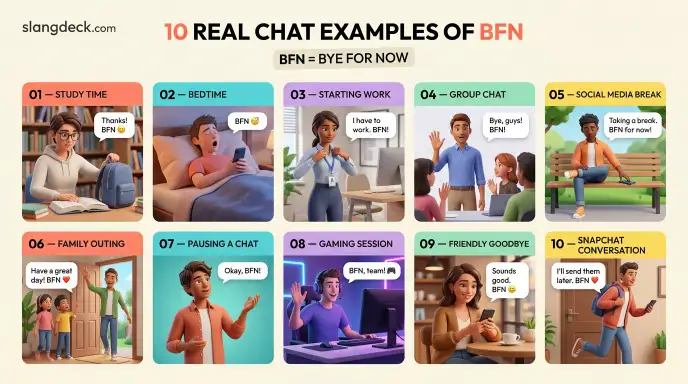
These examples show how BFN can appear in everyday text messages and online conversations.
1. Leaving to Study
A: Want to keep chatting?
B: I need to study for my exam.
A: Okay, good luck!
B: Thanks! BFN 😊
Here, BFN means the sender is leaving temporarily to study.
2. Going to Sleep
A: Are you still awake?
B: Not for much longer. I’m so tired.
A: Get some rest!
B: Thanks, BFN 😴
The sender uses BFN as a casual goodbye before going to sleep.
3. Leaving for Work
A: Are you free to talk right now?
B: I have to start my shift.
A: No worries. Talk later.
B: BFN!
Here, BFN shows that the conversation must pause because the sender has work.
4. Ending a Group Chat
A: Anyone watching the game tonight?
B: I’ll watch it later.
C: I have to leave now, guys. BFN!
In this example, BFN is used to say goodbye to several people in a group chat.
5. Taking a Break From Social Media
A: Why aren’t you replying to messages?
B: I’m taking a break from my phone.
A: Hope you enjoy the break!
B: Thanks! BFN for now 😊
The sender is stepping away from online conversations temporarily.
6. Going Out With Family
A: What are you doing today?
B: Going out with my family.
A: Have fun!
B: Thank you! BFN ❤️
Here, BFN ends the chat before the sender leaves.
7. Pausing a Conversation
A: Can I tell you something later?
B: Sure, whenever you’re free.
A: I have to help my brother now.
B: Okay, BFN!
The abbreviation indicates that the conversation will continue another time.
8. Leaving a Gaming Chat
A: One more round?
B: I can’t. Dinner is ready.
A: Okay, catch you later!
B: BFN, team! 🎮
In this example, BFN is used to leave a casual gaming conversation.
9. Ending a Friendly Conversation
A: It was nice talking to you!
B: Same here.
A: I’ll message you tomorrow.
B: Sounds good. BFN 😊
The sender uses BFN to end the chat on a friendly note.
10. Leaving a Snapchat Conversation
A: Send me the rest of those pictures later.
B: Sure, I’ll send them tonight.
A: Okay, thanks!
B: BFN ❤️
Here, BFN means the sender is leaving the conversation but may return later.
How Do You Reply to BFN in Text?
If someone sends you BFN, you can respond with a friendly goodbye. You do not need to write a long message.
Your reply can depend on the situation and your relationship with the person.
Friendly Replies
Use these responses when chatting with friends or family:
- “Okay, talk later!”
- “See you soon 😊”
- “Catch you later!”
- “Bye for now!”
- “Talk to you tomorrow.”
Casual Replies
If you want to keep your response short, try:
- “Bye!”
- “Later!”
- “Ttyl!”
- “Take care!”
- “Okay, see ya.”
Here, TTYL means “talk to you later.”
Sweet Replies
If you are talking to someone close to you, you can make your reply more affectionate:
- “Okay, take care ❤️”
- “Talk soon 😊”
- “Bye for now, miss you!”
- “See you later, bestie!”
- “Take care, talk soon 🫶”
Professional Replies
If someone uses BFN in a work related chat, a simple response may be better:
- “Thanks, speak later.”
- “No problem. Talk soon.”
- “Have a good day.”
- “Okay, I’ll follow up later.”
You can choose any reply that feels natural. The important thing is to understand that BFN usually signals a temporary goodbye.
Is BFN Rude or Offensive?
No. BFN is generally harmless and not offensive. It is a casual way to say “Bye for Now.”
However, the tone can depend on the situation and how the message is written.
For example, “I need to go now, BFN 😊” sounds friendly. On the other hand, sending only “BFN” during a serious conversation may feel abrupt to someone who expects a more personal response.
Consider these situations:
- With friends: BFN is usually a normal, casual goodbye.
- With family: It can be a quick way to end a chat.
- With a romantic partner: It may be a simple, temporary goodbye.
- At school: It is generally fine in informal messages to friends.
- At work: It may sound too casual for formal communication.
- During an argument: The meaning depends on the surrounding messages and the person’s tone.
BFN does not automatically mean someone is angry, upset, or trying to avoid you. They may simply be busy or need to leave.
If the message seems unclear, consider the full conversation instead of assuming the worst.
Is BFN the Same as Goodbye?
BFN and goodbye are similar, but they do not always communicate exactly the same idea.
BFN specifically means “Bye for Now,” so it often suggests a temporary goodbye. The person may expect to talk to you again later.
The word “goodbye” can also be temporary, but it does not explicitly include the idea of “for now.”
For example:
- “Goodbye!” A general way to end a conversation.
- “BFN!” A casual way to say goodbye for the moment.
- “BFN, talk to you tomorrow!” A temporary goodbye with a clear plan to reconnect.
Even so, BFN does not guarantee that the person will contact you again. It simply communicates a temporary goodbye in ordinary use.
What Is the Difference Between BFN, TTYL, BRB, and GTG?
BFN is similar to several other texting abbreviations. However, each one has a slightly different meaning.
| Abbreviation | Full form | Meaning |
| BFN | Bye for Now | Ending a conversation temporarily |
| TTYL | Talk to You Later | Saying you expect to talk again later |
| BRB | Be Right Back | Leaving briefly and expecting to return soon |
| GTG | Got to Go | Saying you need to leave |
| BBL | Be Back Later | Saying you expect to return later |
| CYA | See You | An informal goodbye |
BFN vs. TTYL
BFN means “Bye for Now,” while TTYL means “Talk to You Later.”
Both can be used when ending a conversation. However, TTYL focuses more directly on talking again later.
Example:
“I’m heading out now, BFN!”
“I’m heading out now, TTYL!”
Both are understandable, but the first emphasizes a temporary goodbye, while the second emphasizes a future conversation.
BFN vs. BRB
BFN is used when ending a conversation for the moment. BRB means “Be Right Back” and usually indicates a short break.
For example:
“Dinner is ready. BFN!” means the person is leaving the chat for now.
“Someone’s at the door. BRB!” means the person expects to return shortly.
BFN vs. GTG
GTG means “Got to Go.” It tells someone that you need to leave, but it does not specifically say that the goodbye is temporary.
BFN makes the temporary nature of the goodbye more explicit.
Who Uses BFN?
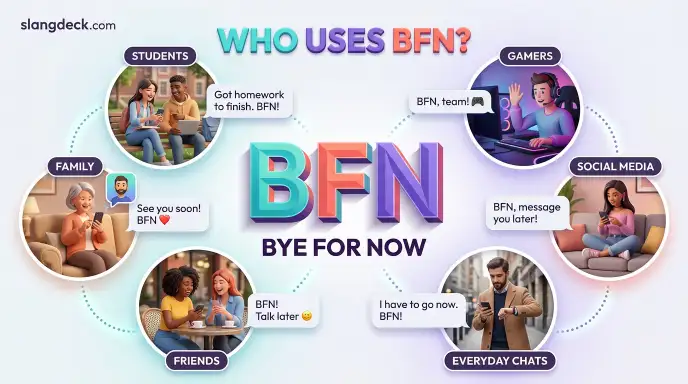
BFN can be used by anyone who communicates through text messages or online chats. It is not limited to one age group.
You may encounter it among:
- Friends chatting on their phones
- Family members exchanging messages
- Students talking about school or homework
- Gamers leaving online conversations
- Social media users ending direct messages
- People who prefer short, informal communication
Some people use BFN regularly, while others prefer more familiar expressions such as “bye,” “talk later,” or “TTYL.”
The abbreviation may be less common in some online communities than other short forms. Therefore, not everyone will immediately recognize it.
Where Did BFN Come From?
BFN comes from the phrase “Bye for Now.” It follows a common pattern in digital communication: taking the first letters of a phrase and using them as a shorter expression.
Text messaging and online chats encourage quick, compact communication. As a result, many phrases have developed abbreviated forms, including TTYL for “Talk to You Later,” BRB for “Be Right Back,” and GTG for “Got to Go.”
BFN fits naturally into this group because it expresses a complete idea using just three letters.
However, the exact date when BFN first appeared is not firmly established here. It is better to explain its connection to informal written communication than to claim a specific origin date without reliable evidence.
Can BFN Have Other Meanings?
Although “Bye for Now” is a common interpretation in casual texting, BFN may have other meanings in specialized contexts, organizations, or online communities.
For example, a technical document or workplace discussion might use the same letters for a different term. It could also appear as part of a username, group name, or product label.
To understand BFN correctly, check how it is used.
If someone writes “I have to leave now, BFN,” the intended meaning is likely “Bye for Now.” If the letters appear in a technical or professional document, do not assume they have the same meaning without checking the context.
Common Misunderstandings About BFN
BFN is easy to understand once you know its meaning, but some people may misinterpret it.
Misunderstanding 1: BFN means goodbye forever
Not usually. It means “Bye for Now,” which normally suggests a temporary goodbye.
Misunderstanding 2: BFN means the sender is angry
No. The abbreviation is generally neutral or friendly. The surrounding message determines the tone.
Misunderstanding 3: BFN means the sender will return immediately
Not necessarily. Unlike BRB, BFN does not promise a quick return.
Misunderstanding 4: BFN is only used on one platform
No. It can appear in text messages, online chats, and different social media conversations.
Misunderstanding 5: Everyone knows what BFN means
Not everyone uses the abbreviation. If someone seems confused, simply explain that it means “Bye for Now.”
Key Takeaways
- BFN usually means “Bye for Now” in casual text messages.
- It is used to end a conversation temporarily.
- You may see it in WhatsApp chats, Snapchat messages, TikTok conversations, and other online spaces.
- BFN is generally friendly and not offensive.
- It is similar to TTYL, but TTYL specifically means “Talk to You Later.”
- BRB means “Be Right Back,” which usually suggests a shorter absence.
- The exact meaning of BFN can depend on the context.
Frequently Asked Questions About BFN
Q1. What does BFN mean in text?
BFN usually means “Bye for Now.” People use it to end a conversation temporarily rather than say a final goodbye.
Q2. What does BFN stand for in texting?
BFN stands for “Bye for Now.” Each letter represents the first letter of one word in the phrase.
Q3. What does BFN mean from a girl?
If a girl sends BFN in a casual conversation, she usually means “Bye for Now.” It does not automatically mean she is upset or losing interest.
Q4. What does BFN mean from a guy?
A guy using BFN is generally saying goodbye for the moment. The abbreviation alone does not reveal his feelings or intentions.
Q5. What does BFN mean on Snapchat?
On Snapchat, BFN can mean “Bye for Now.” It may be used when someone is ending a chat or leaving the app for a while.
Q6. What does BFN mean on WhatsApp?
On WhatsApp, BFN usually means “Bye for Now.” It is a short, informal way to end a private or group conversation.
Q7. Is BFN the same as TTYL?
They are similar but not identical. BFN means “Bye for Now,” while TTYL means “Talk to You Later.” Both are commonly used when ending casual conversations.
Q8. Is BFN rude?
No. BFN is generally harmless and friendly. However, a very short reply can sometimes seem abrupt depending on the conversation.
Q9. What should I reply when someone says BFN?
You can reply with “Bye for now,” “Talk later,” “Take care,” or “TTYL.” Choose a response that matches the tone of your conversation.
Q10. Does BFN mean someone will text me again?
It suggests a temporary goodbye, but it does not guarantee that the person will message you again. Their actions and the wider conversation provide more information.
Conclusion
BFN means “Bye for Now” in casual texting and online conversations. It is a simple abbreviation people use when they need to leave a chat temporarily while keeping the goodbye friendly.
You may see BFN in text messages, WhatsApp chats, Snapchat conversations, and other online spaces. It is similar to TTYL and BRB, although each abbreviation has a slightly different meaning.
When you encounter BFN, look at the surrounding message to understand the sender’s intention. In most everyday conversations, it simply means that the person is leaving for now.
Discover More Texting Slang

Hey, I’m Jordan. I grew up in a bilingual household in LA, so Spanish and Mexican American slang has always been part of how I talk. I’ve been writing online content for five years, explaining terms the way I’d explain them to a friend meaning, tone, and when it’s actually okay to use.