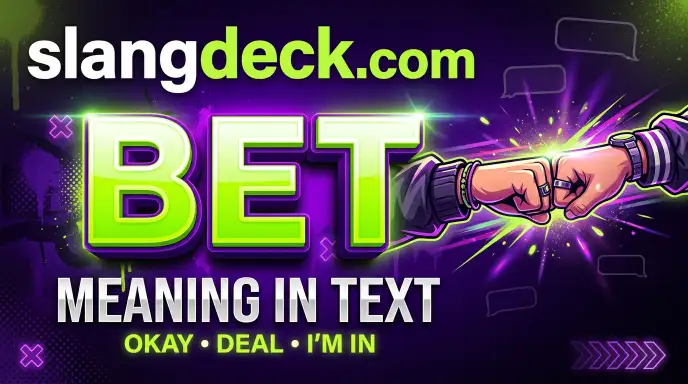
BET means “okay,” “sure,” or “sounds good” in text messages and online slang. People use it to agree with someone, accept a plan, or show confidence. For example, if a friend says, “Meet me at 6,” you can reply, “Bet!” to mean “Okay, I’ll be there.”
You may see BET in text messages, TikTok comments, Snapchat chats, Instagram DMs, and gaming conversations. It is a short, casual way to respond without typing a full sentence.
However, BET can have different meanings depending on the situation. It may show agreement, confidence, or a playful challenge. In other contexts, the word refers to placing money on an outcome, such as a sports match.
This guide explains what BET means in text, how people use it on social media, how to reply, and when this slang word is appropriate.
What Does BET Mean in Text?
In texting and internet slang, BET usually means “okay,” “deal,” “sure,” or “you got it.” It tells the other person that you agree with what they said or accept their suggestion.
For example:
A: Let’s play games tonight.
B: Bet!
Here, BET means “Sounds good” or “I’m in.”
People often use BET because it is quick, simple, and informal. It can also show that someone is confident about a statement or ready to follow through on a plan.
Different Meanings of BET
BET can express several related ideas depending on the conversation.
| Meaning | How It Is Used | Example |
| Okay | Agreeing with a suggestion | “Meet at 5.” “Bet!” |
| Sure | Accepting a request | “Can you send it?” “Bet.” |
| Deal | Agreeing to an arrangement | “Loser buys pizza.” “Bet!” |
| Challenge accepted | Showing confidence | “I can beat you.” “Bet!” |
| A wager | Risking money or something valuable on an outcome | “He made a bet on the game.” |
The first four meanings are common in casual slang conversations. The last meaning is the ordinary dictionary meaning of the word.
Is BET an Acronym?
No. In everyday texting slang, BET is generally a regular English word used informally to mean “okay,” “sure,” or “deal.” It is not usually an acronym in this context.
The slang use is connected to the expression “you bet,” which has long been used to express agreement or certainty.
Where Do People Use BET?
BET is common in informal digital communication. Its exact tone may change slightly depending on the platform and conversation.
1. BET on TikTok
On TikTok, people use BET in comments, captions, replies, and direct messages. It can show agreement, confidence, or excitement about something.
For example:
A: I’m posting part two tomorrow.
B: Bet, I’m ready!
Here, BET means “Okay” or “Sounds good.”
Someone might also comment “Bet!” under a challenge video to show that they accept the challenge or believe they can do it.
2. BET on Snapchat
On Snapchat, BET is often used in quick conversations between friends. It can confirm plans or accept a suggestion.
For example:
A: I’ll send you the pictures later.
B: Bet!
The reply means “Okay, that works.”
Because Snapchat conversations are often casual and brief, BET can replace longer responses such as “Sure, no problem.”
3. BET on Instagram
On Instagram, BET may appear in comments, reels, stories, and direct messages.
For example:
A: Let’s make a reel together this weekend.
B: Bet, that sounds fun!
Here, the sender agrees to the idea.
You may also see BET in comments on fitness challenges, gaming clips, fashion posts, or funny videos. In these situations, it can show confidence or acceptance of a challenge.
4. BET on WhatsApp and Text Messages
In SMS and WhatsApp chats, BET is commonly used to confirm plans or respond to requests.
For example:
A: Can you bring my notebook tomorrow?
B: Bet.
The reply means “Sure, I’ll bring it.”
Although BET is widely understood in casual texting, it may sound too informal for professional emails or formal conversations.
5. BET in Gaming Chats
Gamers may use BET when accepting a challenge, agreeing to join a match, or confirming a plan.
For example:
A: One more round?
B: Bet. Let’s go!
In this context, BET shows that the person is ready to play.
It can also sound competitive when someone uses it after another player makes a bold claim.
6. BET in Everyday Conversations
BET is not limited to social media. People may also say it aloud in casual conversation.
For example:
A: I’ll pick you up at 7.
B: Bet.
The spoken word has the same general meaning: “Okay” or “Sounds good.”
Its use is especially associated with informal American English and youth-oriented conversations, although people outside those groups may use it too.
10 Real Chat Examples of BET
Here are ten realistic examples showing how BET works in different conversations.
1. Making Plans
A: Wanna grab food after class?
B: Bet!
A: Let’s meet outside the library.
Here, BET means “Sure, I’m in.”
2. Confirming a Time
A: Be ready by 8.
B: Bet, I’ll be ready.
The sender confirms the plan and shows agreement.
3. Accepting a Request
A: Can you send me your notes?
B: Bet, I’ll send them tonight.
A: Thanks!
In this example, BET means “Sure” or “No problem.”
4. Accepting a Challenge
A: I bet you can’t beat my score.
B: Bet. Watch this!
Here, BET means “Challenge accepted.” The speaker sounds confident and ready to prove themselves.
5. Talking About Gaming
A: One last match before we leave?
B: Bet, invite me.
The reply shows that the person agrees to play another round.
6. Making a Promise
A: Don’t forget to call me when you get home.
B: Bet, I will.
BET means “Okay, I will do that.”
7. Agreeing With a Friend
A: That movie looks amazing.
B: Bet, let’s watch it tonight.
Here, the speaker agrees with the suggestion and wants to make a plan.
8. Responding to Good News
A: We got tickets for the concert!
B: Bet! This is going to be fun.
The word shows excitement and agreement.
9. Responding to a Bold Claim
A: I can finish this whole project in one hour.
B: Bet, prove it.
In this situation, BET sounds like a playful challenge. The speaker wants to see if the other person can do what they claimed.
10. Confirming a Simple Task
A: Please bring some water when you come.
B: Bet.
The response means “Sure, I’ll do it.”
These examples show that BET can sound friendly, confident, excited, or competitive. The words around it help explain the exact tone.
How to Reply to BET in Text
The best reply depends on how the other person uses BET. Sometimes they are agreeing with you; at other times, they may be accepting a challenge.
1. When BET Means “Okay”
If someone uses BET to confirm a plan, you can respond naturally.
Examples:
- “Perfect!”
- “Sounds good.”
- “See you then.”
- “Awesome, thanks!”
- “Cool, it’s a plan.”
Example:
A: I’ll meet you outside at 6.
B: Bet.
A: Perfect, see you there!
2. When BET Means “Challenge Accepted”
If someone uses BET during a game or playful challenge, you can match their confident tone.
Examples:
- “Let’s go!”
- “Prove it.”
- “Game on.”
- “We’ll see!”
- “You’re on!”
Example:
A: I can beat you at this game.
B: Bet.
A: Game on!
3. When You Want to Keep It Casual
You can keep your reply short and friendly.
Examples:
- “Fr!”
- “Okayyy.”
- “Cool.”
- “Say less.”
- “Got you.”
Use these responses when they fit your usual way of talking. Not every slang expression works naturally in every conversation.
4. When You Are Unsure What BET Means
Although the slang meaning is usually easy to understand from context, you can ask for clarification if needed.
Try:
- “You mean okay?”
- “Deal?”
- “What do you mean by bet here?”
In most casual chats, however, BET simply means that the person agrees or accepts the suggestion.
Is BET Rude or Offensive?
No, BET is generally not rude or offensive in casual texting. It is usually a friendly, informal way to agree with someone or show confidence.
However, tone and context matter.
When BET Is Friendly
BET sounds friendly when someone uses it to confirm plans, accept a request, or show excitement.
For example:
A: Want to get coffee tomorrow?
B: Bet!
This is a normal, casual response.
When BET Sounds Challenging
BET can sound more assertive when someone uses it after a bold statement.
For example:
A: You can’t beat my score.
B: Bet.
The reply suggests that the speaker is ready to prove the other person wrong. Depending on the relationship, it may sound playful or competitive.
Is BET Appropriate at School or Work?
BET is usually fine when chatting casually with friends or classmates. In formal settings, a clearer response may be better.
| Situation | Is BET Appropriate? | Better Approach |
| Texting friends | Yes | Use it naturally |
| Casual gaming chat | Yes | It fits the informal tone |
| Talking with classmates | Usually | Consider the situation |
| Messaging a teacher | It may sound too casual | Use “Okay” or “Understood” |
| Formal work email | Usually not ideal | Use “Confirmed” or “Sounds good” |
| Professional meeting | Depends on workplace culture | Choose clear, professional wording |
The word itself is not offensive. The main concern is whether its casual tone fits the situation.
Who Uses BET?

BET is used by many people, especially in informal conversations and online communities.
Teenagers and Young Adults
Teenagers and young adults may use BET in messages, comments, and conversations with friends. It is short and works well for quick replies.
However, it is not limited to one age group.
Gen Z and Social Media Users
BET is often associated with Gen Z slang and online communication. People use it to agree, confirm plans, or show confidence.
It also appears in conversations among older users who are familiar with the expression.
Gamers and Online Communities
Gamers may use BET to accept challenges or confirm that they are ready to play. Online communities also use it when responding to bold claims or suggestions.
People Who Prefer Short Messages
BET is convenient because one word can communicate agreement without a longer explanation. Still, its meaning can be unclear if the reader is unfamiliar with the slang.
Origin and History of BET Slang
The slang use of BET is connected to the established English expression “you bet,” which can mean “certainly,” “of course,” or “you can count on it.”
Over time, BET became a short standalone response in informal speech and digital conversations. It is also associated with African American English and has spread through music, popular culture, and social media.
Today, people use BET in texting, memes, online comments, gaming chats, and spoken conversation. It can express simple agreement or a stronger sense of confidence.
It is important not to confuse the slang expression with gambling. The ordinary word “bet” can refer to risking money on an outcome, but the texting response usually means “okay,” “deal,” or “challenge accepted.”
BET vs. IDK, IDC, IMO, and BRB
BET is different from other common texting abbreviations because it is a regular English word used as an informal response rather than an acronym.
| Term | Meaning | Type | Common Usage |
| BET | Okay, sure, or deal | Slang expression | Agreeing or accepting a challenge |
| IDK | I Don’t Know | Text abbreviation | Showing uncertainty |
| IDC | I Don’t Care | Text abbreviation | Showing a lack of concern |
| IMO | In My Opinion | Chat abbreviation | Sharing an opinion |
| BRB | Be Right Back | Chat abbreviation | Saying you will return shortly |
For example, if someone asks, “Are you coming tonight?” you might reply “Bet” to confirm your plans.
If you reply “IDK,” you are saying that you do not know yet. Each expression serves a different purpose.
BET vs. “You Bet”
Although BET and “you bet” are closely related, they are not always used in exactly the same way.
BET is a short, casual response often found in texting and online slang.
Example:
A: I’ll send the file tonight.
B: Bet.
YOU BET is a longer, established English expression that can mean “certainly,” “of course,” or “you’re welcome,” depending on the conversation.
Example:
A: Can you help me tomorrow?
B: You bet!
Both can communicate agreement, but BET often has a more informal, modern chat style.
Common Misunderstandings About BET
1. Thinking BET Always Means Gambling
The word BET can refer to gambling or a wager. However, in casual texting, it usually means “okay,” “sure,” or “deal.”
2. Thinking BET Is an Acronym
In common slang use, BET is not usually short for a longer phrase. It is the ordinary word “bet” used as a quick expression of agreement.
3. Assuming BET Always Shows Excitement
BET can express excitement, but it can also be a neutral confirmation. A person replying “Bet” may simply mean “Okay.”
4. Thinking BET Is Always a Challenge
When used after a bold statement, BET can mean “challenge accepted.” When used to confirm a meeting or request, it usually just means “sure.”
5. Assuming Only Young People Use BET
Although it is associated with youth slang and social media, people of different ages may use it. Familiarity with informal language matters more than age alone.
Key Takeaways
- BET usually means “okay,” “sure,” or “deal” in text.
- It can also mean “challenge accepted” when someone makes a bold claim.
- People use BET on TikTok, Snapchat, Instagram, WhatsApp, and in gaming chats.
- It is generally friendly and informal, not offensive.
- BET is a slang use of a regular English word, not usually an acronym.
- In professional settings, “Okay,” “Confirmed,” or “Understood” may be more suitable.
- Context helps you understand the exact meaning and tone.
Frequently Asked Questions
1. What does BET mean in text messages?
BET usually means “okay,” “sure,” or “deal.” It shows that someone agrees with a suggestion, accepts a request, or confirms a plan.
2. What does BET mean on TikTok?
On TikTok, BET usually means “okay,” “sounds good,” or “challenge accepted.” People use it in comments, captions, and replies to show agreement or confidence.
3. Is BET slang?
Yes. BET is commonly used as informal slang in texting and online conversations. It is a regular English word used to express agreement or confidence.
4. Is BET rude or offensive?
No, BET is generally not rude or offensive. It is a casual expression, although it may sound challenging when used in response to a bold claim.
5. How should you reply to BET?
You can reply with “Sounds good,” “Perfect,” “Deal,” or “Let’s go!” The best response depends on whether the person is confirming a plan or accepting a challenge.
6. What does BET mean from a girl or a guy?
The meaning is generally the same regardless of who sends it. A girl or guy may use BET to mean “okay,” “sure,” or “challenge accepted.” It does not automatically indicate romantic interest.
7. What does BET mean in a relationship?
In a relationship, BET often means “okay,” “deal,” or “I’m in.” For example, if your partner suggests watching a movie, replying “Bet” means you agree to the plan.
8. What does BET mean when someone says “Bet, say less”?
This combination usually means “Okay, I understand” or “You don’t need to explain more.” The speaker is showing agreement and suggesting that the plan or message is clear.
9. What is the difference between BET and OK?
Both can express agreement. OK is more neutral and works in formal or informal situations, while BET is more casual and may sound more confident or enthusiastic.
10. Can I use BET in a professional message?
You can use it if the workplace is informal and the recipient understands the slang. In formal emails or messages to clients, “Okay,” “Confirmed,” or “Sounds good” is usually a safer choice.
Conclusion
BET is a common slang expression that usually means “okay,” “sure,” or “deal” in text messages and online conversations.
It can also show confidence or mean “challenge accepted” when someone makes a bold claim.
You may see it on TikTok, Snapchat, Instagram, WhatsApp, and gaming platforms. Although BET is casual, it is generally friendly and not offensive. Just remember that its tone depends on the conversation.
If someone texts you “Bet,” they are usually agreeing with you or accepting your suggestion.
Explore More Slang
- What Does AWL Mean in Text? And Why Everyone Is Using It!
- What Does ALT Mean in Text? The Meaning May Surprise You
- What Does ASL Mean in Text? Why You’re Probably Using It Wrong

Hey, I’m Jordan. I grew up in a bilingual household in LA, so Spanish and Mexican American slang has always been part of how I talk. I’ve been writing online content for five years, explaining terms the way I’d explain them to a friend meaning, tone, and when it’s actually okay to use.