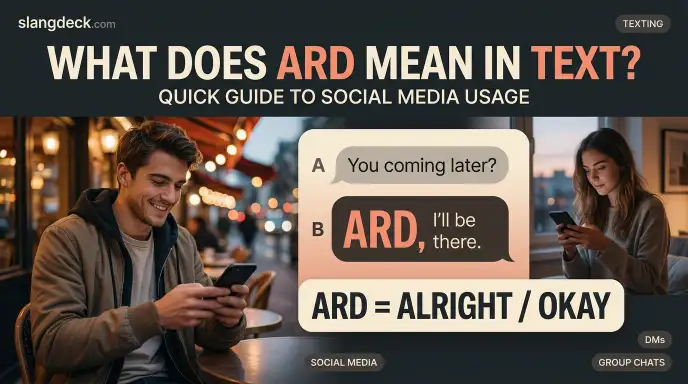
ARD usually means “alright” in text and social media slang. It is a short, casual way to say “okay,” “sure,” or “sounds good” in everyday digital conversations.
You may see ARD in text messages, TikTok comments, Snapchat chats, Instagram DMs, WhatsApp, Discord, and other informal online spaces.
It is especially useful when someone wants to respond quickly without typing the full word “alright.”
If you searched for ARD meaning in text, you may have seen someone reply with “ard” and wondered if it was a typo or another internet abbreviation. In most casual conversations, it simply means “alright” or “okay.”
Like many forms of internet slang, ARD can have other meanings in specialized situations. Therefore, the context of the message is important when figuring out what someone means.
ARD Meaning in Text
In casual texting, ARD usually means “alright.”
It is an informal shortened form used to make digital conversations faster and more relaxed.
For example:
A: Are you coming tonight?
B: Ard.
Here, ard means “alright” or “okay.”
It can also be used as a way to accept a suggestion or confirm a plan.
“Ard, I’ll meet you there.”
This means:
“Alright, I’ll meet you there.”
The meaning is simple, but the tone can change slightly depending on the conversation.
What Does ARD Stand For?
In texting slang, ARD stands for “alright.”
The abbreviation removes some of the letters from the original word while keeping the meaning recognizable.
For example:
“Alright, I’ll call you later.”
can become:
“Ard, I’ll call you later.”
This kind of shortening is common in casual online communication.
Is ARD Slang or an Abbreviation?
ARD is an informal texting abbreviation or shortened slang form of “alright.”
It is not normally used in formal English writing.
You may see it written in different ways:
- ard
- ARD
- Ard
Capitalization usually does not change the meaning.
The lowercase version, “ard,” can feel especially casual in a text or DM.
What Does ARD Mean in Everyday Chat?
In everyday conversations, ARD can communicate several closely related ideas:
- Alright
- Okay
- Sure
- Sounds good
- Got it
- I agree
The exact meaning depends on the message before it.
For example:
A: I’ll pick you up at 7.
B: Ard.
Here, it means “Okay” or “Alright.”
But:
A: We should go with the second option.
B: Ard, let’s do that.
Here, it shows agreement.
Where People Use ARD
ARD is mainly found in casual digital communication. It can appear across several social media and messaging platforms.
ARD on TikTok
On TikTok, you may see ARD in comments, replies, captions, or direct messages.
For example:
“Ard 😂”
can simply mean:
“Okay.”
Someone might also write:
“Ard bet.”
This can mean:
“Alright, sounds good.”
TikTok conversations often use short and informal language, so ARD can fit naturally into quick exchanges.
ARD on Snapchat
Snapchat is another place where you may encounter this abbreviation.
For example:
A: Send me the address when you get there.
B: Ard.
The response means:
“Alright.”
It can also be used when making plans:
A: Meet me outside at 8.
B: Ard, I’ll be there.
The abbreviation keeps the message short and casual.
ARD on Instagram
On Instagram, ARD may appear in DMs, comments, or replies.
For example:
A: I’ll send you the pictures later.
B: Ard, thanks.
Here, the person is simply acknowledging the message.
You might also see:
“Ard, sounds good.”
which means:
“Alright, sounds good.”
ARD on WhatsApp
People may use ARD in WhatsApp chats with friends, classmates, family members, or other contacts.
For example:
A: I’ll call you after dinner.
B: Ard.
The reply confirms that the person understands or accepts the plan.
Because WhatsApp is commonly used for personal conversations, informal abbreviations can appear naturally.
ARD in SMS
ARD can also be used in regular SMS messages.
For example:
“Ard, text me when you get home.”
This simply means:
“Alright, text me when you get home.”
It is more appropriate for casual messages than formal communication.
Real Chat Examples of ARD
Here are ten realistic conversations showing how ARD can appear in everyday texting.
1. Making Plans
A: Are we still meeting at 6?
B: Yeah, definitely.
A: Ard, see you then.
B: See you!
Here, ARD means “alright.”
2. Agreeing With a Friend
A: Let’s get pizza tonight.
B: Ard, I’m down.
A: What kind?
B: Pepperoni 😂
In this example, ARD shows agreement with the suggestion.
3. Quick Response
A: Can you send me the notes?
B: Ard.
A: Thanks!
The person is using ARD as a quick acknowledgment.
4. Snapchat Conversation
A: Don’t forget your charger.
B: Ard 😂
A: I’m serious.
B: I got you.
Here, ARD means “alright” while keeping the conversation casual.
5. Instagram DM
A: I’ll send you the link tonight.
B: Ard, thanks!
A: No problem.
The abbreviation is simply a casual way to acknowledge the information.
6. Accepting a Request
A: Can you wait for me outside?
B: Ard, I’ll wait.
A: Thanks!
Here, ARD means “okay” or “alright.”
7. Making a Promise
A: Call me when you get home.
B: Ard, I will.
A: Okay ❤️
The abbreviation shows that the person agrees to the request.
8. Gaming Chat
A: We’re starting the game in five minutes.
B: Ard, I’ll join.
A: Bet.
B: See you there.
In this context, ARD is simply a quick way to say “okay.”
9. Accepting a Suggestion
A: We should watch that movie tomorrow.
B: Ard, let’s do it.
A: What time?
B: Around 8.
The sender uses ARD to show agreement.
10. Ending a Conversation
A: I have to go now.
B: Ard, talk later.
A: Bye!
B: Later.
Here, ARD works as a casual acknowledgment before ending the conversation.
How to Reply When Someone Says “ARD”
If someone sends you “ard,” you usually do not need a special response.
The person is probably saying “alright” or “okay,” so you can simply continue the conversation.
For example:
A: I’ll see you tomorrow.
B: Ard.
You could leave it there because the message has already acknowledged your statement.
If you want to keep talking, you have several options.
Funny Replies
If you are joking with a friend, you could say:
“That’s it? Just ‘ard’? 😂”
Or:
“Ard then 😭.”
Another playful reply could be:
“Okayyy, I hear you 😂.”
Casual Replies
Simple responses include:
- “Cool.”
- “Bet.”
- “Sounds good.”
- “Okay.”
- “Perfect.”
For example:
A: I’ll be there at 7.
B: Ard.
A: Cool!
Friendly Replies
If a friend says:
“Ard, I’ll come with you.”
You could answer:
“Perfect 😊.”
Or:
“Great, see you then!”
Neutral Replies
If you want to keep your response simple, use:
“Okay.”
“Got it.”
“Alright.”
These responses work even if you are not comfortable using internet slang yourself.
Is ARD Rude or Offensive?
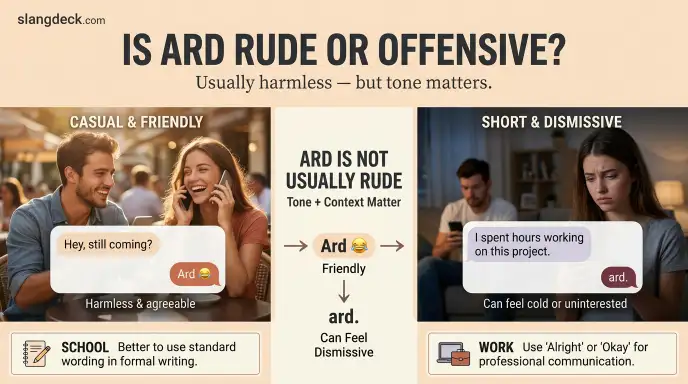
ARD is generally not rude or offensive.
When it means “alright,” it is usually a harmless and informal expression.
For example:
“Ard, I’ll do it.”
does not normally contain anything offensive.
However, the tone of a one word message can depend on context.
Can ARD Sound Dismissive?
Sometimes, yes.
If someone responds with only:
“ard.”
it could sound short or uninterested, especially during a serious conversation.
For example:
A: I spent hours working on this project.
B: ard.
The sender may simply be acknowledging the message, but the short response could feel cold.
That does not mean ARD itself is rude. The overall tone comes from the situation, punctuation, relationship, and previous messages.
Is ARD Safe to Use With Friends?
Yes.
ARD is generally fine in casual conversations with friends.
For example:
“Ard, I’ll see you there.”
or:
“Ard 😂.”
These are informal but harmless uses.
Is ARD Appropriate at School?
ARD is not normally appropriate for formal school writing.
A text to a friend can be casual, but an essay or assignment should use standard wording.
Instead of:
“Ard, I agree with the author.”
formal writing would simply say:
“I agree with the author.”
Is ARD Appropriate at Work?
It is generally better to avoid ARD in professional communication.
Instead of:
“Ard, I’ll send the report tomorrow.”
you could write:
“Alright, I’ll send the report tomorrow.”
Or:
“Okay, I’ll send the report tomorrow.”
The full wording is clearer and more professional.
Who Uses ARD?
ARD is mainly used by people who are familiar with casual texting and internet slang.
You may encounter it among teenagers, young adults, social media users, gamers, and people who regularly communicate through messaging apps.
Gen Z Usage
Gen Z users may use ARD in casual digital conversations, especially when replying quickly to friends.
It can appear on:
- TikTok
- Snapchat
- Discord
- Gaming chats
- Text messages
However, it is important not to assume that every Gen Z user uses ARD.
Different people prefer different abbreviations.
Younger Internet Users
Younger users may encounter ARD through friends, social media, gaming communities, and group chats.
Some may understand the abbreviation without using it themselves.
Older Internet Users
Older users can also recognize or use ARD, especially if they regularly communicate through social media or messaging apps.
Internet slang is not limited to one specific age group.
How Common Is ARD?
ARD is less universal than very common texting abbreviations such as LOL, IDK, or BRB.
You may see it often in some communities while rarely encountering it in others.
Some people may prefer:
- alright
- okay
- aight
- alr
- bet
The preferred form can vary between users and online communities.
Origin of ARD
The texting form “ard” comes from the everyday word “alright.”
People have used shortened forms of words in informal speech and writing for a long time. Digital communication made this habit even more common because messages are often quick, conversational, and informal.
The exact point when ARD became popular as a texting abbreviation is unclear. There is no single confirmed person or event that can be reliably credited with creating it.
Instead, ARD is best understood as part of the wider development of internet shorthand.
As people began communicating through SMS, instant messaging, social media, and online communities, common words were frequently shortened.
For example:
“Alright, I’ll see you later.”
can become:
“Ard, I’ll see you later.”
The meaning remains clear while the message becomes shorter.
ARD vs. IDK, IDC, IMO, and BRB
ARD belongs to the larger group of internet abbreviations, but each expression serves a different purpose.
| Term | Meaning | Type | Usage | Popularity |
| ARD | Alright | Texting abbreviation | Agreement or acknowledgment | Less common |
| IDK | I don’t know | Initialism | Shows uncertainty | Very common |
| IDC | I don’t care | Initialism | Shows indifference | Common |
| IMO | In my opinion | Initialism | Introduces an opinion | Common |
| BRB | Be right back | Initialism | Says someone will return soon | Very common |
The main difference is what each abbreviation communicates.
ARD is usually a response or acknowledgment.
IDK expresses uncertainty.
IDC expresses a lack of concern.
IMO introduces an opinion.
BRB tells someone that the sender is temporarily leaving the conversation.
For example:
“Ard, I’ll come.”
shows agreement.
But:
“IDK what to wear.”
shows uncertainty.
ARD vs. Alright
The simplest comparison is between ARD and the full word alright.
Alright is the standard word.
ARD is an informal shortened version commonly used in texting.
Compare:
“Alright, I’ll do it.”
with:
“Ard, I’ll do it.”
The basic meaning is the same.
The second version simply sounds more casual.
ARD vs. Aight
Aight is another informal form of “alright.”
For example:
“Aight, let’s go.”
and:
“Ard, let’s go.”
can both communicate:
“Alright, let’s go.”
The two forms are not necessarily used by the same people or in the same online communities.
ARD vs. ALR
ALR is another common shortened form of “alright.”
For example:
“Alr, see you later.”
is similar in meaning to:
“Ard, see you later.”
Both are informal.
ARD vs. Bet
Bet is slang that can mean “okay,” “sure,” or “sounds good.”
For example:
A: Meet me at 7.
B: Bet.
This can be similar to ARD when ARD is used as an agreement.
However, bet has its own slang meaning and is not simply another spelling of “alright.”
What Does “Ard Bet” Mean?
You may sometimes see the two expressions together:
“ard bet”
This generally means:
“Alright, sounds good.”
For example:
A: I’ll pick you up at 8.
B: Ard bet.
A: See you then.
Here:
- Ard = alright
- Bet = okay / sounds good
Together, they create a casual agreement.
What Does “Ard Bro” Mean?
“Ard bro” usually means:
“Alright, bro.”
For example:
A: I’ll call you later.
B: Ard bro.
The word bro adds a familiar, friendly tone.
ARD itself still means “alright.”
Does ARD Always Mean Alright?
No.
In casual texting, “alright” is a common meaning, but ARD can stand for other words or phrases in different fields.
You may encounter ARD as an abbreviation in:
- Medical contexts
- Technical documents
- Business
- Academic material
- Organizations
- Specialized industries
Therefore, context matters.
If someone says:
“Ard, I’ll see you later.”
the texting meaning is clear.
But if ARD appears in a technical document, it may have an entirely different meaning.
What Does ARD Mean From a Girl?
If a girl texts you “ard,” it usually means the same thing it would mean from anyone else:
“Alright,” “okay,” or “sure.”
For example:
You: I’ll text you when I get home.
Her: Ard.
She is most likely acknowledging what you said.
The abbreviation itself does not automatically indicate flirting, romantic interest, or a hidden message.
The rest of the conversation is more important when interpreting someone’s tone.
What Does ARD Mean From a Guy?
If a guy texts “ard,” it usually means:
“Alright.”
It can also communicate:
“Okay.”
“Sure.”
“Sounds good.”
For example:
You: We’re meeting at 7.
Him: Ard bet.
This is simply a casual agreement.
Again, ARD itself does not automatically have a romantic or emotional meaning.
Common Misunderstandings About ARD
1. ARD Is Always Rude
No.
It is generally a harmless informal abbreviation.
However, a very short response can sometimes sound dismissive depending on the situation.
2. ARD Is a Formal English Word
No.
ARD is mainly a casual texting form.
Use “alright” or “okay” in formal writing instead.
3. ARD Always Has a Hidden Meaning
Not usually.
In a normal text conversation, it most often simply means “alright.”
4. ARD Is Only Used by Gen Z
Not necessarily.
People from different age groups may understand or use online abbreviations.
5. ARD and ALR Are Completely Different
They can have very similar meanings.
Both can be used as informal shortened forms of “alright.”
6. ARD Is Always About Agreement
Not exactly.
It can also be used as a simple acknowledgment.
For example:
A: I’ll send it later.
B: Ard.
The person may simply be saying they understand.
When Should You Avoid Using ARD?
ARD is best suited to casual digital communication.
You should generally avoid it in:
- School essays
- Academic assignments
- Formal emails
- Job applications
- Business reports
- Professional presentations
- Official documents
Instead of:
“Ard, I’ll send the report tomorrow.”
write:
“Alright, I’ll send the report tomorrow.”
Or:
“Okay, I’ll send the report tomorrow.”
Using standard wording helps ensure that everyone understands the message.
Real World Usage Example
Imagine two friends are planning to meet after school.
One sends a message:
“I’ll meet you outside the café at 5.”
The other replies:
“Ard, see you there.”
This tells the first friend that the plan has been accepted.
Later, the first friend sends:
“I’m running five minutes late.”
The reply is:
“Ard 😂.”
Again, the person is simply acknowledging the update.
This is a good example of how ARD works in real conversations. It does not add a complicated meaning. It is simply a quick and casual response.
Why Do People Use ARD Instead of “Alright”?
The main reason is speed and informality.
Online conversations often move quickly. People may shorten familiar words because their friends already understand what they mean.
Compare:
“Alright, I’ll be there soon.”
with:
“Ard, I’ll be there soon.”
The second version feels more like casual texting.
It can also match the style of other internet expressions.
For example:
“Ard bet 😂.”
sounds much more casual than:
“Alright, that sounds good.”
Neither is wrong. The choice depends on the setting and the people involved.
How to Tell What ARD Means in a Message
The easiest way to understand ARD is to look at the words around it.
If someone writes:
“Ard, I’ll see you tomorrow.”
they are clearly using it as “alright.”
If someone says:
“Ard bet.”
they are probably agreeing with a plan.
If someone sends only:
“ard.”
it may simply be an acknowledgment.
When ARD appears in a professional, medical, or technical document, however, you should check the surrounding information because it may represent a completely different abbreviation.
Key Takeaways
- ARD usually means “alright” in text.
- It can also mean “okay,” “sure,” or “sounds good.”
- ARD is an informal texting abbreviation.
- It is commonly used in casual online conversations.
- You may see it on TikTok, Snapchat, Instagram, WhatsApp, Discord, and SMS.
- ARD is generally not rude or offensive.
- A one word “ard” can sometimes sound dismissive, depending on the situation.
- It is better to avoid ARD in formal school or professional writing.
- Aight, alr, alright, and bet can sometimes have similar uses.
- ARD can have other meanings in specialized contexts, so always consider the surrounding conversation.
Frequently Asked Questions
What does ARD mean in text messages?
ARD usually means “alright.” It is an informal texting abbreviation that can also mean “okay” or “sure.”
What does ARD mean on TikTok?
On TikTok, ARD usually means “alright” or “okay.” It can appear in comments, replies, captions, or DMs.
Is ARD slang?
Yes, ARD is an informal texting abbreviation used in casual digital conversations.
Is ARD rude or offensive?
Usually, no. ARD is generally harmless, although a very short reply can sometimes sound dismissive depending on the context.
How should you reply to ARD?
You can reply with “okay,” “cool,” “sounds good,” “bet,” or simply continue the conversation.
What does “ard bet” mean?
“Ard bet” generally means “alright, sounds good.” Both words are informal expressions used to show agreement.
What does ARD mean from a girl?
It usually means “alright,” “okay,” or “sure.” The abbreviation itself does not automatically have a romantic meaning.
What does ARD mean from a guy?
It usually means “alright,” “okay,” or “sounds good.” Its exact tone depends on the conversation.
Is ARD the same as ALR?
They can have a similar meaning. ARD and ALR are both used informally to represent “alright.”
Is ARD the same as Aight?
They can both mean “alright” in casual communication, but they are different informal forms.
Can ARD mean something else?
Yes. ARD can have different meanings in medical, technical, business, and other specialized contexts. The surrounding context determines the intended meaning.
Is ARD appropriate at work?
Generally, it is better to use “alright,” “okay,” or another clear phrase in professional communication rather than informal texting slang.
Conclusion
ARD usually means “alright” in text and internet slang. People use it as a quick, casual way to say “okay,” “sure,” or “sounds good.”
You may encounter it in TikTok comments, Snapchat messages, Instagram DMs, WhatsApp chats, Discord, gaming conversations, and SMS.
The abbreviation is generally harmless, but it is best suited to informal conversations. For school assignments, professional emails, and other formal writing, use the complete word “alright” or simply “okay.”
If someone sends you “ard” in a normal text conversation, the simplest interpretation is usually “alright.” If the abbreviation appears in a specialized context, however, check the surrounding information because it may have another meaning.
Explore More Articles

Hi, I’m Sarah. I studied Communications at the University of Texas and have spent the last six years writing about internet culture and Gen Z slang across TikTok, Twitter, and everyday conversations. I focus on real usage, not just dictionary definitions.