Slang for nonsense includes casual words such as bullshit, crap, baloney, hogwash, gibberish, malarkey, guff, and rubbish. The best choice depends on how strong, funny, rude, or informal you want to sound.
People search for slang for nonsense when they want a more natural way to say that something is silly, untrue, confusing, or meaningless. Some expressions are mild enough for everyday conversation, while others contain profanity and should be avoided in professional or polite settings.
This guide explains the most useful slang words for nonsense, what each one means, how strong it sounds, and where you can use it. You will also see realistic examples for texting, social media, gaming, school, and everyday conversations.
Quick Answer: What Is Slang for Nonsense?
The most common slang for nonsense includes “bullshit,” “crap,” “baloney,” “hogwash,” “guff,” “malarkey,” “rubbish,” and “gibberish.” They can describe something untrue, foolish, meaningless, confusing, or not worth believing.
The important difference is tone. “Gibberish” is usually about speech or writing that makes little sense, while “bullshit” can strongly dismiss a claim as false or dishonest.
What Does “Slang for Nonsense” Mean?
Slang for nonsense means informal words or phrases people use instead of the standard word “nonsense.”
These expressions can show disbelief, annoyance, humor, or simple confusion. The right word depends on what you are calling nonsense and how strongly you want to criticize it.
For example, “That sounds like baloney” is fairly mild. “That’s bullshit” is much stronger and contains profanity.
Some words also have a more specific meaning. Gibberish usually describes speech or writing that cannot be understood, rather than simply a statement you think is false. Collins lists gibberish as meaningless or unintelligible speech or writing and includes slang alternatives such as “bull” and “crap.”
25 Slang Words for Nonsense
Here are useful options, from common modern expressions to playful or regional choices.
| Slang word or phrase | Basic meaning | Tone |
| Bullshit | Complete nonsense or lies | Strong, vulgar |
| Crap | Nonsense or something worthless | Informal |
| Baloney | Nonsense or an untrue claim | Mild, playful |
| Hogwash | Ridiculous or false talk | Mild, old-fashioned |
| Malarkey | Foolish or dishonest talk | Playful |
| Gibberish | Speech or writing that makes no sense | Mild |
| Guff | Empty or meaningless talk | Informal |
| Rubbish | Nonsense; mainly British | Informal |
| Bollocks | Nonsense; mainly British | Rude |
| Drivel | Silly, pointless talk | Informal |
| Twaddle | Foolish or meaningless talk | Mild, old-fashioned |
| Poppycock | Ridiculous nonsense | Playful |
| Balderdash | Silly or untrue talk | Playful |
| Claptrap | Pretentious or worthless talk | Informal |
| Hot air | Empty talk without real value | Mild |
| Mumbo jumbo | Confusing or meaningless language | Informal |
| Blah-blah | Repeated, unimportant talk | Casual |
| Waffle | Talk or writing that says little | British informal |
| Tosh | Nonsense; mainly British | Informal |
| Hokum | False or silly ideas | Informal |
| Trash | Worthless or ridiculous content | Informal |
| Garbage | Nonsense or worthless ideas | Informal |
| Flapdoodle | Complete nonsense | Humorous |
| Horsefeathers | Nonsense; mainly US | Playful |
| Stuff and nonsense | Dismissive way to call something nonsense | Mild |
Several of these are recognized as informal or slang alternatives to nonsense. Collins, for example, lists guff, malarkey, hogwash, hokum, codswallop, piffle, poppycock, bosh, and flapdoodle among related terms.
The Best Slang for Nonsense by Tone
Not every synonym works in the same situation. Some sound funny, some sound rude, and others are better for describing confusing speech.
Strong and Rude
Bullshit is one of the strongest common choices. It can mean nonsense, false claims, exaggeration, or talk that the speaker believes is deliberately misleading.
Example: “I don’t believe that story. It sounds like bullshit.”
Bollocks can mean nonsense in British English. It is considered rude, so it is not a good choice for formal situations.
Example: “That’s a load of bollocks.”
Mild and Casual
Crap is a common informal option when you want to reject something without using a more severe curse word.
Example: “I tried following those instructions, but they were complete crap.”
Baloney is softer and can sound playful. It works well when you think someone is exaggerating or making an untrue claim.
Example: “He said he finished the whole project in ten minutes. That’s baloney.”
Funny or Old-Fashioned
Hogwash, poppycock, balderdash, and flapdoodle are playful ways to call something nonsense.
They can sound humorous because they are less common in everyday modern speech. They work especially well when you want to sound lighthearted rather than angry.
Example: “That excuse is pure hogwash.”
Confusing or Meaningless Speech
Gibberish is different from many other choices on this list. It usually refers to words, speech, or writing that does not make sense or cannot be understood.
Example: “The message was full of random symbols and looked like gibberish.”
Drivel, babble, and mumbo jumbo can also describe talk that is confusing, empty, or difficult to take seriously.
Slang for Nonsense in Texting and Social Media
Texting and social media make short, casual expressions especially useful.
People may write:
- “That’s BS.”
- “What a load of crap.”
- “Bro, that’s nonsense.”
- “Stop with the BS 😂.”
- “This is complete gibberish.”
- “That explanation is just blah-blah.”
BS is a shortened form of “bullshit.” It is common in informal writing because it is quicker and sometimes feels less direct than spelling out the full word.
On TikTok, Instagram, Reddit, Discord, or group chats, the meaning usually comes from context and tone. Emojis, punctuation, and phrases such as “no way,” “come on,” or “be serious” can make the dismissal sound stronger or more playful.
Slang for Nonsense in Gaming and Discord
Gaming conversations often use short, direct expressions when someone makes an unbelievable claim.
Examples include:
“That excuse is BS.”
“Bro, that strategy is garbage.”
“You’re talking nonsense.”
“That whole explanation was gibberish.”
“What a load of crap.”
In gaming communities, garbage can also mean something is extremely poor in quality, so it does not always mean “nonsense.” Context matters.
If someone says “your argument is garbage,” they are criticizing the argument. If they say “this weapon is garbage,” they probably mean the weapon is poor or ineffective.
Is Slang for Nonsense Rude or Offensive?
Some slang for nonsense is harmless, while some expressions are rude or vulgar.
Words such as baloney, hogwash, gibberish, poppycock, and balderdash are generally mild. They can still sound dismissive, but they do not normally contain profanity.
Words such as bullshit, bollocks, and crap are more informal. Bullshit is clearly vulgar, while “bollocks” is a rude British expression.
| Expression | Workplace | Friends | Social media |
| Gibberish | ✅ Usually safe | ✅ Yes | ✅ Yes |
| Baloney | ✅ Usually safe | ✅ Yes | ✅ Yes |
| Hogwash | ⚠️ Playful | ✅ Yes | ✅ Yes |
| Crap | ⚠️ Informal | ✅ Yes | ✅ Yes |
| Bullshit | ❌ Avoid | ✅ Depends on group | ⚠️ Context matters |
| Bollocks | ❌ Avoid | ✅ With the right group | ⚠️ Rude |
For school, work, or communication with someone you do not know well, nonsense, incorrect, unclear, or misleading are safer choices.
Real-Life Examples of Slang for Nonsense
Friendly Conversation
“You think you can eat five pizzas by yourself? That’s baloney.”
The speaker is teasing rather than seriously insulting the other person.
Text Message
“He said the concert was free, but that’s BS.”
Here, “BS” means the speaker believes the claim is untrue.
Social Media
“These comments are full of nonsense today.”
This version is less aggressive than using profanity.
School
“That explanation sounds like gibberish to me.”
This means the explanation is difficult to understand, not necessarily that the person is lying.
Workplace
“The report contains several unsupported claims.”
This is a better professional alternative than calling the report “bullshit.”
Gaming
“That excuse is garbage. You just missed the shot.”
Here, “garbage” criticizes the excuse rather than literally meaning nonsense.
Where Did These Expressions Come From?
The words on this list do not have one shared origin. They developed at different times and in different varieties of English.
Gibberish, for example, is recorded from the 16th century and is associated with unintelligible speech. Collins gives its American English origin as “gibber” and dates the word to around 1545–55.
Other expressions are much older or have unclear histories. Malarkey, baloney, hogwash, and poppycock became established informal ways to dismiss foolish or untrue ideas, but their exact origins are not equally certain.
This is why it is better to avoid claims such as “Gen Z invented this slang” unless there is strong evidence. Many expressions that appear in modern social media are actually much older.
Which Slang Word for Nonsense Should You Use?
Choose the expression based on what you mean.
When words or writing are difficult to understand, “gibberish” is usually the better choice.
If you strongly reject a claim because you believe it is false or dishonest, “bullshit” expresses that criticism more forcefully.
For casual criticism without using the strongest profanity, “crap” offers a milder alternative.
A slightly playful way to describe something as untrue is “baloney.”
For a humorous or old-fashioned tone, consider expressions such as “hogwash” or “poppycock.”
In British-style English, “rubbish” is a common way to describe something as nonsense.
When you want a neutral and widely understood option, “nonsense” itself works well.
Similar Slang and Related Words
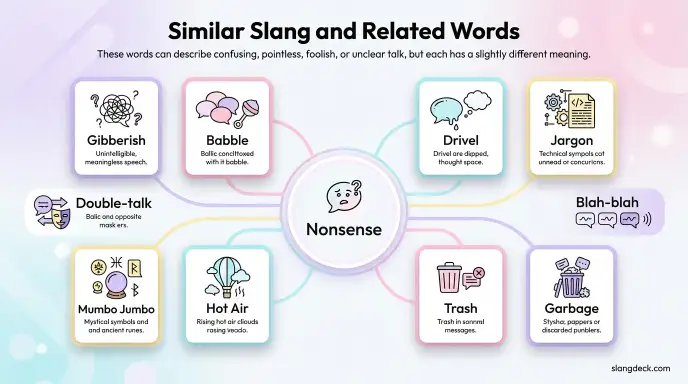
Several words overlap with nonsense but are not exact replacements.
- Gibberish: speech or writing that is hard to understand.
- Babble: excessive or unclear talk.
- Drivel: foolish or pointless speech.
- Jargon: specialized language that may be hard for outsiders to understand.
- Blah-blah: casual dismissal of unimportant or repetitive talk.
- Garbage: worthless ideas, information, or content.
- Trash: something considered poor or worthless.
- Hot air: confident talk without much substance.
- Mumbo jumbo: confusing or meaningless language.
- Double-talk: deliberately confusing or unclear speech.
The distinction matters. Jargon is not automatically nonsense; it can be valid technical language that an unfamiliar reader simply does not understand.
When Should You Avoid Slang for Nonsense?
Avoid stronger slang when you are speaking to someone you need to treat formally or respectfully.
It is usually better to avoid bullshit, bollocks, and similar profanity in:
- Job interviews
- Formal emails
- School assignments
- Academic writing
- Customer service messages
- Professional presentations
- Communication with clients
- Conversations with teachers or senior staff
You should also avoid calling someone’s ideas “garbage” or “bullshit” when you want to have a productive disagreement. A calmer phrase can make your point without turning the conversation into an argument.
Polite Alternatives to Slang for Nonsense
If you need a professional or respectful replacement, try:
- That doesn’t seem accurate.
- That claim is not supported by the evidence.
- I don’t think that is correct.
- That explanation is unclear.
- That doesn’t make sense to me.
- Those statements appear misleading.
- I would question that information.
- Could you clarify what you mean?
These alternatives are useful because they challenge the idea without directly attacking the person.
Why Do People Use Slang for Nonsense?
People use slang because it can express emotion and attitude more clearly than a neutral word.
Saying “That’s nonsense” sounds fairly direct. Saying “That’s total BS” sounds stronger and more frustrated.
A playful expression such as “poppycock” can make the same basic idea sound humorous instead of angry. The choice of word tells the listener not only what you think, but also how strongly you feel about it.
Common Misunderstandings About Nonsense Slang
One common mistake is treating every synonym as having exactly the same meaning.
“Gibberish” does not simply mean “I disagree.” It usually suggests that the speech or writing is unintelligible or meaningless.
Another mistake is assuming that every slang word is modern internet language. Many terms used online have been around for decades or much longer.
It is also easy to confuse jargon with nonsense. Technical language may seem confusing to someone outside a field while still being completely meaningful.
Frequently Asked Questions
What is the best slang word for nonsense?
“Bullshit” is one of the strongest common slang choices, while “crap,” “baloney,” “hogwash,” and “guff” are milder options. The best word depends on the situation and your relationship with the listener.
What is a funny word for nonsense?
Poppycock, balderdash, hogwash, and flapdoodle can sound funny because they have a playful or old-fashioned feel.
What is a slang word for nonsense in British English?
Common British choices include rubbish, bollocks, tosh, guff, waffle, and codswallop. Some are mild, while others are rude.
What is slang for nonsense in American English?
American English commonly uses bullshit, BS, crap, baloney, garbage, hogwash, malarkey, and gibberish, depending on the meaning and tone.
Is “BS” slang for nonsense?
Yes. “BS” is a common abbreviation for “bullshit,” and it is often used in texts, comments, and informal online conversations.
Is gibberish the same as nonsense?
Gibberish is a type of nonsense, but the words are not always interchangeable. Gibberish usually describes speech or writing that is unintelligible or meaningless, while nonsense can simply mean an idea or claim that makes no sense.
Can I use these slang words at work?
Mild terms such as “nonsense” or “gibberish” may work in some casual workplaces, but profanity such as “bullshit” should generally be avoided. In professional writing, use clear phrases such as “inaccurate,” “unsupported,” or “unclear.”
What is a polite way to say “this is nonsense”?
Try “This doesn’t seem accurate,” “This doesn’t make sense,” or “Could you clarify this?” These phrases work better when you want to disagree without sounding rude.
Conclusion: Choosing the Right Slang for Nonsense
Slang for nonsense ranges from mild words like “baloney” and “hogwash” to stronger expressions like “bullshit” and “bollocks.” The key is to match the word with the situation, audience, and meaning you want to express.
Use gibberish for speech or writing that is difficult to understand, bullshit for a strong dismissal of false or dishonest claims, and baloney or hogwash when you want something lighter.
For school, work, or formal communication, “nonsense,” “unclear,” “inaccurate,” or “unsupported” are safer choices.
Discover more:

Hey, I’m Jordan. I grew up in a bilingual household in LA, so Spanish and Mexican American slang has always been part of how I talk. I’ve been writing online content for five years, explaining terms the way I’d explain them to a friend meaning, tone, and when it’s actually okay to use.