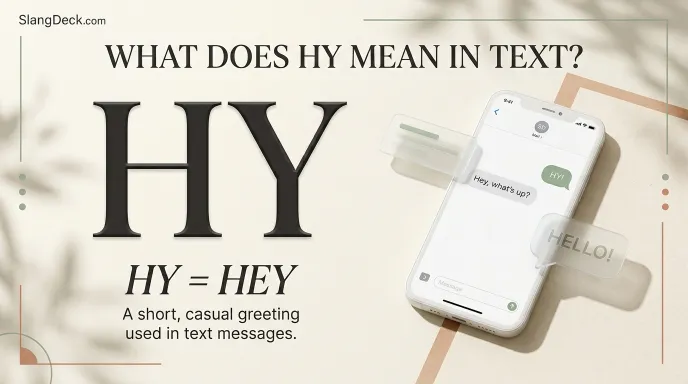
HY in text usually means “Hell Yeah,” an informal way to show strong agreement, excitement, or enthusiasm. Someone might send it when they love an idea, agree with a plan, or feel excited about something.
You may see HY in text messages, TikTok comments, Snapchat chats, Instagram DMs, and other online conversations. It is a short response that can express more excitement than a simple “yes.”
However, abbreviations can have different meanings depending on the conversation. In some personal chats, someone may use HY to mean “Hey You,” so the surrounding message is important.
If you have received this abbreviation and are unsure how to respond, this guide explains its likely meaning, how people use it, and how to understand it in different situations.
HY Meaning in Text
HY is a short, informal abbreviation that can have more than one meaning in everyday online conversations. The two interpretations worth knowing are “Hey” or “Hi” and “Hell Yeah” or “Hell Yes.”
The intended meaning depends on how the sender uses it. When someone starts a conversation with “HY,” they may simply be greeting you. When it appears as a reply to a question or an exciting suggestion, it may express strong agreement.
For example:
- “HY, how are you?” The sender is saying hello.
- “Want to go shopping?” “HY!” The sender is showing excitement and agreeing.
HY is not a formal English word. It is informal texting shorthand, and people may use it differently depending on their habits and online community.
Is HY an Acronym or an Abbreviation?
HY can function as an abbreviation when someone uses it as a shortened greeting. When it stands for “Hell Yeah,” it works as an initialism because each letter represents part of a phrase.
In everyday conversations, people do not usually stop to think about its grammatical category. They use it because it is short and quick to type.
One important thing to remember is that HY does not have one fixed meaning in every conversation. It is better to understand the complete message than guess from the two letters alone.
HY vs. Hey and Hi
Although HY may be used as a quick greeting, it is not as clear or widely understood as writing “Hey” or “Hi.”
| Expression | Meaning | Typical tone |
| HY | Hey or Hi | Casual |
| Hey | Greeting | Friendly |
| Hi | Greeting | Neutral and friendly |
| Hey you | Personal greeting | Playful or warm |
| HY | Hell Yeah | Excited and enthusiastic |
If you are unsure what someone means, check if they are starting a conversation or answering something you said.
Where People Use HY
People may use HY in different online spaces, especially in private messages and casual conversations. However, its meaning can change depending on the platform and the people chatting.
Here is how you can understand it across popular social media apps.
HY Meaning on TikTok
On TikTok, HY may appear in comments, replies, or direct messages. Someone might use it to agree with a video creator, react to an exciting announcement, or start a conversation.
For example:
Comment:
“Are you excited for the next part?”
Reply:
“HY! I can’t wait.”
Here, HY is being used as an enthusiastic yes.
It may also appear as a greeting in a direct message. If someone sends “hy” before asking how you are, they are probably saying hello.
HY Meaning on Snapchat
Snapchat is built around quick conversations, pictures, and short messages. Because of this, users sometimes prefer brief expressions instead of complete sentences.
A person might send:
“HY, what are you doing?”
In this example, HY works as a casual greeting.
It can also be used as an enthusiastic response:
Friend: “Let’s go out this weekend.”
You: “HY!”
The sender is showing that they like the idea and want to join.
HY Meaning on Instagram
On Instagram, HY may appear in comments, story replies, and private messages.
For example, imagine your friend shares a picture announcing that they have passed an exam. You reply:
“HY! Congratulations 🎉”
In this situation, the abbreviation communicates excitement and support.
If someone sends HY at the beginning of an Instagram DM, it may simply be a shortened greeting. The rest of the message will usually help you understand the intended meaning.
HY Meaning on WhatsApp
WhatsApp conversations often include short messages between friends, relatives, classmates, and coworkers.
Someone might open a private chat with:
“HY, are you free?”
Here, HY is being used like “Hey” or “Hi.”
In a group chat, it may also appear as a quick expression of agreement.
Example:
Alex: “Should we meet at 6?”
Sam: “HY, that works for me.”
The sender is agreeing with the suggested time.
HY Meaning in SMS Text Messages
In regular SMS conversations, HY can also work as an informal greeting or an enthusiastic response.
For instance:
Message: “Did you get the concert tickets?”
Reply: “HY! Got them this morning.”
The meaning is clear from the excitement in the conversation.
However, not everyone understands every texting abbreviation. If you are messaging someone who prefers standard English, writing “Hey,” “Hi,” or “Absolutely” may be clearer.
10 Real Chat Examples of HY
The following examples show how HY may appear in different conversations. Some use it as a greeting, while others show its possible meaning as an enthusiastic yes.
These are illustrative examples. They explain how the abbreviation can work in context rather than suggesting that everyone uses it in the same way.
Example 1: Starting a Conversation
Alex: “HY, how are you?”
Mia: “I’m good! How about you?”
Alex: “Doing great.”
Meaning: Alex uses HY as a short and casual way to say “Hey” or “Hi.”
Example 2: Planning a Weekend
Sam: “Are you coming to the party on Saturday?”
Leo: “HY! I wouldn’t miss it.”
Sam: “Awesome. See you there.”
Meaning: Leo uses HY to express an enthusiastic yes and confirm that he wants to attend.
Example 3: Talking About a New Movie
Mia: “Do you want to watch the new movie tonight?”
Alex: “HY, let’s book the tickets.”
Mia: “I’ll check the showtimes.”
Meaning: Alex strongly agrees with the suggestion.
Example 4: Greeting an Old Friend
Emma: “HY! It’s been so long.”
Olivia: “I know! How have you been?”
Emma: “Pretty good. We should catch up.”
Meaning: Emma uses HY as a friendly greeting to start talking again.
Example 5: Discussing a Game
Noah: “Are you joining our game tonight?”
Ethan: “HY! Just send me the time.”
Noah: “We’ll start at 8.”
Meaning: Ethan uses HY to show excitement and agree to join the game.
Example 6: Sharing Good News
Mia: “I finally passed my driving test!”
Sophie: “HY!! That’s amazing!”
Mia: “Thank you! I’m so happy.”
Meaning: Sophie uses HY as an excited reaction to celebrate her friend’s achievement.
Example 7: Asking About Lunch
Daniel: “HY, have you had lunch?”
Ryan: “Not yet. I’m thinking about ordering something.”
Daniel: “Let’s order together.”
Meaning: Daniel uses HY as a casual greeting before asking a question.
Example 8: Making Travel Plans
Alex: “Would you like to visit the beach this weekend?”
Sam: “HY! That sounds like fun.”
Alex: “Let’s leave early in the morning.”
Meaning: Sam uses HY to show strong agreement with the travel plan.
Example 9: Reacting to an Achievement
Olivia: “I got the highest marks in class!”
Mia: “HY! You worked so hard for it.”
Olivia: “Thank you so much!”
Meaning: Mia uses HY to express happiness and excitement about Olivia’s achievement.
Example 10: Checking on a Friend
Liam: “HY, are you feeling better now?”
Jack: “Yes, much better today.”
Liam: “Glad to hear that.”
Meaning: Liam uses HY as an informal greeting before checking on his friend.
How to Reply When Someone Says HY
Your response should match the meaning of the message. If someone uses HY as a greeting, you can greet them back. If they use it to show excitement or agreement, respond to the topic being discussed.
You do not need to use another abbreviation. A simple, natural reply is usually enough.
1. Funny Replies
If you are chatting with a close friend, a playful response can make the conversation more interesting.
- “That’s a lot of energy for two letters 😂”
- “HY to you too, superstar!”
- “Someone sounds excited today!”
- “Okay, I see that enthusiasm 😂”
These replies work best when you already have a relaxed relationship with the sender.
2. Casual Replies
For everyday conversations, keep your response short and easy.
- “Hey! What’s up?”
- “Hi, how’s it going?”
- “I’m good. What about you?”
- “Sounds good!”
- “Absolutely!”
Choose a response that fits the message rather than copying the abbreviation every time.
3. Friendly Replies
If someone is greeting you or sharing something exciting, a warm response can keep the conversation going.
- “Hey! Nice to hear from you.”
- “That’s awesome!”
- “I’m happy for you!”
- “Yes, let’s do it!”
- “Hope you’re having a great day!”
These replies are useful when you want to sound welcoming and positive.
4. Neutral Replies
Sometimes you may not know the sender very well. In that case, use a polite and straightforward answer.
- “Hello!”
- “Hi, how can I help?”
- “Yes, that works.”
- “Sure, no problem.”
- “Thanks for letting me know.”
If you cannot understand what HY means in the message, you can simply ask:
“Hey, what do you mean by HY?”
There is nothing wrong with asking for clarification. It is better than misunderstanding the conversation.
Is HY Rude or Offensive?
HY is not automatically rude or offensive. Its tone depends on the meaning, the conversation, and the relationship between the people using it.
When it means “Hey” or “Hi,” it is generally a casual greeting. When it means “Hell Yeah” or “Hell Yes,” it expresses strong agreement or excitement.
However, there are a few situations where you should be careful.
Is HY Safe to Use With Friends?
Yes. You can use HY in casual conversations with friends who understand texting shorthand.
For example:
“HY! Are we still meeting tonight?”
This is a relaxed way to start a conversation.
Just remember that some people may not recognize the abbreviation. If you want to avoid confusion, write the complete greeting instead.
Is HY Appropriate at School?
It is generally fine in informal messages between classmates and friends.
However, avoid relying on unexplained abbreviations in school assignments, essays, or messages to teachers. Standard English is usually more suitable in those situations.
For example, write:
“Hello, can you please explain the homework?”
instead of:
“HY, can you explain the homework?”
The full greeting is clearer and more respectful in a school related conversation.
Is HY Appropriate at Work?
HY is best kept for informal workplace chats with people who are comfortable using texting shorthand.
For emails to managers, clients, teachers, or professional contacts, use “Hello” or “Hi” instead.
Also, remember that “Hell Yeah” contains a mild profanity. Even though many people use the phrase casually, it may not suit a formal or professional environment.
Who Uses This Term?
HY can be used by people who communicate through text messages and social media. However, there is no reliable reason to claim that it belongs to one specific age group or that it is equally popular across all platforms.
Its use depends more on personal texting habits and the type of conversation than on someone’s age.
Does Gen Z Use HY?
Some Gen Z users may use HY in casual chats, comments, or direct messages. They also use many other short expressions to greet friends, agree with suggestions, and react to online content.
Still, HY is not exclusive to Gen Z. People from different age groups can use or understand it.
It is also important not to assume that every young social media user knows the abbreviation. Many people prefer writing “hey,” “hi,” or “yeah.”
Which Platforms Are Associated With HY?
You may come across HY in:
- TikTok comments and direct messages
- Snapchat conversations
- Instagram DMs and story replies
- WhatsApp chats and group messages
- Regular SMS messages
- Discord and other online communities
These are possible places where informal abbreviations appear. They do not mean HY has one official platform specific definition.
How Often Does HY Appear Online?
HY is a short abbreviation, but it is not as universally recognizable as common expressions such as IDK, BRB, or LOL.
Some people may understand it immediately, while others may need more context. That is why it is useful to look at the message before and after it instead of assuming that every sender means the same thing.
Origin of HY

There is no clearly established origin for HY as a modern texting abbreviation. It is difficult to identify one person, platform, or exact date that introduced every use of these two letters.
The greeting interpretation may come from the general habit of shortening words in quick digital conversations. People often reduce greetings and common expressions to save time while typing.
The “Hell Yeah” interpretation follows a similar pattern. Instead of typing the complete phrase, a person may use its first letters as a quick reaction.
Text messaging, online chat rooms, social media, and gaming communities have all helped make shortened expressions part of everyday digital communication. However, that broader history does not prove that HY started on any particular app.
It is also worth remembering that people sometimes create their own abbreviations with friends. A small group may use HY in a personal way that is not widely understood outside that conversation.
The safest explanation is that HY has more than one informal use, and its exact origin is uncertain. Avoid treating an unverified origin story as an established fact.
HY Compared With Other Common Texting Abbreviations
HY is not the only short expression people use in digital conversations. Other abbreviations such as IDK, IDC, IMO, and BRB are also common in informal messaging.
However, each one has a different purpose.
| Abbreviation | Meaning | Type | Usage | Popularity |
| HY | Hey/Hi or Hell Yeah, depending on context | Informal abbreviation or initialism | Greeting or enthusiastic agreement | Less widely recognized; context dependent |
| IDK | I Don’t Know | Initialism | Showing uncertainty or lack of knowledge | Very common |
| IDC | I Don’t Care | Initialism | Showing that something does not matter to the sender | Very common |
| IMO | In My Opinion | Initialism | Sharing a personal opinion | Common |
| BRB | Be Right Back | Initialism | Telling someone you will return shortly | Very common |
HY vs. IDK
IDK means “I Don’t Know.” People use it when they do not have an answer or are unsure about something.
For example:
Alex: “What time does the shop close?”
Sam: “IDK. You should check online.”
HY has a different purpose. It may be a greeting or an enthusiastic response, depending on the context.
HY vs. IDC
IDC stands for “I Don’t Care.” It tells someone that the sender does not have a strong preference or is not concerned about something.
For example:
Mia: “Do you want pizza or burgers?”
Emma: “IDC. Anything is fine.”
Unlike IDC, HY does not normally communicate a lack of interest. It can express a friendly greeting or strong excitement.
HY vs. IMO
IMO means “In My Opinion.” It is used when someone wants to share a personal view.
For example:
Alex: “IMO, the first design looks better.”
HY does not introduce an opinion. It works more like a greeting or an enthusiastic reaction.
HY vs. BRB
BRB means “Be Right Back.” It tells another person that the sender is leaving the conversation temporarily.
For example:
Sam: “BRB, someone is at the door.”
HY does not communicate that someone is leaving. The two abbreviations serve completely different purposes.
Real World Usage Example
Imagine that two friends are planning to meet after school. One friend sends a message asking if the other person wants to visit a nearby café.
Here is how the conversation might look:
Alex: “Are you free after school today?”
Mia: “Yes, why?”
Alex: “Want to get something to eat?”
Mia: “HY! I’ve been waiting for this all week.”
In this example, Mia uses HY to express an enthusiastic yes. She is not simply agreeing; she is showing that she is excited about the plan.
Now imagine a different situation. Alex has not spoken to Mia for several days and sends:
“HY, how have you been?”
Here, HY is being used as a casual greeting.
Both conversations show why context matters. The same two letters can serve different purposes depending on where they appear and what the sender wants to communicate.
Common Misunderstandings About HY
Short abbreviations can be confusing because they do not always have one universal definition. Here are a few mistakes to avoid when interpreting HY.
1. Assuming HY Always Means Hello
HY can be used as a greeting, but that is not the only possible interpretation. If someone sends it after an invitation or question, they may be expressing an enthusiastic yes.
2. Assuming HY Always Means Hell Yeah
The opposite mistake is also possible. If someone starts a conversation with “HY, how are you?” they are probably greeting you rather than answering a question enthusiastically.
3. Thinking HY Is a Formal English Word
HY is informal texting shorthand. It is not a replacement for standard greetings in professional emails, school assignments, or formal documents.
4. Assuming It Is Always Flirty
A message containing HY does not automatically mean someone is flirting. It can be a normal greeting between friends, classmates, relatives, or other people.
5. Confusing HY With Other Abbreviations
HY should not automatically be read as HYD, which is sometimes used for “How You Doing?” The extra letter changes the abbreviation, so pay attention to the exact spelling.
When the meaning is still unclear, asking the sender is the easiest way to avoid confusion.
Frequently Asked Questions
What does HY mean in text messages?
HY can mean “Hey” or “Hi” as a casual greeting. It can also mean “Hell Yeah” or “Hell Yes” when someone wants to express excitement or strong agreement. The conversation helps identify the intended meaning.
What does HY mean on TikTok?
On TikTok, HY may appear in comments or direct messages. It can be used as a greeting or as an enthusiastic response to a video, question, or suggestion.
Is HY slang?
Yes. HY can be considered informal texting shorthand or slang. It is not a standard formal English word, and its meaning depends on how someone uses it.
Is HY rude or offensive?
HY is not inherently rude or offensive. However, when it stands for “Hell Yeah,” it includes a mild swear word. A simpler greeting or “Absolutely” may be better in formal situations.
How should you reply to HY?
If someone uses HY as a greeting, reply with “Hey!” or “Hi, how are you?” If they use it to show excitement, you can respond with “Let’s do it!” or “Sounds great!”
Does HY mean Hey You?
It can be interpreted as “Hey You” in some casual conversations, but it may also simply mean “Hey” or “Hi.” Look at the rest of the message before deciding.
Does HY mean Hell Yeah?
Yes, HY can stand for “Hell Yeah” or “Hell Yes” in some conversations. In this use, it expresses strong agreement, excitement, or enthusiasm.
Is HY used by Gen Z?
Some Gen Z users may use HY in casual digital conversations, but it is not exclusive to that generation. People of different ages may use or understand it.
Can I use HY in a professional message?
It is better to avoid HY in formal communication because the abbreviation may be unclear. Use “Hello,” “Hi,” or “Absolutely,” depending on what you want to say.
Conclusion
HY is a short texting abbreviation with more than one possible meaning. It can be used as “Hey” or “Hi” to start a conversation, or as “Hell Yeah” or “Hell Yes” to show excitement and agreement.
You may encounter it in text messages, TikTok comments, Snapchat chats, Instagram DMs, and WhatsApp conversations. The meaning usually becomes clearer when you look at the message surrounding it.
Use HY with friends and people who understand informal texting language. For schoolwork, professional emails, and formal conversations, choose complete words instead.
The main thing to remember is simple: do not judge HY by the letters alone. Read the conversation to understand what the sender really means.
Discover More Articles

Hey, I’m Jordan. I grew up in a bilingual household in LA, so Spanish and Mexican American slang has always been part of how I talk. I’ve been writing online content for five years, explaining terms the way I’d explain them to a friend meaning, tone, and when it’s actually okay to use.